Low estradiol thresholds shift by sex and life stage, so where does your number actually fall? One at-home Superpower draw checks 100+ biomarkers, physician-reviewed.
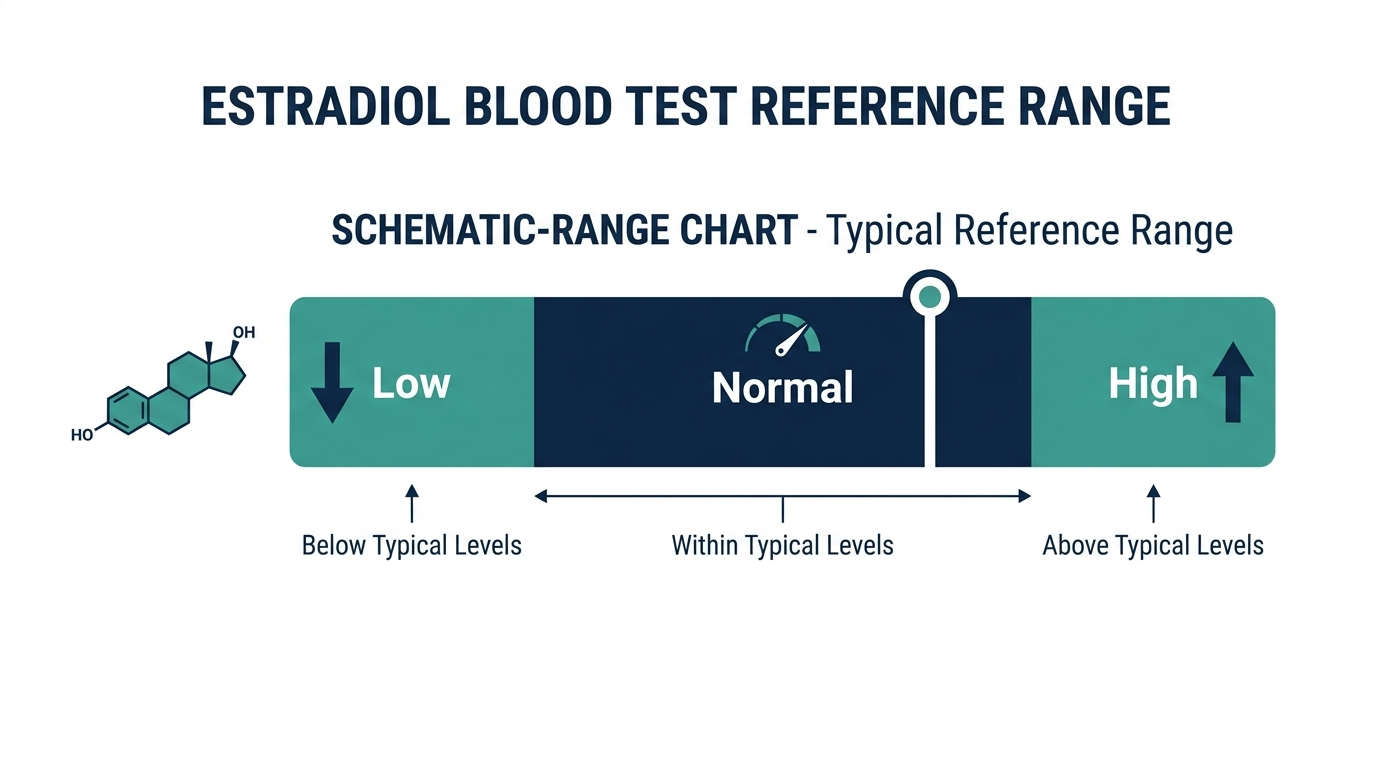
- Low estradiol on a blood test means your estrogen level falls below the lab reference range for your sex and life stage, such as under 30 pg/mL in a menstruating woman or under 10 pg/mL in a man, which can signal ovarian, pituitary, or aromatase problems.
- In premenopausal women the usual normal range is roughly 30 to 400 pg/mL across the cycle, so a value far below this often reflects menopause, ovarian failure, or a hypothalamic cause like low body weight or heavy training (MedlinePlus).
- A single low estradiol result is not a diagnosis on its own, and you should repeat the test with FSH, LH, and a symptom review through your clinician before assuming what it means.
What does low estradiol mean and what is the cutoff?
Low estradiol means your blood estradiol (E2) sits below the lab reference range for your sex and stage of life. MedlinePlus lists a normal range of about 30 to 400 pg/mL for premenopausal women, less than 10 pg/mL after menopause, and roughly 10 to 40 pg/mL for adult men. Estradiol is the most active form of estrogen, made mainly by the ovaries in women and by the conversion of testosterone through the enzyme aromatase in men (Cleveland Clinic).
Because cutoffs differ by lab, age, sex, and where you are in your menstrual cycle, always read your result against the range printed on your own report. A value of 25 pg/mL might be normal in the early follicular phase but low in the mid cycle. The number alone tells you little until it is paired with your symptoms, your age, and other hormones.

What causes low estradiol?
Low estradiol is usually caused by reduced ovarian output in women or reduced aromatase activity in men, and the pattern of other hormones tells you which. When estradiol is low and FSH is high, the problem is at the ovary itself, a state called hypergonadotropic hypogonadism that includes menopause and premature ovarian insufficiency (StatPearls). When both estradiol and FSH are low, the signal from the brain is weak, pointing to a hypothalamic or pituitary cause.
- Menopause and perimenopause: the most common reason, as the ovaries gradually stop producing estradiol.
- Functional hypothalamic causes: very low body weight, eating disorders, intense endurance training, or high stress can switch off the brain signals that drive estrogen.
- Primary ovarian insufficiency: ovarian failure before age 40, sometimes after chemotherapy, radiation, or autoimmune disease.
- Pituitary or hypothalamic disorders: tumors, infiltration, or hyperprolactinemia that blunt FSH and LH.
- In men: low testosterone (less substrate for aromatase), certain medications, or aromatase inhibitors used during testosterone therapy.
What are the symptoms, or is it silent?
Low estradiol is rarely silent and tends to produce recognizable estrogen-deficiency symptoms in both sexes. In women these include hot flashes, night sweats, vaginal dryness, mood changes, sleep trouble, and irregular or absent periods (Cleveland Clinic). Over time, low estradiol drives bone loss, which is a key reason estrogen deficiency is linked to osteopenia and osteoporosis (StatPearls).
Men can be surprised to learn they need estradiol too. Because estradiol supports the male skeleton, libido, and mood, men with low levels report hot flashes, joint pain, reduced sex drive, erectile difficulty, fatigue, and accelerated bone loss. Research on prostate cancer patients who lose estradiol during androgen deprivation shows just how important this hormone is for male bone and metabolic health (Journal of the Endocrine Society). If you have no symptoms at all, a borderline low value is more likely a timing or lab issue than a true deficiency.
When is low estradiol dangerous?
Low estradiol becomes dangerous mainly through its long-term effect on bone and, in younger people, through what it reveals about an untreated underlying condition. Sustained estrogen deficiency increases bone resorption and lowers bone mineral density, raising fracture risk over years (StatPearls). This is the slow, silent danger that matters even when day-to-day symptoms feel mild.
The more urgent concern is the cause behind the number. Low estradiol in a young woman who has stopped menstruating can point to functional hypothalamic amenorrhea, premature ovarian insufficiency, or a pituitary tumor, each of which needs evaluation rather than reassurance. Very low estradiol from extreme calorie restriction or overtraining also signals that the body is under stress and may be losing bone at an age when peak bone mass should still be building. Low estradiol itself is not an emergency, but the condition driving it sometimes is.
What should you do next and when should you see a doctor?
The first step is to confirm the result, because a single low estradiol reading taken at the wrong cycle day or by a less sensitive assay can mislead. Ask your clinician to repeat estradiol alongside FSH and LH, since the FSH pattern separates an ovarian cause from a brain-signal cause (StatPearls). Bring a record of your cycle, your symptoms, your weight history, your training load, and any medications.
- See a doctor promptly if: your periods have stopped for three months or more, you have hot flashes before age 45, or you have a history of fractures or low-impact bone breaks.
- Mention right away: rapid weight loss, very high exercise volume, headaches, vision changes, or milky nipple discharge, which can point to a pituitary cause.
- Ask about: a bone density scan if low estradiol has been present for a while, and whether hormone therapy is appropriate for your situation.
Treatment depends entirely on the cause, so resist self-medicating with over-the-counter hormones before a diagnosis is made.
The insider nuance most people miss
The detail clinicians watch for is that the assay itself can fake a low result, especially at the bottom of the range. Standard immunoassays lose accuracy at very low estradiol concentrations, which is exactly where postmenopausal women and most men sit, so labs increasingly use liquid chromatography mass spectrometry (LC-MS/MS) for these patients. A number reported as 8 pg/mL on a routine immunoassay may not be reliable enough to act on.
The second nuance is timing. In a cycling woman, estradiol swings from a low baseline of around 30 pg/mL to a peak near ovulation, so a draw on day 3 is meant to read low and tells a different story than a draw on day 12. Before you treat a number as abnormal, confirm which day of your cycle the sample was taken and which method the lab used. These two questions resolve a large share of falsely worrying results.
How estradiol is controlled: the HPO axis and the FSH pattern
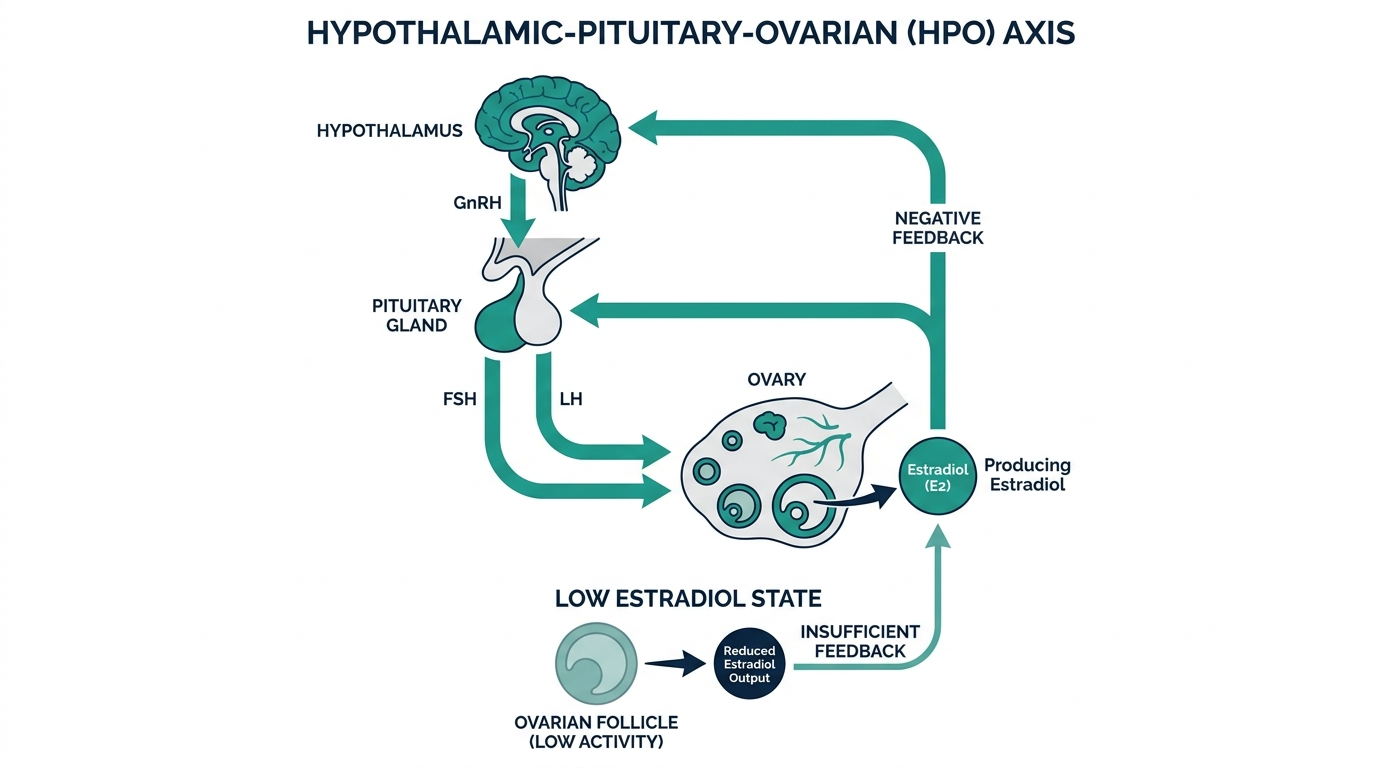
To interpret a low estradiol, you have to understand the chain of command that produces it. In women this is the hypothalamic-pituitary-ovarian (HPO) axis, and it works like a thermostat.
- The hypothalamus in the brain releases GnRH.
- GnRH tells the pituitary to release two hormones, FSH (follicle-stimulating hormone) and LH (luteinizing hormone).
- FSH and LH travel to the ovaries, prompting them to produce estradiol.
- Estradiol feeds back to the brain, telling it whether to speed up or slow down the signal.
This is why FSH is the single most useful companion to a low estradiol, because it tells you where in the chain the problem sits:
| Estradiol | FSH | What it points to |
|---|---|---|
| Low | High | The ovary itself is the problem (menopause, premature ovarian insufficiency). The brain is shouting but the ovary cannot respond. |
| Low | Low or normal | The brain signal is weak (hypothalamic or pituitary cause), such as low body weight, overtraining, stress, or a pituitary disorder. |
This distinction changes everything about what a low estradiol means and how it is managed. A high FSH in a woman under 40, for instance, raises concern for premature ovarian insufficiency, while a low FSH points the workup toward the brain and factors like nutrition and training. Reading estradiol without FSH is like reading half a sentence.

The companion hormones worth testing alongside estradiol
Estradiol is almost never interpreted alone. A handful of related markers turn an ambiguous number into a clear picture, and knowing them helps you have a more productive conversation with your clinician.
- FSH and LH: as above, these localize the problem to the ovary versus the brain. They are the core companions to any estradiol result.
- Prolactin: a high prolactin level can suppress the brain signals that drive estrogen, so it is checked when a hypothalamic or pituitary cause is suspected, especially with milky nipple discharge or headaches.
- AMH (anti-Mullerian hormone): reflects the ovarian reserve, the pool of remaining eggs. It helps assess whether the ovaries are running low, relevant in premature ovarian insufficiency and fertility questions.
- TSH: thyroid problems can disrupt menstrual cycles and hormone balance, so thyroid function is often checked when periods are irregular.
- Testosterone (in men): because men make estradiol from testosterone via aromatase, a man’s low estradiol is read alongside his testosterone. Low testosterone means less substrate for estradiol.
The theme is that hormones work as a connected system, not as isolated numbers. A low estradiol with high FSH, or with high prolactin, or with low testosterone tells three completely different stories, and the companions are what distinguish them.
Timing and preparation: why the cycle day and assay matter
Few tests are as sensitive to timing as estradiol in a menstruating woman, and getting this wrong is one of the most common reasons for a falsely worrying result.
- Cycle day: estradiol naturally swings across the menstrual cycle, from a low baseline early in the cycle to a peak near ovulation. A sample drawn on day 3 is meant to read low and is used to assess baseline ovarian function, while a mid-cycle draw reads much higher. Comparing a day-3 value to a mid-cycle range would falsely flag it as low.
- Assay method: standard immunoassays lose accuracy at very low estradiol concentrations, which is exactly where postmenopausal women and most men sit. For these patients, labs increasingly use liquid chromatography with tandem mass spectrometry (LC-MS/MS), a more accurate method at the low end. A very low value on a routine immunoassay may not be reliable enough to act on.
- Medications: hormonal contraceptives, hormone therapy, and certain other drugs directly affect estradiol, so your clinician needs your full list to interpret the result.
Before treating any estradiol number as abnormal, two questions resolve a large share of false alarms: which day of the cycle was the sample drawn, and which method did the lab use. If you are tracking estradiol over time, keeping these consistent makes the trend meaningful rather than noisy.
Estradiol and bone health: the slow, silent stakes
The most important long-term consequence of low estradiol is its effect on your skeleton, and this is true for both women and men. Estrogen is a key brake on bone breakdown. It restrains the cells that resorb old bone, so when estradiol falls, bone resorption speeds up and bone mineral density declines over time.
This is why the connection between estrogen deficiency and osteoporosis is so well established, and why the rapid drop in estradiol at menopause is associated with accelerated bone loss in the years around the transition. The danger is quiet: bone loss produces no symptoms until a fracture happens, sometimes from a minor fall or even everyday activity.
Two groups deserve particular attention. First, younger women with prolonged low estradiol from causes like functional hypothalamic amenorrhea may be losing bone at exactly the age when they should be building toward peak bone mass, which sets a lower lifetime baseline. Second, men with low estradiol, often on testosterone therapy with an aromatase inhibitor, can also lose bone, a fact that surprises many because estrogen is thought of as a female hormone. For anyone with sustained low estradiol, a bone density scan is a reasonable thing to ask your clinician about, because catching bone loss early is far better than discovering it after a fracture.
When low estradiol comes from training and undereating
One cause of low estradiol deserves its own section because it is common, often missed, and highly reversible: functional hypothalamic amenorrhea, frequently seen in athletes and people who undereat relative to how much they train.
The mechanism is a form of protective shutdown. When the body senses insufficient energy availability, from low calorie intake, high exercise volume, or both, the hypothalamus dials down the GnRH signal that drives the whole reproductive axis. Estradiol falls, periods become irregular or stop, and FSH tends to be low or normal rather than high, which distinguishes it from an ovarian cause.
This pattern is part of what sports medicine now frames as relative energy deficiency, where the consequences extend beyond periods to bone health, mood, and performance. The important and hopeful part is that it is often reversible. Restoring adequate nutrition and reducing excessive training can allow the hypothalamus to resume normal signaling and estrogen production. But it should not be self-managed in isolation, because prolonged low estradiol in this setting carries real bone consequences, and because other causes need to be ruled out first. If you are a lean, highly active person whose periods have become irregular or stopped, this is a specific and actionable conversation to have with your clinician.
How low estradiol is treated: it depends entirely on the cause
There is no single treatment for low estradiol, because the right approach follows from why it is low. This is the central reason not to self-medicate with over-the-counter hormones before a diagnosis.
- Menopause and ovarian failure: lifestyle changes will not restore ovarian production. For appropriate candidates, hormone therapy may be discussed to manage symptoms and protect bone, weighed against individual risks by your clinician.
- Functional hypothalamic causes: the treatment is addressing the root, restoring adequate nutrition, reducing excessive training, and managing stress, which can allow the body to resume its own estrogen production.
- Pituitary causes such as high prolactin: treating the underlying pituitary issue can restore the normal signal to the ovaries.
- In men: if an aromatase inhibitor is driving estradiol too low during testosterone therapy, the dose is reassessed, since men need some estradiol for bone, libido, and mood.
Across all of these, the sequence is the same: confirm the result, identify the cause with companion hormones and your history, then treat the cause rather than the number. A low estradiol is a signal to investigate, not a prescription to fill on your own.
Common misconceptions about low estradiol
A few persistent misunderstandings lead people to misread this result. Clearing them up helps you respond sensibly rather than with alarm.
- “Estrogen is only a female hormone.” Not true. Men make estradiol from testosterone and need it for bone strength, libido, and mood. A low value matters in men too, especially those on testosterone therapy with an aromatase inhibitor.
- “A low reading means something is wrong.” Often it does not. A postmenopausal woman is expected to sit below 10 pg/mL, and a menstruating woman is expected to read low early in her cycle. Context decides whether low is normal or abnormal.
- “I should raise it with over-the-counter hormones or supplements.” This is risky. The right treatment depends entirely on the cause, and self-medicating can mask an underlying problem that needs a different approach or delay a needed diagnosis.
- “One test tells me my level.” A single draw at the wrong cycle day or on a less sensitive assay can mislead. Confirming the value, ideally with the right timing and method plus FSH, is what makes it trustworthy.
- “No symptoms means the number is fine, and symptoms always mean it is off.” Neither is reliable alone. Bone loss from low estradiol is silent, while many symptoms attributed to estrogen overlap with thyroid, stress, and other issues. The number, the symptoms, and the companion hormones together tell the story.
Read as one piece of a connected hormonal system, confirmed with the right timing and companions, and interpreted for your specific life stage, a low estradiol becomes an informative signal rather than a source of unnecessary worry.
Turn what you just learned about estradiol into action.
Superpower lets you test estradiol and 100+ biomarkers from home, then re-check them over time so you can actually see progress, physician-reviewed at every step.
Frequently asked questions
Is low estradiol always a sign of menopause?
No. Menopause is the most common cause, but low estradiol in younger women can come from low body weight, intense exercise, stress, premature ovarian insufficiency, or a pituitary problem. The FSH level helps your clinician tell these causes apart.
What estradiol level is considered too low?
It depends on your stage. Below the lab range for a menstruating woman (roughly under 30 pg/mL) or under about 10 pg/mL in a man may be flagged as low (MedlinePlus). Postmenopausal women normally sit below 10 pg/mL, which is expected, not abnormal.
Can low estradiol cause weight gain?
Low estradiol is more often linked to hot flashes, mood and sleep changes, and bone loss than to direct weight gain. However, the hormonal shifts of menopause can change body composition and where fat is stored. Discuss persistent weight changes with your clinician.
Do men need to worry about low estradiol?
Yes. Men make estradiol from testosterone, and too little is tied to joint pain, low libido, fatigue, and bone loss (Journal of the Endocrine Society). This is common in men on testosterone therapy who use aromatase inhibitors, so levels should be monitored.
How do I raise low estradiol naturally?
If the cause is low body weight, undereating, or overtraining, restoring adequate nutrition and reducing excessive exercise can help the body resume estrogen production. For menopause or ovarian failure, lifestyle changes will not restore levels, and you should discuss hormone therapy with your clinician.
Sources
- MedlinePlus, Estradiol blood test
- MedlinePlus, Estrogen Levels Test
- Cleveland Clinic, Estrogen: Hormone, Function, Levels and Imbalances
- StatPearls (NCBI Bookshelf), Secondary Amenorrhea
- StatPearls (NCBI Bookshelf), Osteopenia
- Journal of the Endocrine Society, Loss of Estradiol by Androgen Deprivation in Prostate Cancer Patients
This article is for general educational purposes and is not medical advice. It cannot diagnose or treat you and does not replace your clinician. Always discuss your lab results and any health decisions with a qualified healthcare professional.
Related reading
Related: compare at-home thyroid hormone tests.
Vital Signs Today may earn a commission if you buy through links on this page. It does not affect our editorial assessments.