Quick answer: An online mental health test is a short, validated questionnaire (most often the PHQ-9 for depression or the GAD-7 for anxiety) that scores how often you have had certain symptoms over the past two weeks. It is a screener, not a diagnosis. A high score means you should talk to a clinician, not that you have been diagnosed with anything. The good ones are free, take two to five minutes, and are the same instruments your doctor uses in the exam room.
Here is the part most websites bury: a mental health test you take at home and a mental health test your primary care doctor hands you on a clipboard are frequently the exact same nine or seven questions. The instrument is not the secret sauce. What you do with the number is. This guide walks through which screeners are real, exactly what each score band means, how accurate they are and where they fail, when a low mood is actually a physical problem in disguise, and when to stop testing and pick up the phone.
A screener like the PHQ-9 flags symptoms, but it can’t see the thyroid, hormone, or nutrient markers that often drive them. One at-home Superpower draw checks 100+ biomarkers, physician-reviewed.
What is an online mental health test actually measuring?
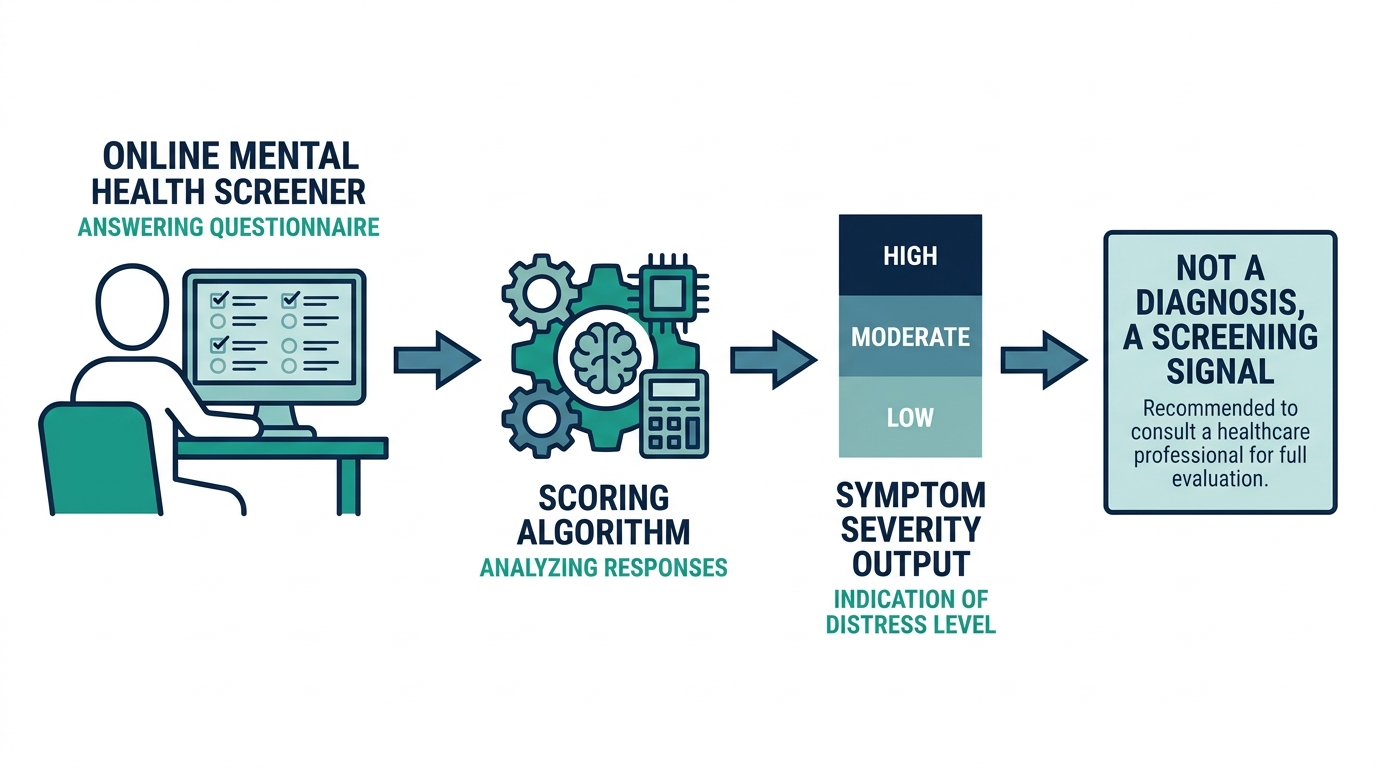
An online mental health test measures symptom frequency, not brain chemistry, and not a disorder. The most widely used screeners ask you to rate, on a scale of “not at all” to “nearly every day,” how often specific symptoms showed up over the last two weeks. Your answers get added into a single score that falls into a severity band. There is no blood, no brain scan, and no algorithm reading your soul. It is structured self-report, and that is both its strength and its ceiling.
The reason this format dominates is boring but important: it is cheap, fast, and repeatable. A doctor can hand you the same nine questions at every visit and watch the number move. That trend line is often more clinically useful than any single score, which is something a one-time online quiz can never give you.
The two screeners you will meet most often
- PHQ-9 (Patient Health Questionnaire, 9 items) screens for depression. Scores run 0 to 27. Question nine asks directly about thoughts of self-harm, which is why a clinician reviews it rather than an app alone.
- GAD-7 (Generalized Anxiety Disorder, 7 items) screens for anxiety. Scores run 0 to 21.
These two are public domain, free to use, and translated into dozens of languages. When a telehealth intake form or a primary care visit screens your mood, this is almost always what is running under the hood.
The other validated instruments worth knowing
Beyond the big two, a handful of named, published screeners cover specific concerns. Knowing they exist keeps you from wasting time on a content-farm quiz that pretends to do the same job.
- PHQ-2: a two-question fast filter. If it comes back positive, it leads into the full PHQ-9. Many clinics run the PHQ-2 first to avoid handing everyone nine questions.
- ASRS v1.1 (Adult ADHD Self-Report Scale): an 18-item screener developed with the World Health Organization. A six-question Part A acts as the high-yield filter for adult attention and hyperactivity patterns.
- EPDS (Edinburgh Postnatal Depression Scale): a 10-item screen built specifically for the perinatal period, because standard depression tools can misread normal pregnancy and postpartum physical symptoms.
- MDQ (Mood Disorder Questionnaire): screens for bipolar-spectrum patterns. This matters because depression screeners alone can miss the manic or hypomanic side of the picture entirely.
- PCL-5: a 20-item screener for post-traumatic stress symptoms, mapped to current diagnostic criteria.
- AUDIT and DAST: brief screens for alcohol and drug use that often run alongside a mood screen, because substance use and mood are deeply tangled.
The insider detail worth knowing: a tool is only worth your time if it has been validated and published, meaning researchers checked it against structured clinical interviews and reported how often it catches real cases. A “Do I have a mental health disorder test” invented by a content farm has none of that behind it, even if it looks identical on the screen. If you cannot find the instrument’s real name and a source, treat it as entertainment.
How to test mental health at home, step by step
The honest answer to “how to test mental health” is that you cannot diagnose yourself, but you can screen yourself reliably and walk into an appointment already two steps ahead. Here is how to test my mental health the way a clinician would actually want you to.
- Pick a validated tool, not a quiz. Look for PHQ-9, GAD-7, ASRS, EPDS, or another named, sourced instrument. Free versions are hosted by nonprofits like Mental Health America and by many health systems. If a site asks for your credit card before showing a score, leave.
- Answer for the right time window, honestly. Most depression and anxiety scoring assumes a two-week window. The ASRS asks about the last six months. Answering for “today” or “this year” breaks the math the instrument was validated on.
- Read your severity band, not just the number. The band is what maps to next steps (see the table below). A raw score with no band is half the information.
- Screenshot or write down the result and the date. Bring it to a clinician. “My PHQ-9 was 16 two weeks ago” is far more useful to a doctor than “I have been feeling off.”
- Re-take it later to track change. Screeners shine as a trend line. A score dropping from 18 to 9 over two months of treatment is real, usable evidence that something is working, and a number that keeps climbing is your cue to escalate.
A worked example
Say you take a GAD-7 on a rough Sunday night and score 16, which lands in the severe band. That single number can feel like a verdict. It is not. You re-take it the following weekend, after a calmer week and two decent nights of sleep, and score 9, which is mild. Neither number is wrong. Together they tell a story a single screen never could: your anxiety is real but reactive, and it tracks closely with sleep and acute stress. That pattern is exactly the kind of thing a clinician wants to hear, and it might point toward sleep and stress management before anything else. One screen is a snapshot. Three screens over a month is a chart.
What does my score mean?
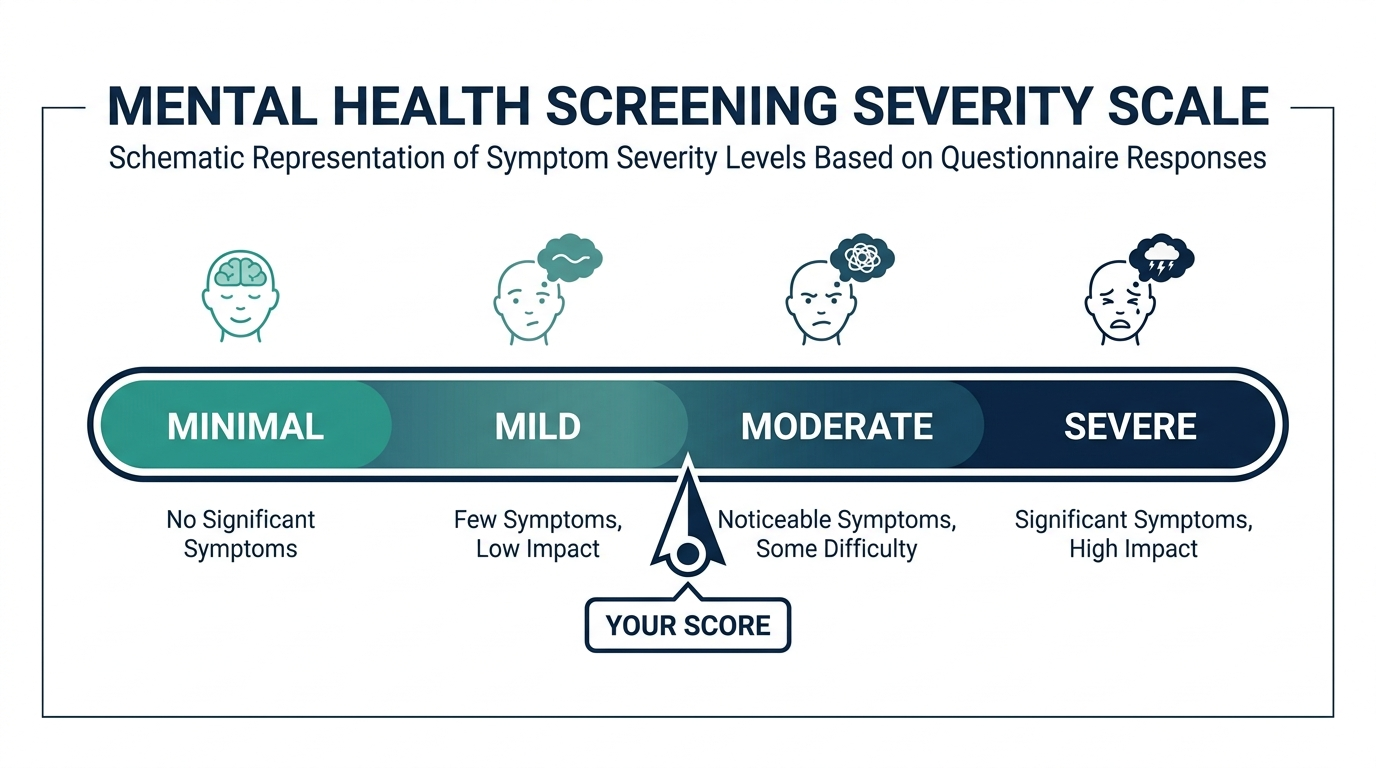
Your score sorts you into a severity band, and the band suggests a next step rather than a label. These cutoffs are the standard published bands for the two most common screeners.
| Tool | Score | Severity band | Typical next step |
|---|---|---|---|
| PHQ-9 (depression) | 0 to 4 | Minimal | No action needed, recheck if things change |
| PHQ-9 | 5 to 9 | Mild | Watchful waiting, lifestyle, recheck in weeks |
| PHQ-9 | 10 to 14 | Moderate | Talk to a clinician about a treatment plan |
| PHQ-9 | 15 to 19 | Moderately severe | See a clinician soon, treatment usually advised |
| PHQ-9 | 20 to 27 | Severe | Prompt professional care |
| GAD-7 (anxiety) | 0 to 4 | Minimal | No action needed |
| GAD-7 | 5 to 9 | Mild | Monitor, self-care |
| GAD-7 | 10 to 14 | Moderate | Talk to a clinician |
| GAD-7 | 15 to 21 | Severe | See a clinician soon |
A high score does not mean you have a disorder. It means your symptoms are frequent enough that a trained person should take a closer look. Plenty of people score high during a grief period, a brutal work stretch, or after a poor month of sleep, and the picture changes once life does. Only a licensed clinician, through an interview and history, can turn a screen into a diagnosis.
Why the same score can mean different things
Two people can both score 14 on a PHQ-9 and need very different things. One is a college student three weeks into a breakup whose sleep and appetite are wrecked but who has a strong support system. The other has carried a flat, joyless 14 for eight months with no obvious trigger. Same number, very different clinical picture. The screener flags both, which is its whole job, but it cannot tell them apart. Context, duration, and history do that, and those live in a conversation, not a questionnaire. This is the single biggest reason a number is a starting line, not a finish line.
One question that gets special handling
On the PHQ-9, the ninth item asks about thoughts that you would be better off dead or of hurting yourself. Any non-zero answer there changes the math. A clinician is trained to ask follow-up questions about that response regardless of the total score, because someone can have a modest overall number and still flag on that one item. This is precisely why a PHQ-9 reviewed by a human beats one scored silently by an app. If you answer anything other than “not at all” on that question, do not wait on the total. Skip to the safety section below.
Screener versus diagnosis: the distinction that matters most
A screener tells you whether to look closer. A diagnosis tells you what you have. They are different tools for different jobs, and conflating them is where people get hurt, either by panicking over a high screen or by dismissing a real problem because an online result felt impersonal.
| Aspect | Online screener | Clinical diagnosis |
|---|---|---|
| What it does | Flags probable cases for further look | Identifies a specific condition |
| Who does it | You, in two to five minutes | A licensed clinician, over a full interview |
| Inputs | Your self-reported symptoms, one window | Symptoms, history, duration, function, ruling out medical causes |
| Output | A score and a severity band | A diagnosis (or not) and a treatment plan |
| Can prescribe | No | Yes, when appropriate |
| Best use | Decide whether to seek care and track change | Actually treat the problem |
Think of it like a home blood pressure cuff. The cuff tells you a number is high. It does not tell you whether you have a kidney problem, a thyroid issue, or just had three coffees and a stressful call. A clinician uses the reading as one input among many. Your mental health screen works the same way. It is a reliable reading that earns a closer look, not a verdict you carry home.
Are online mental health tests accurate?
Validated screeners are accurate at what they are built to do, which is flag people who probably need a closer look, and they are deliberately tuned to over-catch rather than miss. The PHQ-9 and GAD-7 have strong published sensitivity, meaning they rarely miss someone who is genuinely struggling. The tradeoff is more false positives: some people who screen positive turn out fine on full evaluation. That is by design. A screener is a smoke alarm, not a fire inspector. You want it to go off a little too easily.
Two caveats decide whether are online mental health tests accurate in your hands:
- The instrument has to be real. A 15-question BuzzFeed-style “do I have mental health problems test” with no source is entertainment, not screening.
- Honest answers matter more than the tool. The most validated questionnaire on earth is useless if you under-report because you are scared of the result, or over-report on a single terrible day.
Where screeners legitimately fail
Even the good instruments have blind spots, and knowing them keeps you from over-trusting a number.
- They do not catch what they were not built to catch. A PHQ-9 screens depression. It will not flag bipolar disorder, PTSD, ADHD, or an eating disorder. Someone with bipolar disorder can screen positive for depression and get treated for the wrong thing if no one asks about the manic side, which is why the MDQ exists.
- State versus trait. A two-week window captures a state. A bad fortnight after a loss can score the same as a chronic condition. The screener cannot tell duration on its own.
- Cultural and language framing. How symptoms get expressed and reported varies, and a tool validated in one population can read differently in another. This is a known limitation researchers actively study.
- Honesty pressure. When a job, custody, or insurance question is attached, reporting shifts, in both directions. A self-administered screen with no stakes tends to be more honest than one tied to a consequence.
The physical causes a screener cannot see
One thing no online mental health test can do is measure your body. Symptoms like fatigue, low mood, brain fog, poor concentration, and disrupted sleep overlap heavily with thyroid problems, low iron, low vitamin D, low B12, and blood sugar swings. An underactive thyroid alone can produce a picture that looks exactly like depression on a questionnaire. A reasonable first move alongside a screener is to rule out the physical drivers with bloodwork. The usual suspects behind low mood and fatigue show up on a complete blood panel, and a low result on a vitamin deficiency test (think D, B12, and iron) can mimic depression closely enough to fool anyone. If you are getting labs drawn anyway, it is often smarter to capture a full baseline at once rather than chase one marker at a time. Here is how a full-body panel compares for that kind of baseline, and a broader look at the biomarkers worth tracking when symptoms are vague. None of this replaces a mental health evaluation. It runs in parallel, so a treatable physical cause does not get missed while you work on the rest.
Free, legitimate tools versus the junk
You should never pay for a screening questionnaire, because the validated ones are free. What you might pay for is the care that comes after. Here is how to tell a real free tool from a data-harvesting quiz.
| Signal | Legitimate screener | Junk quiz |
|---|---|---|
| Names the instrument | Yes (PHQ-9, GAD-7, ASRS, etc.) | No, or a made-up name |
| Cites a source | Yes, points to research or a clinic | None |
| Cost to see your score | Free | Paywall or upsell before the result |
| Personal data demanded | Minimal or none | Email, payment, or marketing signup required |
| Result framing | Severity band plus next steps | A scary label or a clickbait headline |
| Crisis handling | Shows 988 and safety guidance | None |
Reputable free sources include Mental Health America’s online screening tools, the screening pages of major health systems, and the official instrument pages hosted by professional organizations. A good rule: if the page is trying to sell you something before it shows your score, that score is bait, not screening.
The simplest way to actually get this done
Superpower is a full-body blood panel of 100-plus biomarkers, including thyroid, iron, B12, and vitamin D, the exact markers that can mimic depression and fatigue ($199/year). It is what we point readers to when they would rather get one clean, complete draw than chase single tests one at a time. Here is superpower reviewed in full.
Common mistakes people make with online screeners
Most of the harm from online mental health tests comes not from the tools but from how people use them. These are the recurring errors worth avoiding.
- Treating the score as a diagnosis. A 17 on a PHQ-9 is a reason to book an appointment, not a label to introduce yourself with. Self-diagnosing locks you into a story before a clinician can check it.
- Taking it on the worst possible day. A single screen on your lowest night will read high. That is real data, but one data point. Re-take it on an average day before drawing conclusions.
- Doctor-shopping the questionnaire. Taking five different quizzes until one gives a comforting answer defeats the purpose. Pick one validated tool and trust the number.
- Ignoring the body. Skipping basic bloodwork means a treatable thyroid or iron problem can get mislabeled as a mood disorder for months.
- Under-reporting out of fear. Softening your answers to avoid a scary score only hides the problem from the one tool meant to help you find it.
- Stopping at the screen. The screener is step one. A moderate or higher result that never turns into a conversation with a clinician is a missed alarm.
Edge cases: teens, employers, insurance, and uninsured
Standard screeners cover the common adult case well, but several situations need their own handling.
Minors and teens
Adolescent screening uses age-appropriate tools, and the PHQ-9 has a validated teen version (the PHQ-A). Pediatricians increasingly run depression screens at well visits. For a minor, results should route to a parent or guardian and a pediatric clinician, and confidentiality rules differ by state. An online adult quiz is the wrong tool for a 14-year-old.
Employer-required or pre-employment screening
If a job or program asks you to complete a mental health screen, read who sees the result before you answer. A screen tied to employment is a different situation than a private self-check, and you have a right to ask how the data is used. Honest answers still serve you best, but you should know the stakes.
Insurance, cost, and the uninsured
The screen itself is free. The evaluation after it usually is not, though many plans cover behavioral health visits. If you are uninsured, community mental health centers, federally qualified health centers, and many telehealth platforms offer sliding-scale or low-cost intake. Some primary care visits fold a brief mental health screen into a regular appointment at no extra charge, which can be the cheapest door in.
Older adults and Medicare
Medicare covers an annual depression screening in a primary care setting, and the PHQ tools are commonly used for it. In older adults, mood symptoms can also overlap with medication side effects, cognitive change, and physical illness, so a screen is best read alongside a full medical review rather than alone.
Who should do what: simple decision guidance
If you are unsure what to do with where you are right now, use this as a rough map. It does not replace a clinician, but it sorts the common situations.
- Minimal or mild score, things feel manageable: note your baseline, work on sleep, movement, and stress, and re-screen in a few weeks. No appointment needed unless it slides.
- Moderate score, or symptoms lasting more than two weeks: book a primary care or telehealth visit. Bring your score and date. This is the band where treatment often starts.
- Moderately severe or severe score: seek care soon, not someday. A primary care doctor can begin treatment or refer you out.
- Vague physical symptoms mixed in (fatigue, brain fog, weight change): add basic bloodwork to rule out thyroid, iron, B12, and vitamin D while you pursue the mental health side.
- Any thought of self-harm, or you cannot stay safe: stop screening and use the crisis steps below now.
When to skip the test and get real help now
Skip the questionnaire entirely and reach out immediately if you are having thoughts of harming yourself or others, or if you feel you cannot stay safe. A screener is for sorting non-urgent concerns. It is not a crisis tool. In the US, you can call or text 988 (the Suicide and Crisis Lifeline) any time, day or night, free and confidential. If someone is in immediate danger, call 911.
Short of crisis, treat a moderate or higher score as your cue to book a real evaluation. A primary care doctor is a perfectly good starting point and can begin treatment or refer you to a therapist or psychiatrist. Bring your score and the date you took it. Telehealth platforms also handle mental health intake now, often faster than waiting for an in-person slot. Talk to a clinician about your results before you act on them. A mental health test gets you to the door faster and better prepared. It was never meant to be the room behind it.
Turn what you just learned into action.
Superpower lets you test 100+ biomarkers from home, then re-check them over time so you can actually see progress, physician-reviewed at every step.
FAQ
Do they drug test at a mental health evaluation?
Not routinely. A standard outpatient mental health evaluation is an interview, not a lab visit, and no drug test is involved. A clinician may order a urine or blood test in specific situations, for example if substance use could be driving symptoms or if a medication requires it, but that is a clinical decision, not a default step. Does mental health drug test as a rule? No.
Does health insurance cover ADHD testing?
Usually yes, when it is medically necessary, though coverage varies widely by plan. A brief ADHD screen during a regular visit is typically covered like any other office visit. Full neuropsychological testing is more expensive and often needs prior authorization, so call the number on your insurance card and ask what your specific plan requires before booking.
Does Medicaid cover genetic testing for mental health?
Coverage is inconsistent and state-specific. So-called pharmacogenomic testing, which looks at how you might metabolize psychiatric medications, is covered by some state Medicaid programs in narrow circumstances and denied by others, and major guidelines do not yet recommend it for routine use. Check with your state Medicaid office and your prescriber before assuming it is covered.
How does standardized testing affect students’ mental health?
Research consistently links high-stakes standardized testing to elevated stress and anxiety in students, especially around exam periods, though the effect size and how long it lasts vary by student and environment. It is a real stressor worth taking seriously, but it is a separate question from clinical screening. If a student’s anxiety persists well beyond test season, a GAD-7 screen and a conversation with a clinician are the better next steps.
Is a free online mental health test as good as a paid one?
For the standard screeners, free is just as good. The PHQ-9 and GAD-7 are public-domain instruments, so a free version from a reputable nonprofit is identical to anything behind a paywall. Pay for the follow-up care from a real clinician, not for the questionnaire itself.
How accurate is an online depression test?
A validated one like the PHQ-9 is accurate at flagging people who likely need a closer look, with strong sensitivity, meaning it rarely misses real cases. It is intentionally prone to false positives, so a high score earns an evaluation rather than confirming a diagnosis. Accuracy collapses, though, if the tool is an unsourced quiz or if you answer dishonestly.
Can an online test diagnose anxiety or depression?
No. An online test can screen for anxiety or depression, but only a licensed clinician can diagnose either, through a full interview that weighs duration, history, function, and physical causes. The score is your reason to start that conversation, not the conversation’s conclusion.
What is a normal score on a mental health test?
On both the PHQ-9 and GAD-7, a score of 0 to 4 falls in the minimal range and is generally considered normal. A 5 to 9 is mild and usually warrants self-care and a recheck. Anything 10 or above is the point where most guidelines suggest talking to a clinician.
How often should I take a mental health screener?
If you are tracking how you feel over time or monitoring treatment, every two to four weeks is reasonable, since the tools are designed around a two-week window. Taking one daily tends to add noise rather than signal. Re-screening matters most when something changes, like a new stressor, a new medication, or a stretch where you feel different.
Should I get bloodwork before assuming it is depression?
It is a smart parallel step, not a replacement. Thyroid problems, low iron, low B12, and low vitamin D can all produce fatigue, low mood, and brain fog that mimic depression on a questionnaire. Ruling those out with a basic panel means a treatable physical cause does not get missed while you address the mental health side.
Vital Signs Today may earn a commission if you buy through links on this page. It does not affect our editorial assessments.