Medically reviewed by the VST Editorial Board. Last updated August 24, 2026. This article contains affiliate links.
Your body clock does not care that you landed. It is still keeping time in the city you left, and it will keep doing that for roughly one day per time zone you crossed.
Jet lag typically lasts about one day for every time zone crossed when traveling east, and closer to two-thirds of a day per zone traveling west, which means a six-hour eastward shift usually takes five to six days to fully resolve and the same trip home takes three to four. Sleep itself often feels normal after two nights. The rest of the system, appetite, bowel timing, alertness at 3 p.m., core temperature rhythm, lags behind. This guide gives you the realistic timeline by trip type and the three things that genuinely compress it.
Key takeaways
- Without intervention the body clock shifts about one hour per day, which is where the one-day-per-time-zone rule comes from.
- Eastward travel takes roughly 50% longer to recover from than westward travel across the same number of zones.
- Correctly timed bright light can shift the clock several hours a day instead of one, which is the only intervention that changes the timeline substantially.
Why does jet lag last as long as it does?
The human circadian clock runs on an internal period of about 24.2 hours, slightly longer than a solar day. Every morning, light resets that drift. When you fly across time zones, you are asking a system built to make one-hour corrections to make a six-hour one, and it does it at its own pace.
That 24.2-hour period explains the direction asymmetry that every frequent flyer knows in their body but few can explain. Delaying your clock, which is what westward travel requires, works with the natural drift. Advancing it, which is what eastward travel requires, works against it. Same six zones, different difficulty.
There is a second layer that makes the tail longer than people expect. Your brain’s master clock and your peripheral clocks in liver, gut and muscle do not resynchronize at the same speed. That is why you can be sleeping fine on night three and still feel wrong at lunch, or find your digestion has not caught up. It is also why travel constipation tends to peak in the first 48 hours and resolve on its own schedule.

How long will my specific trip take?
| Route | Zones | Direction | Typical full recovery |
|---|---|---|---|
| New York to London | 5 | East | 4 to 5 days |
| London to New York | 5 | West | 3 days |
| Los Angeles to Paris | 9 | East | 7 to 9 days |
| New York to Tokyo | 13 (adjust as 11 west) | Effectively west | 6 to 8 days |
| Miami to Lima | 0 to 1 | North to south | None. This is travel fatigue |
| Chicago to Denver | 1 | West | Under a day |
Two entries there deserve a note. When a shift exceeds about 12 hours, your clock will pick the shorter direction on its own, so a 13-hour eastward change is often experienced as an 11-hour westward one. And a north-south flight of ten hours produces genuine exhaustion with zero jet lag, because no time zones changed. Calling that jet lag leads people to take melatonin they do not need.
What does the recovery curve actually feel like?
Day 1. The worst day for daytime function. Falling asleep at destination bedtime is difficult after eastward travel, and staying awake past 8 p.m. is difficult after westward travel.
Days 2 to 3. Sleep length usually normalizes first. Most travelers report this as “I think I’m over it,” which is when they stop doing the light timing that would have finished the job.
Days 3 to 6. The residual: an afternoon crash, early waking around 4 a.m., appetite at odd hours, mild fogginess in meetings. This phase is where jet lag quietly costs a business traveler real performance.
Beyond a week. Only expected after shifts of six or more zones, or in older travelers, who as a group adjust more slowly.
(Aside: the reason jet lag has a reputation for being worse than it is may be that we only remember the trips where we had something to perform. Nobody logs the beach holiday where waking at 5 a.m. was fine.)
What actually shortens it?
Timed light is the only thing that moves the timeline much. Bright outdoor light in the morning at your destination advances the clock, which is what you want after flying east. Bright light in the late afternoon and evening delays it, which is what you want after flying west. Get this backwards and you will extend your jet lag, not shorten it. If you land in Paris at 7 a.m. from New York, morning sun is your friend. If you land in Los Angeles from London, afternoon light is.
Melatonin at the right hour helps eastward trips. The Cochrane review found it effective for crossing five or more zones, especially eastward, at 0.5 to 5 mg at destination bedtime. Full dosing detail is in our guide to melatonin for jet lag.
Eat on local time from the first meal. Food is a timing cue for your peripheral clocks. Skipping breakfast because you are not hungry keeps your liver on departure time.
Do not nap longer than 30 minutes before 3 p.m. local. A short nap buys function without stealing that night’s sleep pressure. A three-hour afternoon nap resets the whole process.
The first night decides the next four
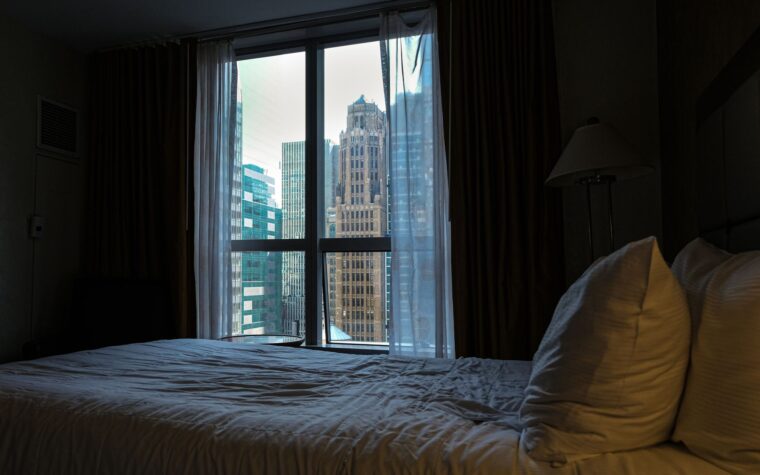
A dark, quiet, cool room on arrival night is worth more than any supplement. If you are booking with points rather than cash, World of Hyatt points can be topped up directly through Points.com, which is how most people close a small gap for a specific arrival-night property.
See World of Hyatt points options
Affiliate link. We may earn a commission at no cost to you.
Should you even try to adjust?
For trips of two days or fewer, many sleep physicians advise staying on home time: schedule meetings during your home-time daytime if you can, keep your usual sleep window, and skip the whole adaptation project. You will feel better on the trip and lose nothing on return.
For trips of four days or more, adapt fully and start before you fly. Shifting your bedtime by an hour a night for two or three nights before departure removes two days from the far end. It is unglamorous and it works.
The middle case, three days, is genuinely a judgment call. My rule: if the trip has one performance that matters, protect the hours around that performance and ignore everything else.
Sleep environment beats sleep supplements
Core body temperature has to fall for sleep to begin, and hotel bedding is often the reason it does not. Cariloha’s bamboo sleepwear and travel bedding are built around cooling and moisture wicking, which is the variable you control in any room.
Affiliate link. We may earn a commission at no cost to you.
When is it not jet lag?
Jet lag is self-limiting and tied to a time-zone change. Suspect something else if:
- Symptoms persist beyond two weeks after arrival
- You have the same symptoms without travel, which points to a circadian rhythm sleep disorder, shift work disorder, or sleep apnea
- You experience loud snoring with witnessed pauses in breathing, which needs evaluation regardless of travel
- Fatigue comes with unexplained weight change, breathlessness or persistent low mood
Seek urgent care if you have chest pain, breathlessness at rest, or one-sided calf pain and swelling in the eight weeks after a long flight. That is a clot presentation, not jet lag, and it is covered in our guide to compression socks for flying.
Frequently asked questions
Does jet lag get worse with age?
Generally yes. Older adults tend to adjust more slowly and experience more sleep fragmentation during the shift.
Is jet lag worse flying east or west?
East. Advancing the clock fights the natural 24.2-hour period, and recovery takes roughly 50% longer than the same westward shift.
How long does jet lag last after a 12-hour time difference?
Expect six to nine days for full circadian adjustment, though sleep length often normalizes within two to three nights.
Can you fully avoid jet lag?
Not for large shifts. You can compress it substantially with pre-travel shifting and correctly timed light, but a nine-zone jump will not be free.
Does alcohol on the flight make jet lag worse?
It fragments sleep and worsens next-day function. It does not change the clock itself, but it reliably makes day one harder.
The bottom line
Count your zones, multiply by one going east and by two-thirds going west, and plan around that number instead of hoping you are the exception. Then spend your effort on the one lever that moves the timeline: getting light at the right end of the day, and blocking it at the wrong end. Everything else is comfort.
Sources
- Herxheimer A, Petrie KJ. Melatonin for the prevention and treatment of jet lag. Cochrane Database of Systematic Reviews. 2002. cochranelibrary.com
- Sack RL. Jet lag. New England Journal of Medicine. 2010;362(5):440-447. pubmed.ncbi.nlm.nih.gov
- National Heart, Lung, and Blood Institute. Circadian rhythm disorders. nhlbi.nih.gov
- UK Civil Aviation Authority. Physiology of flight, guidance for health professionals. caa.co.uk
This article is for general information and is not medical advice. See our medical disclaimer.