Medically reviewed by the VST Editorial Board. Last updated August 24, 2026. This article contains affiliate links.
Fifty people in the Cochrane trials developed a clot in their leg vein without knowing it. Three of them were wearing compression stockings. Forty-seven were not.
Compression socks measurably reduce symptomless deep vein thrombosis and leg swelling on flights, and the evidence for that is rated high certainty, but no trial has shown they prevent a fatal clot because no such event occurred in any of them. That gap between “proven to reduce clots you cannot feel” and “proven to save lives” is the entire honest answer, and it is why the advice differs depending on your baseline risk. Here is what the numbers actually say, who should wear them, and the fitting mistake that makes them useless.
Key takeaways
- Compression stockings cut asymptomatic DVT from about 1% to 0.1% in low-risk flyers and from about 3% to 0.3% in high-risk flyers (Clarke et al., Cochrane, 2021).
- Flights over four hours roughly double the risk of venous thromboembolism, which works out to about one event per 4,656 long-haul flights (WHO WRIGHT project).
- Graduated compression of 15 to 20 mmHg is the range used in most flight trials. Higher is not automatically better, and a sock that bunches at the knee can make things worse.
How risky is flying, in real numbers?
The World Health Organization’s WRIGHT project followed 8,755 employees of international organizations across 38,910 person-years. Among people who had taken a long-haul flight, defined as four hours or more, the rate of venous thromboembolism was 3.2 per 1,000 person-years, compared with 1.0 per 1,000 in people who had not flown. Translated into the unit that matters to a passenger, that is roughly one clot event per 4,656 long-haul flights.
Two details from that data change how you should read it. The elevated risk lasts up to eight weeks after the flight, with the highest rates in the first two weeks. And 42% of the events occurred inside that eight-week window rather than in the air. The calf pain that shows up nine days after you land is not unrelated to the flight.
One clot per 4,656 flights is a small number for a healthy 30-year-old and a meaningfully larger number for a 68-year-old on hormone therapy who had knee surgery last month. Absolute risk is the only useful frame. Relative risk headlines are how this topic gets distorted.
Do compression socks actually work on a plane?
Yes, for the outcomes the trials could measure. The Cochrane review by Clarke and colleagues, most recently updated in 2021, pooled trials in which passengers wore stockings on both legs. Of 2,637 participants with follow-up data, 50 developed a symptomless DVT: three in the stocking groups and 47 in the control groups. The authors graded this as high-certainty evidence.
Expressed as absolute numbers, the incidence of asymptomatic DVT fell from about 1% to 0.1% in low-risk passengers, and from about 3% to 0.3% in high-risk passengers. Swelling was reduced too, at lower certainty, and superficial vein thrombosis appeared to fall at moderate certainty.
Now the limitation the marketing never quotes. The review states plainly that it could not assess the effect on death, pulmonary embolism or symptomatic DVT, because none of those events occurred in the trials. Symptomless clots mostly resolve on their own. So the honest claim is that compression reduces a real intermediate outcome, at essentially no cost and no risk, and it is reasonable to expect that translates downstream. It has not been demonstrated.
I still wear them on anything over six hours. Not because I think a $25 sock is saving my life, but because the swelling reduction alone is worth it and the downside is zero.
Who should definitely wear them?
Wear compression on flights of four hours or more if any of these apply:
- Previous DVT or pulmonary embolism, or a first-degree relative with one
- Known thrombophilia such as factor V Leiden
- Active cancer or cancer treatment in the past six months
- Major surgery, especially orthopedic, in the past three months
- Pregnancy or the six weeks after delivery
- Combined oral contraceptives or hormone replacement therapy
- Age over 60, obesity, or significantly reduced mobility
If you have peripheral arterial disease, diabetic neuropathy with reduced sensation, severe leg edema from heart failure, or an open leg ulcer, do not self-prescribe compression. Get a clinician to assess arterial supply first. Compression on a leg with poor arterial flow is the one scenario where these socks cause harm.
What you wear for the other sixteen hours matters too
Breathable, moisture-wicking layers make a long-haul flight measurably less miserable in a cabin held at 10 to 20% humidity. Cariloha’s bamboo socks, base layers and travel sleepwear are built for that, and they pair with medical-grade compression rather than replacing it.
Affiliate link. We may earn a commission at no cost to you.
What compression level and fit should you buy?
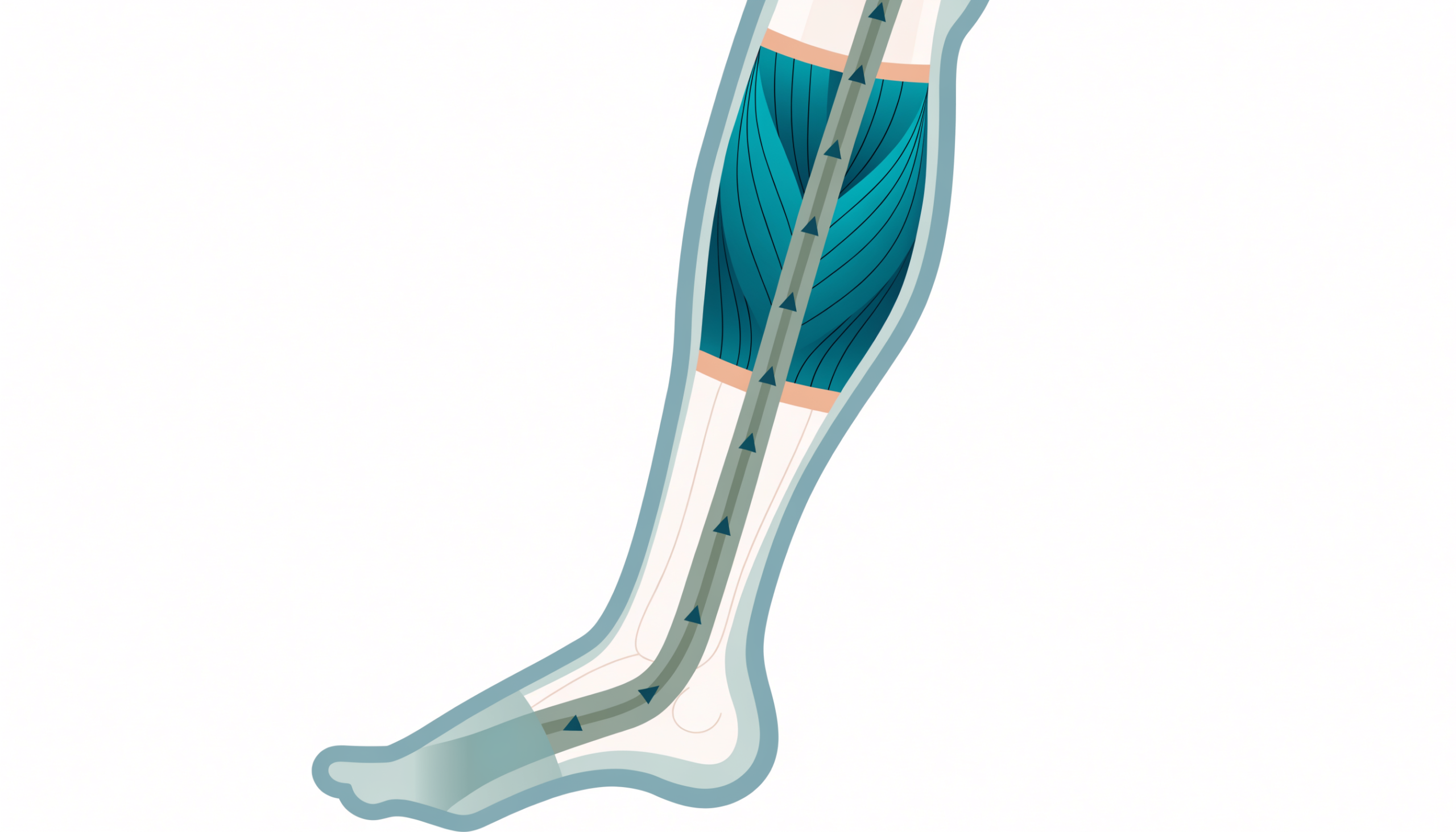
Look for graduated compression, meaning the pressure is highest at the ankle and decreases up the calf. That gradient is what moves blood upward. A sock with uniform pressure is a tight sock.
| Compression | Typical use | Notes for flying |
|---|---|---|
| 8 to 15 mmHg | Light, all-day comfort | Mostly comfort, minimal clinical effect |
| 15 to 20 mmHg | Travel, mild swelling | The range used in most flight trials. Start here |
| 20 to 30 mmHg | Medical, varicose veins, post-DVT | Use if a clinician told you to. Needs proper measuring |
| 30 to 40 mmHg | Prescription only | Not appropriate to self-select for a flight |
Measure your calf circumference at its widest point and your ankle at its narrowest, in the morning before swelling starts. Sizing by shoe size alone is the most common error, and it produces the second most common error: a sock that rolls down and forms a tight band below the knee. That band acts as a tourniquet and is worse than wearing nothing. If it rolls, the size is wrong.
Knee-high is sufficient. The trials used knee-high stockings, and thigh-high versions add cost and slippage without added evidence for flying.
What else reduces flight clot risk?
Move your calves. Ankle pumps, twenty repetitions every hour, activate the calf muscle pump that returns venous blood. This is not a wellness suggestion. It is the mechanism the sock is imitating.
Book an aisle seat on flights over eight hours if you are in any risk category. Window seats are associated with less movement, which is exactly the variable at issue.
Stay hydrated with water, and here is a correction to the usual advice: the UK Civil Aviation Authority notes that cabin dryness adds only about 150 mL of insensible fluid loss over an eight-hour flight, with no measurable change in plasma osmolality. Drink because it keeps you getting up, not because the cabin is desiccating you. On the fluid question, our guide to sleeping on a plane covers the tradeoff with waking up to use the lavatory.
Do not take aspirin to prevent flight clots unless your doctor prescribed it. Aspirin acts on platelets, and flight-related clots are venous. The bleeding risk is real and the benefit is not established.
Long-haul routes where this matters most
South America routings run 9 to 12 hours from most US gateways, which puts them well past the four-hour threshold in the WHO data. If you are pricing those flights, LATAM Airlines publishes its US route deals directly.
Affiliate link. We may earn a commission at no cost to you.
When should you see a doctor?
Go to an emergency department immediately if, during or within eight weeks of a flight, you develop:
- Sudden shortness of breath or chest pain that worsens when you breathe in
- Coughing up blood
- Fainting or a racing heart with breathlessness
- Pain, warmth, redness and swelling in one calf or thigh, particularly if the swelling is one-sided
One-sided calf swelling after a long flight is the classic presentation and it is worth being annoying about. Both ankles puffy after eight hours is ordinary dependent edema. One leg noticeably larger than the other is not.
Book a routine appointment before your trip if you have a personal or family clot history and you are about to fly more than eight hours, because that conversation may end in prescription-strength compression or, in select cases, prophylactic anticoagulation.
Frequently asked questions
How long before the flight should I put them on?
Put them on before you leave for the airport, ideally in the morning before your legs swell, and keep them on until you land and can walk properly.
Should I sleep in them after a long flight?
Not necessary for most people. Remove them at bedtime unless a clinician told you otherwise.
Do compression socks help with swollen feet after flying?
Yes. Reduction in edema is one of the more consistent findings in the Cochrane data, though rated at lower certainty than the DVT effect.
Are athletic compression sleeves the same thing?
No. Calf sleeves leave the foot uncovered and often lack a proper ankle gradient. For flying, buy graduated knee-high socks.
Is a four-hour flight really the cutoff?
Four hours is the definition used in the WHO research, not a biological switch. Risk rises with duration and immobility, so a six-hour drive counts too.
The bottom line
Buy graduated 15 to 20 mmHg knee-high socks, size them by calf and ankle measurement rather than shoe size, put them on before you leave home, and do twenty ankle pumps an hour. If you have a clot history, cancer, recent surgery or a pregnancy, have the conversation with your doctor before you fly rather than after your calf hurts. The evidence is good enough to act on and honest enough to admit what it has not proven.
Sources
- Clarke MJ, Broderick C, Hopewell S, et al. Compression stockings for preventing deep vein thrombosis in airline passengers. Cochrane Database of Systematic Reviews. 2021. cochranelibrary.com
- Kuipers S, Cannegieter SC, Middeldorp S, et al. The absolute risk of venous thrombosis after air travel: a cohort study of 8,755 employees of international organisations (WHO WRIGHT project). PLoS Medicine. 2007. ncbi.nlm.nih.gov
- UK Civil Aviation Authority. Physiology of flight, guidance for health professionals. caa.co.uk
- National Travel Health Network and Centre. Venous thromboembolism factsheet. travelhealthpro.org.uk
This article is for general information and is not medical advice. See our medical disclaimer.