Quick answer: This function health review for women finds it a worthwhile blood test membership for those who want broad coverage at a fair price, but it has real gaps on female-specific markers. The standard 110-plus biomarker draw includes a thyroid panel and basic hormone levels, yet misses free testosterone, AMH (the fertility reserve marker most women over 30 should have), and detailed estrogen fractionation. If your main concern is hormones, fertility workup, or perimenopause monitoring, you will likely need add-ons or a competing service. For most women wanting a solid annual health baseline, it delivers. Read on for what each panel actually contains.
What Does Function Health Actually Cover for Women?
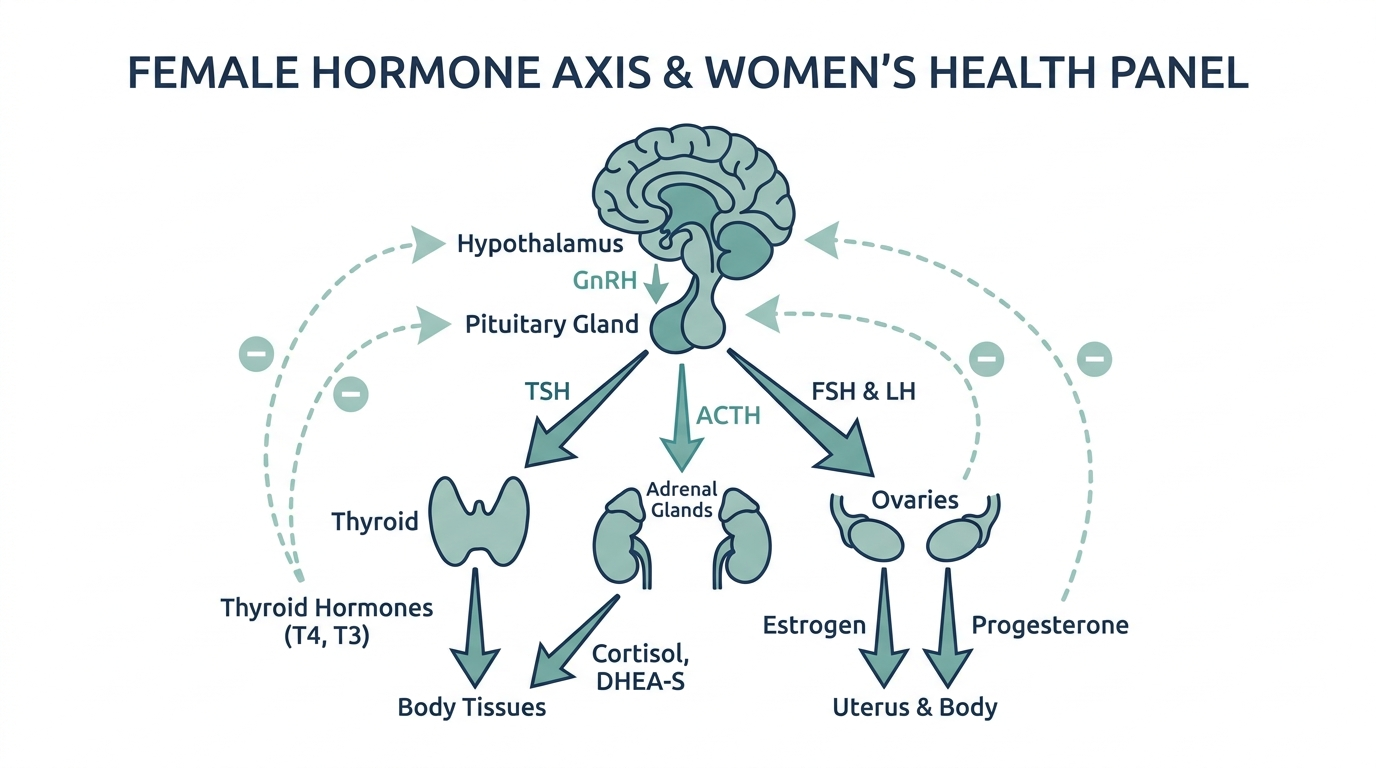
Function Health’s standard membership runs about 110 biomarkers across metabolic health, cardiovascular risk, thyroid, inflammation, nutrients, and basic sex hormones. The female-relevant highlights include TSH, free T3, free T4, thyroid antibodies (TPO and anti-thyroglobulin), estradiol, FSH, LH, prolactin, SHBG, DHEA-S, and a complete iron panel. That lineup is meaningfully better than what most primary care doctors order on a routine checkup, where you might get TSH and nothing else on thyroid, and no sex hormones at all.
If Function’s panel misses key hormone and fertility markers, see a service that tests 150+ biomarkers including the ones women actually need. One at-home Superpower draw checks 100+ biomarkers, physician-reviewed.
The thyroid coverage is genuinely strong. Getting TSH alongside free T3, free T4, and both antibodies in one draw is something you often have to specifically fight your doctor for, and Function includes it by default. Women with Hashimoto’s or a family history of thyroid disease will appreciate this.
Where Function falls behind is on fertility-specific and perimenopausal markers. AMH is not in the standard panel. Neither is progesterone timed to the luteal phase, free (unbound) testosterone, or a detailed breakdown of estrogen fractions (estrone, estriol). For a review of the broader membership pricing structure, see our function health cost breakdown.
Function Health Hormone Panel: What Women Get and What They Do Not
The hormone panel inside a Function Health membership covers the basics but stops short of what a reproductive endocrinologist or integrative gynecologist would want to see. Here is a specific look at what is and is not included.
| Hormone / Marker | In Standard Panel? | Clinical Relevance for Women |
|---|---|---|
| Estradiol (E2) | Yes | Primary estrogen, tracks cycle phase and menopause transition |
| FSH | Yes | Rises sharply in perimenopause; high FSH signals diminished ovarian reserve |
| LH | Yes | LH/FSH ratio matters in PCOS evaluation |
| Prolactin | Yes | Elevated in pituitary issues, antidepressant side effects, thyroid dysfunction |
| SHBG | Yes | High SHBG blunts free testosterone; relevant for libido and energy complaints |
| DHEA-S | Yes | Adrenal androgen; tracks adrenal function and PCOS androgen burden |
| Total testosterone | Yes | Useful but incomplete without the free fraction |
| Free testosterone | No | The bioavailable fraction; missing this underestimates androgen burden in PCOS |
| Progesterone | No (standard) | Must be timed to day 21 of cycle; spotty availability as add-on |
| AMH | No | Gold standard for ovarian reserve; fertility planning essential |
| Estrone / Estriol fractionation | No | Matters in postmenopausal hormone therapy monitoring |
The absence of free testosterone is a genuine problem for women with PCOS symptoms. Total testosterone can look normal even when free testosterone is elevated because SHBG is suppressing the total. You need both numbers to read androgen status correctly. Talk to a clinician about interpreting any hormone results in the context of where you are in your cycle.
Function Health Thyroid Testing: Stronger Than Most Labs
For thyroid, Function Health is one of the better consumer lab services. The standard panel includes TSH, free T3, free T4, TPO antibodies, and anti-thyroglobulin antibodies. You have to specifically request all five of these from most conventional doctors, and insurance denials for antibody testing are common unless you have a documented diagnosis. Getting them bundled in a membership draw is a practical advantage.
Reverse T3 is not included by default. Some functional medicine practitioners track it as a marker of cellular thyroid resistance, particularly in chronic illness or extreme caloric restriction. If you need reverse T3, check whether Function offers it as an add-on or plan to add it through a separate service like ordering a standalone test online.
The practical use case here: a woman in her 30s with fatigue, hair thinning, and cold intolerance who has been told her TSH is “normal” at 3.2 will see from a Function draw that her TPO antibodies are elevated, suggesting early Hashimoto’s. That is a finding most annual physicals miss entirely because antibodies are rarely ordered without a compelling reason documented in the chart.

Function Health Fertility Markers: The Gap That Matters Most
AMH (anti-Mullerian hormone) is the clearest gap in Function Health’s panel for women who care about fertility planning. AMH reflects the remaining pool of primordial follicles and is the single most useful at-a-glance indicator of ovarian reserve. It does not fluctuate across the menstrual cycle, so it can be drawn on any day, making it easy to include in a routine panel. Yet Function does not include it by default.
For context, a woman at 35 with an AMH below 1.0 ng/mL is in the low-normal range and might want to accelerate fertility plans. A woman at 32 with an AMH of 0.4 ng/mL might want to discuss oocyte cryopreservation sooner rather than later. These are clinically actionable numbers. Getting them from a routine membership draw, without a referral to a reproductive endocrinologist, has real value.
Function does include FSH and LH, which give partial fertility signal. Elevated FSH (above 10 to 12 IU/L on cycle day 3) is a red flag for diminished reserve, but it is a late sign compared to AMH. Women who are specifically trying to assess fertility potential rather than just do a general health screen should either request AMH as an add-on if available or use a service that includes it by default.
See our function health review for the full list of what is and is not included across all categories.
Iron and Anemia Markers: Function Health Gets This Right
Iron deficiency is the most common nutrient deficiency in premenopausal women, and Function Health’s iron panel is one of the strongest parts of its offering. The standard draw includes serum iron, ferritin, TIBC (total iron-binding capacity), transferrin saturation, and a complete blood count.
The critical marker here is ferritin, and Function uses it correctly. The conventional lab reference range for ferritin bottoms out around 12 to 15 ng/mL, which is technically not anemia but is functionally iron-depleted. Many women whose ferritin is in the 15 to 30 ng/mL range experience fatigue, hair loss, and poor exercise recovery. Spotting this on paper is the first step toward fixing it. Function’s reporting flags low-normal values rather than just flagging below-range, which is genuinely useful.
For women with heavy menstrual bleeding, these markers drawn annually give a running picture of iron status that a single urgent-care visit never would.
How Function Health Compares to Superpower for Women
This is the comparison most women researching the best blood test membership for women should see side by side.
| Feature | Function Health | Superpower |
|---|---|---|
| Annual price (approx.) | $499/year (first year discounted) | About $199/year |
| Biomarker count | 110 to 160+ | 100+ |
| Thyroid (TSH, fT3, fT4, antibodies) | Yes | Yes |
| AMH (ovarian reserve) | No (add-on only) | Yes (included) |
| Free testosterone | No | Yes |
| Ferritin | Yes | Yes |
| Doctor review of results | Yes (asynchronous) | Yes (included) |
| Longitudinal trending | Yes | Yes |
| Draw location | Quest / Labcorp | Quest / Labcorp |
| HSA/FSA eligible | Yes | Yes |
The price gap is substantial. At $499 versus $199, Function Health is more than twice the cost. Superpower includes AMH and free testosterone by default, which for a 30-something woman specifically shopping for hormone and fertility coverage is a meaningful advantage. Superpower also runs each draw through a physician review, which matters when you are looking at a result you do not fully understand.
For the complete picture on Superpower pricing, see how much does superpower cost.
The simplest way to actually get this done
Superpower is a full-body lab membership that runs 100+ biomarkers, has each result reviewed by a doctor, and tracks your numbers year over year (about $199/year). It is what we point readers to when they would rather get one clean, complete draw than chase single tests one at a time. Here is superpower blood test review reviewed in full.
What Women Get Wrong About Function Health
The biggest misconception is that more biomarkers automatically means better insight. Function Health’s marketing emphasizes the volume of tests, which can create the impression of comprehensive hormone coverage when the actual picture is more limited. A panel that includes 160 biomarkers but omits AMH, free testosterone, and progesterone is doing a lot of metabolic work while leaving the most clinically relevant female hormone picture incomplete.
A second common error is ignoring the draw timing. Estradiol, LH, and FSH values mean very different things on cycle day 2 versus cycle day 14 versus cycle day 21. Function does not require or guide cycle-timed draws. If you draw on a random day during the luteal phase, your FSH might look artificially suppressed and your estradiol high. The results are not useless, but they are not as interpretable as a properly timed baseline. If you care about fertility or perimenopausal tracking, coordinate your draw date with your cycle and document the day in your portal notes.
Third: some women assume the doctor review means a personal consultation. It does not. The physician review is asynchronous and focused on flagging abnormal values, not providing a personalized clinical management plan. Treat it as a first-pass triage. Anything flagged still warrants a follow-up appointment.
Who Should Use Function Health and Who Should Not
Function Health is a good fit for women who want a broad metabolic and thyroid baseline, who have already established fertility plans or are past reproductive age, and who value the depth of cardiovascular and inflammation markers that most annual physicals skip. It is also well-suited for women tracking Hashimoto’s or thyroid optimization, given the complete antibody panel.
It is a poor fit if your primary goal is fertility workup, PCOS androgen evaluation, or perimenopause hormone monitoring. For those use cases, the missing markers matter enough that you will be supplementing with add-ons or additional labs anyway, which erodes the cost advantage.
The function health honest review covers male-specific limitations in comparable detail if you want to see how the gaps compare across sexes. For a head-to-head comparison focused on men, see function health review for men.
Cost and Practical Logistics
Function Health’s membership runs roughly $499 per year at standard pricing, with a lower introductory rate sometimes offered. The draw itself is at a Quest or Labcorp location, so there is no at-home kit involved. You schedule through the Function app, bring your requisition QR code, and results typically appear in the portal within three to seven business days.
The membership is HSA and FSA eligible, which makes it more affordable for women who fund those accounts through their employer. At $499 after tax, HSA-funded, the effective out-of-pocket may be meaningfully lower depending on your bracket. That said, buying $499 of lab work cash-pay through a service like Labcorp OnDemand or Walk-In Lab for specific tests you actually need can sometimes beat the membership cost if your list is short.
For a detailed comparison of the actual dollar figures, see our function health cost page.
When in Your Cycle to Draw Each Hormone
The single biggest factor that determines whether a female hormone panel is interpretable is the day of the cycle it was drawn on. A membership draw scheduled by convenience, rather than by cycle phase, can produce numbers that look alarming or reassuring for the wrong reason. Here is how the timing works for the markers a general panel includes.
- FSH, LH, and estradiol: early follicular phase, roughly cycle days 2 to 4. This is the standard baseline window. A day-3 FSH is what fertility specialists use to gauge ovarian reserve, and estradiol should be at its cycle low here, which is what makes the FSH reading meaningful. Drawing these mid-cycle or in the luteal phase changes their interpretation entirely.
- Progesterone: mid-luteal phase, roughly day 21 of a 28-day cycle, or about 7 days after ovulation. This is the only window where a progesterone level confirms whether ovulation occurred. A day-21 value that is low in a woman who thinks she is ovulating is a genuinely useful finding. Drawn at any other time, progesterone tells you little.
- AMH: any day. Because AMH reflects the standing follicle pool rather than the current cycle, it does not swing with the phase. This is what makes it so convenient and so useful as a reserve marker, and it is why its absence from a standard panel is a real gap.
- Prolactin: morning, and not right after exercise, a meal, or breast stimulation. Prolactin rises transiently with stress, sleep, and nipple stimulation, so a mildly elevated afternoon value often just needs a calm, fasted, morning recheck before anyone worries about a pituitary cause.
If your panel does not let you control the draw day precisely, at minimum record which cycle day you drew on and share it with whoever interprets the results. A number without a cycle day is a number without context.
How Reference Ranges Shift Across Life Stages
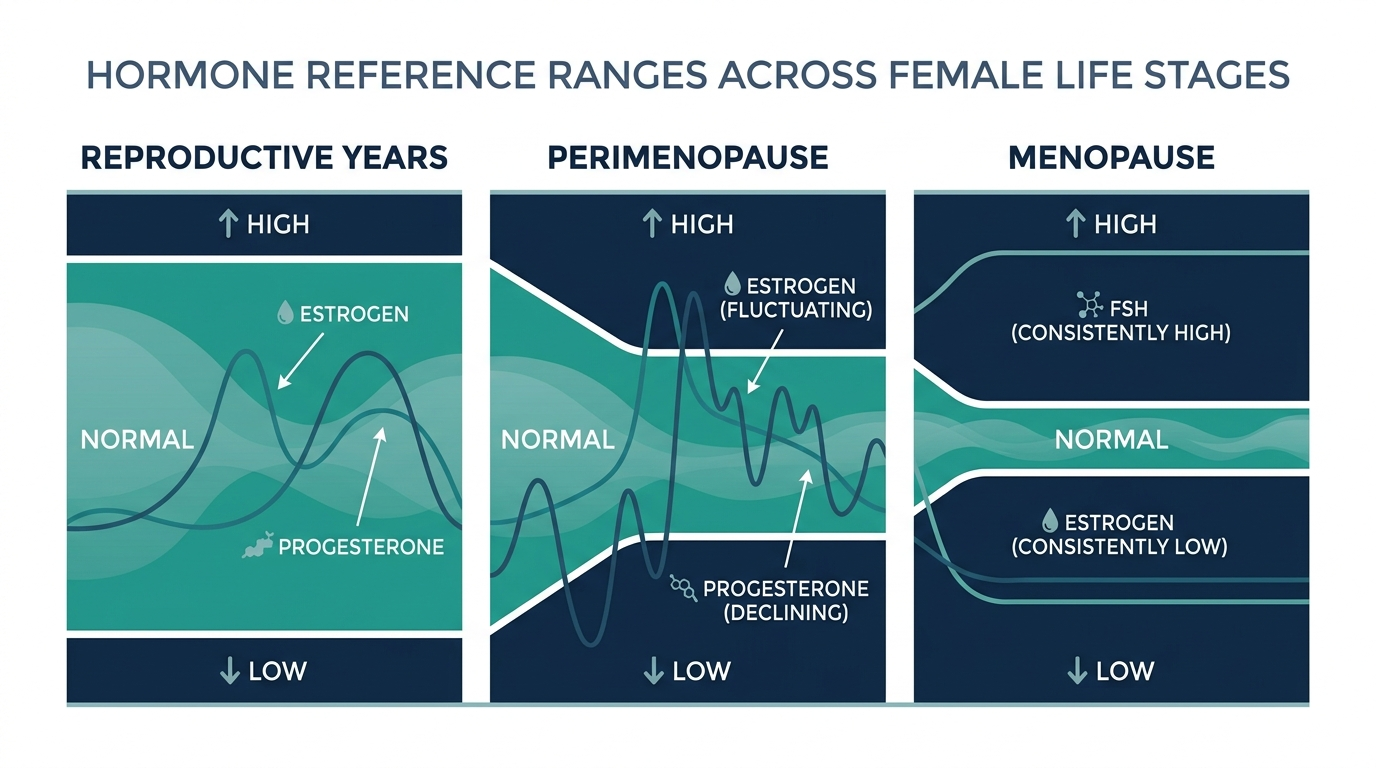
A result that is normal for a 25-year-old can be a red flag for a 45-year-old, and the reverse is also true, so age and reproductive stage change how you read the same number. FSH is the clearest example. A day-3 FSH in the single digits is expected in a woman in her 20s or early 30s; the same value climbing toward and past the low teens signals the perimenopausal transition and diminishing reserve. After menopause, high FSH and low estradiol are simply the expected physiology, not a problem to fix.
Estradiol follows the opposite arc, tapering as the ovaries wind down, which is why a low postmenopausal estradiol is normal rather than a deficiency in the way it would read during reproductive years. Testosterone and DHEA-S also decline gradually with age in women, so interpreting a low-normal androgen in a 50-year-old differs from interpreting the same number in a 30-year-old with PCOS symptoms. The practical rule is to read every hormone value against your specific age and menopausal stage, not against a single lab reference band that lumps all adult women together. This is exactly the kind of nuance a physician review is meant to supply, and it is why a flagged value is a starting point for a conversation rather than a diagnosis.
Preparation Factors That Skew Female Panels
Beyond cycle timing, several everyday factors move hormone and thyroid results enough to change how they read, and controlling them makes your draw far more reliable.
- Biotin supplements. High-dose biotin, common in hair and nail supplements, can interfere with the immunoassays used for thyroid and some hormone tests, producing falsely high or low results depending on the assay. Most labs advise pausing biotin for two to three days before a draw.
- Hormonal birth control. Oral contraceptives suppress FSH, LH, and endogenous estradiol and raise SHBG, which lowers free testosterone. Sex hormone results on the pill reflect the medication, not your baseline physiology, so note it when interpreting.
- Recent acute illness or intense exercise. Both can transiently shift cortisol, prolactin, and thyroid values. If you were sick or ran a hard session the day before, a borderline result may warrant a calmer recheck.
- Time of day. Cortisol and, to a lesser degree, testosterone peak in the morning. A morning draw gives the most comparable, standardized reading for these markers.
Standardizing these conditions across annual draws is what makes year-over-year trending trustworthy. If one year you drew fasted in the morning off supplements and the next year you drew in the afternoon on biotin, a change in the numbers may reflect the conditions rather than your body.
Don’t just read about your health, track it.
A single result is a snapshot. Superpower re-tests 100+ markers over time so you can watch them move as you change sleep, food, and training.
FAQ
Does Function Health include a hormone panel for women?
Yes, Function Health includes basic female hormones: estradiol, FSH, LH, prolactin, SHBG, DHEA-S, and total testosterone. It does not include AMH, free testosterone, or a timed progesterone draw by default. These are meaningful omissions for fertility planning or detailed PCOS evaluation.
Does Function Health test for AMH?
AMH is not part of Function Health’s standard panel. It may be available as an add-on depending on your membership tier, but it is not included by default. Services like Superpower include AMH as a standard part of their panel, which is an advantage for women evaluating ovarian reserve.
Is Function Health good for perimenopause monitoring?
It is partially useful. You get FSH, estradiol, and LH, which together give a reasonable picture of where a woman is in the menopausal transition. Missing progesterone and estrogen fractionation means the picture is incomplete for women on hormone therapy or those trying to optimize hormone levels precisely. Most perimenopausal women using Function will supplement with additional testing through their gynecologist.
How does Function Health’s thyroid testing compare to a standard doctor visit?
It is considerably more thorough. A routine physical typically orders only TSH. Function Health includes TSH, free T3, free T4, TPO antibodies, and anti-thyroglobulin antibodies. That five-marker panel catches subclinical Hashimoto’s and conversion problems that a TSH-only draw misses. For women with unexplained fatigue, hair loss, or weight changes, this is one of Function’s strongest arguments.
Can I use Function Health to check fertility markers?
Function Health gives partial fertility signal through FSH and LH, but it is not a fertility workup. AMH is missing, and progesterone is not included in a cycle-timed format. If fertility assessment is your primary goal, you are better served by a dedicated fertility panel through a reproductive endocrinologist or a service that includes AMH by default.
Is Function Health worth it for women with PCOS?
Possibly, but with caveats. Function includes LH/FSH ratio, total testosterone, SHBG, DHEA-S, fasting insulin, and glucose, all of which are relevant to PCOS evaluation. What it lacks is free testosterone, which is often more diagnostically useful than total testosterone in PCOS. If you know your SHBG is low, total testosterone can look falsely normal even when androgen burden is high.
What is the best blood test membership for women?
For most women wanting a broad annual health screen, Superpower at around $199 per year covers metabolic, thyroid, iron, hormone, and fertility markers (including AMH and free testosterone) with physician review, at less than half the cost of Function Health. Function Health has a slight edge in sheer biomarker volume and some cardiovascular markers, but for female-specific priorities, Superpower’s default inclusions are more aligned. See our full superpower blood test review for details.
Does Function Health do iron testing for women?
Yes, and it is thorough. Function includes serum iron, ferritin, TIBC, transferrin saturation, and a complete blood count. For premenopausal women with heavy periods or chronic fatigue, this is one of the most practically valuable parts of the draw. The ferritin reference range guidance is better than what most conventional labs flag.
Can I use Function Health results with my OB-GYN?
Yes. Function generates a standard PDF lab report that any physician can read. The draw is done at Quest or Labcorp and follows standard methodology, so results are clinically valid. Your OB-GYN may want cycle-day context for hormone interpretation, so note the day of your cycle on the draw date in your records.
How often does Function Health recommend testing for women?
Function’s standard membership includes one comprehensive draw per year with follow-up testing on specific markers at six months. For women tracking perimenopausal transition, active thyroid treatment, or iron supplementation, once per year is often not frequent enough to catch changes. You can supplement with targeted add-on draws between annual panels.
Vital Signs Today may earn a commission if you buy through links on this page. It does not affect our editorial assessments.