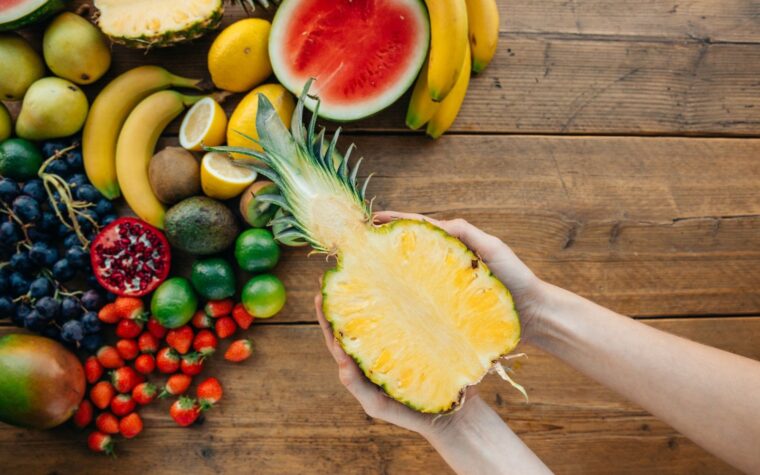
Quick answer: Pineapple can fit a weight-loss diet, but it does not burn fat or melt belly fat the way social posts claim. One cup of fresh pineapple chunks has about 82 calories, 16 grams of sugar, and 2.3 grams of fiber, so it is a reasonable swap for cookies or chips and a poor swap for nothing at all. The pineapple loses its edge the moment you drink it as juice or eat it by the bowlful, because the sugar adds up fast and the fiber disappears. Whether pineapple helps you depends far less on the fruit and far more on your total calories and how your body handles sugar.
Is pineapple healthy for weight loss, or is that a myth?
Pineapple is healthy, but it is not a weight-loss food in any special sense. It is mostly water (about 86 percent by weight), it brings vitamin C and manganese, and it has enough fiber to take the edge off a sweet craving. None of that causes fat loss. The only thing that causes fat loss is a sustained calorie deficit, and a fruit can either support that deficit or quietly undo it.
The famous bromelain claim is where most of the myth lives. Bromelain is a mix of enzymes in pineapple that breaks down protein, which is real and useful for tenderizing meat. It does not break down body fat. There is no human trial showing that eating pineapple or taking bromelain leads to meaningful weight loss. So when a video tells you pineapple “flushes fat,” treat that the same way you would treat a coupon that sounds too good: read the fine print, which here is simply that fruit does not have magic powers.
Where pineapple genuinely helps is displacement. If a cup of pineapple replaces a 250-calorie pastry in your afternoon, that is a real 170-calorie win, repeated daily, that adds up over a month. The fruit is doing the work of being satisfying and low-calorie, not the work of a drug.
Are pineapples good for weight loss compared to other fruit?
The simplest way to actually get this done
Superpower is a full-body lab membership that runs 100+ biomarkers, has each result reviewed by a doctor, and tracks your numbers year over year (about $199/year). It is what we point readers to when they would rather get one clean, complete draw than chase single tests one at a time. Here is superpower reviewed in full.
Pineapple sits in the middle of the fruit pack for weight loss: better than dried fruit and fruit juice, worse than berries, and roughly even with banana or mango per serving. The deciding factors are calorie density, fiber per gram of sugar, and how fast the sugar hits your blood. Here is how a standard serving compares.
| Fruit (1 cup, chopped) | Calories | Sugar (g) | Fiber (g) | Glycemic index (approx.) |
|---|---|---|---|---|
| Raspberries | 64 | 5 | 8 | Low (about 32) |
| Strawberries | 53 | 7 | 3 | Low (about 40) |
| Pineapple, fresh | 82 | 16 | 2.3 | Medium (about 59) |
| Banana, sliced | 134 | 18 | 3.9 | Medium (about 51) |
| Mango | 99 | 23 | 2.6 | Medium (about 56) |
| Grapes | 104 | 23 | 1.4 | Medium (about 59) |
The numbers tell the honest story. Pineapple is fine, with a moderate glycemic index and a fair calorie load, but it carries more sugar and less fiber than berries. If your goal is the most satiety for the fewest calories, berries win. If you simply enjoy pineapple and it keeps you off the candy, it earns its place. For a wider look at how the fruit aisle ranks, see what fruits are good for weight loss, and for the closest like-for-like comparison, see whether bananas are good for weight loss.
Ripeness, form, and why the same fruit can score differently
A detail the tidy table above hides: the glycemic hit from pineapple is not fixed. A very ripe, golden pineapple releases its sugar faster than a firmer, slightly under-ripe one, and the difference is enough to notice if you are sensitive to blood-sugar swings. Cut size matters too. Finely diced or crushed pineapple digests faster than large chunks you have to chew. And the moment you cook it down, as in a grilled pineapple dessert or a sweet-and-sour sauce, the sugars concentrate and any small fiber benefit shrinks further. None of this makes pineapple bad. It just means the honest version of “pineapple is medium GI” is really “fresh, firm, whole pineapple in a one-cup portion is medium GI,” and every step away from that pushes it in the wrong direction.
Is pineapple juice good for weight loss? Almost certainly not
Pineapple juice is a poor choice for weight loss, and it is the single biggest mistake people make with this fruit. The juicing process removes nearly all the fiber and concentrates the sugar. One cup of unsweetened pineapple juice carries about 130 calories and 25 grams of sugar, and you can drink it in fifteen seconds without the chewing or fullness that whole fruit forces on you.
That matters because of how your body handles liquid sugar. Calories you drink do not trigger the same fullness signals as calories you chew, so juice tends to add to your day rather than replace anything in it. People also rarely stop at one cup of juice. So the question “does pineapple juice help in weight loss” has a clean answer: no, and it usually works against you. If you love the taste, eat the fruit and skip the glass.
The same logic kills most “pineapple smoothie for fat loss” recipes. Blend a cup of pineapple, a banana, and a splash of juice, and you have built a 350-calorie sugar drink that you will be hungry again after. A smoothie can work for weight loss, but only when protein and fiber lead and fruit plays a supporting role. A protein shake built around weight loss does the satiety job far better than a fruit smoothie does.
How to make pineapple water for weight loss (and what it actually does)
Pineapple water is harmless, mildly useful, and not a fat burner. To make it, drop a few fresh pineapple chunks or a couple of pineapple cores into a pitcher of cold water, add mint or a slice of ginger if you like, and let it infuse in the fridge for two to four hours. You drink the water, not the fruit, so a glass has only a handful of calories.
The honest mechanism is plain: it makes water taste pleasant, so you drink more of it. Better hydration can reduce the false hunger that people often misread as a need to snack, and a glass of flavored water before a meal can take a small edge off your appetite. That is the entire benefit. It does not detox anything, it does not target belly fat, and the trace bromelain that leaches into the water does nothing measurable to your metabolism.
If swapping a daily soda for pineapple water saves you 150 calories a day, that single change beats every pineapple “fat-burning” trick combined. Use it as a low-effort way to cut liquid calories, not as a treatment.
Do pineapples help with weight loss through fiber and fullness?
Pineapple helps modestly through fiber, water volume, and the act of chewing, not through any fat-burning enzyme. The 2.3 grams of fiber in a cup is real but not impressive, and the high water content adds bulk that fills your stomach for few calories. Chewing whole fruit also slows you down compared with sipping juice, which gives your fullness signals time to catch up.
You can stack the deck in your favor with a few simple moves:
- Pair it with protein or fat. A cup of pineapple with a serving of cottage cheese or Greek yogurt blunts the blood-sugar rise and keeps you full far longer than fruit alone.
- Eat it whole, never juiced. Keep the fiber that the juicer would throw away.
- Mind the portion. One cup is a serving. A whole pineapple is roughly five servings and over 400 calories, easy to clear in front of the TV.
- Choose fresh or frozen over canned in syrup. Canned pineapple in heavy syrup can double the sugar. If you buy canned, get it packed in juice or water and drain it.
Done this way, pineapple behaves a lot like oatmeal does for breakfast: a fine vehicle for fullness when you respect the portion and pair it well. The same discipline that makes oatmeal good for weight loss applies here.
Simple ways to eat pineapple that support a deficit
The pairing principle is easy to turn into actual meals. A cup of pineapple stirred into plain Greek yogurt or low-fat cottage cheese turns a fast-digesting fruit into a slow, high-protein snack that holds you for hours. Diced pineapple over a green salad with grilled chicken adds sweetness without a dessert. A few grilled spears alongside a lean protein at dinner scratch the sweet-tooth itch for well under a hundred calories. What to avoid is just as concrete: pineapple blended into a juice or smoothie, pineapple piled on a sugary dessert, and canned pineapple eaten straight from the syrup. The rule of thumb is that pineapple should arrive with a fork and some protein, not in a glass or on top of sugar.
What results can pineapple realistically deliver?
Here is the math nobody selling a pineapple detox wants to walk through. Suppose you swap a 250-calorie afternoon pastry for a one-cup serving of pineapple at 82 calories. That is a 168-calorie daily saving. Held every day, that is roughly 1,100 calories a week, or in the range of a pound of fat over about three weeks, assuming nothing else changes. That is a real, respectable result, and it comes entirely from the swap, not from the fruit. Nothing about the pineapple itself accelerates the process.
Now run it the other way. Add two cups of pineapple on top of your normal day because you decided fruit is free, and you have added around 160 calories daily, the same math working against you. Same fruit, opposite outcome. This is why the honest answer to whether pineapple is good for weight loss is always that it depends on what it replaces. Expect a supporting role and a modest contribution, not a transformation. Any dramatic before-and-after credited to pineapple is really a picture of a calorie deficit that pineapple happened to be part of.
A concrete example: someone who has a large glass of pineapple juice with breakfast, a bowl of pineapple as a mid-morning snack, and canned pineapple with dinner can easily take in 400 to 500 calories of pineapple sugar in a day while believing they are eating clean. Swap the juice for water, the snack bowl for a measured cup with yogurt, and the canned rings for fresh, and the same person cuts a few hundred calories without giving up the fruit at all. The pineapple did not change. The packaging and the portion did.
What stalls people: the common pineapple mistakes
Most people who add pineapple and see the scale stick are making one of a handful of predictable errors. The fruit is rarely the villain. The habits around it are.
- Treating it as a free food. “It is just fruit” turns into three cups a day, which is roughly 250 extra calories. Fruit has calories. They count.
- Drinking it instead of eating it. As covered above, juice and smoothies quietly pour liquid sugar into a diet that looks healthy on paper.
- Canned in syrup. A serving of pineapple in heavy syrup can carry 30 grams of sugar, nearly double the fresh version, and people rarely read the can.
- Eating it alone as a snack. A bowl of pineapple by itself spikes and crashes blood sugar for many people, which leaves them hungrier an hour later and reaching for more.
- Assuming the bromelain is working. Believing the fruit is “burning” something gives people permission to relax elsewhere in the diet, which is where the real damage happens.
There is also a quieter reason the scale stalls that has nothing to do with pineapple at all. If you are genuinely eating in a deficit, watching portions, and the weight still will not move, the problem is often upstream of your plate. An underactive thyroid, insulin resistance, or a hormone shift in perimenopause can flatten a deficit that should be working. That is a measuring problem, not a willpower problem, and no fruit fixes it.
Who should be careful with pineapple?
Pineapple is safe for most people, but a few groups should treat it with more care than the average eater. The fruit’s sugar load and acidity are the usual issues.
- Insulin resistance or prediabetes. Pineapple’s medium glycemic index can produce a sharper blood-sugar spike in people who do not clear glucose well. Pairing it with protein and keeping portions to half a cup helps. If you do not know your fasting glucose or HbA1c, that is exactly the number to find out.
- Type 2 diabetes. Pineapple is not off limits, but the carbohydrate count needs to fit your plan. A cup is about 22 grams of carbohydrate, which is meaningful for a fixed-carb meal.
- Acid reflux or a sensitive mouth. Pineapple is acidic and the bromelain can leave the tongue raw. People with GERD often tolerate it poorly.
- Possible food sensitivity. Some people feel bloated, gassy, or sluggish after pineapple. That is worth tracking, because a food that leaves you uncomfortable is a food you will struggle to stick with.
This is where the more useful question shifts from “is this food good” to “what does my body actually do with this food.” Two people can eat the same cup of pineapple and get very different blood-sugar responses, and you cannot feel the difference reliably. You measure it.
Why testing beats guessing when the scale will not move
If you have cleaned up your diet, swapped juice for whole fruit, controlled portions, and the weight still will not budge, the highest-value move is to stop self-experimenting with foods and look at your actual numbers. Most stalled weight loss traces back to something a lab can flag in an afternoon.
The usual suspects are concrete and testable. An underactive thyroid (a high TSH, low free T4) slows metabolism and is common, especially in women over 40. Insulin resistance, visible in fasting insulin, fasting glucose, and HbA1c, makes fat loss feel like pushing a boulder uphill. Hormone shifts in perimenopause change where the body stores fat and how it responds to a deficit. None of these show up on a bathroom scale, and none respond to pineapple water.
You do not need a hospital visit to start. At-home panels now let you check thyroid, HbA1c, metabolism markers, food sensitivity, and women’s or men’s hormones from your kitchen, with results reviewed by a physician. Everlywell runs single at-home tests through CLIA-certified labs, often from about $49 to $249 depending on the panel, mailed to your door with physician-reviewed results. If you suspect a food sensitivity to fruit, or you want to see your HbA1c before you blame the pineapple, an at-home test gives you a number instead of a guess. Here is Everlywell reviewed in full. For a broader single-draw panel that covers thyroid, metabolism, and hormones together, a full-body workup like a comprehensive blood panel can show the whole picture at once.
It is always worth talking to a clinician before making big changes based on a result, but having the number in hand is what turns a frustrating plateau into a fixable problem.
So, is pineapple good for a weight-loss diet?
Pineapple is a fine part of a weight-loss diet in honest portions: one cup of fresh fruit, eaten whole, ideally paired with protein, in place of something worse. It will not burn fat, the bromelain will not melt anything, and the juice and syrup versions will work against you. Treat it as a pleasant, lower-calorie way to satisfy a sweet tooth, not as a treatment. And if you are doing everything right and still stuck, put your energy into measuring your metabolic numbers rather than hunting for the next miracle fruit. That is where the real lever is.
Want a real clinician to run the numbers, not a guess?
Joi + Blokes is a telehealth clinic that prescribes GLP-1 medication (Zepbound, compounded semaglutide and tirzepatide), hormone therapy (TRT, HRT), thyroid care, and peptides after a real lab panel and clinician review, with no membership or consult fee (prescriptions from about $59/month, lab panels from $149). If the scale will not budge, this is where you find out whether insulin, thyroid, or hormones are the real reason. Here is Joi + Blokes reviewed in full.
FAQ
Does pineapple help with weight loss at night?
Eating pineapple at night does not specifically help or hurt weight loss. Total daily calories matter more than timing for most people. A small portion of pineapple as an evening snack is fine, but a large bowl close to bed can spike blood sugar and disrupt sleep in sensitive people, which indirectly works against you.
Can pineapple help with weight loss if I eat it every day?
Daily pineapple can support weight loss if it replaces higher-calorie foods and you keep to about one cup. Eaten on top of your usual diet, or in large portions, the sugar and calories can stall you. Consistency in your overall calorie balance matters far more than any single fruit.
Does pineapple juice help weight loss in any form?
No. Pineapple juice concentrates sugar and strips the fiber, delivering about 130 calories and 25 grams of sugar per cup with little fullness. Liquid sugar tends to add calories to your day rather than replace anything. Whole pineapple is always the better choice.
Is canned pineapple as good as fresh for weight loss?
Fresh and frozen are better. Canned pineapple in heavy syrup can carry nearly double the sugar of fresh fruit. If you buy canned, choose varieties packed in juice or water and drain them before eating to cut the added sugar.
Does bromelain in pineapple actually burn fat?
No. Bromelain breaks down protein, which is why it tenderizes meat, but it has no proven effect on body fat. There is no human study showing that pineapple or bromelain supplements cause meaningful weight loss. Any fat loss while eating pineapple comes from your overall calorie deficit.
How much pineapple can I eat on a weight-loss diet?
About one cup of fresh chunks, roughly 82 calories and 16 grams of sugar, is a sensible serving. People with insulin resistance or diabetes may want half that, paired with protein. The key is to count it as part of your day rather than treating it as a free food.
Is pineapple good for belly fat specifically?
No food targets belly fat, and pineapple is no exception. Where you lose fat is largely set by genetics and hormones, not by which fruit you eat. Pineapple can support overall fat loss only as a low-calorie, satisfying food within a calorie deficit.
Why am I eating healthy foods like pineapple and still not losing weight?
If your portions and total calories are genuinely in check and the scale still will not move, the cause is often metabolic rather than dietary. An underactive thyroid, insulin resistance, or perimenopausal hormone changes can flatten a real deficit. A simple at-home or clinic blood panel for thyroid, HbA1c, and hormones usually finds the answer faster than another food swap.
Is frozen pineapple as good as fresh for weight loss?
Yes. Frozen pineapple is usually picked and frozen without added sugar, so it keeps the same calories, fiber, and vitamin C as fresh. It is often cheaper and lasts longer, which makes it easier to keep a controlled portion on hand. Just check the bag to confirm there is no added sugar or syrup, and treat a cup of frozen chunks the same way you would a cup of fresh.
Does pineapple reduce bloating or is that a myth?
It is mostly a myth for weight, though there is a small grain of truth for digestion. Bromelain can help some people break down protein and may ease mild discomfort after a heavy meal, which can feel like less bloating. That is a comfort effect, not fat loss, and for other people the fruit’s acidity and fiber actually cause more gas and bloating. If pineapple leaves you bloated rather than relieved, that is a signal to eat less of it, not more.
Should I take a bromelain supplement to lose weight?
No. Bromelain supplements are marketed for digestion and inflammation, not fat loss, and there is no human evidence that they help you lose weight. Spending money on bromelain capsules for weight loss is spending on a claim the science does not support. If the scale is stuck, that budget is far better spent on a blood panel that can actually tell you what is going on.