
Quick answer: Does hypnosis work for weight loss? A little, and only as an add-on. The best evidence shows that adding hypnosis to a standard diet and behavior program produces a few extra pounds of loss, roughly 2 to 6 pounds more than the same program without it, with the larger effects coming from older, small studies that researchers now view cautiously. Hypnosis is not a metabolic treatment. It can quiet stress eating, late-night snacking, and the autopilot reach for the pantry, but it does nothing to your hormones, insulin, or thyroid. If the scale will not move no matter how disciplined you are, hypnosis is the wrong lever, and your metabolic numbers are the right one.
Does weight loss hypnosis work, and what does the evidence actually say?
Yes, but the effect is small and it only shows up when hypnosis is bolted onto a real behavior-change program, never on its own. The most cited support comes from two meta-analyses from the 1990s by Kirsch and colleagues. They reported that people who added hypnosis to cognitive behavioral weight programs lost more than those doing the program alone, and that the gap appeared to widen over follow-up. Those numbers, often quoted as a doubling of weight loss, came from a handful of small studies, and several had design flaws that would not pass review today.
Hypnosis might shave off a few pounds, but do you actually know what’s driving your weight in the first place? One at-home Superpower draw checks 100+ biomarkers, physician-reviewed.
Here is the insider read most articles skip. The trials that look most impressive are the oldest and smallest, and when newer, tighter research has tried to reproduce the big numbers, the effect shrinks toward modest. A more honest summary of the literature is this: hypnosis as an add-on to diet and exercise produces a genuine but small extra loss, on the order of a few pounds, and the people it helps most are those whose eating is driven by stress, emotion, or habit rather than by a hormonal problem. That is a real niche. It is not a miracle, and anyone selling it as one is overstating thin data.
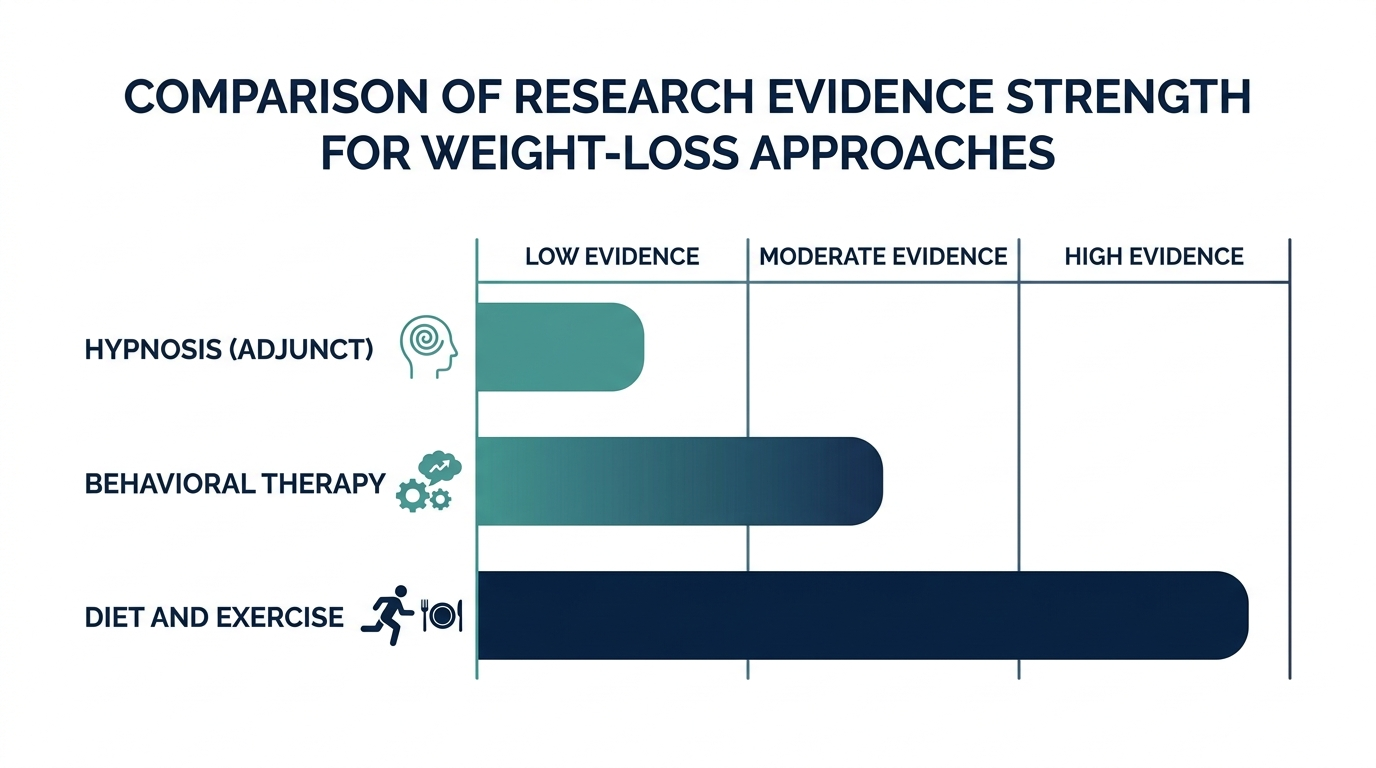
To put the size of the effect in perspective, compare it with interventions that have large modern trials behind them.
| Approach | Typical average effect | Evidence strength |
|---|---|---|
| Hypnosis added to a diet/behavior program | ~2 to 6 lbs more than the program alone | Weak, mostly small older studies |
| Hypnosis alone, no diet change | Little to no reliable loss | Very weak |
| Sustained calorie deficit plus protein and resistance training | 5 to 10% of body weight, durable with adherence | Strong |
| Wegovy (semaglutide, STEP trials) | ~15% average body weight loss at about 68 weeks | Strong, FDA-approved |
| Zepbound (tirzepatide, SURMOUNT trials) | ~20%+ average body weight loss at the highest dose | Strong, FDA-approved |
The gap is not subtle. A few extra pounds from hypnosis sits next to 15 to 20 percent of body weight from medications run by a clinician. That does not make hypnosis useless. It makes it a behavioral tool for a behavioral problem, and a poor substitute for treating a metabolic one.
How does hypnosis work for weight loss? The actual mechanism
The simplest way to actually get this done
Superpower is a full-body lab membership that runs 100+ biomarkers, has each result reviewed by a doctor, and tracks your numbers year over year (about $199/year). It is what we point readers to when they would rather get one clean, complete draw than chase single tests one at a time. Here is superpower reviewed in full.
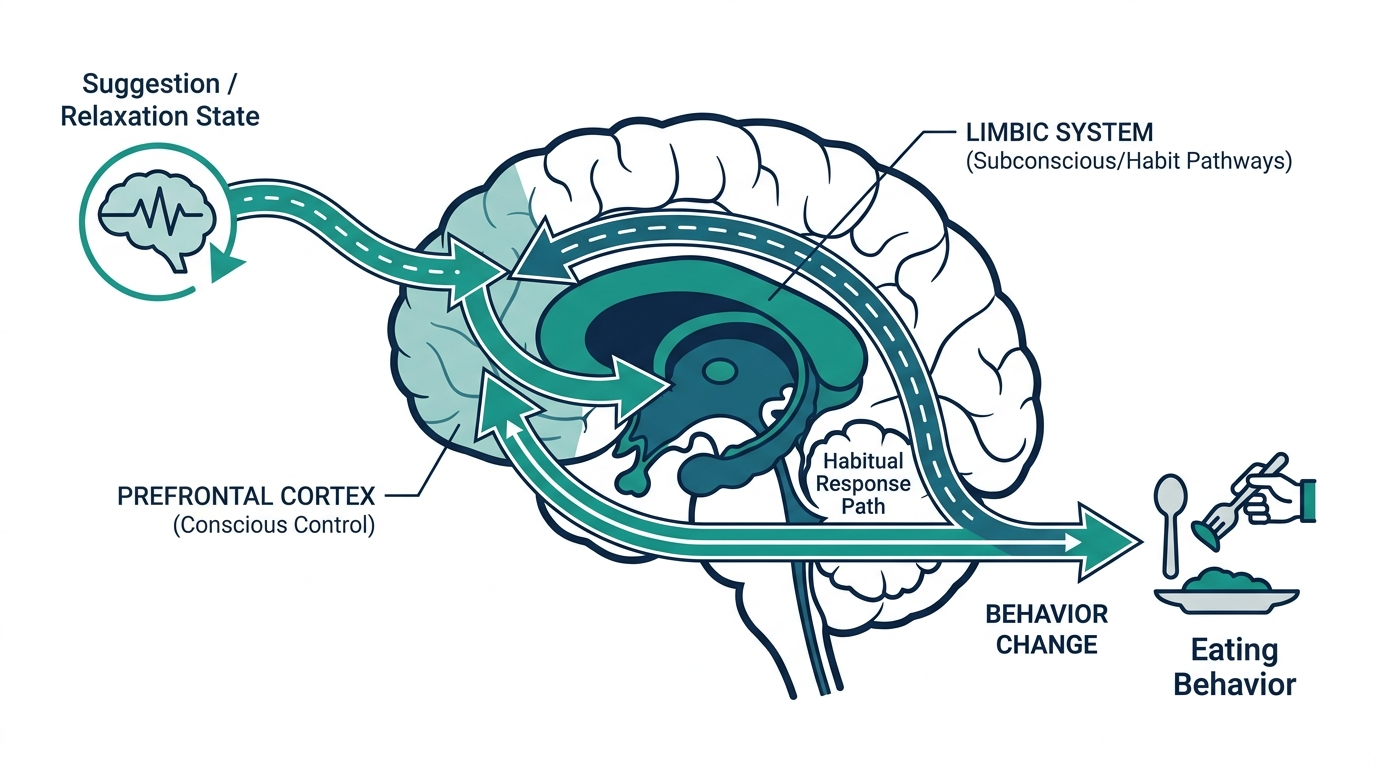
Hypnosis works on behavior, not biology. It is not sleep and it is not mind control. Clinical hypnosis is a state of focused attention and heightened suggestibility, similar to being absorbed in a film, in which a trained therapist offers suggestions that the brain is more willing to accept and rehearse. For weight loss, those suggestions target the automatic loops that drive overeating: reaching for chips when stressed, finishing a plate you are not hungry for, eating past 10 pm out of boredom.
The mechanism is closest to a focused form of cognitive behavioral therapy. By rehearsing a new response in a relaxed, receptive state, hypnosis can make the new behavior feel more automatic. People report fewer cravings, smaller portions, slower eating, and less emotional snacking. None of that touches resting metabolic rate, fat oxidation, or any hormone. The pounds that come off come off because the person ate less, not because hypnosis changed their body chemistry.
This is why the framing matters. If your weight is stuck because of stress eating and unconscious habits, a tool that rewires habits can help. If your weight is stuck because of hypothyroidism, high fasting insulin, or perimenopause, no amount of suggestion will move it, because the problem was never your willpower.
How effective is hypnosis for weight loss compared with hype?
Realistically, expect hypnosis to add a small edge to a diet you are already running, not to replace one. The marketing language around clinics and apps, often promising effortless or rapid loss, runs far ahead of the data. The honest expectation: if you are already eating in a modest deficit and hypnosis helps you stop snacking at night, that might mean a few extra pounds over a few months. That is worth something. It is not worth quitting on a calorie plan or skipping a checkup.
Three things separate the people who benefit from the people who waste their money:
- It is paired with real behavior change. Every study that showed a benefit used hypnosis on top of diet and activity changes. Hypnosis alone, with no food plan, is the version with almost no evidence.
- The eating is emotional or habitual, not hormonal. Hypnosis can interrupt stress eating and autopilot snacking. It cannot fix a sluggish thyroid or insulin resistance.
- The person is reasonably hypnotizable. Suggestibility varies. Some people drop into the focused state easily and respond well; others barely respond, and for them the effect is close to zero.
That last point is the quiet truth of the field. Response to hypnosis is not uniform, and there is no reliable way to know in advance whether you are a strong responder. That variability is part of why the average effect across a group looks small even when a subset does well.
Will hypnosis work for weight loss for you? Who it helps and who it does not
Hypnosis is most likely to help if your overeating is emotional or habitual and your labs are clean. It is least likely to help if a stalled scale is being driven by something a blood test would catch. Use this as a rough sorting guide.
| Your situation | Likely hypnosis benefit | Better first step |
|---|---|---|
| Stress eating, night snacking, eating on autopilot | Moderate, worth trying as an add-on | Pair with a real food plan |
| You eat well, move, sleep, and still cannot lose | Low | Test thyroid, fasting insulin, A1C |
| Suspected hypothyroidism or PCOS | Low | Full thyroid panel and metabolic labs |
| Perimenopause weight gain | Low to modest | Hormone and metabolic workup |
| Obesity with high BMI and comorbidities | Low as a standalone | Clinician-supervised GLP-1 discussion |
The pattern is consistent. Hypnosis is a behavioral assist for a behavioral problem. The moment the cause is metabolic, hormonal, or pharmacological, hypnosis drops to the bottom of the list and a clinician with labs moves to the top. People who are uninsured often reach for cheap interventions like hypnosis apps precisely because a workup feels expensive, but guessing for a year costs more than testing once.
What stalls people: the mistakes that make hypnosis pointless
The biggest mistake is treating hypnosis as the intervention instead of a tweak on top of one. A relaxing session cannot outrun a 500-calorie daily surplus, and most people who feel stuck are eating more than they think, sleeping badly, or carrying an untreated metabolic issue. Here are the patterns that waste people’s time and money.
- Using hypnosis with no food plan. The studies that showed any loss controlled eating first. Hypnosis was the add-on, never the engine.
- Expecting one session to last. The behavioral effect fades without reinforcement. Single-session gimmicks at a fair or a one-off app download rarely change anything durable.
- Confusing relaxation with results. Feeling calm after a session is pleasant and real, but calm is not fat loss. The scale only moves if eating actually changed.
- Paying for unregulated providers. Hypnotherapy is loosely regulated in much of the US. Look for a licensed mental health clinician (psychologist, LCSW, or physician) trained in clinical hypnosis, not a weekend-certificate practitioner.
- Ignoring why the scale is stuck. A stalled scale despite genuine effort is often hypothyroidism (which slows metabolism), insulin resistance, perimenopause, or a medication side effect. No suggestion fixes a TSH of 8.
That last point is the one that derails people most. If you have cut calories, you are moving, you are sleeping, and the scale still will not budge for a month or more, the lever is your metabolic numbers, not your subconscious. Hypothyroidism, high fasting insulin, low iron, and low vitamin D all blunt weight loss and are invisible without a blood draw. That is the difference between guessing and measuring. Some people also assume a vitamin will do what discipline cannot, which is why we wrote up whether B12 helps with weight loss, with the same answer: fix what the labs reveal first.
Before you try to rewire your brain, see what your body is actually doing.
Superpower is a full-body lab membership that runs 100+ biomarkers including fasting insulin, A1C, thyroid, testosterone and cortisol, has each result reviewed by a doctor, and tracks your numbers year over year so you can see what is actually stalling your weight (about $199/year). If hypnosis is your plan because nothing else has worked, your thyroid and insulin numbers will tell you in one draw whether the problem was ever behavioral at all. Here is Superpower reviewed in full.
How does weight loss hypnosis work in practice, and what does it cost?
In practice, weight loss hypnosis is a short course of sessions with a clinician, plus self-hypnosis or recordings to practice at home. A typical plan runs 4 to 8 sessions over a couple of months, each lasting 45 to 60 minutes. The therapist guides you into a focused, relaxed state, delivers tailored suggestions about hunger, portions, and triggers, then teaches you to reinforce those cues on your own. The home practice matters as much as the sessions, because the effect fades without it.
Costs in 2026 vary widely by route:
- In-person clinical hypnotherapy: often $100 to $250 per session, so a full course can run $400 to $1,500 or more, rarely covered by insurance for weight loss specifically.
- Telehealth hypnotherapy: frequently $75 to $175 per session.
- Apps and recordings: roughly $10 to $20 a month or a one-time $20 to $60, with the weakest evidence and no clinician oversight.
Compare that with what the money could buy in clarity. A full metabolic and hormone panel tells you whether your weight problem is behavioral or biological, which decides whether hypnosis is even the right category of tool. Spending several hundred dollars to rehearse new habits makes sense once you know your thyroid and insulin are normal. Spending it while a TSH of 8 goes undiagnosed is a year lost.
Hypnosis versus the medical route, told honestly
If your weight is in the range where clinicians discuss medication, hypnosis is not a substitute for that conversation, and it is fair to know the difference. Wegovy (semaglutide) and Zepbound (tirzepatide) are FDA-approved weight-loss drugs, studied in the STEP and SURMOUNT trials, with average losses around 15 percent and 20 percent of body weight respectively. Saxenda is also FDA-approved. Ozempic and Mounjaro are the same molecules approved for diabetes and prescribed off-label for weight.
Be precise about one thing the gray market blurs: compounded semaglutide and tirzepatide sold cheaply online are not FDA-approved. They can be legally prescribed through a licensed clinician and pharmacy, but they are not the same as the approved branded products, and the difference is real. If you ever consider that route, do it through supervised telehealth with proper labs, not a sketchy website, and talk to a clinician before starting or stopping any medication. Cost and coverage questions trip people up here too, which is why we cover whether Medicare covers weight loss drugs, whether Medicaid covers weight loss shots, and how much Ro weight loss costs in separate guides.
None of that means you should jump to a drug. It means the order of operations matters: measure first, treat the cause, and reach for behavioral tools like hypnosis where the cause is behavioral. Even simple habits get overrated in this gap, which is why people ask how much water they should drink for weight loss hoping it is the missing key. It is the same lesson: helpful at the margin, useless as the whole plan.
Sort your numbers before you spend on hypnosis
Behavioral tools only earn their cost once your metabolic labs are sorted, and that is the through-line for hypnosis, vinegar, vitamins, and every other fix people try. Before booking sessions, it is worth seeing your fasting glucose, fasting insulin, HbA1c, full thyroid panel, and key nutrient levels, because those numbers explain far more about a stuck scale than any subconscious pattern. If the labs are clean and your eating is clearly emotional, hypnosis is a reasonable, low-risk add-on to a real diet. If the labs are not clean, you have found the thing hypnosis was never going to fix.
A full-body panel reviewed by a doctor turns guessing into measuring. That is the entire point of this article. Hypnosis can be a genuine help for the right person, and a quiet money pit for the person whose real problem is sitting in a blood test they never ran.
Curious what your own levels look like?
Baseline 100+ biomarkers today and retest as life changes, all in one membership with physician review.
Want a real clinician to run the numbers, not a guess?
Joi + Blokes is a telehealth clinic that prescribes GLP-1 medication (Zepbound, compounded semaglutide and tirzepatide), hormone therapy (TRT, HRT), thyroid care, and peptides after a real lab panel and clinician review, with no membership or consult fee (prescriptions from about $59/month, lab panels from $149). If the scale will not budge, this is where you find out whether insulin, thyroid, or hormones are the real reason. Here is Joi + Blokes reviewed in full.
FAQ
Does hypnosis really work for weight loss?
It can produce a small extra loss, roughly 2 to 6 pounds, but only when added to a real diet and behavior program, and the strongest-looking numbers come from older, small studies. On its own, with no change to eating, hypnosis has very little reliable effect on weight.
How does hypnosis work for weight loss?
It works on behavior, not biology, by using a focused, relaxed, suggestible state to rehearse new eating responses, such as smaller portions or less stress snacking. It is closest to a concentrated form of cognitive behavioral therapy and does nothing to your metabolism or hormones.
Can hypnosis help with weight loss if I have a thyroid problem?
Not directly. Hypnosis cannot correct hypothyroidism, which slows metabolism and blunts weight loss regardless of willpower. If your thyroid is the issue, the fix is a diagnosis and treatment from a clinician, after which behavioral tools may help on top.
How many hypnosis sessions does weight loss take?
A typical clinical course is 4 to 8 sessions of 45 to 60 minutes over a couple of months, plus home practice with self-hypnosis or recordings. The home reinforcement matters as much as the sessions, since the behavioral effect fades without it.
Is hypnosis effective for weight loss compared with GLP-1 drugs?
No, the scale of effect is very different. Hypnosis as an add-on yields a few extra pounds, while FDA-approved drugs like Wegovy and Zepbound averaged roughly 15 and 20 percent of body weight in the STEP and SURMOUNT trials. They address different problems, behavioral versus metabolic.
How much does weight loss hypnosis cost?
In 2026, in-person clinical sessions often run $100 to $250 each, telehealth roughly $75 to $175, and apps about $10 to $20 a month. Insurance rarely covers hypnosis for weight loss specifically, so a full course can total several hundred dollars or more.
Does hypnosis work for weight loss through an app?
App-based hypnosis has the weakest evidence and no clinician oversight, though it is cheap and low-risk to try. It may help mild habit nudges for some people, but do not expect it to match supervised hypnotherapy or to do anything without a real food plan behind it.
Can hypnosis help weight loss without dieting?
Almost certainly not. Every study that found a benefit paired hypnosis with diet and activity changes, and hypnosis alone changed little. The pounds only come off if your eating actually changes, and hypnosis is just one way to make that change feel more automatic.
Is weight loss hypnosis safe?
For most people it is safe, since it is essentially guided relaxation and suggestion with no drugs involved. The main risks are wasting money on unregulated providers and delaying a real medical workup, so choose a licensed mental health clinician trained in clinical hypnosis and rule out metabolic causes first.
Why does hypnosis work for weight loss for some people but not others?
Response depends heavily on how suggestible you are and whether your overeating is behavioral. Strong responders with stress-driven or habitual eating can do well, while low responders or people with hormonal causes often see little to nothing, which is why the average effect across a group looks small.
Vital Signs Today may earn a commission if you buy through links on this page. It does not affect our editorial assessments.