
Last updated June 2026. Educational content, not medical advice. Consult a licensed dermatologist before making significant changes to an active skincare routine.
Short answer: Apply your peptide serum twice daily, morning and night, after cleansing and any water-based toner, and before moisturizer. If you also use L-ascorbic acid vitamin C, apply that first and wait 5 to 10 minutes before following with peptides. If you use a copper peptide serum (GHK-Cu), the night slot is the stronger play because skin permeability increases after dark and the repair cycle peaks during sleep.
Layering a peptide serum is a skincare routine. Layering in a full biomarker panel tells you what’s happening underneath. One at-home Superpower draw checks 100+ biomarkers, physician-reviewed.
Peptides are one of the few topical actives with both the clinical data and the tolerability to run twice a day without the irritation roulette of retinol or the oxidation anxiety of vitamin C. The timing question is real, but the bigger mistake most people make is not timing, it is buying the wrong peptide class for their goal and then quitting after three weeks when collagen remodeling takes a minimum of eight.
Why does timing actually matter for a peptide serum?
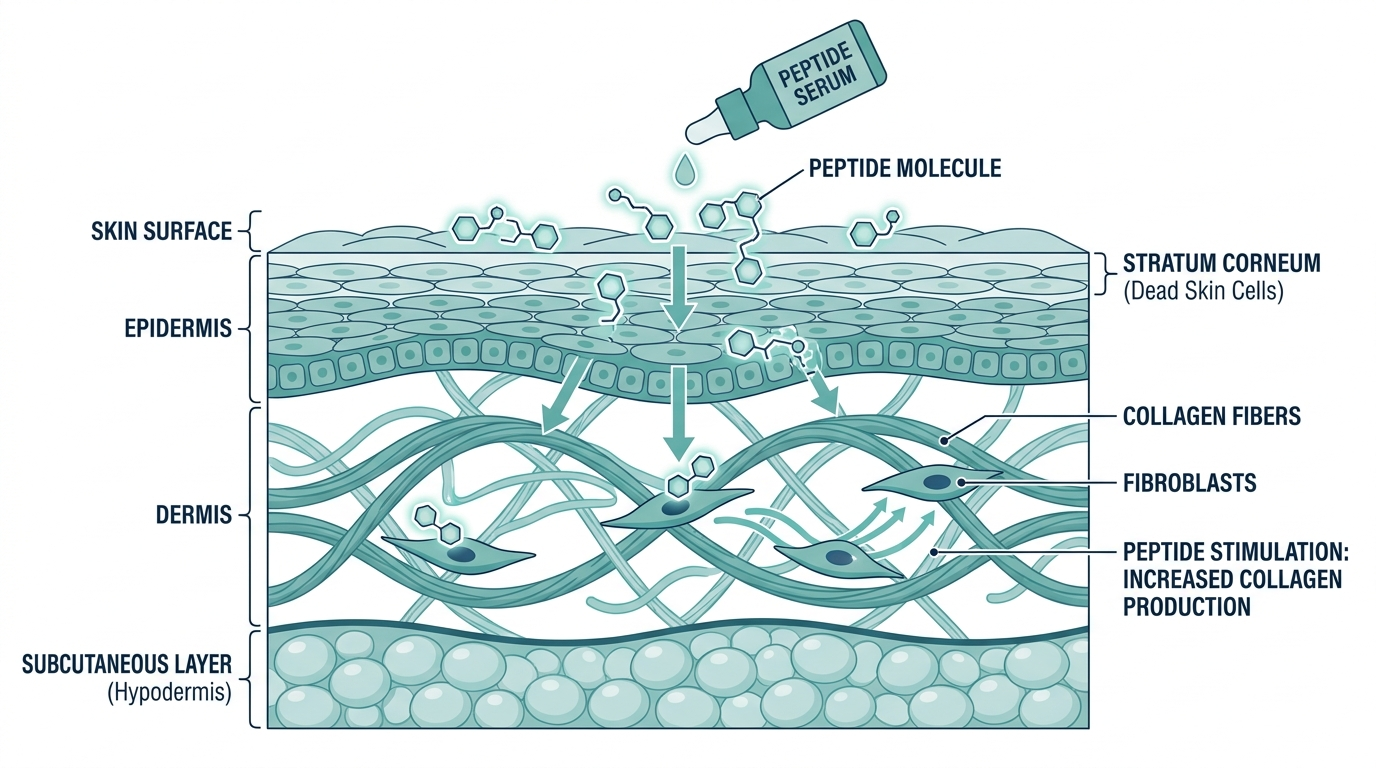
Most skincare timing advice is formulation folklore passed between brands. With peptides, a few rules are genuinely backed by mechanism, not just convention.
The most important is pH. Peptide bonds are stable across a wide range, but L-ascorbic acid vitamin C serums formulated at pH 2.5 to 3.5 can temporarily hydrolyze certain peptides, particularly copper peptides, if layered immediately on top of each other. The fix is simple: apply vitamin C first, wait 5 to 10 minutes for it to absorb and for your skin’s surface pH to rise back toward 5.5, and then apply your peptide serum. SeoulCeuticals and PeptideJournal.org both document this compatibility issue specifically for GHK-Cu, while noting that most non-copper signaling peptides like Matrixyl 3000 tolerate the same-layer approach without measurable deactivation.
The second mechanism that matters is the skin’s circadian repair cycle. Human skin shows measurably higher permeability at night, when transepidermal water loss peaks and the outer stratum corneum loosens its barrier function slightly to support cellular turnover. Asterwood’s 2026 GHK-Cu guide and multiple formulation pharmacists cite this as the pharmacokinetic case for an evening-weighted copper peptide routine: more of what you apply actually reaches the dermis where collagen synthesis happens.
Full-body lab membership: 100+ biomarkers, doctor-reviewed, tracked over time.
What are the peptide classes and does timing change between them?
The simplest way to actually get this done
Superpower is a full-body lab membership that runs 100+ biomarkers, has each result reviewed by a doctor, and tracks your numbers year over year (about $199/year). It is what we point readers to when they would rather get one clean, complete draw than chase single tests one at a time. Here is superpower reviewed in full.
Peptide serums are not one category. Three classes dominate the skincare market, and each has a slightly different timing logic.
Signal peptides (Matrixyl 3000, Matrixyl synthe’6, Syn-Tacks) tell fibroblasts to synthesize collagen and elastin. They are the workhorse of most mainstream peptide serums, including The Ordinary Multi-Peptide + HA Serum at $22 and Paula’s Choice Peptide Booster at $59. Sederma’s proprietary clinical data for Matrixyl 3000, used at 3 to 5% concentration in twice-daily application over two months, showed a 45% reduction in deep wrinkle area and a nearly 20% improvement in skin tonicity in female subjects, with collagen I increasing by 117% and collagen IV by a remarkable 327% in fibroblast culture assays (Matrixyl 3000 guide, Klow Peptide). Signal peptides tolerate AM and PM use equally, have no photosensitivity liability, and layer cleanly with most actives.
Neurotransmitter-inhibiting peptides (Argireline, SNAP-8) reduce the amplitude of repeated facial muscle contractions, mimicking in a mild and reversible way the mechanism of botulinum toxin at the SNARE complex level. SNAP-8 is roughly 30% more potent than Argireline at equivalent concentrations and showed up to 63% inhibition of neurotransmitter-mediated vesicle exocytosis in catecholamine assays (SeekPeptides SNAP-8 guide). In human subjects, clinical trials documented 17 to 27% wrinkle depth reduction after 28 days of twice-daily use. The obvious limitation: this is a topical with limited dermal penetration, not a needle. Do not believe any brand that claims it “replaces” Botox. It does not. What it can do is flatten very fine dynamic lines when used consistently, and the twice-daily application matters here because the inhibitory effect wears off as the peptide clears the tissue. Applying only at night reduces daily coverage.
Carrier peptides (GHK-Cu, AHK-Cu) deliver trace minerals into the skin where they act as enzyme cofactors for collagen cross-linking and wound repair. GHK-Cu is the best-studied cosmetic peptide in this class. A published human trial comparing topical GHK-Cu against vitamin C and retinoic acid found that GHK-Cu increased collagen levels in 70% of volunteers, outperforming both comparators. Published data in the International Journal of Cosmetic Science and a 2018 PMC review (PMC6073405) document wrinkle volume reduction of 55.8% and wrinkle depth reduction of 32.8% versus a control serum. Carrier peptides, and specifically GHK-Cu, are the class most sensitive to pH timing and the class with the strongest case for nighttime-primary use, though morning application provides antioxidant protection from oxidative stress and is perfectly safe.
One label-reading habit saves a lot of wasted money here. Brands rarely print the exact peptide percentage, so use the ingredient list order as a proxy. If the peptide complex sits near the bottom of the INCI list, below the preservatives and fragrance, the serum is likely running a token amount for marketing rather than the 3 to 5% range the clinical data used. A serum that lists its hero peptide in the first third of the ingredients, with a hydrating base like glycerin or sodium hyaluronate, is far more likely to be dosed at a level that does something. Price is a weak signal. Formulation position is a much better one.
| Peptide Class | Examples | Best Time | Key Sensitivity |
|---|---|---|---|
| Signal peptides | Matrixyl 3000, Syn-Tacks, Matrixyl synthe’6 | AM + PM | Very low; broad compatibility |
| Neurotransmitter-inhibiting | Argireline, SNAP-8 | AM + PM (twice-daily matters) | Minimal; stable across pH 4-8 |
| Carrier / copper peptides | GHK-Cu, AHK-Cu | PM-primary (AM acceptable) | Separate from L-ascorbic acid by 5-10 min |
What is the exact layering order?
Layering order is where most people sacrifice efficacy through no fault of their own, because brands rarely explain the physics. The rule is thinnest to thickest, but the more useful version is lowest-pH to highest-pH and most hydrophilic to most lipophilic.
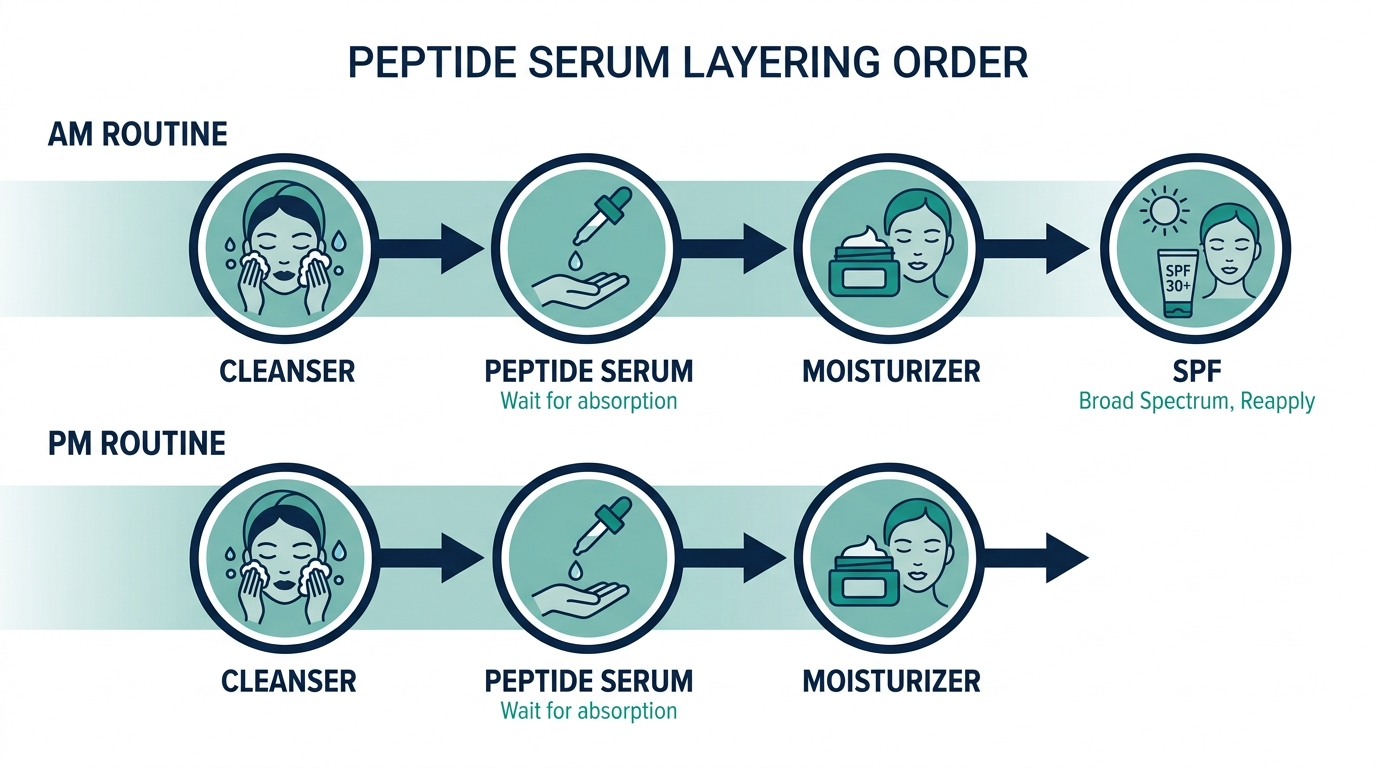
A morning routine with a peptide serum:
- Cleanser
- Water-based toner or essence (optional, no actives)
- Vitamin C serum (if using L-ascorbic acid, pH 2.5 to 3.5); wait 5 to 10 minutes
- Peptide serum
- Moisturizer
- SPF (always, because peptides help build collagen that UV then quietly dismantles)
An evening routine:
- Double-cleanse or cleanse
- Water-based toner or essence
- Peptide serum (apply first on evenings when you skip retinol or AHA)
- On retinol nights: apply retinol, then finish with your peptide serum or a peptide-containing moisturizer to buffer irritation
- Night moisturizer or occlusive if skin is dry
The “retinol sandwich” technique, where you layer a light moisturizer, then retinol, then peptide serum, has a real rationale: it slows retinol’s transdermal absorption slightly to reduce initial irritation while keeping the collagen-signaling stack active. Dermatologists at DermaluciLab document this as a legitimate approach for retinol beginners.
Personally, I have tried running a copper peptide serum alongside L-ascorbic acid without the wait time and noticed the serum felt less effective over a few weeks compared to properly separating them by 10 minutes. It is a genuinely annoying extra step. It is also a real one.
A realistic version of a full day looks like this. Morning: cleanse, a few drops of vitamin C, scroll your phone for the length of a short email while it sinks in, then a signal peptide serum, moisturizer, and SPF before you walk out the door. Night: cleanse off the day, apply your copper peptide serum first on the nights you are not using retinol, then moisturizer. On retinol nights the peptide moves to the buffer slot on top of the retinol. That is the whole system. Two extra products, one built-in wait, and you have covered prevention in the morning and repair at night without the interactions people worry about.
When should you NOT use a peptide serum?
Directly after an AHA or BHA chemical exfoliant, skip the peptide until your skin’s pH normalizes. Glycolic acid drops skin surface pH to roughly 3.0 to 3.5 during and immediately after application. At that pH, some peptide bonds hydrolyze and the signaling molecules lose the tertiary structure needed to activate receptors. The fix is either to alternate: acids in the morning and peptides at night, or to wait 30 minutes after your acid before applying peptide serum. Revagi and PureSpa Direct both recommend this time-separation approach.
Also skip standalone peptide serums during the first week of a new retinoid, while your skin is still in the initial irritation adjustment phase. Add the peptide back in week two. It actually helps retinol tolerability, because it counterbalances the barrier disruption retinoids cause at the start.
Do not use a peptide serum on actively broken or infected skin as a substitution for treatment. Peptides support repair; they do not replace antifungals, antibiotics, or anything addressing an active condition.
When is the right age to start, and does it change in your 40s?
The biology is useful here. Collagen production begins declining around age 25, at roughly 1% per year. By the mid-30s, that cumulative loss becomes visible as fine lines and reduced skin firmness. By the 40s, collagen cross-linking changes and skin density has noticeably shifted.
The pragmatic guidance: start a signal peptide serum in your mid-to-late 20s as a preventive. The cost-per-outcome is high at that stage because you are maintaining a structure that is mostly intact. In your 30s, peptides shift from maintenance to active rebuilding. In your 40s and beyond, the evidence for copper peptides specifically gets stronger, because GHK-Cu’s mechanism of directly stimulating fibroblast activity matters more when fibroblast density and function have declined with age. The I’m Fabulous Cosmetics guide and Colorescience’s 2026 peptide piece both frame mid-20s as the appropriate entry point with intensity increasing each decade.
Two groups should slow down before starting. If you are pregnant or breastfeeding, copper peptides and the more bioactive peptide complexes are understudied in that context, so a simpler barrier-support routine and a conversation with your obstetrician is the safer default. And if your skin is highly reactive or you have rosacea, introduce one peptide serum on its own for two weeks before stacking anything else, so that if a reaction appears you know exactly which product caused it. Peptides are among the gentlest actives, but “gentle” is not the same as “zero risk” on compromised skin.
Hydrolyzed type I & III collagen peptides, third-party tested, unflavored.
The myth about peptides and vitamin C denaturing each other
This is the most repeated wrong piece of advice in skincare routines, and it deserves a direct correction. The claim that vitamin C and peptides “cancel each other out” or “completely deactivate” each other is an oversimplification that originated from legitimate concerns about copper peptides, then spread to all peptides.
The reality: most signaling peptides (Matrixyl, Argireline, SNAP-8, palmitoyl tripeptide-5) are stable at the pH of an L-ascorbic acid serum when applied sequentially, not simultaneously. The interaction that is real is specific to GHK-Cu: copper ions chelate with certain vitamin C derivatives, potentially reducing the bioavailability of both. For all other peptide classes, applying vitamin C first and waiting a few minutes is a precaution, not a strict requirement. The Admiremyskin guide explains this distinction clearly, and studies show the combination of vitamin C with peptides produces greater improvements in fine lines, firmness, and texture than either ingredient alone.
The simpler takeaway: vitamin C in the morning, copper peptide serum at night, and you have bypassed the concern entirely without losing either ingredient.
How long before you see results?
Eight to twelve weeks of consistent twice-daily use is the minimum window to expect visible change, and this is where most people abandon the routine three weeks early and declare it “doesn’t work.”
Collagen synthesis is not a rapid process. Signal peptides stimulate fibroblasts, which then have to synthesize procollagen, fold it into a triple helix, and deposit it into the extracellular matrix, which remodels gradually over weeks. Argireline and SNAP-8 produce faster results, sometimes visible within 15 days, because they operate on muscle mechanics rather than matrix remodeling, but even those results deepen with continued use.
Clinical benchmarks to set expectations:
- Matrixyl 3000 at 3 to 5%: 45% deep wrinkle reduction at 8 weeks with twice-daily use (Sederma clinical data, Asterwood)
- GHK-Cu topical: 55.8% wrinkle volume reduction versus control serum in published trial (PMC6073405)
- SNAP-8: 17 to 27% reduction in wrinkle depth at 28 to 30 days of twice-daily use, measurable at 15 days (SeekPeptides)
- Copper peptide serums: visible firmness changes in 70% of volunteers at 12 weeks (Asterwood GHK-Cu guide 2026)
These are manufacturer-funded studies in many cases, so treat specific percentages as directional rather than definitive. The independent clinical direction is consistent: results build over weeks to months, not days.
Practical mistakes that kill peptide efficacy
Do not apply peptide serum directly after a heavy occlusive. Petrolatum-based balms or thick oil-based moisturizers applied before a water-based peptide serum form a physical barrier that prevents the peptide from penetrating. Sequence peptide serum before any oil-based layer.
Do not store copper peptide serums in clear glass bottles in a sunny window. GHK-Cu degrades with UV exposure and some oxidation. The metallic smell that NIOD CAIS3 is known for is partly a sign of the copper compound’s integrity. If your copper peptide serum stops smelling faintly metallic, it may have degraded.
Do not use a peptide serum as your only active if your concern is texture and hyperpigmentation. Peptides address structure (collagen, elastin, firmness) and do not exfoliate, inhibit melanin synthesis, or drive cellular turnover. They need to be paired with vitamin C for brightness or AHA/retinol for cell turnover, just in the correct sequence.
One thing I tell people who ask about peptides for the first time: the best peptide serum is the one you will use every day for three months. A $22 bottle of The Ordinary Multi-Peptide used consistently beats a $200 bottle used irregularly, every single time. The molecule is less important than the commitment.
Turn what you just learned into action.
Superpower lets you test 100+ biomarkers from home, then re-check them over time so you can actually see progress, physician-reviewed at every step.
Frequently asked questions
Should I use peptide serum morning or night?
Both. Peptide serums have no photosensitivity and no risk of oxidizing in sunlight, so twice-daily use maximizes your collagen-signaling exposure. If you are using a copper peptide serum specifically, prioritize the evening slot because skin permeability is higher and the skin’s repair cycle is most active at night. Morning application is still beneficial for antioxidant support.
Can I use peptide serum every day?
Yes, and you should. Unlike retinol or AHA exfoliants, peptides do not require adjustment periods or alternating nights. Daily, twice-daily use is the clinical standard most studies are conducted at. Skipping or cycling peptides extends the timeline to visible results without any benefit.
Can I use vitamin C and peptide serum together?
Yes, with one caveat. Apply L-ascorbic acid vitamin C first, wait 5 to 10 minutes, and then apply your peptide serum. This allows the skin surface pH to normalize before the peptides land. If you use a copper peptide serum, the safer route is vitamin C in the morning and the copper peptide at night, since copper ions and ascorbic acid can chelate and reduce the bioavailability of both.
Do peptide serums work for acne-prone skin?
Generally yes, though with a formulation check required. Look for non-comedogenic, oil-free formulations. NIOD Copper Amino Isolate Serum (CAIS3) and INNBEAUTY Project Elastic Skin are both third-party tested and labeled non-comedogenic. GHK-Cu also has documented anti-inflammatory properties that may benefit sensitized or reactive skin.
What peptide serum should a beginner buy?
The Ordinary Multi-Peptide + HA Serum at $22 for 30mL contains Matrixyl 3000, Matrixyl synthe’6, Argirelox, and Syn-Ake alongside sodium hyaluronate. It is the most accessible clinical-grade formulation on the market. It runs at pH 6.0 to 7.0, which is compatible with most routines.
Can I use a peptide serum with retinol?
Yes, and the combination is stronger than either alone. On retinol nights, apply retinol first, allow it to absorb for a few minutes, and then layer your peptide serum or a peptide-infused moisturizer on top. Peptides buffer retinol irritation while maintaining the collagen-signaling layer. This pairing is sometimes called the retinol-peptide stack and is particularly useful during the first few months of starting retinol.
How long should I use a peptide serum before giving up?
Give any peptide serum a minimum of 8 to 12 weeks before evaluating results. Collagen remodeling is a slow biological process. Neurotransmitter-inhibiting peptides like Argireline may show visible softening of dynamic lines within 2 to 4 weeks. Signal peptides need 8 weeks minimum. Copper peptides showed results in 70% of volunteers at 12 weeks in the most-cited human trial.
Can I layer two different peptide serums at once?
Yes, and stacking classes is a legitimate strategy rather than overkill. A signal peptide for collagen and a neurotransmitter-inhibiting peptide for expression lines target different mechanisms and do not compete for the same receptors. Apply the thinner, more water-based one first, then the richer one. The only pairing that needs care is a copper peptide next to a low-pH vitamin C in the same layer, which is the one interaction worth spacing out.
Are topical peptides the same as injectable peptides?
No, and it is worth being clear about this. The peptides in a serum act at the surface and upper dermis to signal collagen and soften fine lines. Injectable peptides are a separate category with systemic effects and real prescribing considerations, which we cover in our guides on peptide therapy cost and injection sites and rotation. Do not treat a cosmetic serum and an injected peptide as interchangeable. They are different tools with different oversight.
Hydrolyzed type I & III collagen peptides, third-party tested, unflavored.
Author: Vital Signs Today Editorial Team, [credential]”]. Educational content, not medical advice. Sources linked inline.
Primary sources:
– Sederma Matrixyl 3000 clinical data summary: https://klow-peptide.com/en/guide/matrixyl-3000/
– PMC review of GHK-Cu regenerative actions: https://pmc.ncbi.nlm.nih.gov/articles/PMC6073405/
– SeekPeptides SNAP-8 complete guide: https://www.seekpeptides.com/blog/articles/snap-8-peptide
– Asterwood GHK-Cu Copper Peptides Complete Guide 2026: https://www.asterwood.co/blogs/skincare/copper-peptides-guide-2026
– Innerbody Best Copper Peptide Serum 2026: https://www.innerbody.com/best-copper-peptide-serum
– Admiremyskin vitamin C and peptides compatibility: https://www.admiremyskin.com/blogs/learn-to-glow/can-you-use-vitamin-c-and-peptides-together-or-will-they-clash
– SeoulCeuticals copper peptides with vitamin C: https://seoulceuticals.com/blogs/news/copper-peptides-with-vit-c
– Superpower biomarker panel pricing 2026: https://superpower.com/blood-test-for-biomarkers
– PeptideJournal layering guide: https://www.peptidejournal.org/skincare/how-to-combine-peptides-with-vitamin-c
– Revagi AHA/BHA and collagen serum compatibility: https://revagi.sg/blogs/news/can-you-combine-collagen-serums-with-actives-like-aha-bha-or-niacinamide
Related reading
Vital Signs Today may earn a commission if you buy through links on this page. It does not affect our editorial assessments.