Last updated June 2026. Educational content, not medical advice. Many peptides are not FDA-approved for weight loss. Speak to a licensed clinician before starting any peptide regimen.
Short answer: The peptides with the strongest clinical evidence for weight loss are the GLP-1 receptor agonists: semaglutide (Wegovy, injectable and now pill), tirzepatide (Zepbound), and the investigational retatrutide, which hit 28.3% average body weight loss in the TRIUMPH-1 Phase 3 trial. Below them sits tesamorelin, the only FDA-approved peptide for visceral fat reduction. Below that, growth hormone secretagogues like CJC-1295/Ipamorelin and AOD-9604 have far weaker evidence. If someone promises those last two will deliver the same results as a GLP-1, they are selling you something the data does not support.
GLP-1 peptides move the scale, but your own metabolic markers show what’s actually changing underneath. One at-home Superpower draw checks 100+ biomarkers, physician-reviewed.
Why are people suddenly talking about peptides for weight loss?
The GLP-1 drug category created the attention, and the rest of the peptide world borrowed it. When Wegovy showed 15% average body weight loss in the STEP 1 trial, published in the New England Journal of Medicine in 2021, the “peptide for weight loss” search category exploded overnight. Clinics, forums, and supplement brands rushed to attach themselves to that momentum.
The problem is that “peptide” covers everything from the GLP-1 drugs, which have the most rigorous obesity trial data in history, to research chemicals sold in vials with zero human efficacy data. These are not the same thing, and calling them all “weight loss peptides” in the same breath has caused a lot of confusion, and a lot of wasted money.
Personally, I think the peptide weight loss conversation has been badly distorted by vendors who benefit from blurring that distinction. The honest version of this conversation starts with the clinical hierarchy: what has actually been tested, in how many people, with what result.
The clinical hierarchy: which peptides actually move the scale?
The simplest way to actually get this done
Superpower is a full-body lab membership that runs 100+ biomarkers, has each result reviewed by a doctor, and tracks your numbers year over year (about $199/year). It is what we point readers to when they would rather get one clean, complete draw than chase single tests one at a time. Here is superpower reviewed in full.
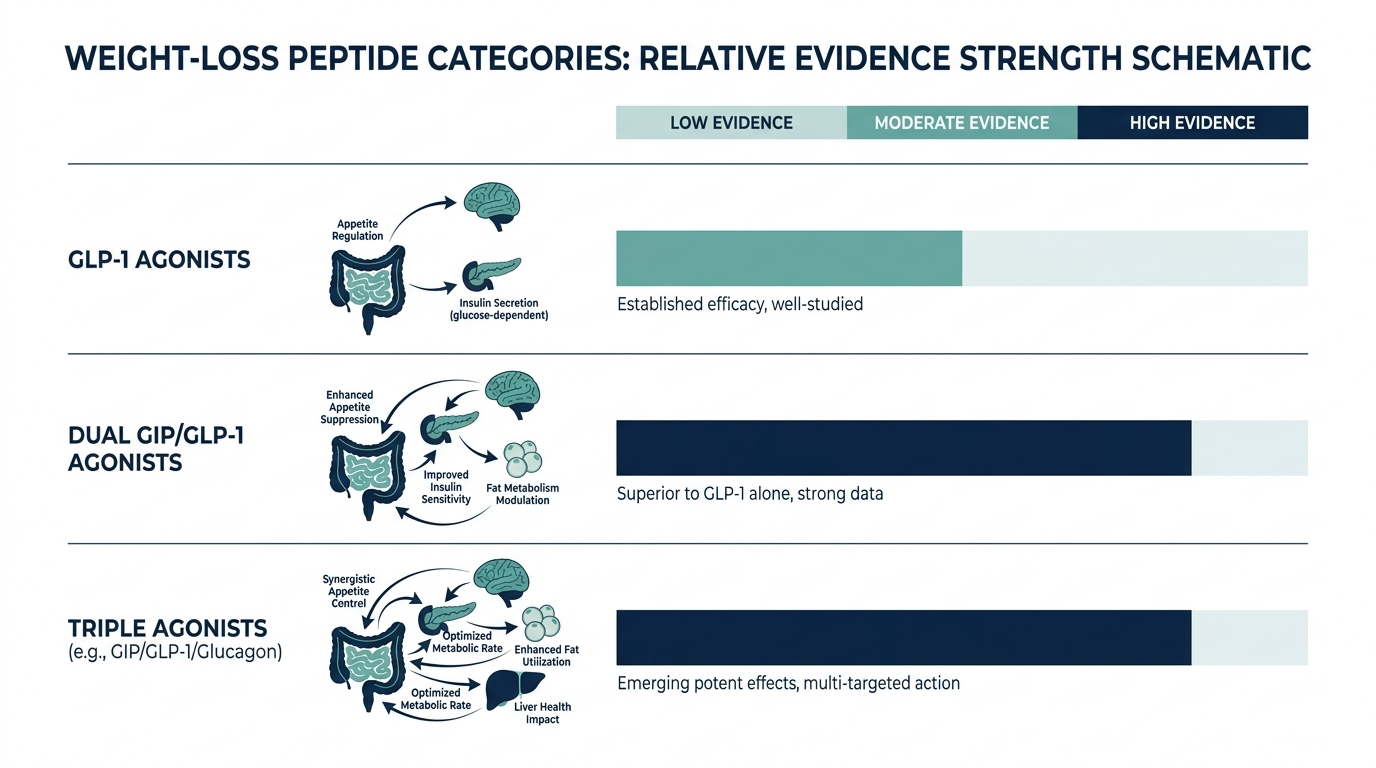
Not all peptides are created equal, and the gap between the top tier and the bottom is enormous. Before spending a dollar or drawing a syringe, understanding this hierarchy is the most valuable thing you can do.
| Peptide | Mechanism | Best clinical result | FDA status | How to access |
|---|---|---|---|---|
| Retatrutide | Triple agonist: GLP-1 + GIP + glucagon | 28.3% body weight loss (TRIUMPH-1, May 2026) | Investigational, not approved | Research only / clinical trial |
| Tirzepatide (Zepbound) | Dual GLP-1 + GIP agonist | 22.5% body weight loss (SURMOUNT-1) | FDA-approved for obesity | Telehealth or physician Rx |
| Semaglutide injectable (Wegovy) | GLP-1 agonist | ~15% body weight loss (STEP 1); 19% with 7.2 mg HD | FDA-approved for obesity | Telehealth or physician Rx |
| Semaglutide oral (Wegovy pill) | GLP-1 agonist (oral) | 13.6% body weight loss (OASIS 4, 64 weeks) | FDA-approved December 2025 | Telehealth or physician Rx |
| Tesamorelin (Egrifta) | GHRH analogue | ~18% reduction in visceral fat (Phase III) | FDA-approved for HIV lipodystrophy only | Physician Rx (off-label for others) |
| CJC-1295 + Ipamorelin | GH secretagogue stack | No large human RCT for obesity; clinical evidence indirect | Not approved | Telehealth (some clinics) / research |
| AOD-9604 | hGH fragment (176-191) | Failed Phase IIb trial in 2007; development terminated | Not approved | Research only |
| Sermorelin | GHRH analogue | No RCT for obesity; GH-supportive; body composition improvements reported | Not approved for weight loss | Telehealth, compounding Rx |
The gap between the top three rows and everything below is not a matter of degree. It is a different order of magnitude.
Tier 1: The GLP-1 receptor agonists (semaglutide, tirzepatide, retatrutide)
These are genuine weight loss drugs, not supplements dressed in clinical language.
Semaglutide: the one that started the conversation
Semaglutide (marketed as Wegovy at the 2.4 mg weekly dose for obesity) was the first GLP-1 approved for chronic weight management in adults without diabetes. In STEP 1, 86.4% of participants lost at least 5% of body weight, 69.1% lost at least 10%, and 50.5% lost at least 15% over 68 weeks. Average loss was about 15%.
Then Novo Nordisk raised the ceiling. The higher-dose injectable Wegovy HD at 7.2 mg reached roughly 19% average weight loss at 72 weeks. And on December 22, 2025, the FDA approved oral Wegovy (once-daily 25 mg tablet), the first oral GLP-1 approved specifically for weight management, based on the OASIS 4 trial showing 13.6% mean weight loss at 64 weeks.
The oral pill changes the access picture significantly. A lot of people who would not self-inject will take a daily tablet. That lowers one real barrier.
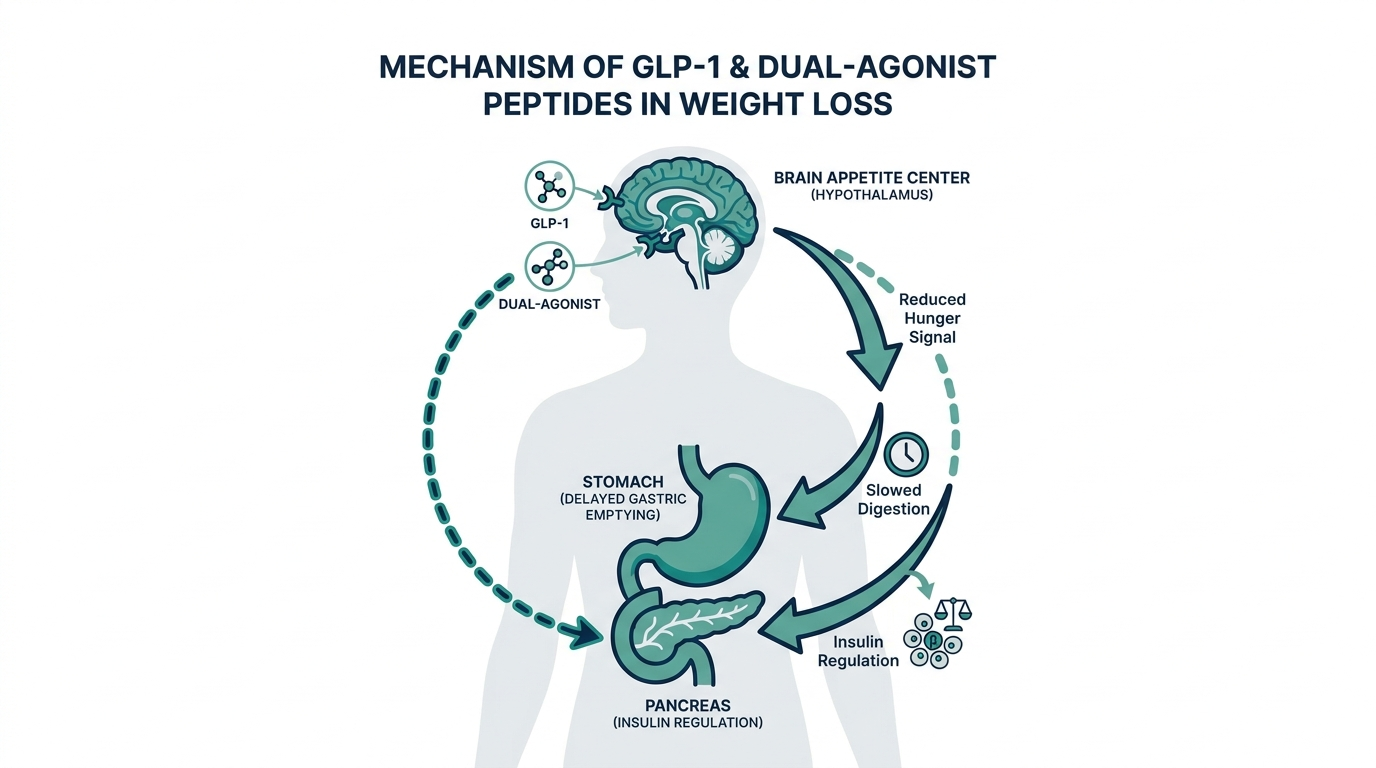
How semaglutide works is important context: it mimics the naturally occurring GLP-1 peptide your gut releases after eating. It slows gastric emptying, reduces hunger, and acts on brain regions that regulate food reward. This is not appetite suppression in the vague supplement sense. It is a direct neurohormonal effect with measurable mechanism, tested in tens of thousands of people across controlled trials.
The side effect picture is real and worth knowing up front. About half of users in clinical trials reported nausea, and around one-third reported diarrhea, according to a 2025 RAND survey of U.S. GLP-1 users. Most side effects cluster in the first few weeks and improve with slow dose titration.
Full-body lab membership: 100+ biomarkers, doctor-reviewed, tracked over time.
Tirzepatide: the current efficacy leader among approved drugs
Tirzepatide (Zepbound for obesity, Mounjaro for type 2 diabetes) adds a GIP receptor agonist on top of the GLP-1 mechanism, and the results are measurably stronger. SURMOUNT-1 showed a mean 22.5% body weight loss at 72 weeks at the 15 mg dose, with participants losing an average 12 lbs more than the best semaglutide result in matched-duration trials.
Do not believe any claim that tirzepatide and semaglutide are “basically the same.” The data does not support that. Patients in tirzepatide groups have consistently lost more weight in head-to-head comparisons, with better diabetic biomarkers as a secondary finding.
The FDA declared the tirzepatide shortage resolved on October 2, 2024, which ended the compounding window for cheap compounded copies. Brand-name Zepbound now runs $900 to $1,350 per month without insurance, but compounded versions through licensed telehealth platforms range from $169 to $499 per month depending on dose and service level.
Retatrutide: the investigational triple agonist that just posted historic data
Retatrutide is Eli Lilly’s next candidate and it adds a glucagon receptor agonist to the GLP-1 and GIP combination. In May 2026, the TRIUMPH-1 trial, the largest pivotal trial to date, reported 28.3% average body weight loss at the 12 mg dose, with 45.3% of patients losing 30% or more of their body weight. That last number overlaps with bariatric surgery outcomes.
Retatrutide is not FDA-approved as of June 2026, and Lilly has not yet filed a New Drug Application. It is available only through clinical trials or, in some jurisdictions, through grey-market research vendors, which is exactly the wrong route given the stakes.
Tier 2: Tesamorelin, the FDA-approved visceral fat specialist
Tesamorelin (brand: Egrifta SV) is a growth hormone-releasing hormone (GHRH) analogue, meaning it tells your pituitary to release more of your own GH rather than supplying it from outside. It was FDA-approved in 2010 specifically for HIV-associated lipodystrophy, a condition where antiretroviral drugs cause dangerous visceral fat accumulation.
Phase III trials showed approximately 18% reduction in visceral adipose tissue at 26 weeks with 2 mg daily dosing. A more recent meta-analysis (PubMed 2026) of randomized controlled trials confirmed mean visceral adipose tissue reduction of 27.71 cm2, along with meaningful reductions in trunk fat (1.18 kg), hepatic fat percentage (4.28 percentage points), and waist circumference (1.61 cm).
Here is what makes tesamorelin genuinely different from the GLP-1 drugs: it preferentially targets visceral fat, the dangerous organ-surrounding fat directly linked to cardiovascular disease and insulin resistance, without significantly reducing overall body weight or subcutaneous fat. That is not better or worse than a GLP-1, it is a different intervention for a different problem.
Search volume for tesamorelin grew 49% in six months in the U.S., from roughly 90,500 monthly searches in September 2025 to over 135,000 by February 2026, suggesting rapid mainstream awareness beyond its original HIV indication.
Off-label prescribing for tesamorelin in metabolic syndrome and general visceral obesity is happening at telehealth clinics and functional medicine practices, though the evidence base outside of HIV patients is thinner than the GLP-1 literature. Pricing typically runs $300 to $600 per month, with monitoring included at reputable clinics.
Tier 3: GH secretagogues (CJC-1295 + Ipamorelin, Sermorelin)
These peptides stimulate your pituitary to release more endogenous growth hormone. They do not directly drive fat loss in the way GLP-1s do, and that distinction matters enormously.
CJC-1295 is a GHRH analogue; Ipamorelin is a ghrelin mimetic. Together they create a synergistic GH pulse. Clinics typically combine them because CJC-1295 elevates growth hormone amplitude while Ipamorelin increases frequency with minimal cortisol or prolactin side effects. One provider’s five-week supply runs around $325, with longer program packages at $675.
The honest clinical picture: there are no large randomized controlled trials showing meaningful weight loss in obese adults from CJC-1295/Ipamorelin. What the evidence supports is an improvement in body composition, specifically lean mass gain and some reduction in body fat percentage, in the context of a caloric deficit and resistance training. That is not the same as a weight loss drug.
Sermorelin is another GHRH analogue with a long track record, often priced at $175 to $225 per month at telehealth clinics, making it far cheaper than synthetic HGH. It has the same limitation: evidence for body composition improvement, not a clinically documented weight loss treatment.
Personally, I would not choose a GH secretagogue as a primary weight loss strategy. As a support layer alongside a GLP-1, or for someone who has achieved their target weight and wants to preserve lean mass, it has a more defensible case.
Telehealth GLP-1 program with provider visits and pharmacy coordination.
Tier 4: AOD-9604, the one that failed the test that mattered
AOD-9604 is a synthetic 16-amino acid fragment of human growth hormone (specifically the C-terminal domain, residues 176-191), designed to preserve GH’s lipolytic effect while stripping out the anabolic and glucose-raising effects of full HGH.
Mechanistically, it is elegant: it stimulates lipolysis through beta-3 adrenergic receptors in adipose tissue, inhibits lipogenesis, and does not elevate IGF-1 or affect blood glucose. Animal studies were compelling.
The problem is that it did not replicate in humans at the scale that counts. AOD-9604 underwent six human clinical trials involving more than 900 participants, and the largest Phase IIb trial failed to achieve statistical significance for weight loss. The developer terminated the obesity indication in 2007.
It is still sold by clinics and research vendors, and still marketed heavily in wellness circles. The animal data is real; the fat-burning mechanism is biologically plausible. But a biologically plausible mechanism that failed its pivotal human trial is not a proven weight loss peptide. It is a hypothesis that was tested and did not pass.
The weight regain problem: what nobody says clearly enough
The most important clinical finding of the past two years is not about losing weight on peptides. It is about what happens when you stop.
A 2025 Lancet meta-analysis found pooled mean weight regain of 9.69 kg after GLP-1 discontinuation. In the STEP-10 trial, over 40% of lost weight returned within 28 weeks of stopping semaglutide. In SURMOUNT-4, more than half of tirzepatide-driven weight loss rebounded over 52 weeks. Real-world data is more mixed, with one Ohio/Florida cohort showing no significant regain in the majority of patients over several months, but the controlled trial data is clear.
This rebound happens because GLP-1 drugs are treating a neurohormonal condition, appetite dysregulation. When you stop the drug, the underlying condition reasserts. The body wants to return to its defended weight, and without the neurohormonal support, hunger hormones (ghrelin, neuropeptide Y) ramp back up.
The practical implication: treating GLP-1 peptide therapy as a short course rather than long-term management often leads to cycling. Clinics that take this seriously build maintenance protocols, including slower dose tapering, dietary behavior coaching, and in some cases transition to lower-dose maintenance.
One study followed 85 patients slowly tapering semaglutide over 26 weeks while focusing on lifestyle change, and found average weight remained stable with a 1.5% additional loss after complete withdrawal. That is an outlier result, but it points to what a properly structured exit looks like.
What does accessing these peptides actually cost in 2026?
The cost landscape shifted materially in 2025 to 2026 after FDA enforcement against compounded GLP-1s.
Brand-name GLP-1s (injectable Wegovy, Zepbound): $900 to $1,350 per month without insurance. Starting July 1, 2026, eligible Medicare members may access Wegovy, Zepbound, or Foundayo for $50 per month through the Medicare GLP-1 Bridge Program.
Compounded semaglutide or tirzepatide (where still legally available): $169 to $499 per month depending on platform and dose. The FDA GLP-1 shortage resolutions in 2024-2025 narrowed the compounding window; verify your provider is using a 503A-compliant pharmacy before paying.
Oral Wegovy (25 mg tablet, launched January 2026): $149 to $299 per month per early pricing disclosures, significantly more accessible than the injectable.
Telehealth GH secretagogue programs (CJC-1295/Ipamorelin, sermorelin): $175 to $675 per program length at clinics such as Defy Medical, Marek Health, and Hone Health.
Tesamorelin (off-label at compounding clinics): $300 to $600 per month.
One cost detail that every platform buries: none of this is covered by insurance unless you have an approved diabetes or obesity indication with documentation. Plan for out-of-pocket costs before the first invoice, not after.
Three things a peptide clinic will not tell you upfront
This is the insider section. These are things you learn after you have been in this space long enough.
First: GLP-1 drugs reduce hunger partly by affecting dopamine signaling in the brain’s reward center. Some patients report reduced interest in alcohol, gambling, and compulsive shopping alongside appetite reduction. A 2024-2025 literature review flagged this as a potential signal for broader behavioral effects. Clinics do not lead with this because the mechanism is still under investigation, but it changes what patients experience beyond the scale.
Second: the clinical trial populations for semaglutide and tirzepatide were predominantly people with BMI over 30, with controlled diet and exercise programs. In a 2026 Johns Hopkins analysis of 64 GLP-1 trials, women on average lost 11% of starting body weight while men lost 7%. If you are a male patient with a lower BMI and less structured lifestyle support, your result will likely be below the headline number, not above it.
Third: CJC-1295 and Ipamorelin require fasted dosing to produce a meaningful GH pulse, because elevated insulin blunts GH release. A clinic that sells you this stack without explaining the fasted protocol is either poorly informed or hoping you will not notice the difference. Proper timing is the mechanism, not just the molecule.
What the myth-busting looks like here
The most persistent myth in the peptide weight loss space is that AOD-9604 and CJC-1295/Ipamorelin are “natural” alternatives to GLP-1 drugs because they work through your own hormones rather than introducing a drug. This sounds appealing but it is medically irrelevant. Naturalness and efficacy are separate axes. The GLP-1 drugs also mimic a natural peptide. The question is always: did it pass rigorous clinical testing? For GLP-1s, the answer is yes at scale. For AOD-9604 and GH secretagogues in the context of obesity, the answer is either no or insufficient data.
A second myth: that topical or oral collagen peptides help with weight loss. Collagen peptides are a protein supplement. They have excellent evidence for skin, joint, and hair health. They have no clinical evidence for weight loss. When you see a collagen brand leaning into the weight loss peptide narrative, you are watching borrowed authority, not science.
Don’t just read about your health, track it.
A single result is a snapshot. Superpower re-tests 100+ markers over time so you can watch them move as you change sleep, food, and training.
Frequently asked questions
What is the best peptide for weight loss in 2026?
By clinical evidence, tirzepatide (Zepbound) is the FDA-approved leader, with 22.5% mean body weight loss in SURMOUNT-1. If retatrutide receives FDA approval in 2026 or 2027, it will take that position with 28.3% mean loss in the TRIUMPH-1 trial. Access either through a licensed telehealth provider or physician, not a research vendor.
Can you buy weight loss peptides without a prescription?
No therapeutic peptide with meaningful weight loss evidence requires a prescription for legal human use in the U.S. Over-the-counter versions of GLP-1 drugs do not exist. AOD-9604 and GH secretagogues are sold without a prescription in research-use settings, but “research use only” means they are not approved for human self-administration, and the weight loss evidence for those is weak or negative.
How quickly do GLP-1 peptides cause weight loss?
Most patients see meaningful scale movement within four to eight weeks of reaching a therapeutic dose, with the titration period (starting low, increasing slowly) typically running four to twelve weeks depending on protocol. Maximum effects in trials are measured at 52 to 80 weeks.
Do you regain weight when you stop GLP-1 peptides?
Likely yes, without additional support. A 2025 Lancet meta-analysis found average regain of 9.69 kg after stopping GLP-1 drugs, and STEP-10 showed 40% of lost weight returning within 28 weeks of stopping semaglutide. The drug treats a chronic condition and stopping it removes the treatment.
What about tesamorelin for belly fat?
Tesamorelin has FDA approval for visceral fat reduction in HIV lipodystrophy, with Phase III data showing 18% reduction in visceral adipose tissue. For people without that diagnosis, it is prescribed off-label by functional medicine and longevity clinics. It is the right tool for someone whose primary concern is dangerous organ-surrounding fat, not scale weight.
Are there peptides for weight loss that do not require injections?
Yes, as of January 2026. Oral Wegovy (once-daily 25 mg semaglutide tablet) is FDA-approved after the OASIS 4 trial showed 13.6% mean weight loss at 64 weeks. It is the first oral GLP-1 receptor agonist approved for weight management.
Is CJC-1295 and Ipamorelin worth it for weight loss?
Not as a primary weight loss strategy. There are no large RCTs showing meaningful fat mass reduction from this stack in obese adults. For body composition support, lean mass preservation during a caloric deficit, and GH optimization in people over 40, the clinical rationale is more defensible. Expect to pay $325 to $675 for a program-length supply, and confirm your provider explains the fasted dosing protocol.
Telehealth GLP-1 program with provider visits and pharmacy coordination.
Author: Vital Signs Today Editorial Team, [credential]”]. Educational content, not medical advice. Sources linked inline.
Primary sources:
- STEP 1 Trial: Semaglutide 2.4 mg for obesity, NEJM 2021
- SURMOUNT-1: Tirzepatide for obesity, NEJM 2022
- TRIUMPH-1 Phase 3 retatrutide results, Lilly press release, May 2026
- FDA approves oral Wegovy (semaglutide pill), December 2025, via AJMC
- Metabolic rebound after GLP-1 discontinuation, Lancet eClinicalMedicine 2025
- Tesamorelin meta-analysis, PubMed 2026
- GLP-1 weight-loss drugs comparably effective across demographics, Johns Hopkins 2026
- New GLP-1 Use and Side Effects in the U.S., RAND survey 2025, PMC
- FDA GLP-1 compounding policy clarification
- Medicare GLP-1 Bridge Program pricing, Policy Lab
- Tesamorelin benefits and Phase III data, The Peptide Catalog
- CJC-1295 and Ipamorelin pricing, Chicago Arthritis and Regenerative Medicine
- GLP-1 behavioral effects research review, ScienceDaily November 2025
Want a real clinician to run the numbers, not a guess?
Joi + Blokes is a telehealth clinic that prescribes GLP-1 medication (Zepbound, compounded semaglutide and tirzepatide), hormone therapy (TRT, HRT), thyroid care, and peptides after a real lab panel and clinician review, with no membership or consult fee (prescriptions from about $59/month, lab panels from $149). If the scale will not budge, this is where you find out whether insulin, thyroid, or hormones are the real reason. Here is Joi + Blokes reviewed in full.
Related reading
Vital Signs Today may earn a commission if you buy through links on this page. It does not affect our editorial assessments.