
Last updated June 2026. Educational content, not medical advice. Retatrutide is not FDA-approved and is not available by legal prescription outside of clinical trials. Talk to a licensed clinician before starting any weight-loss therapy.
Short answer: Retatrutide is sold on research-chemical sites under its investigational drug code LY3437943, often nicknamed “Triple G” because it activates three hormone receptors. The “RUO” label means it is packaged for laboratory research, not for human use, and the FDA explicitly states that retatrutide “cannot be used in compounding under federal law.” The only legal way to receive it today is enrollment in an active Eli Lilly clinical trial.
Curious what a research peptide like retatrutide would actually do to your bloodwork? See your real hormone and metabolic numbers instead of guessing. One at-home Superpower draw checks 100+ biomarkers, physician-reviewed.
What is retatrutide, and why is everyone searching for it?
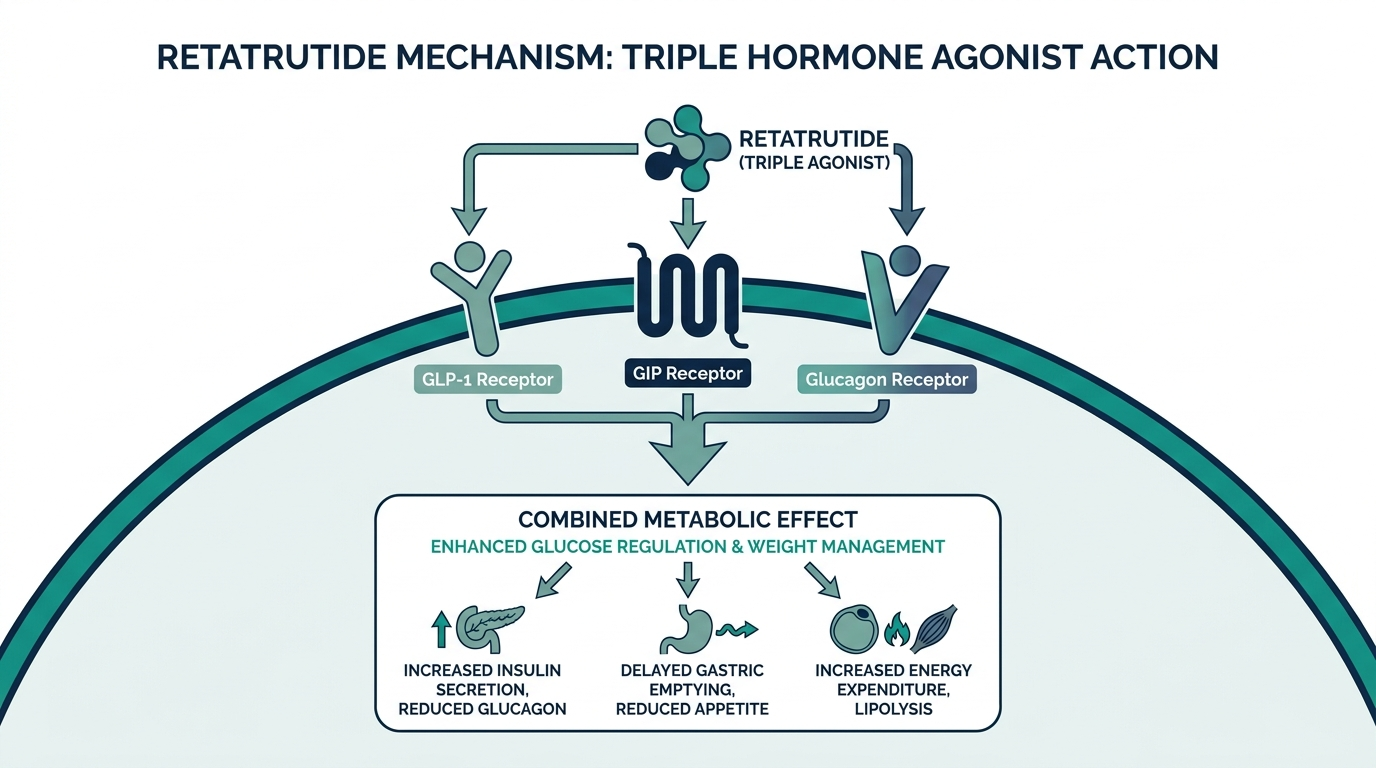
Retatrutide is an investigational once-weekly injectable drug developed by Eli Lilly. Its official research code is LY3437943, and that is the name you will see on research-chemical vendor sites alongside “RUO” in the product title.
The reason it is generating so much search traffic is straightforward: it has produced the highest weight-loss numbers ever recorded in a Phase 3 trial for any obesity medication in history. In the TRIUMPH-1 trial results announced on May 21, 2026, 2,339 adults lost a mean of 28.3% of their body weight at 80 weeks on the 12 mg dose, which translates to roughly 70 lbs. For comparison, the best tirzepatide result in SURMOUNT-1 was 22.5%.
Those numbers traveled fast. People who follow the weight-loss space saw the data, searched for retatrutide, found it listed on research sites, and ordered. That sequence is the problem this article addresses.
Full-body lab membership: 100+ biomarkers, doctor-reviewed, tracked over time.
What does “RUO” actually mean on a peptide site?
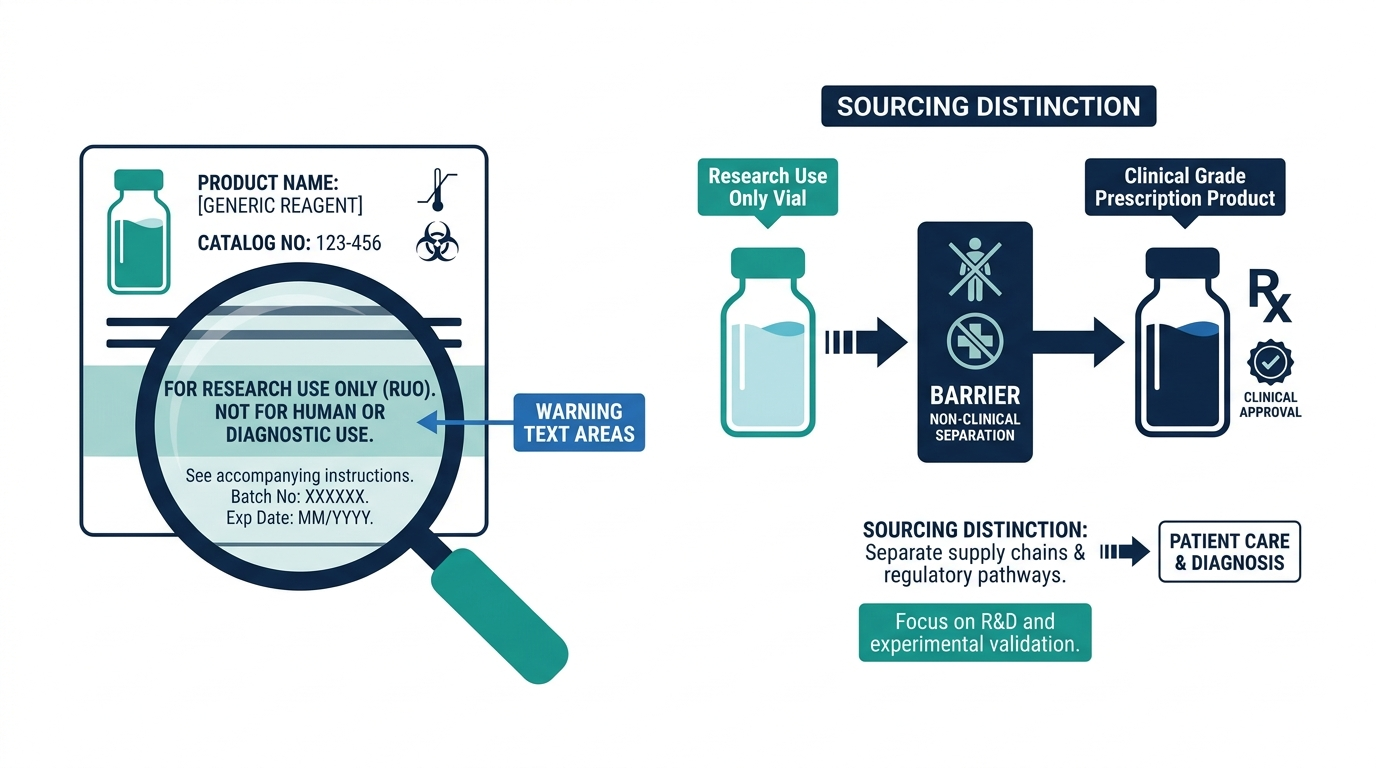
“Research Use Only” is a labeling category, not a safety certification, not a purity guarantee, and not a legal pathway to self-administer. It is a regulatory designation that allows a company to sell a pharmaceutical compound without requiring a prescription or medical oversight, provided the stated intent is laboratory research.
In plain terms: RUO is the legal fiction that makes the entire grey-market peptide industry possible. The day you draw it into a syringe and inject it, you have left every protection the label offered.
The distinction feels technical until it matters. Here is when it matters: the vial has no pharmacist who verified the dose, no physician who reviewed your health status, and no pharmacy that confirmed the compound is what it says it is.
The FDA’s enforcement posture in 2025 and 2026 has moved precisely against the gap between the “for laboratory research” disclaimer and the obvious consumer weight-loss marketing surrounding it. A product page styled to look like a telehealth clinic does not become a compliant research supply operation by adding “not for human use” in the footer. Multiple vendors received warning letters in September 2025 specifically citing retatrutide, which is a compound that has no approved form for humans in any context.
The simplest way to actually get this done
Superpower is a full-body lab membership that runs 100+ biomarkers, has each result reviewed by a doctor, and tracks your numbers year over year (about $199/year). It is what we point readers to when they would rather get one clean, complete draw than chase single tests one at a time. Here is superpower reviewed in full.
What is the “triple G” nickname, and why does the third receptor matter?
Retatrutide earned the nickname “Triple G” because it activates three hormone receptors simultaneously: GLP-1 (glucagon-like peptide-1), GIP (glucose-dependent insulinotropic polypeptide), and GCG (glucagon). Each generation of weight-loss drug adds a receptor:
| Drug | Receptors targeted | Phase 3 mean weight loss |
|---|---|---|
| Semaglutide (Ozempic / Wegovy) | GLP-1 only | ~15% at 68 weeks |
| Tirzepatide (Mounjaro / Zepbound) | GLP-1 + GIP | 22.5% at 72 weeks (SURMOUNT-1) |
| Retatrutide (LY3437943) | GLP-1 + GIP + glucagon | 28.3% at 80 weeks (TRIUMPH-1) |
The third receptor, glucagon, is what separates retatrutide mechanistically from everything before it. GLP-1 and GIP both work primarily by reducing appetite, and GIP adds some metabolic tuning. Glucagon receptor activation does something qualitatively different: it increases energy expenditure through thermogenesis, and it directly signals the liver to oxidize stored fat rather than synthesize new fat. You are not just eating less; your resting calorie burn goes up and your liver fat comes down faster.
That liver effect is not trivial. A Phase 2a trial published in Nature Medicine found retatrutide produced significant reductions in liver fat, which matters for the substantial overlap between obesity and metabolic-dysfunction-associated steatotic liver disease (MASLD). No approved GLP-1 drug has a comparable liver-specific data set.
Personally, the glucagon piece is what makes retatrutide scientifically interesting beyond the headline weight numbers. The other drugs moved appetite. This one moves metabolism at the cellular level, which is a different category of intervention.
What does the Phase 2 NEJM trial actually show?
Before the Phase 3 TRIUMPH program, a Phase 2 trial published in the New England Journal of Medicine in June 2023 by Jastreboff et al. enrolled 338 adults with obesity or overweight without type 2 diabetes and ran for 48 weeks. The dose-response data is worth understanding before trusting any “retatrutide dose guide” you find on a research vendor’s site:
- 1 mg group: -8.7% mean weight loss
- 4 mg group: -17.1%
- 8 mg group: -22.8%
- 12 mg group: -24.2%
- Placebo: -2.1%
At 12 mg, 100% of participants lost at least 5% of body weight, 93% lost at least 10%, and 83% lost at least 15%. Those responder rates are higher than any head-to-head data for semaglutide or tirzepatide.
The same trial documented a dose-dependent increase in resting heart rate that peaked at week 24 and declined afterward. Nausea was reported in up to 60% of participants at the 12 mg dose during escalation phases. Dysesthesia (abnormal skin sensation) appeared in 20.9% of TRIUMPH-1 participants at 12 mg, a side effect that does not show up in GLP-1 monotherapy trials and which is almost certainly missed entirely when someone uses an unverified RUO compound with no medical monitoring.
Why is the “research use only” label not a green light?
Myth to bust directly: the RUO label does not mean the compound is safe to use yourself at lower doses. It means the opposite. It means no regulatory body has reviewed the specific product for sterility, dosing accuracy, or biological activity in humans.
Retatrutide sold through RUO channels faces compounding problems that do not appear in clinical trial vials:
The FDA documented heavy metals, endotoxins, and incorrect peptide sequences in unregulated GLP-1 samples during its 2025 inspection sweep. Those are not edge cases from bad actors; they are the predictable output of supply chains that skip the quality controls an approved manufacturer must meet.
Independently, Finnrick Analytics, which has run more than 8,000 independent peptide tests across 225 vendors, assigned Peptide Sciences’ retatrutide an E rating, the lowest grade on its scale, across 37 batches tested between December 2024 and March 2026. Finnrick flagged a counterfeit detection in November 2025. Peptide Sciences had been running its own COAs showing 98 to 99% purity during that same period. Peptide Sciences shut down in March 2026.
Do not believe a vendor COA for retatrutide without a third-party lab key you can verify yourself on Janoshik or MZ Biolabs’ own site. The discrepancy between what Peptide Sciences published internally and what Finnrick found externally is the argument against relying on vendor-provided documents.
What actually goes wrong when people inject an RUO vial?
The abstract legal problem becomes a concrete medical one the moment a research vial meets a syringe. The failure modes are predictable, and they stack.
You cannot verify what is in the vial. As the Finnrick data on retatrutide shows, even a vendor publishing 98 to 99% purity certificates was selling batches that independent testing graded at the bottom of the scale. Heavy metals, bacterial endotoxins, and outright incorrect peptide sequences have all been documented in unregulated GLP-class samples. You are trusting a number on a PDF that the seller generated.
The dose math is a trap. Research peptides arrive as a lyophilized (freeze-dried) powder that you reconstitute with bacteriostatic water, and the final concentration depends entirely on how much water you add. A small arithmetic error, or confusing the units on an insulin syringe, can mean injecting several times the intended dose of a drug whose clinical protocol escalates slowly from 1 mg to 12 mg over roughly six months for a reason.
Sterility is on you. There is no pharmacy sterilizing the fill. Improper reconstitution, reused needles, or a contaminated vial can cause injection-site infections, abscesses, or worse, and none of that announces itself until it is already a problem.
No one is watching the side effects. The Phase 2 trial documented a dose-dependent rise in resting heart rate and dysesthesia in about one in five participants at the top dose. In a trial, a clinician catches those signals. Alone with an RUO vial, you are the one who has to notice, interpret, and act, without the baseline labs or monitoring that make that possible.
Is compounded retatrutide legal?
No. This is one of the cleaner legal answers in an otherwise murky regulatory landscape.
The FDA has stated explicitly that retatrutide “cannot be used in compounding under federal law.” It fails all three eligibility criteria for 503A bulk drug substances:
- There is no USP or NF monograph for retatrutide.
- It is not a component of any FDA-approved drug.
- It has never appeared on a national drug shortage list.
This is a sharper wall than what surrounds tirzepatide and semaglutide. Those two drugs were temporarily compoundable because they appeared on the FDA’s shortage list. That window closed (tirzepatide on October 2, 2024; semaglutide on February 21, 2025). Retatrutide never had that window at all. The Alliance for Pharmacy Compounding (A4PC), the professional body for compounding pharmacists, has explicitly told its members not to compound it.
Any telehealth platform or online clinic advertising “compounded retatrutide” is operating outside the law, full stop.
Telehealth GLP-1 program with provider visits and pharmacy coordination.
What are the legal ways to access retatrutide today?
There are exactly two routes that involve real retatrutide, verified pharmaceutical-grade, with legitimate medical oversight:
Route 1: Enroll in a TRIUMPH clinical trial.
Eli Lilly’s TRIUMPH program spans nine trials covering obesity, type 2 diabetes, cardiovascular outcomes, sleep apnea, knee osteoarthritis, chronic low back pain, and liver disease. As of June 2026, TRIUMPH-3 (cardiovascular outcomes), TRIUMPH-5 (sleep apnea), and TRIUMPH-7 through -9 are actively recruiting. Participants receive pharmaceutical-grade LY3437943 at no cost under continuous physician supervision. Search ClinicalTrials.gov for “retatrutide” with your zip code, or call Lilly at 1-877-CTLILLY. Some sites have waitlists of 200 or more candidates, so applying earlier is better.
Route 2: Wait for FDA approval.
Lilly submitted TRIUMPH-1 data on May 21, 2026, and is on track for an NDA filing in Q4 2026. The FDA review process typically runs 6 to 10 months, putting an approval decision in late 2027 or Q1 2028 at the optimistic end. Commercial availability would follow one to three months after that.
The path that does not exist: buying LY3437943 from an RUO site, injecting a compound no pharmacist has touched, at a dose derived from a clinical protocol designed for a different population, with no monitoring for heart rate changes or dysesthesia. That is not a calculated risk; it is an uninformed one.
What side effects does retatrutide cause even when it is done right?
Even in a controlled trial with pharmaceutical-grade drug and physician oversight, retatrutide is not gentle, and understanding that is part of understanding why casual use is a bad idea.
The most common effects are gastrointestinal, the same family GLP-1 drugs are known for: nausea, vomiting, diarrhea, and constipation, concentrated during the dose-escalation phase. In the Phase 2 data, nausea was reported in up to 60% of participants at the 12 mg dose while the dose was climbing. These usually ease as the body adapts, but they are the main reason trials titrate slowly rather than starting high.
Two effects set retatrutide apart from GLP-1 monotherapy. The first is a dose-dependent increase in resting heart rate, which peaked around week 24 in the Phase 2 trial before declining. The second is dysesthesia, an abnormal skin sensation such as tingling or a crawling feeling, reported in roughly 21% of participants at the 12 mg dose in TRIUMPH-1. That second one barely appears in single-receptor drugs, and it is exactly the kind of signal that goes unrecognized without medical follow-up.
As with the whole GLP class, there are also considerations around gallbladder issues, the potential for low blood sugar when the drug is combined with other glucose-lowering medication, and loss of lean muscle alongside fat if protein intake and resistance training are neglected. None of these are reasons to fear a properly supervised program. They are the reasons the supervision exists.
How does retatrutide compare to what is available now?
For people who cannot wait for approval or cannot access a trial, understanding where the currently approved options land is useful.
Tirzepatide at its 15 mg dose produces 22.5% mean weight loss at 72 weeks, and the SURMOUNT-5 head-to-head trial against semaglutide showed tirzepatide delivered roughly 47% more weight loss. That is not a trivial gap between tirzepatide and semaglutide, just as the gap between retatrutide and tirzepatide is not trivial in the other direction.
The practical question is not always “which drug produces the most weight loss in a trial.” It is “which drug can I access, afford, and tolerate consistently over 12 to 18 months.” The TRIUMPH data, however extraordinary, involves a slow dose escalation from 1 mg to 12 mg over roughly 24 weeks. The nausea and heart rate effects documented in Phase 2 require clinical monitoring, not a vague “start low and go slow” note on a vendor website.
What does proper medical supervision actually add?
It is easy to dismiss clinical oversight as bureaucracy until you see what it catches. A clinician running a GLP-class program starts with baseline labs, screens for contraindications, sets a titration schedule matched to how you tolerate the drug, and checks in as the dose climbs. If your resting heart rate jumps, they see it. If a metabolic marker moves the wrong way, they adjust. If the drug is not the right fit, they stop it.
That structure is the actual product of a legitimate telehealth weight-loss clinic, not the molecule by itself. For retatrutide specifically that path does not exist yet outside a trial, but for the approved drugs that come closest, semaglutide and tirzepatide, a clinician-led program with real lab work is the legal, traceable, and monitored version of what the RUO buyer is trying to improvise. If the scale will not move, a proper panel also tells you whether the obstacle is insulin, thyroid, or hormones in the first place, before any prescription is written.
Want a real clinician to run the numbers, not a guess?
Joi + Blokes is a telehealth clinic that prescribes GLP-1 medication (Zepbound, compounded semaglutide and tirzepatide), hormone therapy (TRT, HRT), thyroid care, and peptides after a real lab panel and clinician review, with no membership or consult fee (prescriptions from about $59/month, lab panels from $149). If the scale will not budge, this is where you find out whether insulin, thyroid, or hormones are the real reason. Here is Joi + Blokes reviewed in full.
What should you actually do if retatrutide is your goal?
If your goal is retatrutide specifically: apply for a TRIUMPH trial, check every 60 to 90 days since new sites come online as the program expands, and use the wait to get your metabolic baseline in order. Your labs before and during treatment are the only way to know if the intervention is working at the level that matters, beyond the number on a scale.
If your goal is the best weight-loss outcome available to you right now: a licensed telehealth clinic prescribing tirzepatide, with required lab work before starting and structured follow-up visits, is a medically supervised path that is legal, traceable, and producing results within 5 percentage points of retatrutide’s Phase 2 efficacy. That gap will almost certainly close further as dosing protocols for tirzepatide mature.
What I would not do is spend money on a vial from an RUO site, not because the concept of research peptides is inherently fraudulent, but because retatrutide specifically is the product category where independent testing has been worst (37 failed batches at the market’s most trusted vendor), regulatory enforcement has been most active (FDA warning letters specifically naming it), and the actual clinical doses require monitoring that an online order cannot provide.
Curious what your own levels look like?
Baseline 100+ biomarkers today and retest as life changes, all in one membership with physician review.
Frequently asked questions
What is retatrutide’s drug code on RUO research sites?
The research code is LY3437943, the Eli Lilly internal designation carried over into vendor listings. You will also see it called “Triple G” because it targets three hormone receptors: GLP-1, GIP, and glucagon.
Is retatrutide the same as a GLP-1?
Retatrutide includes GLP-1 receptor agonism but adds GIP and glucagon receptor activity. The glucagon component increases energy expenditure through thermogenesis and promotes liver fat oxidation, which GLP-1 monotherapy does not do. It is more accurate to call it a triple incretin or a GIP/GLP-1/glucagon receptor agonist than simply a GLP-1.
Can I buy retatrutide legally in 2026?
No. Retatrutide is not FDA-approved, is explicitly prohibited from compounding under federal law, and cannot be prescribed outside active clinical trials. Products sold on RUO sites are not legal pharmaceutical-grade retatrutide.
What happened to Peptide Sciences’ retatrutide?
Independent testing platform Finnrick Analytics assigned Peptide Sciences’ retatrutide an E rating, the lowest grade, across 37 batches between December 2024 and March 2026, including a counterfeit flag in November 2025. Peptide Sciences shut down voluntarily in March 2026.
What is the TRIUMPH program?
TRIUMPH is Eli Lilly’s Phase 3 registrational trial program for retatrutide, spanning nine trials. TRIUMPH-1 reported 28.3% mean weight loss at 80 weeks in 2,339 non-diabetic adults in May 2026. Multiple trials are still enrolling as of June 2026.
When will retatrutide be FDA-approved?
Lilly is on track to file the NDA in Q4 2026. Given a 6 to 10 month review period, the earliest realistic approval window is late 2027, with commercial launch following within 1 to 3 months after that.
How does retatrutide compare to tirzepatide?
In head-to-head trial data, retatrutide’s 12 mg dose produced 28.3% mean weight loss at 80 weeks versus tirzepatide’s 22.5% at 72 weeks. Retatrutide’s glucagon receptor component adds a calorie-burning mechanism that tirzepatide lacks, which may explain the additional efficacy, particularly in liver fat reduction.
What are the main side effects of retatrutide?
The most common are gastrointestinal (nausea, vomiting, diarrhea, constipation), heaviest during dose escalation. Retatrutide also raised resting heart rate in a dose-dependent way and caused dysesthesia, an abnormal skin sensation, in about 21% of participants at the 12 mg dose. These were observed under trial monitoring, which grey-market use does not provide.
Why is the dose so hard to get right with a research vial?
Research peptides ship as a freeze-dried powder you reconstitute yourself, so the final concentration depends on how much water you add. Combined with the slow 1 mg to 12 mg clinical titration, a small measuring error can mean a large accidental overdose, which is one more reason the clinical setting matters.
Author: [CAN XAC NHAN: ten + credential tac gia/reviewer health cua Vital Signs Today, vd “Medically reviewed by [name], [credential]”]. Educational content, not medical advice. Sources linked inline.
Primary sources:
– TRIUMPH-1 Phase 3 results press release, Eli Lilly, May 21 2026
– Jastreboff et al., “Triple-Hormone-Receptor Agonist Retatrutide for Obesity, A Phase 2 Trial,” NEJM, June 2023
– Retatrutide Phase 2a MASLD trial, Nature Medicine, 2024
– Lilly: What to know about retatrutide
– Finnrick Analytics: Peptide Sciences retatrutide test results
– Finnrick Analytics: Retatrutide vendor ratings
– GLP3 Planner: Compounded retatrutide legal status
– FDA warns companies over compounded retatrutide, Lengea Law
– Victory Men’s Health: Research Use Only peptides and FDA enforcement
– ClinicalTrials.gov: TRIUMPH-1 NCT05929066
– ClinicalTrials.gov: TRIUMPH-Outcomes NCT06383390
Related reading
Vital Signs Today may earn a commission if you buy through links on this page. It does not affect our editorial assessments.