
Educational content, not medical advice. Talk to a licensed clinician before starting any medication.
Short answer: Yes. Ozempic (semaglutide) is a 31-amino-acid synthetic peptide, engineered to mimic the gut hormone GLP-1 while resisting the enzyme that normally destroys native GLP-1 within two minutes. Three specific molecular modifications give it a half-life of roughly seven days, which is why one weekly injection can suppress appetite for the entire week.
Ozempic’s molecular tricks stretch a hormone’s half-life to a week. Want to see how your own GLP-1-related markers are trending? One at-home Superpower draw checks 100+ biomarkers, physician-reviewed.
Most people who have heard of Ozempic think of it as either a diabetes drug, a weight-loss injection, or the reason their favorite celebrity lost 30 pounds. Almost nobody knows it is also a peptide, in the strictest chemical sense, or that the gap between what it is and what your own body makes is exactly three changes to a 31-link chain.
That gap is worth understanding, because it explains why Ozempic works the way it does, why it causes the side effects it does, and why the compounding pharmacies that tried to copy it cheaply ran into serious trouble with the FDA. The molecule is not magical. It is precise.
What exactly is a peptide?
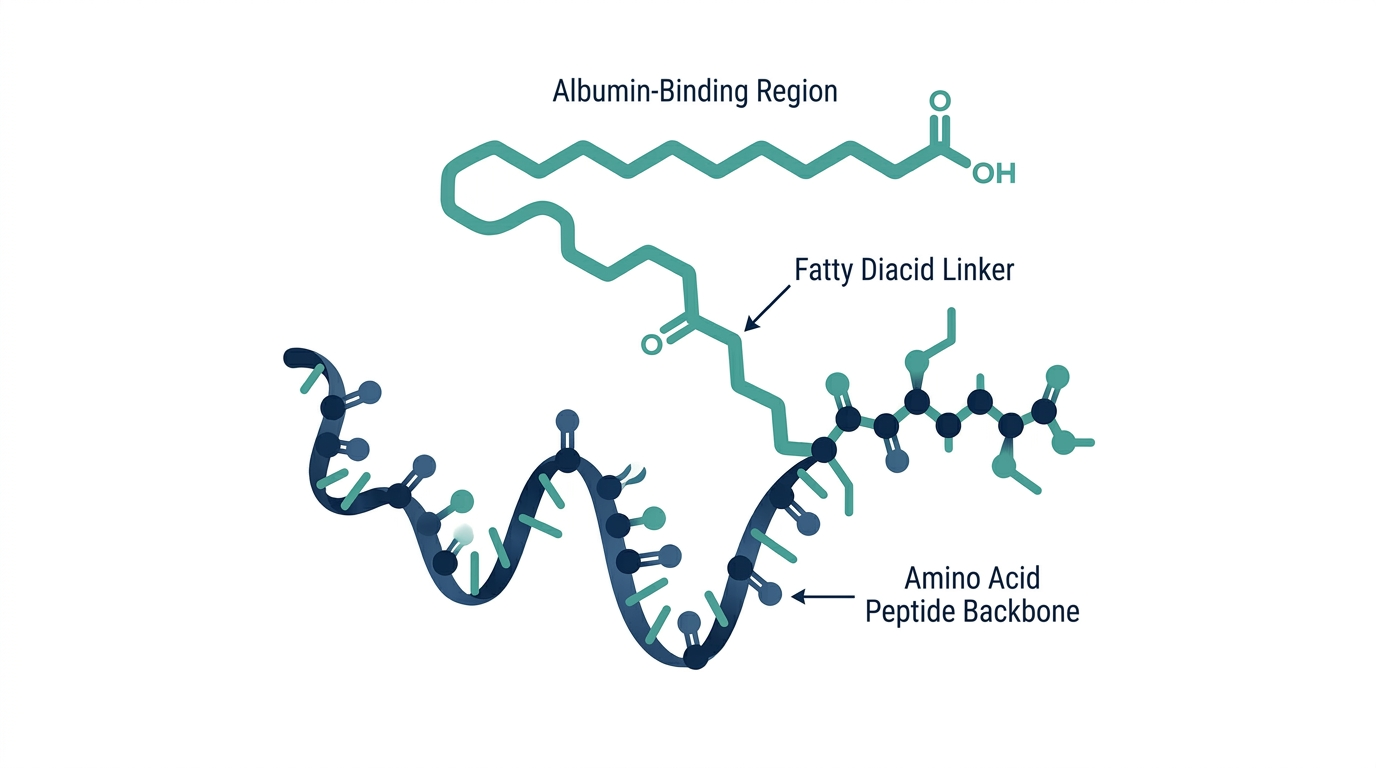
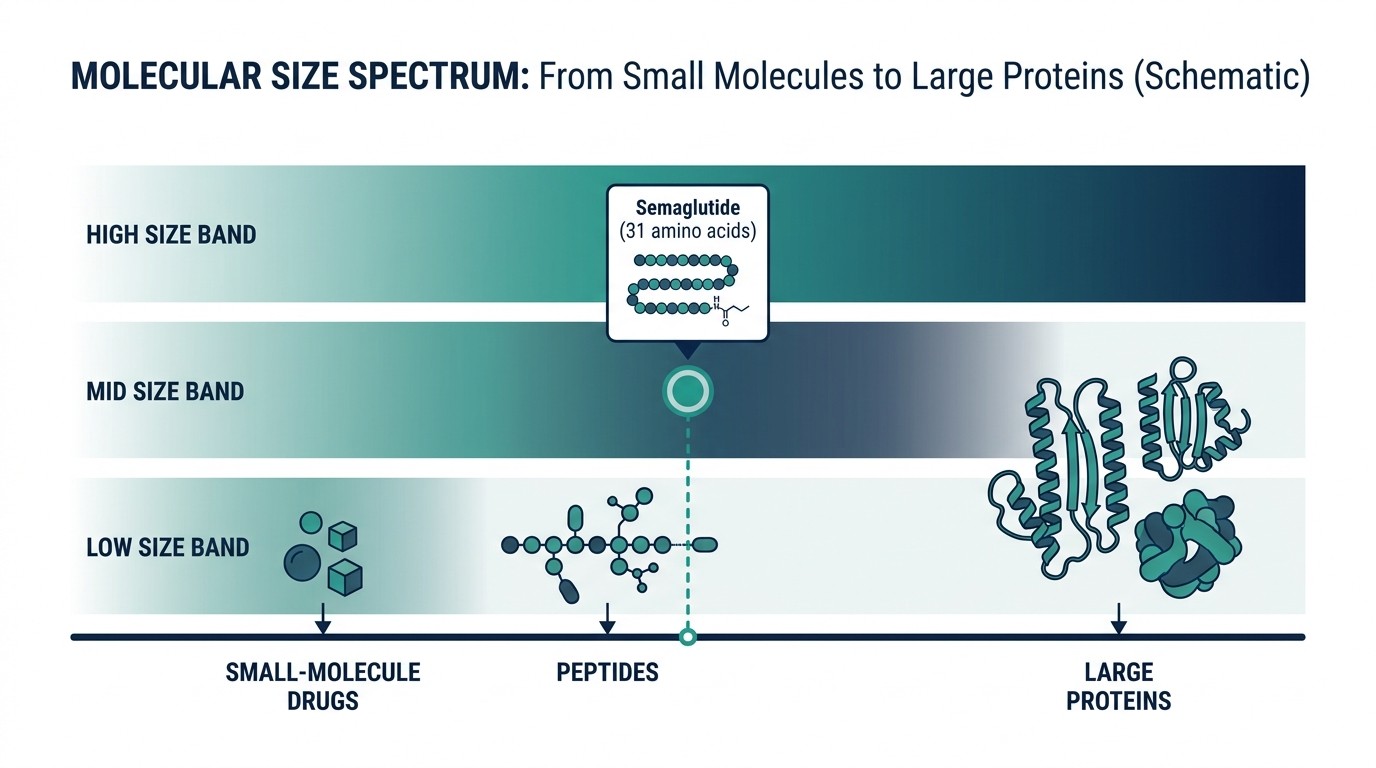
A peptide is a chain of amino acids linked by peptide bonds. When the chain is under 50 amino acids long, scientists call it a peptide. When it crosses 50, it is generally called a protein. Insulin, the diabetes drug, is a 51-amino-acid peptide. Semaglutide, the active ingredient in Ozempic and Wegovy, is a 31-amino-acid peptide.
The distinction matters for more than vocabulary. Peptides are built by ribosomes in your cells, circulate as signaling molecules, regulate appetite and metabolism, and are broken down by enzymes just like proteins are. They are biological software, not small-molecule pharmaceuticals like aspirin or metformin. That is why they require injection: swallow a peptide and the digestive tract dismantles it before it reaches the bloodstream.
(Rybelsus, the oral form of semaglutide, works around this with a special formulation using sodium N-[8-(2-hydroxylbenzoyl) aminocaprylate, or SNAC, that temporarily permeabilizes the stomach lining. Even then, bioavailability tops out around 1% compared to the injection.)
What is native GLP-1 and why does it not work as a drug?
The simplest way to actually get this done
Superpower is a full-body lab membership that runs 100+ biomarkers, has each result reviewed by a doctor, and tracks your numbers year over year (about $199/year). It is what we point readers to when they would rather get one clean, complete draw than chase single tests one at a time. Here is superpower reviewed in full.
Glucagon-like peptide-1, or GLP-1, is a 30-amino-acid hormone your gut L-cells release within minutes of eating. It signals the pancreas to release insulin, tells the brain you are full, slows gastric emptying so nutrients absorb more slowly, and mildly suppresses glucagon to prevent glucose spikes. In other words, it does almost everything that makes Ozempic famous.
The problem: native GLP-1 has a half-life of roughly two minutes in the bloodstream. An enzyme called dipeptidyl peptidase-4, or DPP-4, clips off the first two amino acids at position 2 (alanine), deactivating the molecule almost instantly. Kidneys and plasma proteases handle the rest. You would need a continuous intravenous drip to use it clinically. Nobody will wear a GLP-1 IV for the rest of their life.
Novo Nordisk, the Danish pharmaceutical company that makes Ozempic, spent years engineering around exactly that problem.
How semaglutide differs from natural GLP-1 (the three modifications)
Semaglutide shares 94% sequence homology with native human GLP-1, meaning 29 of 31 positions are structurally similar. The three changes Novo Nordisk made to the backbone are what separate a two-minute hormone from a seven-day drug.
Modification 1: position 8, alanine to aminoisobutyric acid (Aib). Native GLP-1 has alanine at position 8, which is where DPP-4 grabs the molecule and snips it. Swapping alanine for Aib creates steric hindrance, a physical bulge that prevents DPP-4 from fitting its active site onto the molecule. This single substitution eliminates the primary clearance pathway.
Modification 2: position 34, lysine to arginine. This swap is essentially a site-clearance step that makes position 26 available for the third and most important modification without interfering with the receptor-binding portion of the chain.
Modification 3: a C-18 fatty diacid chain at position 26, attached via a miniPEG spacer. This long fatty-acid tail binds reversibly to albumin, the most abundant protein in human blood. Albumin itself has a half-life of roughly 20 days. By hitching a ride on albumin, semaglutide borrows longevity from one of the body’s most stable proteins. More than 99% of semaglutide in circulation is albumin-bound at any given time, which shields it from renal filtration and residual enzymatic degradation.
The resulting pharmacokinetics: a half-life of approximately 168 hours, or seven days, which is what makes once-weekly dosing pharmacologically valid. This is the molecular reason you inject once and feel appetite suppression for the full week.
| Feature | Native GLP-1 | Semaglutide (Ozempic) |
|---|---|---|
| Amino acid count | 30 | 31 |
| Half-life | ~2 minutes | ~7 days (168 hours) |
| DPP-4 resistance | None | Full (Aib at position 8) |
| Albumin binding | None | >99% (C-18 fatty diacid chain) |
| Molecular weight | ~3,298 Da | 4,113.58 Da |
| Route of administration | Endogenous only | Subcutaneous injection or oral (low bioavailability) |
| Homology to native GLP-1 | 100% | 94% |
Ozempic and Wegovy: same peptide, different dose
Personally, I find the Ozempic-versus-Wegovy confusion one of the most revealing failures of pharmaceutical marketing. Both drugs contain identical semaglutide molecules. Both are made by Novo Nordisk. The difference is dosage ceiling and the indication the company got approved.
Ozempic is FDA-approved for type 2 diabetes, with a maximum dose of 2 mg weekly. Wegovy is FDA-approved for chronic weight management, with a maintenance dose of 2.4 mg weekly. That 20% higher ceiling accounts for most of the difference in weight-loss outcomes. The STEP 1 trial, the pivotal obesity study, tested semaglutide at 2.4 mg weekly and found an average body-weight reduction of 14.9% compared to 2.41% in the placebo group over 68 weeks in 1,961 subjects.
The insurance implications are significant. Ozempic is covered by most commercial plans for diabetes. Wegovy’s weight-management coverage varies widely. Physicians sometimes prescribe Ozempic off-label for weight loss, which is legal, though Novo Nordisk does not market it that way. This creates a paperwork-and-coverage gap that has pushed millions of patients toward telehealth platforms.
Full-body lab membership: 100+ biomarkers, doctor-reviewed, tracked over time.
What does Ozempic actually do in the body?
The GLP-1 receptor is found in the pancreas, the brain, the gut, the heart, and the kidneys. Semaglutide’s long half-life means it occupies those receptors continuously rather than in brief post-meal spikes the way native GLP-1 does. That continuous signaling is responsible for both the drug’s effectiveness and its side-effect profile.
Appetite suppression: semaglutide acts on GLP-1 receptors in the hypothalamus and brainstem, areas that regulate satiety and food reward. Users consistently report that the drug reduces what clinicians call “food noise,” the persistent mental background noise of thinking about food. This is not willpower chemistry. It is direct receptor signaling in appetite-control centers.
Gastric emptying: the drug slows the rate at which the stomach empties into the small intestine. This extends fullness after meals and blunts post-meal glucose spikes, but it is also the primary mechanism behind the most common side effect: nausea. The STEP trials reported nausea in roughly 44% of semaglutide users versus 16% on placebo, concentrated in the titration phase.
Cardiovascular effects: the SELECT trial, a randomized controlled trial of 17,604 adults with overweight or obesity and established cardiovascular disease but without diabetes, found that semaglutide 2.4 mg weekly reduced the composite of cardiovascular death, non-fatal heart attack, and non-fatal stroke by 20% versus placebo over a median follow-up of 39.8 months. Heart attack risk specifically fell by 28%. In 2025, the FDA expanded semaglutide’s indication to include cardiovascular risk reduction in adults with overweight or obesity and established heart disease, making it the first obesity drug with that label claim.
The thyroid warning: semaglutide carries a boxed warning for thyroid C-cell tumors based on rodent studies. In actual clinical data, the rates of acute pancreatitis were similar in semaglutide and placebo groups (0.27 versus 0.33 cases per 100 patient years), and long-term human data has not shown a clear increase in thyroid cancer risk. The warning stands because the rodent signal requires human surveillance. If you have a personal or family history of medullary thyroid carcinoma or multiple endocrine neoplasia syndrome type 2 (MEN2), semaglutide is contraindicated.
The myth that Ozempic is a “natural” or “clean” option
Do not believe the wellness-space framing that Ozempic is somehow more natural or gentle than other medications because it mimics a peptide hormone. The fact that semaglutide is derived from a naturally occurring hormone structure does not make it a gentle supplement. It is a pharmaceutical engineered for potency and half-life extension, and it works by continuously occupying receptors that were designed to receive brief post-meal signals.
That continuous occupation is why the weight loss is real (14.9% in STEP 1, compared to vanishingly small results from every supplement on the market), and it is also why the nausea, the slowed gastric motility, and the need for careful titration are real. The molecule does not care what narrative surrounds the brand name.
The related myth: that you can replicate Ozempic’s effects with berberine, inositol, or “natural GLP-1 boosters.” None of those compounds have semaglutide’s receptor affinity, its half-life, or its clinical trial evidence. Berberine has modest glucose-lowering effects; it does not have a SELECT trial.
Is Ozempic a peptide you can buy outside of a prescription?
No, and this is the legal bright line worth understanding clearly. Semaglutide is a prescription-only FDA-approved drug. The two legitimate routes to get it are:
- A licensed clinician (your primary care doctor, endocrinologist, or a telehealth provider) prescribes it, and a licensed pharmacy dispenses it.
- A compounding pharmacy produces it under a valid prescription from a licensed prescriber, within the rules that apply in 2026 (see below).
There is no legal over-the-counter route for injectable semaglutide. Research peptide vendors that have listed “semaglutide” or “GLP-1 peptide” as catalogue items have been the explicit target of FDA enforcement action. In April 2026 the FDA issued 30 warning letters to compounding operations and proposed removing semaglutide and tirzepatide from the 503B bulk compounding list permanently.
Telehealth GLP-1 program with provider visits and pharmacy coordination.
The compounding chapter: what happened and where things stand in 2026
The semaglutide shortage of 2022 to early 2025 created a legal window for compounding pharmacies to produce semaglutide copies at dramatically lower prices, roughly $150 to $300 per month versus $900 to $1,400 for brand-name Ozempic or Wegovy without insurance. That window closed in two stages:
- The FDA declared the tirzepatide shortage resolved on 2 October 2024, and the semaglutide shortage resolved on 21 February 2025, removing the legal basis for shortage-driven compounding.
- Enforcement deadlines for 503A pharmacies ran to April 22, 2025 and for 503B outsourcing facilities to May 22, 2025.
503A compounding pharmacies, the ones used by most telehealth platforms, can still compound semaglutide under a patient-specific prescription in 2026, but the regulatory landscape tightened significantly. The FDA’s April 2026 proposal to permanently remove semaglutide and tirzepatide from the 503B bulks list, combined with active warning letters, signals that the compounded GLP-1 window is closing rather than stabilizing.
The practical result: telehealth platforms that relied entirely on compounded semaglutide had to adapt. Hims, one of the largest, fully exited compounded GLP-1 medications and now distributes brand-name Wegovy as an authorized Novo Nordisk partner at $299 per month for injectable and $249 for oral. Ro and some others continue to offer compounded semaglutide starting at $149 to $159 per month from licensed 503A pharmacies with valid prescriptions, while compliance holds.
A new challenger: Foundayo (orforglipron) and why it matters for the peptide question
On 1 April 2026 the FDA approved Foundayo (orforglipron), Eli Lilly’s oral GLP-1 receptor agonist for weight management. Orforglipron is not a peptide. It is a small-molecule non-peptide GLP-1 receptor agonist, taken once daily as a pill with no food or water restrictions.
This is worth noting because it draws the peptide boundary clearly. Semaglutide works because it is a modified peptide that mimics GLP-1’s structure closely enough to activate the receptor. Orforglipron works by fitting the receptor’s binding pocket from a completely different molecular angle, the way a different key can open the same lock. The ATTAIN-1 trial (3,127 participants, 72 weeks) showed weight loss of 7.5% to 11.2% at various doses versus 2.1% placebo, somewhat below semaglutide’s 14.9% in STEP 1 but delivered in a pill taken anytime, without needles.
The significance: the GLP-1 receptor is now accessible by both the peptide route (semaglutide, tirzepatide) and the small-molecule route (orforglipron). The peptide route still has the stronger efficacy data, but the small-molecule route removes the injection barrier entirely. For patients who will not self-inject, orforglipron is the first genuinely practical alternative.
What does this cost, practically?
Here is the realistic price landscape for GLP-1 access in mid-2026:
| Route | Monthly cost | Notes |
|---|---|---|
| Brand-name Ozempic, no insurance | ~$900 to $1,000 | Requires prescription; Novo Nordisk savings card can lower to $25 with eligible insurance |
| Brand-name Wegovy, no insurance | ~$1,300 to $1,400 | Same molecule, obesity indication, slightly higher max dose |
| Wegovy via Hims (Novo Nordisk authorized) | ~$299 (injectable) | Brand-name, requires clinical intake |
| Compounded semaglutide via Ro | ~$149 to $159/month | 503A pharmacy, with valid prescription |
| Compounded semaglutide, general telehealth range | ~$149 to $299/month | Prices rise at higher doses; compliance varies |
| Foundayo (orforglipron) oral | ~$149/month (expected) | Small-molecule, pill, once daily, recently launched |
None of this is covered by standard insurance for weight management. Only about 20 to 25% of commercial plans cover obesity drugs. Medicaid coverage varies by state. Budget for it as a monthly out-of-pocket before you start; sticker shock after the first invoice is a common reason for discontinuation.
Telehealth GLP-1 program with provider visits and pharmacy coordination.
Don’t just read about your health, track it.
A single result is a snapshot. Superpower re-tests 100+ markers over time so you can watch them move as you change sleep, food, and training.
Frequently asked questions
Is Ozempic a peptide or a drug?
Both. Ozempic is a pharmaceutical drug whose active ingredient, semaglutide, is a 31-amino-acid synthetic peptide. Being a peptide describes its molecular structure; being a drug describes its regulatory classification and mechanism of therapeutic action. The two are not mutually exclusive.
What is the difference between semaglutide and natural GLP-1?
Native GLP-1 has 30 amino acids and a half-life of about two minutes before the enzyme DPP-4 destroys it. Semaglutide has 31 amino acids and three key modifications: a DPP-4-resistant amino acid at position 8, a C-18 fatty-acid chain at position 26 that binds albumin, and a lysine-to-arginine swap at position 34. These changes extend the half-life to roughly seven days. The molecules share 94% structural homology.
Are Ozempic and Wegovy the same?
Yes, same semaglutide molecule. The difference is dosage ceiling (2 mg max for Ozempic versus 2.4 mg for Wegovy) and FDA indication (type 2 diabetes for Ozempic versus chronic weight management for Wegovy). Insurance coverage and list prices differ substantially between the two brands despite the identical active ingredient.
Can you get semaglutide without a prescription?
Not legally in the United States. Any site selling injectable semaglutide without requiring a valid prescription from a licensed prescriber is operating outside the law. The FDA has issued warning letters specifically targeting peptide vendors who listed GLP-1 compounds as research-use items. The legal route is always a licensed clinician plus a licensed pharmacy.
Why does Ozempic cause nausea?
Semaglutide slows gastric emptying, which is the same mechanism behind its appetite suppression and blood-sugar benefits. The stomach empties more slowly than the body expects, and the mismatch produces nausea, particularly during the titration phase when the dose is being increased. Most patients report that nausea peaks during the first one to two months and diminishes once they reach a stable maintenance dose.
Is Ozempic related to peptide therapy clinics offer?
Ozempic belongs to the GLP-1 class of prescription peptide drugs. Peptide therapy clinics typically offer a different set of peptides, mainly sermorelin, BPC-157, CJC-1295, Ipamorelin, and GHK-Cu, for goals like recovery, growth hormone support, and anti-aging. These are a different category from GLP-1 drugs. The GLP-1 class is FDA-approved; the others are mostly in grey-zone or regulated compounding territory. A clinic that offers “peptide therapy” and happens to also prescribe semaglutide is covering both categories.
What about orforglipron, the new pill? Is it a peptide too?
No. Orforglipron (Foundayo), approved by the FDA on 1 April 2026, is a small-molecule GLP-1 receptor agonist, not a peptide. It activates the same GLP-1 receptor that semaglutide activates, but through a different molecular mechanism. This makes it the first non-peptide oral GLP-1 drug. It produces 7.5% to 11.2% average weight loss in trials versus semaglutide’s 14.9%, with the advantage of a no-restriction daily pill rather than a weekly injection.
Author: Vital Signs Today Editorial Team, [credential]”]. Educational content, not medical advice. Sources linked inline.
Primary sources:
– Semaglutide, a glucagon-like peptide-1 receptor agonist (PMC review)
– FDA Ozempic label (accessdata.fda.gov)
– SELECT trial final results, 20% MACE reduction (iMedic Health)
– Semaglutide half-life and pharmacokinetics (Halflife Labs)
– STEP 1 trial protocol (ClinicalTrials.gov)
– FDA approves Lilly’s Foundayo orforglipron (Eli Lilly press release)
– FDA clarifies compounding policies for GLP-1 supply (FDA.gov)
– GLP-1 pricing by provider 2026 (Telehealth Ally)
– Hims GLP-1 2026 complete guide (Telehealth Ally)
– Semaglutide cost guide (WVU Healthcare)
– Ozempic vs Wegovy comparison (GoodRx)
– FDA moves to close compounded GLP-1s (Pharmacy Times)
Want a real clinician to run the numbers, not a guess?
Joi + Blokes is a telehealth clinic that prescribes GLP-1 medication (Zepbound, compounded semaglutide and tirzepatide), hormone therapy (TRT, HRT), thyroid care, and peptides after a real lab panel and clinician review, with no membership or consult fee (prescriptions from about $59/month, lab panels from $149). If the scale will not budge, this is where you find out whether insulin, thyroid, or hormones are the real reason. Here is Joi + Blokes reviewed in full.
Related reading
Vital Signs Today may earn a commission if you buy through links on this page. It does not affect our editorial assessments.