Quick answer: A comprehensive metabolic panel is a routine blood test that measures 14 substances in one draw to check your kidneys, liver, blood sugar, electrolytes, and fluid balance. Most labs want you to fast 8 to 12 hours first, mainly for the glucose number. A cash CMP usually runs about $10 to $50, and it is one of the most ordered blood tests in the country. It is almost always part of a standard physical, and reading it well means looking at patterns across related markers, not panicking over one bold flag.
If your doctor checks a box for routine bloodwork, the comprehensive metabolic panel is almost always part of it. It is cheap, fast, and it quietly screens four major systems at once. The trouble is that almost no one explains what the 14 lines on the printout mean, so a single mildly out of range value sends people into a spiral over something a clinician would barely note. This guide walks through each marker, the fasting rules that actually matter, what each setting costs in 2026, and how to read an abnormal result without overreacting.
A CMP covers 14 markers for your kidneys, liver, and blood sugar. See what shows up when you check 100+ at once. One at-home Superpower draw checks 100+ biomarkers, physician-reviewed.
What is a comprehensive metabolic panel test?
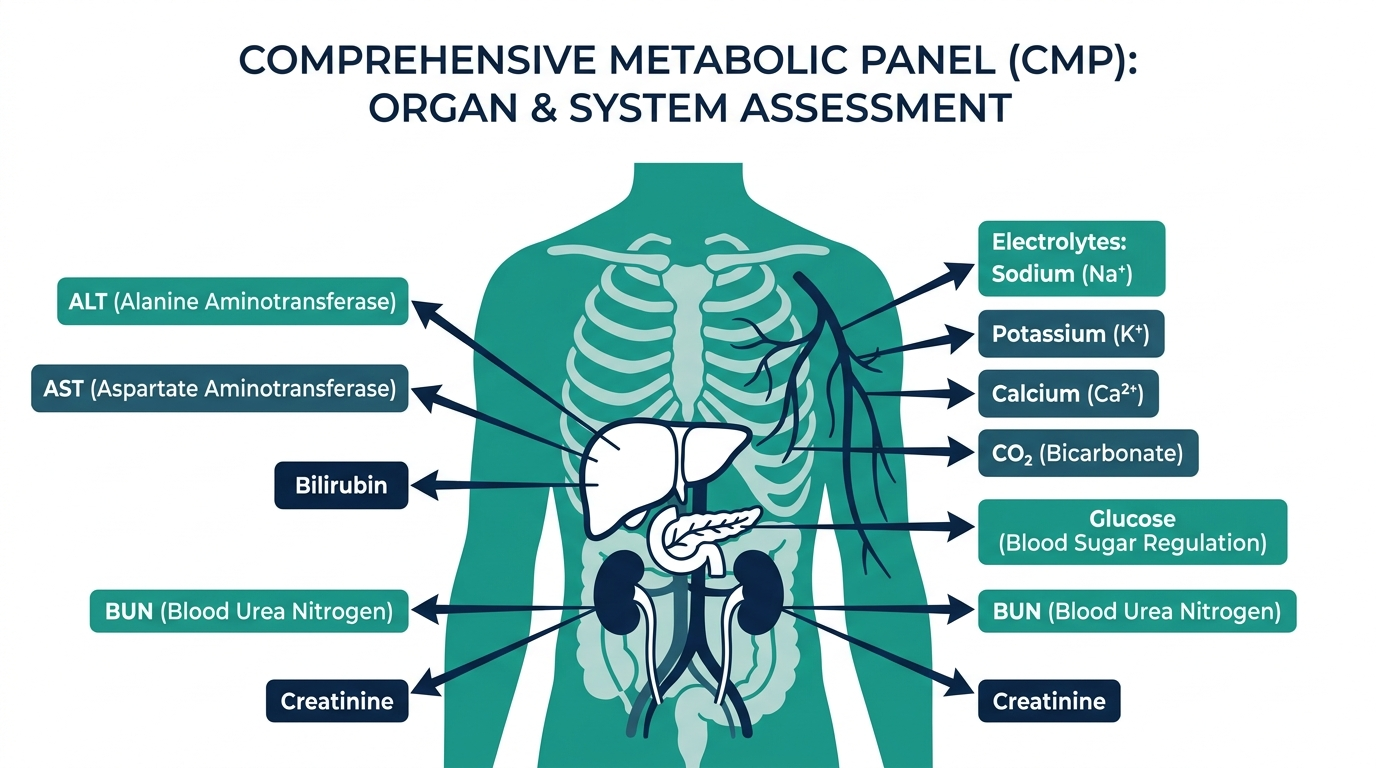
A comprehensive metabolic panel test is a single blood draw that reports 14 separate measurements grouped into kidney function, liver function, blood sugar, and electrolytes. Doctors order it for annual physicals, before starting certain medications, to monitor chronic conditions like diabetes or kidney disease, and any time they want a broad metabolic snapshot from one vial of blood.
The blood goes into a serum separator tube, spins in a centrifuge, and runs on an automated analyzer that reports all 14 values in minutes. That automation is why the panel is so cheap. The lab is not running 14 separate tests by hand, it is running one cartridge that happens to report 14 channels. This is also why ordering the full CMP instead of cherry-picking three markers rarely saves money. The marginal cost of the extra channels is close to zero.
It is the bigger sibling of the basic metabolic panel (BMP), which has only 8 markers. The CMP adds six more: total protein, albumin, and four liver enzymes and pigments. That liver add-on is the whole reason a clinician picks “comprehensive” over “basic.” If you are also looking at red and white blood cells, that comes from a complete blood panel, which is a different test entirely. The two are often drawn together but they are not the same thing, and they answer different questions.
CMP vs BMP: what is the actual difference?
The basic metabolic panel covers glucose, kidney markers, and electrolytes. The comprehensive metabolic panel adds the liver story on top. Here is the side by side, because this is the single most common point of confusion at the order desk.
| Group | Markers | In BMP (8) | In CMP (14) |
|---|---|---|---|
| Blood sugar | Glucose | Yes | Yes |
| Kidney | BUN, creatinine, eGFR | Yes | Yes |
| Electrolytes | Sodium, potassium, chloride, CO2 | Yes | Yes |
| Mineral | Calcium | Yes | Yes |
| Protein | Total protein, albumin | No | Yes |
| Liver | ALP, ALT, AST | No | Yes |
If a clinician suspects a kidney, electrolyte, or sugar problem and has no liver concern, a BMP is enough and slightly cheaper. The moment liver health, nutrition status, or a medication that taxes the liver enters the picture, the CMP is the right call. In practice many doctors just order the CMP by default because the price gap is small and the extra liver data is useful context. When you see “chem 14” or “chemistry panel” on a slip, that is usually the CMP.
What does a comprehensive metabolic panel check? The 14 markers
A comprehensive metabolic panel checks 14 markers across four systems. Here is each one, what it reflects, and a typical adult reference range. Ranges vary slightly by lab and by the equipment used, so always read your own report’s numbers, not a generic chart. The flag on your result is set against your lab’s range, not the one below.
| # | Marker | System | What it reflects | Typical adult range |
|---|---|---|---|---|
| 1 | Glucose | Sugar | Blood sugar, screens for diabetes and prediabetes | 70 to 99 mg/dL (fasting) |
| 2 | BUN (blood urea nitrogen) | Kidney | Kidney filtering and protein breakdown | 7 to 20 mg/dL |
| 3 | Creatinine | Kidney | Kidney function (paired with eGFR) | 0.6 to 1.3 mg/dL |
| 4 | eGFR (estimated) | Kidney | Calculated kidney filtration rate | Above 60 mL/min |
| 5 | Sodium | Electrolyte | Fluid balance and nerve signaling | 135 to 145 mmol/L |
| 6 | Potassium | Electrolyte | Heart rhythm and muscle function | 3.5 to 5.0 mmol/L |
| 7 | Chloride | Electrolyte | Fluid balance and acid levels | 96 to 106 mmol/L |
| 8 | Carbon dioxide (bicarbonate) | Electrolyte | Acid and base balance | 23 to 29 mmol/L |
| 9 | Calcium | Mineral | Bones, nerves, and muscle | 8.5 to 10.2 mg/dL |
| 10 | Total protein | Protein | Overall protein in blood | 6.0 to 8.3 g/dL |
| 11 | Albumin | Liver | Liver-made protein, nutrition status | 3.5 to 5.0 g/dL |
| 12 | ALP (alkaline phosphatase) | Liver | Liver and bone enzyme | 44 to 147 IU/L |
| 13 | ALT (alanine aminotransferase) | Liver | Liver cell enzyme | 7 to 56 IU/L |
| 14 | AST (aspartate aminotransferase) | Liver | Liver and muscle enzyme | 10 to 40 IU/L |
Some labs also report bilirubin as part of the liver group and the albumin to globulin ratio as a calculated value, which is why you may see a printout that looks like it has more than 14 lines. The 14 above are the standard CMP core. Below is what each group is really telling you.
The blood sugar marker: glucose
Glucose is the single most fasting-sensitive value on the panel, and the reason most CMPs come with a fasting instruction. A fasting glucose of 100 to 125 mg/dL falls in the prediabetes range, and 126 or higher on two separate occasions meets the line for diabetes. A non-fasting draw can push a perfectly healthy person into the prediabetes band on paper, which is exactly the false alarm fasting is designed to prevent. If your glucose is borderline, the next step is usually an A1C, which reflects three months of average sugar and does not care what you ate that morning.
The kidney markers: BUN, creatinine, eGFR
These three move as a story, not as solo readings. Creatinine is a waste product your kidneys clear, so when filtration slows, creatinine rises. The eGFR is a formula that turns creatinine, age, and sex into an estimated filtration rate, and it is the number nephrologists watch most. An eGFR above 60 is generally reassuring. BUN reflects both kidney function and protein turnover, so a high BUN with normal creatinine often points at dehydration or a high protein intake rather than a failing kidney. The classic dehydration signature is a high BUN to creatinine ratio, which often corrects with a few glasses of water and a repeat draw.
The electrolyte quartet: sodium, potassium, chloride, CO2
Sodium, potassium, chloride, and carbon dioxide regulate fluid balance, nerve signaling, and acid base status. Potassium is the one clinicians treat with the most respect, because both high and low potassium can disturb heart rhythm. It is also the marker most often thrown off by a technical artifact: if the tourniquet is on too long or red cells break during the draw (hemolysis), potassium can read falsely high. A surprise high potassium on an otherwise clean panel is very often repeated before anyone acts on it. Sodium swings usually track hydration and certain medications like diuretics. Carbon dioxide here means bicarbonate, a window into whether your blood is drifting acidic or alkaline.
The liver and protein markers: ALT, AST, ALP, albumin, total protein, calcium
ALT and AST are enzymes that leak out of liver cells when those cells are stressed or damaged, so they tend to rise together when the liver is the problem. ALT is the more liver-specific of the two. AST also lives in muscle, so a hard workout the day before a draw can nudge it up on its own. ALP rises with both liver and bone activity, which is why a child or a healing fracture can show a high ALP that means nothing about the liver. Albumin and total protein speak to nutrition and the liver’s manufacturing capacity, since albumin is liver-made. Calcium rides along in this group and reflects bone, nerve, and parathyroid status. The key habit here: never read one liver enzyme alone. One number is noise, a pattern across the four is signal.
How clinicians actually read it
Doctors rarely fixate on one number. They read the panel in clusters. BUN and creatinine move together for kidney stories. The four liver markers (ALT, AST, ALP, albumin) get read as a group, because one enzyme alone is noise but a pattern is signal. Sodium, potassium, chloride, and carbon dioxide are the electrolyte quartet that flags dehydration, medication effects, or kidney trouble. A single mildly high or low value on an otherwise clean panel is usually repeated, not panicked over. The trend across two or three draws over time tells a far cleaner story than any single snapshot.

Do you need to fast for a complete metabolic panel?
Yes, most labs ask you to fast 8 to 12 hours before a complete metabolic panel, and the main reason is the glucose marker. Eating or drinking anything with calories in the hours before your draw pushes blood sugar up and can make a normal person look prediabetic on paper. Water is fine and encouraged, since being hydrated makes the blood draw easier and keeps your BUN reading honest.
Here is the insider detail most people miss: fasting matters far less for the other 13 markers. Your kidneys, liver enzymes, and electrolytes do not swing much based on your last meal. So if a comprehensive metabolic panel is ordered without an explicit fasting instruction, it is often because the doctor cares about kidney or liver values and is not worried about a perfectly clean glucose reading. When in doubt, fast. It costs you nothing and keeps the glucose number trustworthy.
Should you fast for a comprehensive metabolic panel if it is bundled with a lipid (cholesterol) test? Definitely yes. Lipid panels and triglycerides are very food-sensitive, so a combined draw is the clearest case for the full overnight fast. Black coffee is a gray area, so skip it to be safe and have it after your draw.
Fasting quick reference
| Situation | Fast? | Why |
|---|---|---|
| CMP alone, glucose matters | 8 to 12 hours | Keeps fasting glucose accurate |
| CMP for liver or electrolytes only | Not strictly needed | Those markers barely move with food |
| CMP plus lipid panel | Yes, 8 to 12 hours | Triglycerides are very food-sensitive |
| Water before the draw | Yes, drink it | Easier draw, truer BUN |
| Black coffee | Skip to be safe | Gray area, have it after |
| Regular medications | Usually take them | Confirm with your clinician first |
One practical note that trips people up: an 8 to 12 hour fast does not mean starving all day. Schedule a morning draw, stop eating after dinner the night before, drink water in the morning, and you have hit the window without thinking about it. Fasting longer than 14 hours does not make the result more accurate and can actually nudge some values, so the overnight window is the sweet spot.
How much is a CMP blood test?
A CMP blood test usually costs about $10 to $50 cash at online and direct-to-consumer labs, and it is often $0 out of pocket when ordered as preventive care under insurance. The price swings a lot by setting, and the same exact panel can cost five times more depending on where the needle goes in.
| Setting | Typical cash price | Notes |
|---|---|---|
| Online or direct-to-consumer lab | $10 to $50 | You order, get a requisition, walk into a draw site |
| Insurance, preventive physical | Often $0 | Covered as wellness, unless a high-deductible plan applies |
| Insurance, diagnostic (symptom-driven) | Negotiated rate | Coded diagnostic, can move from free to a real charge |
| Urgent care | $50 to $150+ | Facility fees stack on top of the lab fee |
| Hospital draw | $100 to $250+ | Highest setting once chargemaster pricing hits |
Here is a worked example of how wide that gap gets. A CMP through a discount online lab runs about $29 cash. The exact same panel, same 14 markers, billed through a hospital outpatient lab can hit $200 or more before any insurance adjustment. The blood and the analyzer are identical. The price difference is entirely the building it was drawn in and how the visit was coded.
One billing trap worth knowing: a panel ordered to investigate a symptom gets coded as diagnostic, not preventive, which can move it from free to a real charge even on good insurance. If you walk in for a free annual physical and mention you have been tired, and the doctor adds the CMP to chase that fatigue, it can quietly become a diagnostic test you owe a copay on. If you want the full picture of what a draw can cost in 2026, read our guide on How Much Does Blood Work Cost? Real 2026 Prices With and Without Insurance. For where the CMP sits among the tests actually worth running, see the biomarkers worth tracking.
The simplest way to actually get this done
Superpower is a full-body lab membership that runs 100+ biomarkers, has each result reviewed by a doctor, and tracks your numbers year over year (about $199/year). It is what we point readers to when they would rather get one clean, complete draw than chase single tests one at a time. Here is superpower reviewed in full.

How does getting a CMP actually work, step by step?
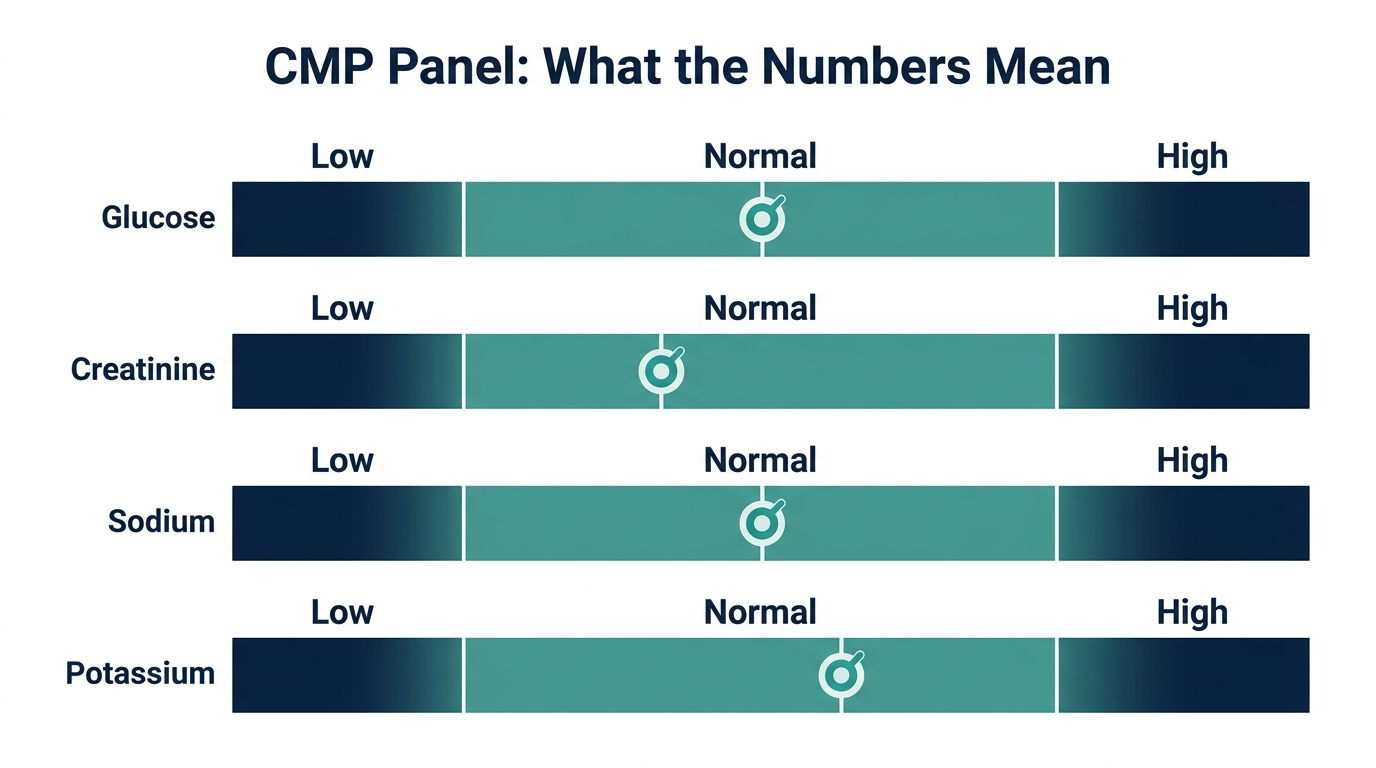
Getting a comprehensive metabolic panel is one of the fastest medical errands you can run. The whole appointment is usually under ten minutes. Here is the real sequence from decision to result.
- Get an order. Either your doctor writes it, or you buy a CMP from an online lab that issues the physician requisition for you. No clinic visit is required for the direct-to-consumer route.
- Fast if needed. Stop eating after dinner the night before, drink water in the morning, and book an early slot so you are not fasting through lunch.
- Get the draw. A phlebotomist takes one vial from a vein in your arm. The CMP needs a serum separator tube, which is a quick single stick.
- The lab processes it. The tube spins down and runs on an automated analyzer that reports all 14 values. Turnaround is usually same day to 48 hours.
- Read the result. You get a printout or portal report with your numbers next to the lab’s reference ranges, with out of range values flagged H (high) or L (low).
- Act on the pattern. If anything is flagged, the move is to read it in context with related markers and your symptoms, and loop in a clinician for anything that is more than a trivial single-value miss.
What happens if a CMP result is out of range?
An out-of-range value on a CMP is a starting point, not a diagnosis. A single flagged marker often gets repeated, because lab values shift with hydration, recent exercise, medications, and even how long the tourniquet was on. Patterns across related markers carry the real weight. The reference range itself is built so that roughly the middle 95 percent of healthy people fall inside it, which mathematically means a small share of perfectly healthy people will land just outside it by chance on any given draw.
By group: what an abnormal value usually means
| If this is off | Common direction | What it can point to | Typical next step |
|---|---|---|---|
| Glucose | High | Prediabetes or diabetes, or a missed fast | A1C to confirm |
| BUN and creatinine | Both high | Reduced kidney filtration | Repeat draw, check eGFR trend |
| BUN high, creatinine normal | Split | Dehydration or high protein intake | Hydrate, repeat |
| ALT and AST | Both high | Liver stress, fatty liver, medication, alcohol | Repeat, medication review |
| Potassium | High | Often a draw artifact (hemolysis) | Repeat with a clean draw |
| Sodium | Low or high | Hydration or medication effects | Review meds and fluids |
| Calcium | High | Parathyroid or vitamin D issues | Recheck with related labs |
A high glucose may prompt an A1C test to confirm. Rising BUN and creatinine together point at kidney function and usually trigger a closer look. Elevated ALT and AST suggest the liver is worth investigating, often with a repeat draw and a medication review. The right move is simple: bring the printout to a clinician and ask them to read the pattern, not to react to one bold number. If you are building a broader baseline, you can pair the CMP with what Superpower tests for to cover hormones, inflammation, and nutrients the CMP never touches.
Worked example: the scary potassium that was not
Say your CMP comes back with potassium flagged high at 5.6 mmol/L and everything else dead normal. On paper that looks alarming, since high potassium can affect heart rhythm. But an isolated high potassium with a clean rest of panel and no symptoms is one of the most common false alarms in lab medicine, usually caused by red cells breaking during a tight or slow draw. The standard response is not medication, it is a careful repeat draw, which in this scenario comes back at 4.4 and the flag vanishes. This is exactly why clinicians read patterns and repeat outliers instead of reacting to a single bold number.
Common mistakes people make with a CMP
Most CMP confusion comes from a handful of avoidable errors. Knowing them up front saves you a needless scare or a wasted draw.
- Comparing your numbers to a chart from the internet. Ranges differ by lab and analyzer. Read the range printed on your own report, not a generic table.
- Panicking over one flagged value. A single mildly out of range marker on an otherwise clean panel is usually repeated, not treated. The pattern matters more than any one line.
- Skipping the fast, then trusting the glucose. A non-fasting draw can fake a prediabetes reading. If you ate, tell the lab so the glucose gets read in context.
- Working out hard the day before. Intense exercise can bump AST and creatinine, so a brutal gym session before a draw can produce a misleading liver or kidney flag.
- Assuming the CMP covers everything. It does not include cholesterol, a full blood count, thyroid, vitamin D, or inflammation. It is a metabolic snapshot, not a whole-body workup.
- Letting a free physical turn diagnostic. Mentioning a symptom that prompts the test can change the billing code from preventive to diagnostic.
Who should get a CMP, and edge cases
A comprehensive metabolic panel is reasonable for most adults at an annual physical, and it is standard before or during treatment with medications that affect the kidneys or liver, and for monitoring diabetes, high blood pressure, or kidney disease. A few situations have their own rules worth knowing.
- Uninsured: the direct-to-consumer cash route at $10 to $50 is almost always cheaper than walking into a hospital lab without coverage. You order online, get a requisition, and pay the lab directly.
- Minors: children can have a CMP, but several ranges differ from adults. ALP in particular runs much higher in growing kids and teens because of active bone growth, so a “high” ALP that would flag in an adult is normal in a child.
- Employer or insurance-required draws: a CMP sometimes appears in employment or life-insurance physicals. These usually have their own fasting and consent rules, so follow the instructions they send rather than the default ones here.
- Medicare: a CMP is typically covered when medically necessary and ordered by a provider, but routine wellness coverage rules vary, so confirm whether yours is coded preventive or diagnostic.
- Pregnancy: some reference ranges shift in pregnancy, so values should be read against pregnancy-appropriate norms, not the standard adult chart.
Turn what you just learned into action.
Superpower lets you test 100+ biomarkers from home, then re-check them over time so you can actually see progress, physician-reviewed at every step.
FAQ
What is a comprehensive metabolic panel test in plain terms?
It is one blood draw that reports 14 numbers covering your kidneys, liver, blood sugar, and electrolytes. Think of it as a broad metabolic health check that most annual physicals include by default. It does not diagnose a specific disease on its own, it gives a clinician a wide snapshot to spot where to look closer.
Do you fast for a complete metabolic panel every time?
Plan to fast 8 to 12 hours unless your doctor says otherwise, mostly to keep the glucose reading accurate. The other markers are not very food-sensitive, so a missed fast is rarely a crisis, but fasting keeps the whole panel clean. Drink water during the fast, since hydration makes the draw easier and keeps your BUN honest.
Do you need to be fasting for a comprehensive metabolic panel if only liver values matter?
Strictly for liver enzymes and electrolytes, no, those barely move with food. But because the panel includes glucose, the safe default is still an overnight fast unless your clinician tells you to eat normally. If your doctor only cares about the liver story, they may explicitly waive the fast.
How much is a CMP blood test without insurance?
Expect about $10 to $50 cash through online labs, and more at urgent care or a hospital once facility fees apply. The cash direct-to-consumer route is usually the cheapest path for the uninsured. To compare with a full membership approach, see how much Superpower costs.
What does a comprehensive metabolic panel check that a basic panel does not?
The comprehensive version adds liver markers (ALT, AST, ALP, albumin, total protein) on top of the 8 markers in a basic metabolic panel. That liver coverage is the main reason a clinician orders the comprehensive one. If there is no liver concern, a BMP covers the rest.
Does a CMP test for cholesterol or a blood count?
No. A CMP does not include cholesterol, triglycerides, red and white blood cells, thyroid, or inflammation markers. Cholesterol comes from a separate lipid panel, and blood cells come from a complete blood count, both of which are often drawn at the same visit but are different tests.
How long do CMP results take?
Most CMP results come back the same day to within 48 hours, since the panel runs on an automated analyzer rather than requiring manual work. Online labs usually post results to a portal, and your doctor’s office will call or message if anything needs attention.
Can a CMP detect diabetes?
It can flag high blood sugar through the glucose marker, which is a strong hint, but a fasting glucose of 126 or higher needs confirmation, usually with a second draw or an A1C test. The CMP is a screen, and the A1C is the more definitive follow-up because it reflects three months of average sugar.
Why is my potassium high when I feel fine?
An isolated high potassium on an otherwise normal panel is very often a draw artifact, where red cells break during a tight or slow blood collection and release potassium into the sample. The standard response is a clean repeat draw rather than treatment, and the value usually returns to normal.
Should I worry if one marker is slightly out of range?
Usually not. Reference ranges are built so a small share of healthy people fall just outside them by chance, so a single mildly flagged value on an otherwise clean panel is typically repeated rather than treated. The pattern across related markers and the trend over time carry far more weight than one bold line.
Vital Signs Today may earn a commission if you buy through links on this page. It does not affect our editorial assessments.