Quick answer: A physical exam is a head-to-toe checkup where a clinician reviews your history, records vital signs, and examines your body system by system to catch problems before they cause symptoms. A routine adult physical usually includes blood pressure, heart and lung listening, an abdominal and skin check, and a short conversation about lifestyle and risk. Most visits also order blood work, which is where the real screening happens. The visit itself runs 15 to 30 minutes, and in most cases the labs that follow tell you more than the hands-on exam does.
So what is a physical exam actually checking, beyond a quick listen with the stethoscope? More than most people realize, and also less than most people hope. Here is what a doctor does during a routine physical, what each part of the body screen is looking for, what blood work comes with it, how to prepare, and why the labs that follow the visit often matter more than the exam itself.
A physical exam checks the outside, so what does the bloodwork ordered during it actually reveal underneath? One at-home Superpower draw checks 100+ biomarkers, physician-reviewed.
What is a physical exam, and what is the doctor looking for?
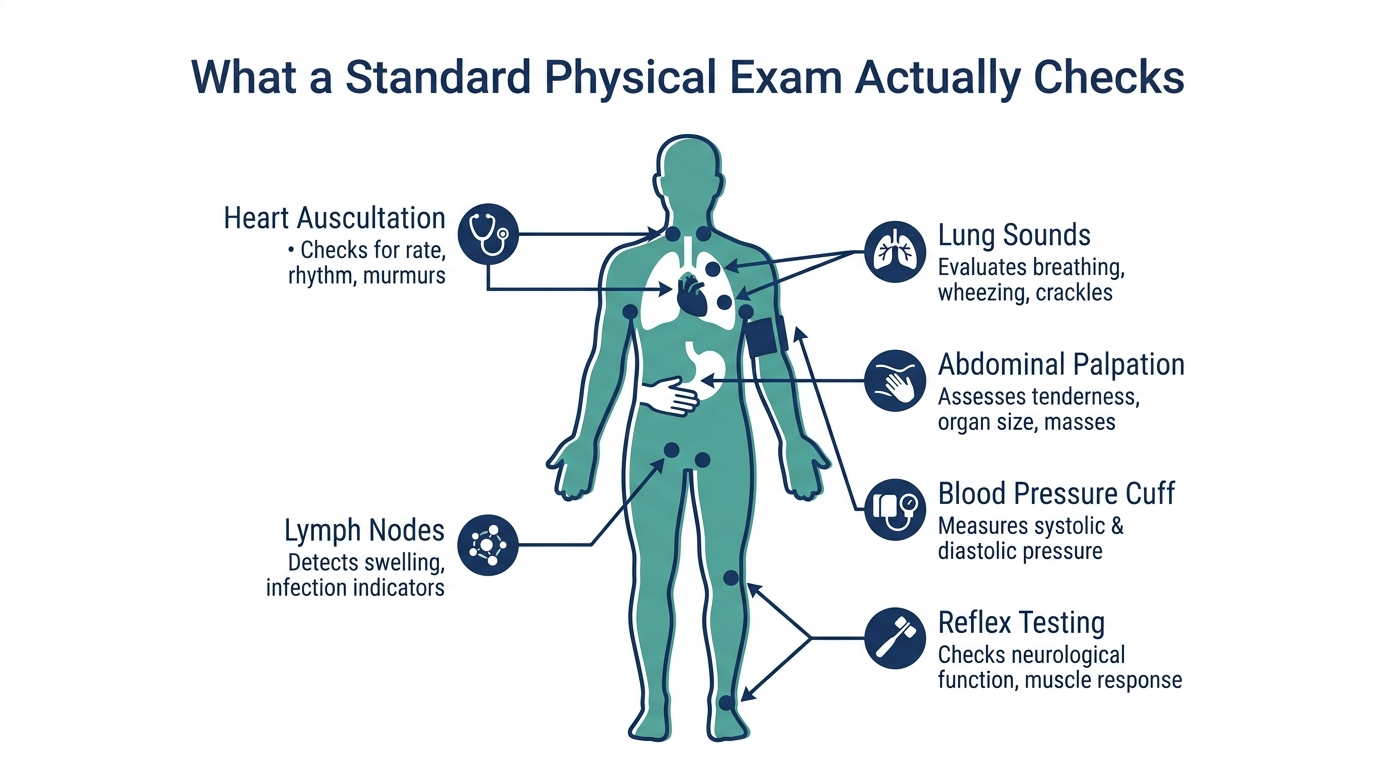
A physical exam is the hands-on portion of a checkup where the clinician inspects, palpates (presses on), percusses (taps), and listens to your body to find anything abnormal. The goal is early detection. A doctor is hunting for signs you cannot feel yet: a heart murmur, an enlarged organ, a suspicious mole, a swollen lymph node, blood pressure creeping into a danger zone.
The exam has been the core ritual of medicine for over a century, and the four classic techniques still structure every encounter. Inspection means looking, and it starts the moment you walk in. Palpation means feeling with the hands, which is how a doctor finds a hard lymph node or an enlarged liver edge. Percussion means tapping a finger against your chest or belly and listening to the pitch, which tells a trained ear whether the tissue underneath is air, fluid, or solid. Auscultation means listening with the stethoscope to the heart, lungs, and bowel. A skilled clinician runs through all four in a few minutes without you noticing the switch. So when you ask what is a physical exam at its core, the answer is this disciplined four-step sweep, repeated across every body system.
Here is the insider part most patients miss. The hands-on exam on a healthy adult rarely finds the thing that kills people. Major guidelines, including those from the U.S. Preventive Services Task Force, have quietly walked back a lot of the old routine maneuvers because they do not change outcomes in people without symptoms. The annual physical survives partly out of habit and partly because it is the one reliable moment each year to update screenings, vaccines, and labs. The conversation and the blood work usually carry more weight than the poking. That does not make the exam useless. It means the value sits in different places than most people assume, and knowing where helps you steer the visit toward what actually matters for you.
What do they do at a physical, step by step?
What they do at a physical follows a predictable sequence. Knowing it in advance makes the visit faster and helps you ask better questions. A typical primary care physical moves through these stages in order.
- History and intake. A nurse or medical assistant asks about your symptoms, medications, family history, smoking, alcohol, and what brought you in. This is also when you should raise anything that worries you.
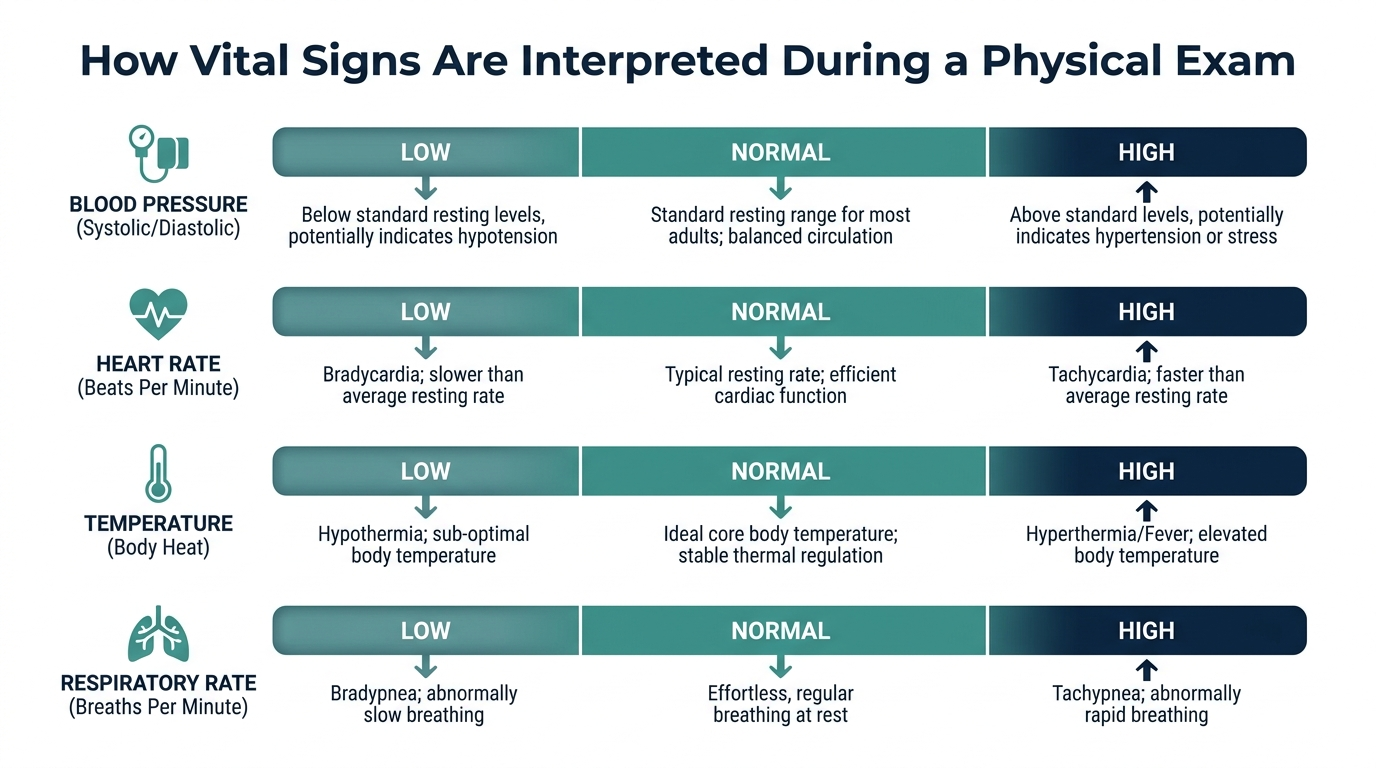
- Vital signs. Blood pressure, heart rate, temperature, breathing rate, height, weight, and BMI. These numbers drive most of what follows.
- General inspection. The clinician looks at your skin, eyes, posture, and overall appearance. A lot of clinical judgment happens in the first ten seconds of eye contact.
- Head and neck. Ears, eyes, nose, throat, thyroid, and lymph nodes get checked. They press along your neck feeling for swelling and have you swallow while they feel the thyroid.
- Heart and lungs. The stethoscope listens for murmurs, irregular rhythms, wheezing, or crackles, usually with you sitting and breathing deeply.
- Abdomen. They press on your belly to feel the liver, spleen, and any tenderness or masses, and listen for bowel sounds.
- Extremities and skin. Pulses in the legs, swelling (edema), range of motion, reflexes, and a scan for concerning moles.
- Neurological spot checks. Reflexes at the knee, strength, balance, and sometimes a quick test of the cranial nerves if anything in your history suggests a reason.
- Targeted exams. Depending on age, sex, and risk, this may include a clinical breast exam, a testicular or prostate check, or a pelvic exam. Many of these are now optional and guideline-dependent, so it is fine to ask why one is being done.
- Wrap-up and orders. The clinician summarizes, orders any labs, updates vaccines, and tells you what to follow up on. Do not let this part get rushed, because this is where your action items live.
What doctors check for during a physical is the same theme on repeat: signs of cardiovascular disease, cancer, infection, and organ trouble that have not yet announced themselves. The sequence is deliberate. The least invasive steps come first so you are relaxed by the time anything more involved happens.
How long does each part take?
The full visit is shorter than people expect. The hands-on portion is often the quickest piece, and the conversation is where the clock should be spent.
| Stage | Rough time | What dominates it |
|---|---|---|
| History and intake | 5 to 10 minutes | Your answers and the medication list |
| Vital signs | 2 to 4 minutes | Blood pressure, weight, height |
| Hands-on exam | 5 to 10 minutes | Listening, pressing, looking |
| Discussion and orders | 5 to 10 minutes | Screenings, labs, plan |
That adds up to 15 to 30 minutes for most adults. If you walk out in eight minutes with no conversation, you got a vitals check and a quick listen, not a real preventive visit. The fix is to come in with your two or three questions already written down so the clinician spends time on you, not on paperwork.
What does each part of the exam actually screen for?
Each maneuver maps to a specific worry. Most patients sit through the exam without knowing what the doctor is ruling in or out at each step, which makes the whole thing feel like a formality. It is not. Here is the translation.
| Exam step | What the doctor is checking for | Why it matters |
|---|---|---|
| Blood pressure | Hypertension | Silent for years, a top driver of stroke and heart disease |
| Heart auscultation | Murmurs, irregular rhythm (like atrial fibrillation) | Valve problems and arrhythmias often have no symptoms |
| Lung auscultation | Wheezing, crackles, reduced air movement | Early asthma, COPD, fluid, or infection |
| Neck and thyroid | Enlarged thyroid, swollen lymph nodes | Thyroid disease, possible infection or lymphoma signal |
| Abdominal palpation | Enlarged liver or spleen, masses, tenderness | Liver disease, hernias, rarely a tumor |
| Skin inspection | Suspicious moles, lesions | Early skin cancer, including melanoma |
| Leg pulses and swelling | Poor circulation, edema | Vascular disease, heart or kidney strain |
| Reflexes and strength | Neurological deficits | Nerve or spinal issues, rarely early disease signs |
Notice the pattern. The exam is strong at finding structural and surface problems: a mole, a lump, a murmur, a swollen ankle. It is weak at finding the slow metabolic diseases that cause the most death and disability, because high cholesterol, prediabetes, and early kidney decline produce nothing a hand or stethoscope can detect. That gap is exactly what the blood work fills.
What blood work usually comes with a physical?
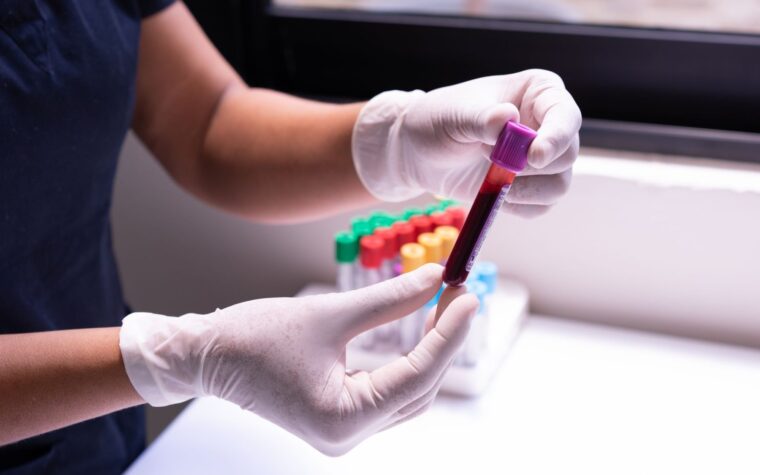
This is where a physical exam earns its keep. The exam itself is mostly normal in healthy adults, but the labs ordered alongside it screen for the conditions that quietly run for years: high cholesterol, prediabetes, thyroid issues, kidney decline, and vitamin deficiencies. Your stethoscope cannot hear an LDL of 190. A blood draw can.
A typical primary care order looks like this, often as part of a complete blood panel:
| Test | What it screens for | Fasting needed? |
|---|---|---|
| Complete blood count (CBC) | Anemia, infection, blood disorders | No |
| Comprehensive metabolic panel (CMP) | Kidney and liver function, electrolytes, glucose | Often yes |
| Lipid panel | Cholesterol and triglycerides (heart risk) | Yes for accurate triglycerides |
| Hemoglobin A1C | Average blood sugar over 3 months (diabetes) | No |
| TSH | Thyroid function | No |
| Vitamin D and B12 | Common deficiencies, fatigue, bone health | No |
One detail worth knowing: A1C does not require fasting because it reflects a three-month average, while triglycerides spike after a meal, which is why the lab tells you to skip breakfast. Standard insurance-covered “annual physical” labs are usually a narrow slice of this list. If you want to know the biomarkers worth tracking, you often have to ask for them by name or pay out of pocket.
The cost gap nobody warns you about
The same blood test can carry wildly different prices depending on where it is run and how it is billed. A comprehensive metabolic panel through a cash-pay discount lab runs about $29. The identical panel billed through a hospital outpatient lab can hit $200 to $250 before insurance adjustments. A lipid panel is often $20 to $40 cash but appears as $100 or more on a hospital itemized bill. This is why two people with the same physical can see very different numbers on their statements.
There is a second trap. A blood draw your doctor frames as “routine” can get coded as diagnostic rather than preventive if you mention a symptom during the visit, and a diagnostic code can shift the bill from fully covered to subject to your deductible. It is worth asking up front whether the labs being ordered fall under your preventive benefit.
The simplest way to actually get this done
Superpower is a full-body lab membership that runs 100+ biomarkers, has each result reviewed by a doctor, and tracks your numbers year over year (about $199/year). It is what we point readers to when they would rather get one clean, complete draw than chase single tests one at a time. Here is superpower reviewed in full.
Physical exam versus wellness visit: are they the same?
They are not the same, and the difference can cost you money. A Medicare Annual Wellness Visit, and many insurance “wellness” visits, are not full hands-on physicals at all. They are structured prevention conversations: a health risk assessment, a review of your medications and screenings, cognitive and fall-risk checks, and a personalized prevention plan. There is often no stethoscope and no head-to-toe exam.
A traditional physical, sometimes billed as a “comprehensive” or “complete” physical exam, includes the hands-on assessment described above. The confusion shows up on the bill. Wellness visits are usually covered at 100% as preventive care. A full physical may not be covered the same way, and if your clinician addresses an active problem during the visit, that portion can be billed separately as a problem-oriented visit with a copay.
| Wellness visit | Full physical exam | |
|---|---|---|
| Hands-on exam | Limited or none | Full head-to-toe |
| Focus | Risk assessment, prevention plan | Exam plus screening |
| Typical coverage | Often 100% preventive | Varies, can incur cost |
| Common setting | Medicare, some insurers | Primary care, employer, sports |
The practical move: when you book, ask the front desk exactly which visit type they are scheduling and how it will be billed. “I want my annual physical” and “I qualify for a wellness visit” can produce two different appointments with two different bills.
What are physical exams for different situations?
Not every physical is the same. The setting and the form you need shape what gets checked.
- Routine annual physical. The general health checkup described above, focused on prevention and screening updates.
- Sports physical. A focused exam clearing you for athletics, centered on heart screening, joints, and injury history. It is narrower than a full physical, so do not assume it replaces one. See the Sports Physical: What It Covers, Cost, and Where to Get One guide for what to expect.
- DOT physical. A federally regulated exam for commercial drivers, with strict vision, hearing, and blood pressure thresholds. It must be done by a certified medical examiner and follows a fixed checklist with little flexibility.
- Pre-employment or pre-op physical. Tailored to the job or surgery, sometimes adding drug screening, an EKG, or specific labs the employer or surgical team requires.
- Immigration or school physical. Driven by a required form, often centered on vaccination records and a few specific screens rather than a broad exam.
Where you go matters too. A primary care office gives the most thorough visit, while urgent care and retail clinics handle simpler forms faster. Our breakdown of Where to Get a Physical Near You (Cost and Same-Day Options) compares each route, and you can preview the price in How Much Does a Physical Cost With and Without Insurance? before you book.
Worked example: routine physical versus form-driven physical
Say two people book the same week. One is a 45-year-old wanting a general checkup. Her visit runs the full sequence, adds a lipid panel, A1C, and CMP, and ends with a conversation about her father’s heart disease. Total clinical value sits in the labs and the family-history talk, and if it is coded as preventive, she pays little or nothing.
The other is a 30-year-old who only needs a signed sports form for a recreational league. His visit is fifteen minutes, heart and joints focused, no broad labs, and the deliverable is a signature on a one-page clearance form. Same word on the calendar, “physical,” but two very different appointments. Booking the wrong one wastes a slot and sometimes a copay, which is why naming the form or goal when you schedule matters.
How should you prepare, and what should you ask?
A little prep turns a rushed fifteen minutes into a useful visit. Walk in ready and you change what the clinician spends time on.
- Bring a current medication list, including doses, supplements, and anything over the counter you take regularly.
- Know your family history of heart disease, diabetes, cancer, and stroke, and roughly at what age relatives were diagnosed.
- Write down two or three concerns that are actually bothering you, in priority order, so the most important one gets raised first.
- Fast correctly if labs require it. For fasting labs, do not eat for 9 to 12 hours and drink only water. Black coffee is a gray area, so when in doubt, skip it.
- Wear easy clothing with sleeves that roll up for blood pressure and a blood draw.
Then advocate. Ask which screenings you are due for based on your age, what your blood pressure and BMI actually mean for you, and whether your labs cover more than the bare minimum. If you are getting blood drawn anyway, it is often smarter to capture a full baseline at once rather than repeating partial draws every year. After the visit, request a copy of your results and make sure abnormal numbers get a follow-up plan, not just a note in your chart. And as always, talk to a clinician about anything in your results you do not understand.
Common mistakes people make with their physical
Most of the value people leave on the table comes from a handful of avoidable errors. These are the ones that show up again and again.
- Treating it as a pass or fail. A “normal” exam does not mean you are healthy. It means nothing structural showed up that day. Your labs and trends tell the longer story.
- Skipping the conversation. Patients who answer in one-word replies waste the single most valuable part of the visit. The history is where real problems surface.
- Assuming standard labs are comprehensive. The default insurance panel is a thin slice. Hormones, inflammation markers, iron studies, and many vitamin levels are not ordered unless you ask.
- Mentioning a symptom and getting surprise-billed. Raise a real complaint and a preventive visit can flip to a problem visit with a copay. Fine if you need it, just know it can happen.
- Never getting the results. No-news is not always good news. Charts get backlogged and abnormal values get missed. Ask for a copy and confirm the follow-up plan.
- Booking the wrong visit type. A wellness visit, a sports physical, and a full physical are different appointments. Naming what you need prevents a wasted slot.
Who should get a physical, and how often?
Once you know what is a physical exam meant to do, the frequency question gets easier to answer. The rigid “everyone needs a physical every year” rule has softened. For a healthy adult with no chronic conditions, evidence that an annual hands-on exam improves outcomes is thin. What does help is staying current on the specific screenings that match your age and risk: blood pressure checks, cholesterol and glucose screening, cancer screenings on schedule, and vaccines.
That said, here is reasonable decision guidance.
- Healthy adults under 50 with no risk factors can often go every one to three years, as long as blood pressure and key labs are tracked in between.
- Adults over 50, or anyone with high blood pressure, diabetes, high cholesterol, or strong family history, benefit from a yearly visit to keep numbers and medications in line.
- People starting a new medication, managing a chronic condition, or with new symptoms should be seen on whatever schedule their clinician sets, which may be every few months.
- Anyone who needs a form, for sports, work, the DOT, school, or immigration, gets a physical whenever the form requires one, regardless of the general schedule.
The deeper point: the visit is a delivery mechanism for screening, not the screening itself. If you are tracking your blood pressure and a full set of labs reliably, you are getting most of the benefit. If you are not, an annual visit is the simplest way to make sure nothing falls through.
Edge cases: uninsured, minors, employer-required, and Medicare
The standard advice assumes an insured adult booking their own checkup. Plenty of real situations break that mold.
- Uninsured. A cash physical at a retail clinic or community health center often runs $75 to $200, and sliding-scale clinics price by income. Cash-pay labs ordered separately can be cheaper than a hospital-billed bundle, so it is worth pricing the labs on their own.
- Minors. Pediatric physicals and well-child visits follow a separate schedule with growth tracking, development checks, and vaccines. School and sports forms for kids are usually filled at these visits. A parent or guardian typically must consent and attend.
- Employer-required. If your job mandates the exam, ask whether the employer covers it and whether you can use your own primary care provider or must use a designated clinic. Results tied to employment have privacy rules, so confirm what gets shared.
- Medicare. Medicare does not cover a traditional head-to-toe annual physical. It covers a “Welcome to Medicare” visit in your first year and an Annual Wellness Visit after that, both prevention-focused rather than hands-on. Knowing this prevents a surprise bill when you expect a full exam and get a wellness conversation.
Turn what you just learned into action.
Superpower lets you test 100+ biomarkers from home, then re-check them over time so you can actually see progress, physician-reviewed at every step.
FAQ
What do they do at a physical that I should not skip?
The conversation and the vitals. Blood pressure trends and an honest talk about symptoms, family history, and lifestyle catch more real problems than any single hands-on maneuver. Come prepared to actually use that time, and do not leave before you understand what labs were ordered and what to follow up on.
What is a physical test versus a physical exam?
People use “physical test” and “physical exam” interchangeably for the routine checkup. If a form asks for a “physical test,” it almost always means a standard physical exam with vitals and a hands-on assessment, sometimes plus specific labs the employer or school requires.
What doctor does physicals?
Primary care physicians, family medicine doctors, internists, and pediatricians all perform routine physicals. Nurse practitioners and physician assistants do them too. For specialized forms like DOT exams, you need a clinician certified for that specific exam, not just any provider.
What do they check for in a physical that bloodwork would miss?
The exam catches physical findings labs cannot: skin lesions, lumps, murmurs, abnormal reflexes, and joint problems. Bloodwork and the exam are complements, not substitutes, which is why a thorough checkup uses both.
Do I have to fast before a physical?
Only if your clinician ordered fasting labs, mainly a lipid panel or a glucose test. For those, do not eat for 9 to 12 hours beforehand and drink only water. A1C, CBC, TSH, and vitamin levels do not require fasting, so if those are your only labs, you can eat normally.
How long does a physical exam take?
Most adult physicals run 15 to 30 minutes. The hands-on portion is often the shortest part at 5 to 10 minutes, with the rest split between intake and the discussion of your results and plan. If your visit lasts under ten minutes with no real conversation, you likely got a vitals check rather than a full preventive visit.
Is an annual physical actually necessary?
For a healthy adult with no chronic conditions, a yearly hands-on physical is not strictly required, and guidelines have moved away from mandating one. What matters is staying current on age-appropriate screenings, blood pressure, key labs, and vaccines. People with chronic conditions, risk factors, or who are over 50 generally do benefit from a yearly visit.
Will my physical be free with insurance?
A preventive wellness visit is usually covered at 100% under most plans. A full physical may not be covered the same way, and if you raise an active health problem during the visit, that part can be billed separately with a copay. Ask the front desk how the visit is coded and whether the labs fall under your preventive benefit.
What is the difference between a physical and a wellness visit?
A wellness visit is a prevention-focused conversation with a risk assessment, screening review, and a personalized plan, often with little or no hands-on exam. A full physical includes the head-to-toe hands-on assessment. Medicare and many insurers cover wellness visits fully but may not cover a traditional physical the same way.
Can I get a physical at urgent care or a retail clinic?
Yes for simpler needs like a sports form or a basic pre-employment check, often same day and at a flat cash price. For a thorough preventive exam with comprehensive labs and follow-up, a primary care office is the better fit because it keeps your history and can track your numbers over time.
Vital Signs Today may earn a commission if you buy through links on this page. It does not affect our editorial assessments.