
Quick answer: An A1C test is a blood test that shows your average blood sugar over the past two to three months by measuring the percentage of your hemoglobin that has glucose stuck to it. It is the standard test for diagnosing and monitoring prediabetes and type 2 diabetes. The cutoffs are simple: below 5.7% is normal, 5.7% to 6.4% is prediabetes, and 6.5% or higher on two readings means diabetes. You do not need to fast for an A1C, and most adults can get one at a lab, pharmacy clinic, or with an at-home kit for roughly $9 to $80 cash.
What does the A1C test measure?
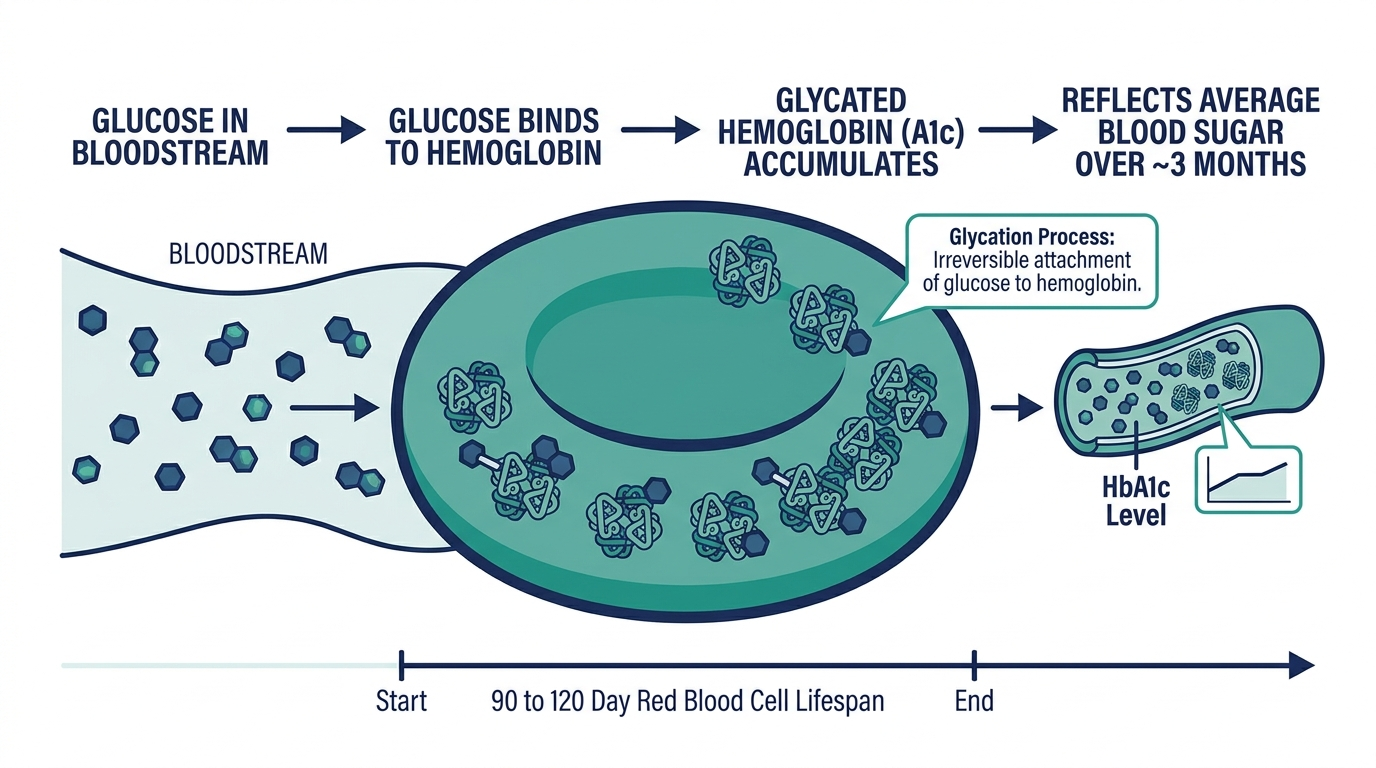
An A1C test measures the percentage of your red blood cells that have sugar bonded to them, which gives a rolling average of your blood glucose over roughly the last three months. The full name is hemoglobin A1C, sometimes written HbA1c or glycated hemoglobin. Here is the mechanism in plain terms: glucose floating in your blood sticks to hemoglobin, the oxygen-carrying protein inside red blood cells. The more sugar in your blood over time, the more of it gets stuck. Since red blood cells live about 90 to 120 days, the test captures a quarter-year of your glucose history in one number.
Just read about A1C targets? See where your own number falls, plus 99 other biomarkers, in one test. One at-home Superpower draw checks 100+ biomarkers, physician-reviewed.
That is the whole reason the test exists and why it beats a single finger-stick. A one-time glucose reading is a snapshot. It can swing high after a donut or low after a workout. The A1C is the long exposure photograph. You cannot game it by eating well for two days before your appointment, which is exactly why clinicians trust it. It is one of the core markers on any list of the biomarkers worth tracking for metabolic health.
One nuance that surprises people: the three months are not weighted evenly. Your A1C leans most heavily on the most recent four to six weeks, because the youngest red blood cells in your bloodstream outnumber the oldest ones. Roughly half of your A1C value reflects the last 30 days, and only a small fraction reflects glucose from 90 days ago. So if you tightened up your diet a month before the draw, that effort already shows. The flip side is that a great six weeks followed by a sloppy two weeks can still drag the number up more than you would expect.
How the A1C percentage translates to a glucose number (eAG)
An A1C percentage maps directly to an estimated average glucose, or eAG, in the same mg/dL units you see on a home glucose meter. This is the most useful trick for making sense of your result, because most people think in mg/dL, not percentages. The conversion uses a validated formula (eAG = 28.7 times A1C minus 46.7), but you do not need the math; the table below covers the range you will actually encounter.
| A1C (%) | Estimated average glucose (mg/dL) | Category |
|---|---|---|
| 5.0% | 97 mg/dL | Normal |
| 5.5% | 111 mg/dL | Normal |
| 5.7% | 117 mg/dL | Prediabetes starts |
| 6.0% | 126 mg/dL | Prediabetes |
| 6.4% | 137 mg/dL | Prediabetes (upper edge) |
| 6.5% | 140 mg/dL | Diabetes threshold |
| 7.0% | 154 mg/dL | Common diabetes target ceiling |
| 8.0% | 183 mg/dL | Above target |
| 9.0% | 212 mg/dL | Poorly controlled |
| 10.0% | 240 mg/dL | Poorly controlled |
Read it this way: every full 1% jump in A1C is roughly 29 mg/dL of average glucose. That is why a move from 6.5% to 7.5% is not a rounding difference. It is your blood running about 29 mg/dL higher all day, every day, for months. Seeing the eAG also explains the mismatch some people notice between their A1C and their meter. If your A1C says 7% (an average of 154 mg/dL) but your fasting reads are always 110, your numbers are spiking after meals when you are not testing. The eAG is the honest tiebreaker.
What is a normal A1C, and your target range
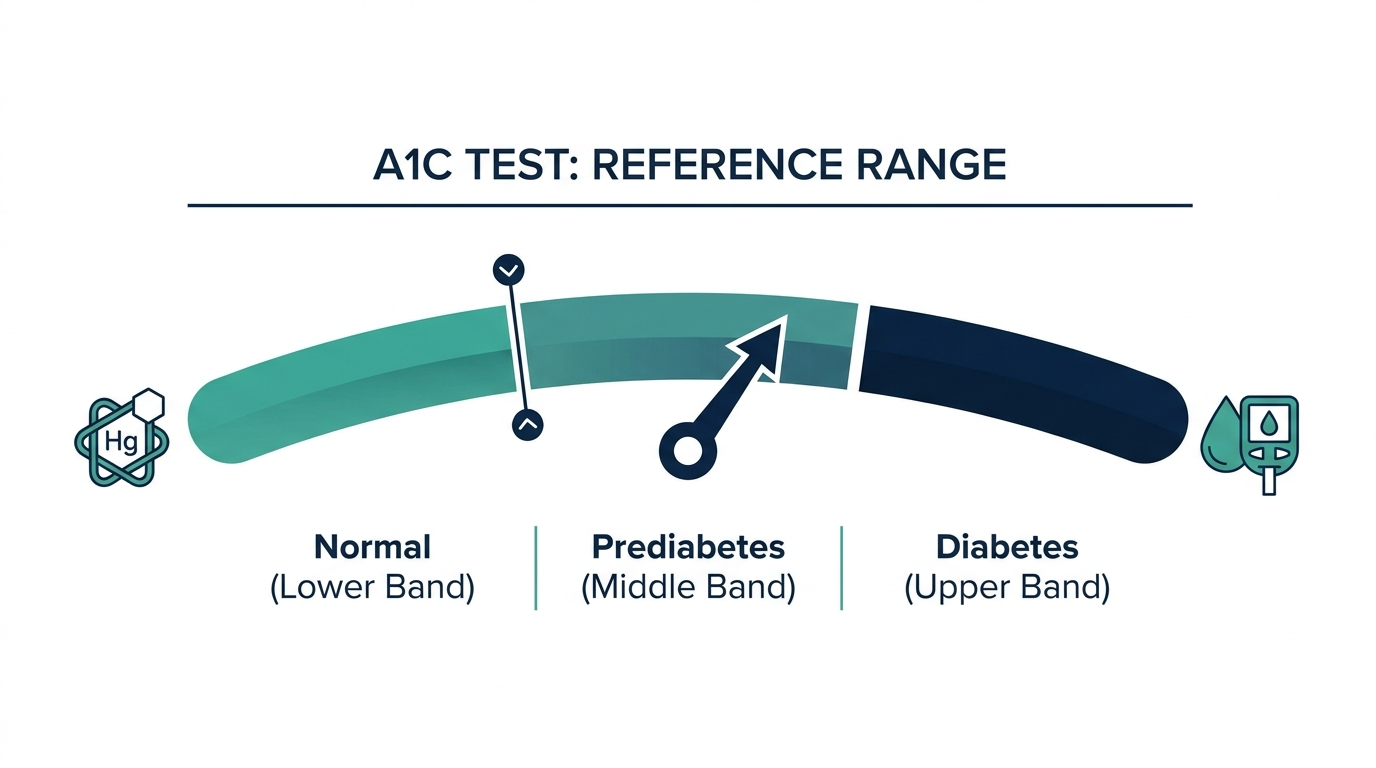
A normal A1C for an adult without diabetes is below 5.7%. The standard ranges set by the American Diabetes Association are clean and worth memorizing:
| A1C result | What it means | Rough average glucose |
|---|---|---|
| Below 5.7% | Normal | Under 117 mg/dL |
| 5.7% to 6.4% | Prediabetes | 117 to 137 mg/dL |
| 6.5% or higher | Diabetes | 140 mg/dL and up |
If you already have diabetes, the target shifts. Most adults aim for an A1C under 7%, but the right number is personal. A young, otherwise healthy person might push for 6.5% or lower, while an older adult with heart disease may be told 7.5% or even 8% is safer, because chasing a low A1C with aggressive medication raises the risk of dangerous low blood sugar. This is the part people miss: lower is not automatically better once you are on glucose-lowering drugs. The goal is steady control, not the smallest possible decimal.
Why the prediabetes band matters more than people think
The 5.7% to 6.4% window is not a gray zone to ignore until it tips over 6.5%. It is the most actionable result on the whole scale, because prediabetes is the one stage that reliably reverses. Large prevention trials show that people in this band who lose modest weight and move more cut their progression to type 2 diabetes by more than half over a few years. A 5.9% is not a slightly-off normal. It is an early warning with a known fix, and it is the result where reading this article actually changes the next three months of your life.
The honest caveat: when the number lies
A1C can read falsely high or low in several real situations, and a layperson rarely hears about them. It can read falsely low when red blood cells are turning over too fast to accumulate sugar: recent blood loss, hemolytic anemia, late pregnancy, recent transfusion, or treatment for iron or B12 deficiency. It can read falsely high with iron-deficiency anemia, severe kidney disease, or after a splenectomy, because cells live longer and collect more glucose. Certain hemoglobin variants common in people of African, Mediterranean, South Asian, and Southeast Asian descent (such as HbS, HbC, and HbE traits) can throw older A1C machines off in either direction. If your A1C and your daily glucose readings tell different stories, that mismatch is a real clue, not a rounding error, and it is worth flagging to a clinician who can confirm with a fasting glucose or an oral glucose tolerance test.
Fasting glucose vs A1C vs CGM: which test do you need?
You do not need to fast for an A1C test, and that is its quiet advantage over a fasting glucose test. Because the A1C reads a three-month average baked into your red blood cells, breakfast does not move it. You can walk into a lab at 4pm after lunch and get an accurate result. A fasting glucose test, by contrast, requires 8 to 12 hours without food to be valid.
So which should you get? Each test answers a slightly different question, and the table makes the trade-offs concrete.
| Test | What it sees | Fasting needed | Best for |
|---|---|---|---|
| A1C (HbA1c) | 3-month average glucose | No | Screening, diagnosis, long-term tracking |
| Fasting glucose | One morning snapshot | Yes, 8 to 12 hours | Cheap quick check, confirming A1C |
| Oral glucose tolerance test | How fast you clear a sugar load over 2 hours | Yes | Pregnancy, catching early insulin resistance |
| Continuous glucose monitor (CGM) | Glucose every few minutes for days to weeks | No | Seeing spikes, patterns, time-in-range |
For most people screening for type 2 diabetes, the A1C is the practical first move. Where it gets interesting is that A1C and fasting glucose do not always agree. You can have a normal fasting glucose but a creeping A1C, or vice versa, because they measure different time windows. That is why a thorough metabolic workup runs both, often alongside a cholesterol test (lipid panel), since blood sugar and lipids tend to drift together when insulin resistance sets in.
A continuous glucose monitor fills the gap the other three leave open. A1C gives the average but hides the swings; a CGM shows you that a bowl of oatmeal sends you to 180 while the same calories of eggs barely move you. It is overkill for a simple screen, but for someone in the prediabetes band trying to learn which foods are the problem, two weeks of CGM data teaches more than a year of quarterly draws. A1C is the report card, the CGM is the game film.
What can throw off your A1C result
Several everyday factors can skew an A1C up or down without your blood sugar actually changing, and knowing them keeps you from over-reacting to a single number. This is the insider context that separates a useful result from a misleading one.
- Anemia and iron status: iron-deficiency anemia tends to push A1C up; treating it can drop your A1C a few tenths with no change in diet. Recent blood loss or donation pushes it down.
- Pregnancy: red blood cell turnover speeds up, so A1C underreads in the second and third trimesters. This is exactly why gestational diabetes is screened with a glucose tolerance test, not an A1C.
- Kidney disease and dialysis: can shift A1C in either direction, and the number becomes less reliable as kidney function falls.
- Hemoglobin variants: sickle cell trait and other traits can confuse some lab machines. A lab can run a method that corrects for this if your clinician flags it.
- High-dose vitamin supplements: very large doses of vitamin C or E have been reported to interfere with certain A1C assays.
- Recent transfusion: mixes someone else’s red blood cells into your sample and muddies the average for weeks.
Notice what is NOT on this list: what you ate that morning, a stressful commute, or a poor night of sleep before the draw. Those move a fasting glucose but not an A1C, which is the whole point of the test. If none of the factors above apply, the simplest explanation for a surprising result is that your true average is higher or lower than you assumed.
Where to get an A1C test and what it costs
You can get an A1C test at a doctor’s office, a walk-in lab, a pharmacy clinic, or with an at-home kit, and prices vary more than most people expect. The blood can be drawn from a vein at a lab or, for point-of-care machines, from a finger prick that returns a result in about five minutes. Both are accepted, though the venous lab draw is considered the gold standard for diagnosis.
Rough US cash pricing in 2026:
| Where | How it works | Typical cash price |
|---|---|---|
| Lab walk-in (Quest, Labcorp) self-pay | Venous draw, results in a day or two | $9 to $50 |
| Pharmacy clinic (CVS MinuteClinic, etc.) | Finger-stick, result same visit | $30 to $75 |
| At-home kit | Finger-prick you mail in or read yourself | $10 to $40 |
| Doctor visit with insurance | Often $0 if preventive, billed lab fee if diagnostic | $0 to $50 copay |
| Full-body membership | A1C inside 100+ biomarkers, doctor-reviewed | About $199/year |
Here is the billing trap worth knowing. An A1C ordered as a routine screen for a healthy person is often a covered preventive benefit and costs you nothing. But the moment your chart carries a diagnosis like prediabetes or obesity, the same blood test can get coded as diagnostic monitoring, which means it counts toward your deductible. Same needle, same lab, different code, different bill. If cost matters, ask whether it is being billed as screening or diagnostic before you check out. For the bigger picture on lab pricing, see how much Superpower costs compared to paying per test.
If you are getting blood drawn anyway, it rarely makes sense to test A1C in isolation. Glucose, lipids, kidney, and liver markers all move together with metabolic health, and capturing them in one draw beats booking four separate tests. A complete blood panel gives you that full context for not much more than a standalone A1C at urgent care, which is part of what Superpower tests for in a single membership draw.
The simplest way to actually get this done
Superpower is a full-body lab membership that runs 100+ biomarkers, has each result reviewed by a doctor, and tracks your numbers year over year (about $199/year). It is what we point readers to when they would rather get one clean, complete draw than chase single tests one at a time. Here is superpower reviewed in full.
Does insurance cover A1C tests and glucose test strips?
Most plans cover an A1C as preventive screening at no cost, and they cover glucose test strips for anyone with a diabetes diagnosis, but the details trip people up constantly. Let us separate the two, because they run through different parts of your benefits.
The A1C test itself
Under most commercial plans and the Affordable Care Act preventive rules, a screening A1C for an at-risk adult is covered with no copay. Once you carry a diabetes or prediabetes diagnosis, the test is reclassified as ongoing diagnostic monitoring and typically applies to your deductible, even though it is the exact same lab. Medicare covers A1C testing for people with diabetes and, for those at risk, up to two diabetes screenings per year under Part B.
Glucose test strips
Test strips are covered when you have a documented diabetes diagnosis, but the channel and quantity depend on your plan. Most commercial plans run strips through the pharmacy benefit, while traditional Medicare covers them under Part B as durable medical equipment, with quantity limits that are higher if you use insulin than if you do not. UnitedHealthcare and the AARP-branded Medicare Advantage plans it administers generally cover diabetes testing strips, but they often steer you to a preferred brand (frequently OneTouch or Accu-Chek), and using a non-preferred brand can mean a higher copay or no coverage at all. The practical move is to call the number on your card and ask two questions: which strip brand is preferred, and how many strips per month are covered for your insulin status. If you do not have a diabetes diagnosis, strips are almost never covered and run about $0.30 to $1.00 each out of pocket.
Tax deduction angle
You can include diabetes test costs in the medical expense deduction on your federal taxes, including A1C lab fees, glucose meters, and test strips, as long as they are not reimbursed by insurance and you itemize. The catch is the threshold: only the portion of total qualified medical expenses above 7.5% of your adjusted gross income is deductible, so for most people the strips alone will not clear the bar unless they are bundled with a large medical year. HSA and FSA funds, by contrast, can pay for all of these with pre-tax dollars and have no threshold, which is usually the better route. This is general information, not tax advice, so confirm specifics with a tax professional.
Common mistakes people make with the A1C test
Most A1C confusion comes from a handful of repeat mistakes, and avoiding them saves you money, anxiety, and a wasted retest. Here are the ones we see most.
- Fasting for it anyway. Plenty of people skip breakfast for an A1C out of habit. It is not wrong, just unnecessary, and it makes the appointment harder than it needs to be. Eat normally.
- Retesting too soon. Because the number is a three-month average, rechecking it after two or three weeks of clean eating tells you almost nothing. The biology has not caught up. Wait at least eight to twelve weeks to see a meaningful move.
- Panicking over one reading. A single A1C of 6.6% is not a diabetes diagnosis. Diagnosis needs two abnormal readings, or one plus clear symptoms. Lab error and assay variation are real.
- Crash-dieting the week before the draw. Unlike fasting glucose, you cannot meaningfully game an A1C with a few good days, so the crash diet just makes you miserable for no payoff.
- Ignoring a normal A1C with high meter readings. If your A1C is fine but your post-meal spikes are frequent, you may have early dysfunction the average is smoothing over. Trust the mismatch and dig deeper.
- Buying a random at-home kit for diagnosis. At-home kits are great for tracking trends, but a formal diabetes diagnosis should rest on a CLIA-certified venous lab result ordered through a clinician.
How to lower a high A1C and when to recheck
If your A1C lands in the prediabetes range, the good news is that it responds to the same levers that drive it up, and many people pull it back under 5.7% without medication. Because the number reflects a three-month average, changes show up slowly. Do not retest in two weeks expecting a different decimal. The standard interval is every three months while you are actively working to move it, then every six to twelve months once it is stable.
What actually shifts the number:
- Cut refined carbs and sugary drinks: the fastest dietary lever, since these spike glucose hardest and most often.
- Move after meals: even a 10 to 15 minute walk after eating blunts the post-meal glucose surge that feeds A1C.
- Lose modest weight: dropping 5% to 7% of body weight meaningfully improves insulin sensitivity in people with prediabetes.
- Sleep and stress: chronic short sleep and high cortisol both raise blood sugar, which is why an A1C can creep up even when diet looks clean.
A worked example of what to expect
Say you draw a 6.1% in January, an estimated average glucose around 128 mg/dL. You drop the daily soda and the nightly cereal, walk fifteen minutes after dinner, and lose six pounds over three months. A realistic April result is 5.7% to 5.8%, an eAG near 117. That is not dramatic on paper, but it is the difference between trending toward diabetes and away from it. Keep the same habits another quarter and a July reading in the low 5.5% range is common. The number moves at the speed of red blood cell turnover, so the calendar matters as much as the effort.
A single elevated A1C is a reason to confirm, not to panic. Diagnosis of diabetes requires two readings of 6.5% or higher, or one reading plus clear symptoms. Talk to a clinician about your result rather than self-diagnosing from one number, especially if you also have unexplained thirst, frequent urination, or fatigue. The A1C tells you the trend. What you do with the next three months tells the rest of the story.
Edge cases: health fairs, at-home kits, minors, and the uninsured
The standard path is a lab or pharmacy, but plenty of people get an A1C through less obvious routes, and each has its own rules.
Who can run a diabetes test at a health fair?
At a community health fair, a finger-stick glucose or A1C screening is usually performed by licensed personnel such as registered nurses, pharmacists, supervised medical assistants, or trained public-health staff, operating under a physician or pharmacy CLIA waiver (see the California specifics in the FAQ below). A health-fair result is a screen, not a diagnosis. If it flags high, the next step is a confirmatory lab draw ordered by a clinician, not a treatment decision.
I received an A1C kit I did not order
If a kit shows up from a company like Home Access Health or a similar mail-order lab and you never requested it, do not use it and do not ignore a bill. Unsolicited test kits sometimes trace back to a telehealth order tied to your insurance, or to a marketing list, and occasionally to billing fraud. Call the company to confirm what was ordered and under whose name, check your insurance explanation-of-benefits for a charge, and if it looks fraudulent, report it to your insurer and to the FTC. You are not obligated to pay for or use a test you did not authorize.
Minors, employers, and the uninsured
For a minor, an A1C generally needs a parent or guardian’s consent and is usually ordered by a pediatrician only when risk factors such as obesity or a strong family history exist, since routine screening is not recommended for low-risk children. If an employer or wellness program asks for an A1C, it is run through a contracted vendor and the result goes to you, not your boss, under wellness-program privacy rules. Without insurance, the cheapest reliable route is a self-pay order through a discount lab network (often $9 to $30), or a sliding-scale draw at a community or federally qualified health center; an at-home mail-in kit at $10 to $40 is a fine middle ground for tracking.
Don’t just read about your health, track it.
A single result is a snapshot. Superpower re-tests 100+ markers over time so you can watch them move as you change sleep, food, and training.
FAQ
What is a healthy fasting glucose number compared to A1C?
A normal fasting glucose is under 100 mg/dL, 100 to 125 mg/dL signals prediabetes, and 126 mg/dL or higher on two tests indicates diabetes. It lines up roughly with the A1C cutoffs but measures a single fasting moment rather than a three-month average. The two can disagree, which is why doctors often run both.
Does health insurance cover A1C and glucose test strips?
Most plans cover an A1C as preventive screening at no cost, but coverage can shift to your deductible once a diabetes-related diagnosis is on your chart. Glucose test strips are generally covered for people with a diagnosis of diabetes, often through pharmacy or durable medical equipment benefits, though brand and quantity limits apply. Check your specific plan, since Medicare Advantage and commercial rules differ.
Does UnitedHealthcare or AARP Medicare cover diabetes testing strips?
Yes, UnitedHealthcare and the AARP-branded Medicare Advantage plans it administers cover diabetes testing strips for members with a diabetes diagnosis, but they usually designate a preferred brand and may charge more or deny coverage for a non-preferred one. Traditional Medicare covers strips under Part B as durable medical equipment with monthly quantity limits that depend on whether you use insulin. Call the number on your card to confirm the preferred brand and your covered quantity before you fill.
Can I include diabetes test costs on a health expense tax deduction?
Yes. Unreimbursed A1C lab fees, glucose meters, and test strips count as qualified medical expenses for the federal itemized medical deduction, but only the amount of your total qualified expenses above 7.5% of your adjusted gross income is deductible. For most people, HSA or FSA dollars are the easier win, since they pay for the same items pre-tax with no income threshold. This is general information, so confirm with a tax professional.
Where are glucose test strips made and are they all the same?
Major glucose test strips are made by manufacturers like LifeScan (OneTouch), Roche (Accu-Chek), Ascensia (Contour), and Abbott, with production in the US, Europe, and Asia depending on the line. They are not interchangeable across meters: each strip is calibrated to a specific brand and model of meter, so a OneTouch strip will not work in an Accu-Chek device. Using the wrong or expired strip is a common cause of inaccurate readings, so match the strip to your meter and watch the expiration date.
Can I do an A1C test at home?
Yes. At-home A1C kits use a finger-prick sample you either read on a small meter or mail to a lab, with results in minutes or a few days. They are reliable enough for tracking trends, but a formal diabetes diagnosis should be confirmed with a venous lab draw ordered through a clinician.
How often should I get an A1C test?
If your levels are normal, every three years is the standard screening interval for adults over 35 or those with risk factors. With prediabetes, retest every year. If you are actively lowering an elevated A1C or managing diabetes, every three to six months tracks your progress without testing so often that the average has not had time to change.
How fast can an A1C change?
Meaningful change shows up over weeks to months, not days, because the test reflects the lifespan of your red blood cells. You may see a small move at four to six weeks, since recent glucose is weighted most heavily, but the fullest picture takes a full three months. That is why retesting sooner than eight weeks usually wastes a draw.
Who can perform diabetes testing at a health fair in California?
In California, finger-stick glucose and A1C screening at a health fair is performed by licensed health professionals such as nurses or pharmacists, or by trained volunteers working under a supervising clinician’s CLIA-waived certificate, following state lab and bloodborne-pathogen rules. A health-fair reading is a screen only. Anything that flags high should be confirmed with a clinician-ordered lab test before any diagnosis or treatment.
Vital Signs Today may earn a commission if you buy through links on this page. It does not affect our editorial assessments.