Quick answer: A liver function test is a blood test that checks how healthy your liver is by measuring a small group of enzymes and proteins, usually run as the liver panel inside a comprehensive metabolic panel. It measures the enzymes ALT and AST, plus ALP and GGT, along with bilirubin, albumin, and total protein. Elevated ALT and AST suggest liver cells are inflamed or damaged, while abnormal bilirubin or albumin show how well the liver is actually doing its job. You do not need to fast for a basic liver function test, and most adults can get one at a lab, urgent care, or through an at-home kit for roughly $20 to $80 cash.
What a liver function test measures
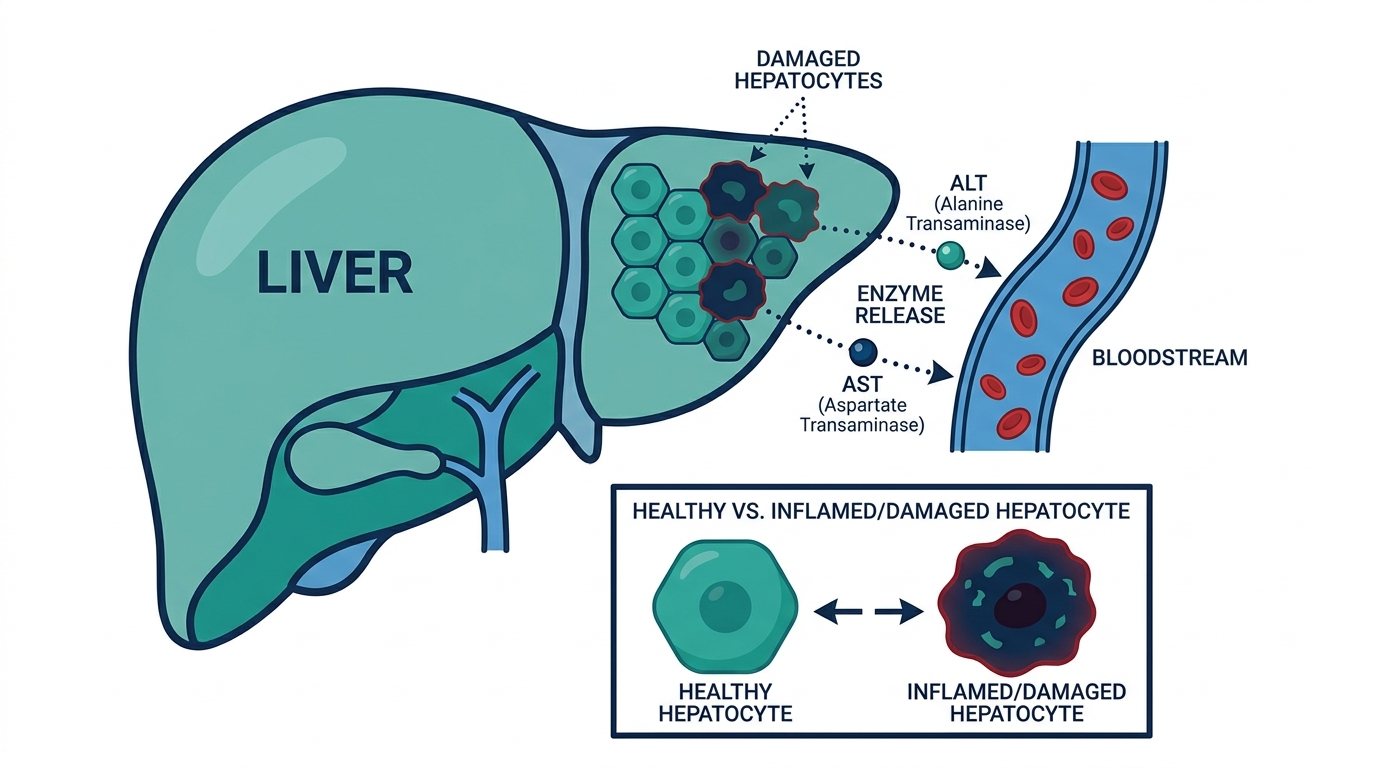
A liver function test (sometimes written LFT) is a group of blood markers that together tell you whether your liver is irritated, leaking enzymes, or struggling to perform its normal work. Here is the catch most people miss: the name is slightly misleading. Half of these markers are not function tests at all. They are damage markers. The enzymes (ALT, AST, ALP, GGT) leak out when liver cells or bile ducts are injured. The true function markers (bilirubin, albumin, sometimes prothrombin time) tell you how well the surviving liver is doing its real jobs. Knowing the difference is what separates a useful reading from a scary one.
ALT and AST flag liver stress, but a full panel can catch problems long before symptoms show up. Curious what yours would reveal? One at-home Superpower draw checks 100+ biomarkers, physician-reviewed.
Think of it like checking on a factory. The enzymes are the smoke and noise off the machines, a sign something is straining. The function markers are the finished products coming off the line. A factory can be noisy but still shipping (high enzymes, normal function), or quiet but barely producing (normal enzymes, low albumin). Read both halves together. Here is what a standard panel includes and what each line is really telling you.
ALT (alanine aminotransferase)
ALT is the most liver-specific enzyme on the panel, which is why most clinicians look at it first. It lives mostly inside liver cells, so when those cells are damaged, ALT spills into the blood and the number climbs. Because it is so concentrated in the liver and barely anywhere else, a high ALT points fairly directly at the liver itself rather than some other organ. If you only remember one number from your liver function test, make it ALT.
AST (aspartate aminotransferase)
AST also rises with liver damage, but it is not liver-exclusive. It lives in muscle, heart, and red blood cells too. That means a hard leg workout, a recent muscle injury, or even a bruised arm from a rough blood draw can push AST up without anything being wrong with your liver. AST is most useful when you read it next to ALT as a ratio, not on its own.
ALP (alkaline phosphatase)
ALP is tied to the bile ducts and to bone. A high ALP usually points to a bile-flow problem (the plumbing that carries bile out of the liver) rather than the liver cells themselves. Because ALP also comes from bone, it runs naturally higher in growing teenagers and in pregnancy, neither of which is a liver problem. When ALP is up, clinicians often check GGT next to figure out whether the source is the liver or the bone.
GGT (gamma-glutamyl transferase)
GGT is the tie-breaker. It rises with bile-duct issues and is sensitive to alcohol, so it is the marker that helps sort out a confusing result. If ALP is high and GGT is also high, the problem is almost certainly the liver or bile ducts. If ALP is high but GGT is normal, the ALP is probably coming from bone, not the liver. GGT is not on every basic panel, but it is the first add-on a clinician orders when the bile-duct picture is unclear.
Bilirubin
Bilirubin is the yellow-orange pigment left over when old red blood cells break down. A healthy liver grabs it from the blood, processes it, and ships it out in bile. When the liver cannot keep up or the bile ducts are blocked, bilirubin backs up into the bloodstream and you get jaundice, the yellowing of skin and the whites of the eyes. Labs often split it into total and direct (conjugated) bilirubin, because the pattern between them hints at whether the holdup is before, inside, or after the liver.
Albumin and total protein
Albumin is a protein the liver manufactures, and it is one of the truest function markers on the panel. Low albumin can mean the liver has been underperforming for a while, since albumin reflects weeks of production rather than a single bad day. Total protein is albumin plus the antibody proteins (globulins). These two together tell you about the liver’s long-term output and your overall nutrition and inflammation status, not just acute damage.
ALT and bilirubin are the workhorses; the rest add context. If you want to understand which markers are worth tracking beyond the liver, see the biomarkers worth tracking.

Normal ranges for each marker
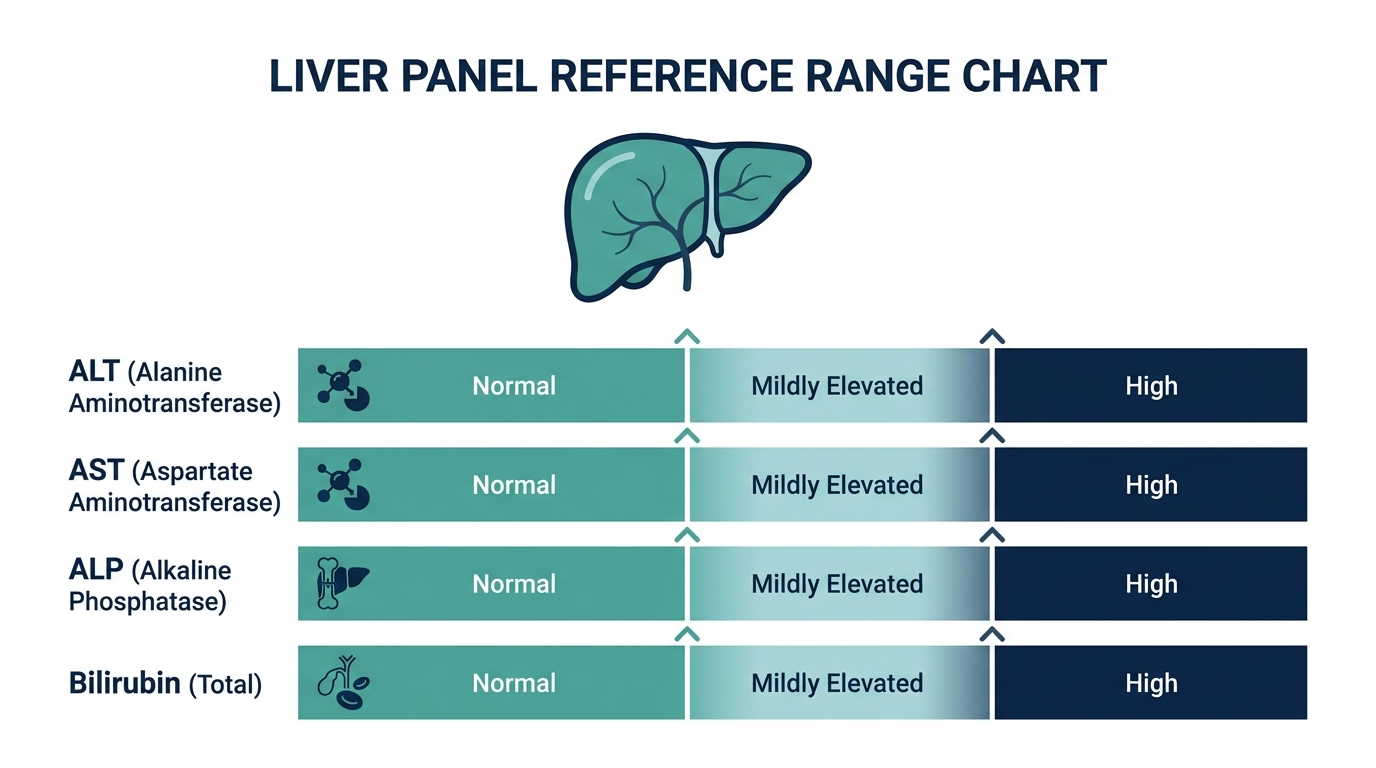
Reference ranges vary slightly by lab, by sex, and by the assay the lab uses, and your report will print its own ranges next to your numbers. Always compare your result to the range on your own printout, not to a number from the internet. As a general US adult guide:
| Marker | Typical reference range | What it mostly reflects |
|---|---|---|
| ALT | 7 to 55 U/L | Liver cell damage (most specific) |
| AST | 8 to 48 U/L | Liver, but also muscle and heart |
| ALP | 40 to 130 U/L | Bile ducts and bone |
| GGT | 9 to 48 U/L | Bile ducts, sensitive to alcohol |
| Total bilirubin | 0.1 to 1.2 mg/dL | Bile clearance, jaundice risk |
| Albumin | 3.5 to 5.0 g/dL | Long-term liver production, nutrition |
| Total protein | 6.0 to 8.3 g/dL | Albumin plus antibody proteins |
One nuance worth knowing: many hepatologists now argue the standard ALT ceiling is too generous. The lab might flag anything over 55 U/L, but research suggests the true healthy upper limit is closer to 30 U/L for men and 19 to 25 U/L for women. So an ALT of 45 can read as “normal” on your report and still be worth a second look if it is trending up over time. This is exactly the kind of thing a single snapshot misses and a tracked baseline catches.
What high ALT and AST levels mean
High ALT and AST mean liver cells are releasing enzymes they normally keep inside, which signals inflammation or injury. The size of the jump tells most of the story. Mildly elevated numbers (say, ALT in the 50s to low 100s) are extremely common and usually point to fatty liver, alcohol, certain medications, or a recent viral illness. Levels in the hundreds or thousands are a different conversation and warrant prompt medical attention, since they can signal acute hepatitis, a serious drug reaction, or significant liver injury.
The most common causes of a modestly elevated liver function test in US adults:
- Metabolic-associated fatty liver disease (MASLD, formerly NAFLD): now the leading cause of mildly high ALT, driven by excess weight, insulin resistance, and a diet heavy in sugar and refined carbohydrates. It is quietly common and often the answer when someone with no symptoms has a slightly off panel.
- Alcohol: heavy or even moderate regular intake. A classic clue is an AST that is roughly twice the ALT, often with a high GGT alongside.
- Medications and supplements: acetaminophen at high doses, some statins, certain antibiotics, and yes, some bodybuilding, weight-loss, or herbal supplements. Green tea extract, kava, and high-dose niacin are repeat offenders that people rarely suspect.
- Viral hepatitis: hepatitis B and C can simmer for years with only modest enzyme bumps, which is why a one-time elevated panel sometimes leads to a hepatitis screen.
- Recent hard exercise: intense weightlifting or endurance work can raise AST (and to a lesser degree ALT) from muscle for a day or two, with nothing wrong with the liver at all.
Here is the insider detail: a slightly high AST on its own often means nothing about your liver. If you lifted weights or ran hard the day before, AST climbs from muscle, not liver. Clinicians lean on the pattern between markers and repeat the test before reading too much into one result. One abnormal number is a reason to recheck in a few weeks, not a reason to panic.

Reading the AST:ALT ratio and common patterns
The single most useful trick in a liver function test is comparing the markers to each other instead of reading each one alone. The relationship between AST and ALT, and between the enzymes and ALP, sketches out the likely cause before any other test is run. Clinicians do this in their head in seconds. You can learn the same shortcuts.
| Pattern | What it often suggests | Typical next step |
|---|---|---|
| AST and ALT both high, ALT higher (ratio under 1) | Fatty liver, viral hepatitis, medication injury | Recheck, screen for MASLD and hepatitis |
| AST roughly 2x ALT or more | Alcohol-related liver injury (classic ratio), or advanced scarring | Honest alcohol history, GGT, possible imaging |
| ALP and GGT both high, enzymes mild | Bile-flow obstruction (gallstones, duct problem) | Ultrasound of the liver and bile ducts |
| ALP high, GGT normal | Bone source, not liver (growth, pregnancy, bone disease) | Reassure, look at bone markers if needed |
| Enzymes normal, albumin low, bilirubin high | Reduced liver function, possible chronic disease | Clinical evaluation, do not ignore |
Notice the last row. It is the pattern people most often miss because the famous numbers (ALT, AST) look fine. Damage markers can be calm while function markers quietly slip, which happens in long-standing liver disease where there are fewer healthy cells left to leak enzymes. That is why a good liver function test reports both halves, and why you read them together.
A worked example: reading a real-looking panel
Say a 41-year-old man with no symptoms gets a routine liver function test and sees this: ALT 78, AST 52, ALP 70, GGT 60, total bilirubin 0.8, albumin 4.4. What does it say?
Walk it through. ALT is above the lab ceiling and higher than AST, so the ratio is under 1, which steers away from alcohol as the lead suspect and toward fatty liver or a medication effect. GGT is mildly up, ALP is normal, so the bile ducts look fine and the GGT bump fits alcohol or fatty liver rather than obstruction. Bilirubin and albumin are squarely normal, so the liver is still functioning well; this is damage signal, not failure. The realistic read: probably early MASLD, the most common cause of exactly this picture in a US adult, worth a recheck in four to six weeks after cleaning up diet, alcohol, and any nonessential supplements. No emergency, but not nothing either.
Now change one number. If that same man had AST 140 and ALT 70 (AST roughly double ALT) with a GGT of 200, the story flips toward alcohol-related injury, and the conversation becomes a candid one about drinking rather than diet. Same panel, different pattern, different path. This is why the cheapest, most powerful upgrade to a liver function test is not a fancier test, it is a second data point a few weeks later so you can see direction, not just position.

Where the liver panel lives in your results
The blood test that shows liver health is the liver panel, and most people already have it without realizing. It is bundled into the complete blood panel setup that a comprehensive metabolic panel (CMP) provides. A CMP includes ALT, AST, ALP, bilirubin, albumin, and total protein alongside kidney and electrolyte markers. So if your doctor ordered a CMP at your last physical, your liver was already screened, even if no one used the words “liver function test” out loud.
You can also order a standalone hepatic function panel if you only want the liver markers. The difference matters mostly for cost and for what else you learn. A standalone liver panel is cheaper as a single line item, but a CMP gives you kidney and glucose data for nearly the same draw. Since the same vial of blood is being used, capturing more at once is usually the smarter move. The liver and kidneys are often stressed by the same things (alcohol, certain medications, metabolic disease), which is why a kidney function test pairs naturally with a liver workup.
Do you need to fast for a liver function test?
You do not need to fast for a standard liver function test. ALT, AST, ALP, and bilirubin are not meaningfully changed by a recent meal, so you can walk in and get a basic liver panel any time of day. This is one of the genuinely easy tests, no skipped breakfast required.
The wrinkle is that liver markers are often ordered together with a CMP or a lipid panel, and those companions do have fasting rules. Glucose and triglycerides read more accurately after 8 to 12 hours without food. So if your draw includes cholesterol or fasting glucose, you will be asked to fast for the whole order, the liver part along with it. When in doubt, ask what is on the requisition. If it is liver markers only, eat normally and stay hydrated, since being dehydrated can subtly skew several blood values. One thing that does matter regardless of fasting: skip hard exercise and alcohol for a day or two before the draw, because both can nudge enzymes up and muddy the read.
How to test liver health at home and what it costs
You can test liver health at home with a finger-prick or mail-in kit, and the convenience is real, but so are the limits. At-home liver panels typically measure ALT, AST, and sometimes ALP from a small blood sample you collect yourself, then mail to a lab. Results land in an app within a few days. They are a reasonable screening tool for an otherwise healthy person who wants a baseline, not a diagnosis. The trade-off is that a finger-prick sample is smaller and easier to contaminate or hemolyze than a clean venous draw, which can occasionally throw off a result, and most at-home kits cover fewer markers than a full venous panel.
Rough US pricing in 2026:
| Where | What you get | Typical cash price |
|---|---|---|
| Lab walk-in (Quest, Labcorp) self-pay | Hepatic function panel or CMP, venous draw | $20 to $80 |
| Discount online lab (order online, draw in person) | CMP or liver panel, venous draw, no doctor visit | $15 to $45 |
| Urgent care or CVS MinuteClinic | Liver panel as part of a visit | $100 to $250 with the visit fee |
| At-home mail-in kit | ALT, AST, sometimes ALP, finger-prick | $50 to $100 |
| Full-body membership | Liver markers inside 100+ biomarkers, doctor-reviewed | About $199/year |
For a single yes-or-no on your liver, an at-home kit or a cheap walk-in draw is plenty. But if you are getting a needle in your arm anyway, capturing your liver, kidney, metabolic, and cardiovascular picture in one draw is almost always the better value than chasing single tests one at a time. If you want to compare what a broad panel actually covers, here is what Superpower tests for, and here is how much Superpower costs against piecemeal lab fees.
The simplest way to actually get this done
Superpower is a full-body lab membership that runs 100+ biomarkers, has each result reviewed by a doctor, and tracks your numbers year over year (about $199/year). It is what we point readers to when they would rather get one clean, complete draw than chase single tests one at a time. Here is superpower reviewed in full.
Common mistakes people make with a liver function test
Most of the panic and confusion around liver results comes from a handful of avoidable errors. Knowing them turns a stressful printout into a calm one.
- Reading one number in isolation. A lone high AST after a gym session means little. The pattern across markers matters far more than any single value.
- Panicking over a mild elevation. An ALT in the 60s or 70s is common and usually points to fatty liver, not catastrophe. Mild and stable is a “recheck and adjust,” not an “emergency.”
- Working out hard the day before. Intense exercise raises AST (and some ALT) from muscle and can fake a worse result. Rest a day or two before the draw.
- Forgetting supplements count. People list prescription drugs but forget the pre-workout, the fat-burner, the green tea extract, or the herbal “liver detox” that is, ironically, stressing the liver. Tell the clinician everything you swallow.
- Treating one snapshot as the truth. A liver function test is a moment in time. Without a prior value, you cannot tell whether a borderline number is rising, falling, or steady. The trend is the diagnosis.
- Assuming normal enzymes mean a healthy liver. In advanced disease, enzymes can settle back toward normal because there are fewer cells left to leak. Low albumin or high bilirubin with “normal” enzymes is not reassuring, it is the opposite.
- Skipping the recheck. The most useful follow-up to an odd result is simply repeating it in a few weeks. Many one-off elevations resolve on their own.
Edge cases: uninsured, employer-required, Medicare, and minors
Who you are changes how you should get a liver function test and who pays.
Uninsured or cash-pay: skip the urgent care markup. A direct-to-consumer online lab lets you order a CMP or hepatic panel yourself for $15 to $45 and draw at a local Quest or Labcorp, no doctor visit needed. This is the cheapest legitimate route and the results are identical to a clinician-ordered draw.
Employer or insurance-required: some life-insurance applications and a few jobs require a liver panel, often alongside other screens. Read whether it must be fasting (it usually is not for liver alone, but the bundled glucose or lipids might be). Use an in-network lab to avoid a surprise bill.
Medicare and older adults: Medicare covers a liver panel when it is medically necessary (symptoms, a known condition, or monitoring a medication like a statin), but not purely for curiosity. If your reason is screening without symptoms, expect to pay cash or use a self-pay lab.
Minors: children’s reference ranges differ, especially ALP, which runs much higher in growing kids and teens because their bones are active. A teen’s “high” ALP is frequently just growth, not a liver problem. Pediatric liver testing should go through a clinician who reads it against age-specific ranges, not adult numbers.
Who should test, and how often
If you have no symptoms and no risk factors, a liver function test once at a routine physical, then every few years, is reasonable. The picture changes if you carry risk. Test more proactively, roughly once a year or as your clinician advises, if any of these apply to you:
- You drink regularly, or are cutting back and want to watch the markers improve.
- You are overweight, have prediabetes or type 2 diabetes, or have high triglycerides (the MASLD cluster).
- You take a long-term medication that the liver processes, such as a statin, methotrexate, or certain seizure or psychiatric drugs.
- You use bodybuilding, weight-loss, or herbal supplements regularly.
- You have a family history of liver disease, or a past hepatitis exposure.
The decision rule is simple. A one-time normal result is a snapshot. If you have any liver risk at all, a tracked baseline you can compare against next year is worth far more than a single reading, because the whole game with the liver is catching a slow drift early, while it is still reversible.
When a single number should send you to a clinician
A single mildly high value is common and rarely an emergency. The right move is to recheck in a few weeks, ideally after cutting alcohol, pausing nonessential supplements, and not exercising hard right before the draw. What should not wait: numbers several times the upper limit, a trend that keeps climbing across repeat draws, or any liver result paired with symptoms like fatigue, abdominal pain on the upper-right side, dark urine, pale stools, or yellowing skin and eyes. Talk to a clinician about your results rather than self-diagnosing from a single printout. The test tells you where to look; a clinician tells you what to do.
Turn what you just learned into action.
Superpower lets you test 100+ biomarkers from home, then re-check them over time so you can actually see progress, physician-reviewed at every step.
FAQ
What is a liver function test, in plain terms?
It is a blood test that measures a handful of enzymes and proteins to gauge whether your liver is irritated, damaged, or underperforming. The enzymes (ALT, AST, ALP, GGT) flag damage; the proteins and bilirubin show how well the liver is doing its job. Read together, they give a quick read on liver health from a single draw.
How is liver health tested without a blood test?
Blood is the standard screen, but imaging adds another layer. An ultrasound or a FibroScan can show fat, scarring, and stiffness in the liver tissue itself, which enzymes alone cannot. You cannot reliably check liver health without any test at all; symptoms like fatigue or right-side discomfort are too vague to confirm anything. Bloodwork is the practical starting point, and imaging follows when results or symptoms call for it.
What blood test indicates liver health most directly?
ALT is the most liver-specific marker, so it is the number clinicians weigh most heavily. Bilirubin and albumin tell you how well the liver is functioning rather than how damaged it is. Read together, ALT plus bilirubin gives the clearest quick picture of damage and function in two numbers.
How do you test your liver health if you have symptoms?
If you have jaundice, dark urine, persistent fatigue, or upper-right abdominal pain, do not rely on an at-home kit. See a clinician and get a full hepatic function panel plus, if warranted, viral hepatitis testing and imaging. Symptoms change the urgency and the workup, and they move you from screening into diagnosis.
How to check liver health in a blood test you already have?
Pull up your most recent CMP or metabolic panel results in your patient portal and find the ALT, AST, ALP, bilirubin, and albumin lines. Compare each to the reference range printed beside it. If the markers sit inside their ranges, your liver screened normal on that draw. If one is flagged, note how far off it is and whether you have an older result to compare against.
What blood tests show liver health beyond the basic panel?
Beyond ALT, AST, ALP, GGT, bilirubin, and albumin, a clinician may add a hepatitis B and C screen, an INR or prothrombin time (a true function test of clotting factors the liver makes), and a platelet count, which can drop in advanced liver disease. These are not on a basic liver function test but round out the picture when something looks off.
Can a liver function test be normal and the liver still be unhealthy?
Yes. Early fatty liver and even some scarring can exist with normal or only slightly elevated enzymes, and in advanced disease the enzymes can fall back toward normal as fewer cells remain to leak them. This is why low albumin or high bilirubin with normal enzymes is not reassuring, and why imaging is sometimes needed even when the bloodwork looks fine.
How fast can liver enzymes improve after a lifestyle change?
For mild fatty-liver elevations, cutting alcohol, losing even 5 to 10 percent of body weight, and reducing sugar can move ALT and AST measurably within a few weeks to a few months. That is exactly why a recheck a month or two later is so useful: it shows whether your changes are working.
Do I need to fast before a liver function test?
Not for the liver markers themselves. ALT, AST, ALP, and bilirubin are not changed in a way that matters by a recent meal. You only need to fast if your draw is bundled with glucose, an A1C is not affected but fasting glucose is, or a lipid panel, which do require 8 to 12 hours without food. Check the requisition or ask the lab.
Related: see our ranking of the best at-home blood tests.
Vital Signs Today may earn a commission if you buy through links on this page. It does not affect our editorial assessments.