Last updated June 2026. Educational content, not medical advice. Peptides vary widely in legal status and evidence quality. Consult a licensed clinician before starting any peptide therapy.
Short answer: Tirzepatide (Zepbound/Mounjaro) is the best clinically proven peptide for weight loss available today, with a mean 22.5% body-weight reduction at 15 mg over 72 weeks in the SURMOUNT-1 trial. If Eli Lilly’s retatrutide clears FDA approval in 2027, that number could jump to 28.3% based on Phase 3 TRIUMPH-1 data. Every other peptide marketed for fat loss produces results measured in single-digit percentages, if it has human data at all.
Tirzepatide leads the rankings for weight loss, but your own metabolic markers determine what actually works for you. One at-home Superpower draw checks 100+ biomarkers, physician-reviewed.
That ranking matters because the “best peptide for weight loss” question is one of the most frequently distorted searches in the health and wellness space. Forums and vendor blogs cheerfully stack GH secretagogues, growth-hormone fragments, and exotic mitochondrial peptides next to FDA-approved GLP-1 drugs as if they are comparable options. They are not. The evidentiary gap between tirzepatide and CJC-1295 is about the same size as the gap between chemotherapy and a multivitamin.
What follows is a level-by-level breakdown of every major peptide class marketed for weight loss, ranked honestly by evidence, plus the real costs, legal realities, and the one thing most of these articles will not say directly: for most people who just want to lose meaningful weight and keep it off, only one or two of these actually work.
Full-body lab membership: 100+ biomarkers, doctor-reviewed, tracked over time.
Which peptide class produces the largest weight loss?
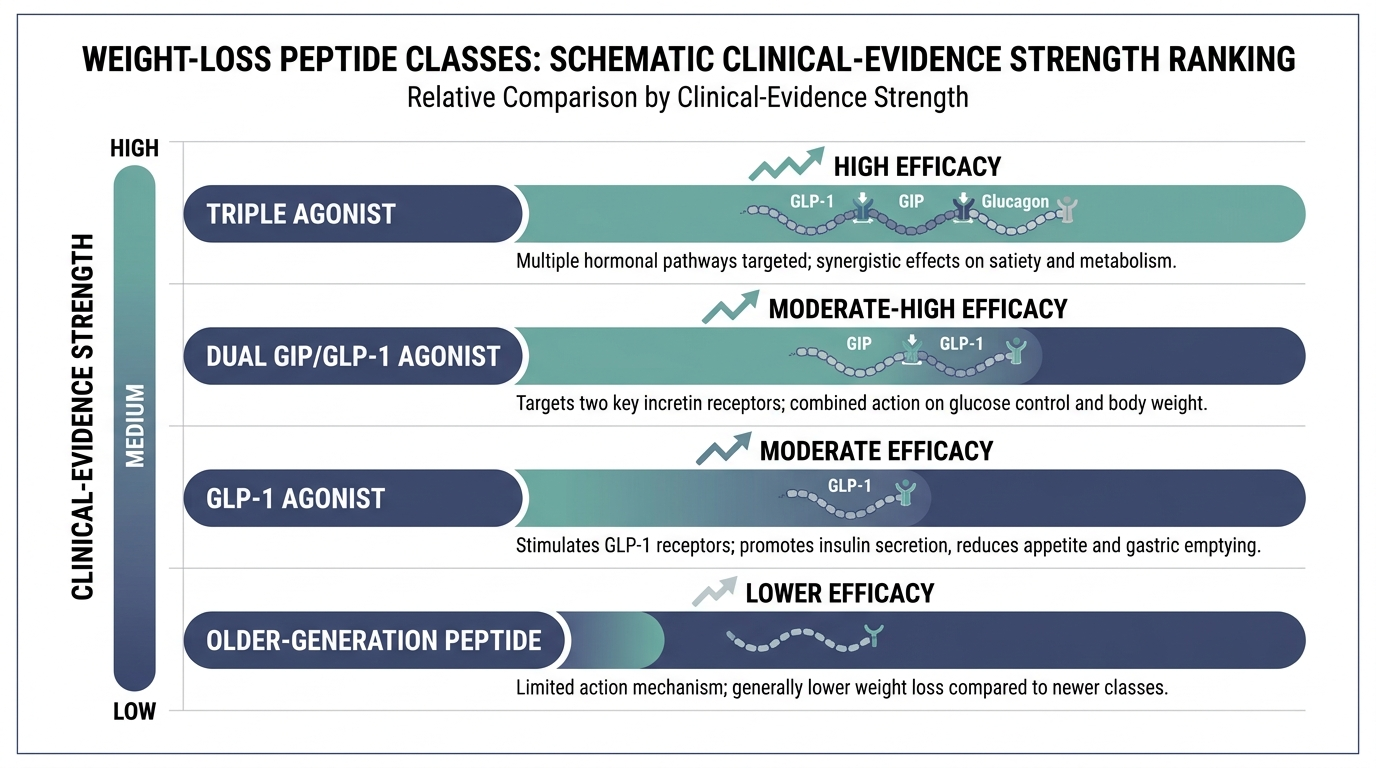
The incretin hormones win, and it is not close. GLP-1 receptor agonists and their multi-receptor cousins are the only class of peptides that has produced double-digit, sustained, fat-mass-dominant weight loss in large, randomized, placebo-controlled trials. Every other peptide category is in a different evidence tier.
Here is the head-to-head comparison across every category you will find discussed online:
| Peptide | Mechanism | Best human trial weight loss | FDA status | Legal route |
|---|---|---|---|---|
| Tirzepatide (Zepbound) | GLP-1 + GIP dual agonist | 22.5% at 72 wks (SURMOUNT-1) | Approved (obesity) | Prescription only |
| Semaglutide (Wegovy) | GLP-1 agonist | 14.9% at 68 wks (STEP-1) | Approved (obesity) | Prescription only |
| Retatrutide | GLP-1 + GIP + glucagon triple agonist | 28.3% at 80 wks (TRIUMPH-1, Phase 3) | Investigational | Clinical trial enrollment only |
| Sermorelin | GHRH analog, raises natural GH | Body composition improvements; no large weight-loss RCT | Prescription (telehealth) | Licensed telehealth / compounding |
| CJC-1295 + Ipamorelin | GH secretagogue stack | No controlled weight-loss trial; GH rise confirmed | Research use only | Research-chem vendor or grey-market |
| AOD-9604 | GH fragment, lipolysis signaling | Phase 3 failed for obesity; modest waist reduction in earlier trials | Not approved | Research use only |
| 5-Amino-1MQ | NNMT inhibitor, fat-cell metabolism | No published human clinical trials as of June 2026 | Not approved | Research use only |
| MOTS-c | Mitochondrial peptide, energy expenditure | Strong preclinical data; no completed human RCT | Not approved | Research use only |
Three things jump out of that table immediately. First, the approved options lap the field by a large margin: 14.9% to 22.5% sustained weight loss in real trial populations is a number the entire lower half of the table cannot approach even in optimistic scenarios. Second, retatrutide’s 28.3% Phase 3 result from the May 2026 TRIUMPH-1 data is extraordinary and, if it holds through FDA review, would make it the most effective anti-obesity molecule ever approved. Third, the research-use-only peptides at the bottom of the table are not “natural alternatives” to GLP-1 drugs. They are different molecules, in different evidence tiers, with entirely different legal and safety profiles. Treating them as interchangeable is how people get hurt.
What does “22.5% weight loss” actually look like?
The simplest way to actually get this done
Superpower is a full-body lab membership that runs 100+ biomarkers, has each result reviewed by a doctor, and tracks your numbers year over year (about $199/year). It is what we point readers to when they would rather get one clean, complete draw than chase single tests one at a time. Here is superpower reviewed in full.
Numbers like 22.5% are easy to gloss over, so it is worth translating them into a human frame. In the SURMOUNT-1 trial, the average participant weighed approximately 231 pounds (105 kg) at baseline. A 22.5% reduction on tirzepatide 15 mg means losing roughly 52 pounds (24 kg) over 72 weeks. That is not a modest shift in the scale. That is a clinical transformation that moves a majority of participants out of the obese BMI category entirely.
Semaglutide’s 14.9% result from the STEP-1 trial represents about 34 pounds on the same hypothetical 231-pound starting point. Still dramatic by any historical standard. For context, the best obesity drugs of the previous generation (orlistat, phentermine/topiramate) topped out at 6 to 9% mean weight loss in trials.
And retatrutide’s TRIUMPH-1 Phase 3 data, released by Eli Lilly in May 2026, showed that 65.3% of participants on the 12 mg dose fell out of the obesity BMI category entirely after 80 weeks. That is not a side effect of treatment. That is the closest thing to a clinical cure for obesity that pharmacology has produced.
The honest caveat: weight loss on all three reverses when the drug stops, in most people. These are ongoing treatments, not one-time interventions.

Why do GLP-1 drugs work so much better than GH-pathway peptides?
The mechanism difference is the answer, and most articles skip it.
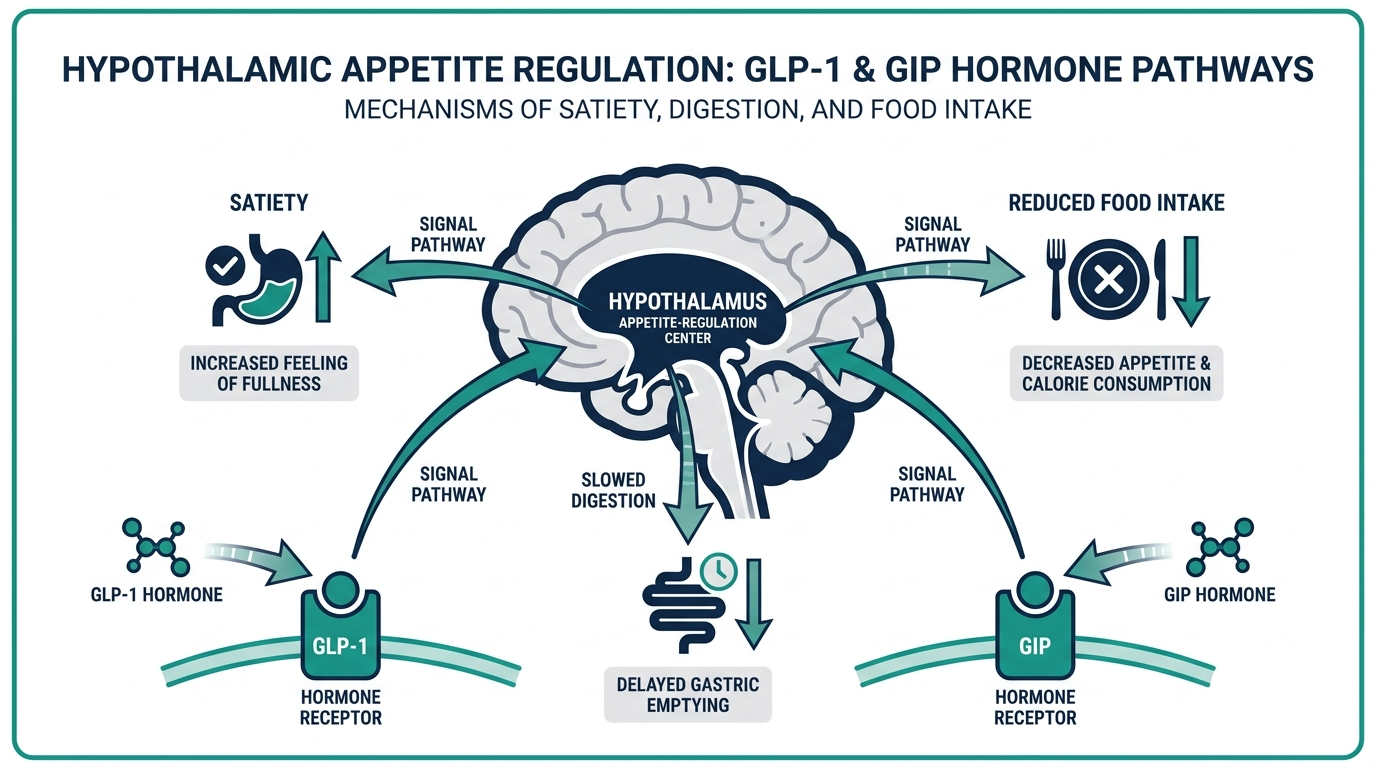
GLP-1 receptor agonists like semaglutide and tirzepatide work primarily through appetite regulation in the brain, specifically in the hypothalamus and brainstem, where GLP-1 receptors modulate hunger and satiety signals. Slowing gastric emptying keeps food in the stomach longer, extending the satiety window after eating. Reducing appetite at the neural level makes the caloric deficit happen automatically, without conscious willpower. That is why people on these drugs consistently describe losing interest in food rather than fighting cravings.
Tirzepatide adds GIP receptor agonism. GIP receptors sit directly on fat cells (adipocytes) and when activated promote lipolysis and thermogenesis on top of the GLP-1 appetite effects. That second receptor explains why tirzepatide consistently outperforms semaglutide in head-to-head trials, including the SURMOUNT-5 comparison where tirzepatide 15 mg reached 20.2% weight loss versus semaglutide 2.4 mg at 13.7% in the same population.
Retatrutide goes one step further, adding glucagon receptor agonism. Glucagon stimulates the liver to burn fat for fuel (hepatic gluconeogenesis) and increases energy expenditure even at rest, which is why retatrutide’s Phase 3 numbers exceed tirzepatide’s. The trade-off: higher nausea rates during dose escalation, reported at 27% in Phase 2 at the 12 mg dose.
GH-pathway peptides work through a completely different axis. Growth hormone promotes lipolysis, yes, but primarily during acute fasted GH pulses, not as a sustained 24-hour metabolic shift. CJC-1295 can increase GH secretion 2 to 10 fold for up to six days per injection, a real and measurable effect, but there are no controlled weight-loss trials translating that GH pulse into pounds on the scale. Personally, I find this gap remarkable: CJC-1295 has been discussed in longevity circles for over a decade, and there is still no randomized controlled trial showing meaningful fat mass reduction in humans. The GH-elevation mechanism is plausible. The weight-loss outcome is unproven.
The myth that GH secretagogues burn fat reliably
Do not believe the forum consensus that the CJC-1295 + Ipamorelin stack is a meaningful weight-loss tool. It is a reasonable body-composition tool, potentially useful for preserving lean mass and improving recovery, but the claim that it drives fat loss comparable to GLP-1 drugs is not supported by evidence.
Here is what the evidence actually shows. A 2006 randomized trial of CJC-1295 in healthy adults demonstrated sustained GH elevation over days, confirming the peptide does what it says at the hormonal level. What it did not show is scale weight loss. No published RCT has measured body fat percentage reduction from CJC-1295 + Ipamorelin in an obesity population. The inference chain is: elevated GH promotes lipolysis in theory, therefore the stack burns fat. That is a reasonable hypothesis. It is not clinical evidence.
AOD-9604 had the most honest trial pathway of the non-approved peptides. It was designed specifically as a fat-loss molecule, taken to Phase 3, and failed to beat placebo for obesity. Some earlier trials showed modest waist reduction, but “modest” here means well under 5%, which is the threshold where clinical significance begins to get murky. The failure of AOD-9604’s Phase 3 is actually the most informative data point in this space, because it tells you what the GH-fragment approach can and cannot do at scale.
That failure also cost significant clinical trial investment. The lesson it taught: making a molecule that looks like a fat-burning peptide in cell culture does not mean it will work that way in a 120-pound fat depot attached to a human under stress.

What about the research-only peptides? Should you use them?
This is where the conversation gets legally and practically complicated. Peptides like CJC-1295, Ipamorelin, AOD-9604, 5-Amino-1MQ, and MOTS-c are sold online as “research chemicals” and technically legal to purchase if labeled for laboratory use. The moment they are administered to a human, you have exited the legal protection that label provides.
There are a few things about this market that most articles will not say directly.
First, the quality problem is severe. The independent testing platform Finnrick has tested more than 8,000 samples across 225 vendors and found routine purity failures, counterfeit flags, and mis-labeling. A peptide purchased from a research-chemical vendor is not manufactured under GMP (Good Manufacturing Practice) conditions. There is no pharmacist, no prescriber, and no chain of accountability for what arrives.
Second, the regulatory situation is shifting toward licensed access, not away from it. The FDA’s April 2026 removal of BPC-157 from Category 2 and HHS’s February 2026 signal that roughly 14 peptides including CJC-1295, Ipamorelin, and Sermorelin may return to Category 1 (permitted for compounding) means the grey-market reason to buy these from unregulated vendors is shrinking. The licensed route is becoming available.
Third, CJC-1295 and Ipamorelin through a licensed telehealth clinic are a fundamentally different product from the same-name compounds in a research vial. GMP manufacturing, batch testing, a clinician’s supervision, and a dosing protocol calibrated to your labs: these are not optional upgrades. They are the entire safety infrastructure that makes a hormone-affecting compound reasonable to administer.
Telehealth GLP-1 program with provider visits and pharmacy coordination.
How much does each option cost in 2026?
The price spread is enormous, and the cheapest option is almost never the best value once you account for what is missing.
FDA-approved GLP-1 drugs, brand name: Wegovy (semaglutide 2.4 mg) carries a list price of approximately $1,350 per month. Zepbound (tirzepatide) runs $499 to $1,086 per month depending on dose. Insurance coverage remains inconsistent.
Compounded semaglutide and tirzepatide through telehealth (self-pay): Following the GLP-1 shortage resolutions in 2024 to 2025, the FDA began enforcing against 503A compounders making copies of non-shortage GLP-1 drugs. Some platforms are still offering compounded versions at $149 to $299 per month (Hims at $149 to $199, Henry Meds and Mochi Health at $179 to $249 for the first month), but their compliance status varies and is worth confirming directly. Any platform still advertising compounded semaglutide or tirzepatide in mid-2026 should be able to name the specific 503A pharmacy it uses and confirm that pharmacy’s accreditation status.
Medicare coverage starting July 1, 2026: The new Medicare GLP-1 Bridge Program covers Wegovy, Foundayo, and Zepbound KwikPen for eligible Part D beneficiaries at a $50 copay, running through December 31, 2027. This is a meaningful new access point for patients 65 and older who have been priced out.
Research-use peptides (not for human use): Grey-market research vials of CJC-1295, Ipamorelin, or AOD-9604 typically run $40 to $120 per vial, not including bacteriostatic water, syringes, or the cost of reconstituting them correctly. There is no monitoring, no dosing guidance from a clinician, and no accountability for what is in the vial.
Telehealth peptide therapy (GH secretagogues under clinical supervision): Clinics like Defy Medical, Marek Health, and Hone Health offer sermorelin, CJC-1295 + Ipamorelin, and related peptides at roughly $175 to $399 per month depending on the protocol, with baseline labs and follow-up built in. This is the appropriate route if that class of peptide is clinically indicated for you.
Who should actually consider non-GLP-1 peptide therapy?
GLP-1 drugs are not right for everyone. There are real clinical scenarios where the GH-secretagogue class makes sense, even though the weight-loss evidence is weaker.
People with low baseline growth hormone (confirmed by lab, not assumed from symptoms) may benefit from sermorelin or CJC-1295 + Ipamorelin for body composition: preserving lean mass while losing fat on a caloric deficit, rather than as primary weight-loss agents. This is a different goal than scale weight reduction and the research, while not RCT-level, is more supportive.
People who experience significant side effects on GLP-1 drugs, primarily nausea, vomiting, or gastroparesis-adjacent symptoms, sometimes layer in peptide support. There is a small clinical literature on using peptides like BPC-157 (once it returns to legal compounding) to mitigate GLP-1 GI side effects, though this remains early-stage.
And people in legitimate clinical trials for retatrutide or other investigational molecules are accessing the most cutting-edge option currently available: 28.3% weight loss at 80 weeks, two-thirds of participants falling out of the obese BMI range. If retatrutide is approved in 2027 as expected, the best-peptide-for-weight-loss answer will need updating.
Personally, I think the framing of “GLP-1 vs peptide therapy” is a false binary in clinical practice. The most sophisticated weight-loss protocols in 2026 often combine a GLP-1 drug for the primary appetite and metabolic signal with adjunct peptides and lifestyle work. The interesting question is not “which one” but “which combination, supervised by whom.”
Are peptides safe for weight loss?
Safety varies enormously by class, and conflating them distorts the risk picture.
FDA-approved GLP-1 drugs have large safety databases from clinical trials and real-world use. The primary risks are GI (nausea in 40 to 50% during escalation, vomiting, diarrhea), along with rare but serious risks including pancreatitis, gallbladder disease, and a theoretical concern about thyroid C-cell tumors seen in rodent models (though no confirmed human cases from the approved drugs). These risks are managed in a prescriber relationship.
Research-use peptides carry a fundamentally different risk profile: not because the molecules are necessarily more dangerous, but because the quality control infrastructure is absent. Purity failures, contamination, incorrect concentration, and injection-site infections are the most common adverse events reported by grey-market users, and none of these are monitorable without clinical oversight.
One insider fact that almost no vendor page acknowledges: reconstituting a lyophilized research peptide at home is not a trivial task. Add the wrong volume of bacteriostatic water and your concentration is off, sometimes by a factor of ten. Draw from an improperly swabbed stopper and you risk introducing bacteria into an injectable. These are pharmacy-level tasks that require pharmacy-level conditions. The low barrier to entry is not the same as low risk.
Turn what you just learned into action.
Superpower lets you test 100+ biomarkers from home, then re-check them over time so you can actually see progress, physician-reviewed at every step.
Frequently asked questions
What is the best peptide for weight loss right now?
Tirzepatide (Zepbound), a GLP-1 and GIP dual receptor agonist, is the most effective FDA-approved peptide for weight loss, producing an average 22.5% body weight reduction at 15 mg over 72 weeks in the SURMOUNT-1 trial. Semaglutide (Wegovy) is second at 14.9% over 68 weeks. For people who cannot access or tolerate these, supervised sermorelin or CJC-1295 + Ipamorelin through a licensed clinic offers body-composition benefits, but not comparable scale-weight results.
Is retatrutide approved yet?
No, as of June 2026, retatrutide remains investigational. The TRIUMPH-1 Phase 3 trial published in May 2026 showed 28.3% average weight loss at 80 weeks on the 12 mg dose, and Eli Lilly is expected to file for FDA approval. Analysts project approval in 2027. It is not available outside enrolled clinical trials.
Do GH secretagogues like CJC-1295 and Ipamorelin work for fat loss?
They reliably raise growth hormone levels. GH has lipolytic (fat-mobilizing) properties. However, there are no published randomized controlled trials demonstrating meaningful body-fat reduction from CJC-1295 + Ipamorelin in an obesity population. They are used in clinical practice for body composition and lean-mass preservation, but they are not weight-loss drugs in the way GLP-1 agonists are.
Can I buy weight-loss peptides without a prescription?
FDA-approved GLP-1 drugs (semaglutide, tirzepatide) require a prescription, obtained through a licensed clinician or telehealth platform. Sermorelin and CJC-1295 + Ipamorelin are also prescription products when dispensed through compounding pharmacies. Research-chemical versions of many peptides can be purchased without a prescription, but are legally labeled “for research use only” and are not intended for human administration.
What is the cheapest way to get a GLP-1 peptide for weight loss?
Starting July 1, 2026, eligible Medicare Part D enrollees can access Wegovy or Zepbound KwikPen for a $50 monthly copay through the Medicare GLP-1 Bridge Program. For non-Medicare patients, telehealth platforms offering compounded semaglutide start at around $149 per month (Hims, Henry Meds), though confirming 503A pharmacy compliance is important before purchasing. Brand-name Zepbound self-pay starts at $299 for the 2.5 mg dose through Lilly’s direct program.
Are there peptides for weight loss with no side effects?
No. Every peptide that produces meaningful metabolic effects has side effects. GLP-1 drugs cause GI side effects in most users during dose escalation. GH secretagogues can cause water retention, joint aches, and morning hand swelling at higher effective GH levels. The question is not which peptide has no side effects, but which side effect profile is manageable for a given patient in a supervised clinical setting.
How long does it take for peptide therapy to work for weight loss?
On GLP-1 drugs, most patients notice appetite reduction within the first one to two weeks. Meaningful scale-weight change typically becomes visible at four to six weeks and compounds over months. The 22.5% tirzepatide result was measured at 72 weeks: over a year of consistent use. Research peptides like CJC-1295 + Ipamorelin, when used for body composition, show effects over a three to six month horizon and are generally measured in changes to body fat percentage rather than dramatic scale weight.
Author: Vital Signs Today Editorial Team, [credential]”]. Educational content, not medical advice. Sources linked inline.
Telehealth GLP-1 program with provider visits and pharmacy coordination.
Primary sources:
- SURMOUNT-1 tirzepatide trial, NEJM 2022
- TRIUMPH-1 retatrutide Phase 3 results, AJMC May 2026
- SELECT semaglutide cardiovascular outcomes trial, NEJM / ACC
- FDA bulk drug substances under 503A, current list
- Medicare GLP-1 Bridge Program, CMS June 2026
- Finnrick independent peptide vendor testing database
- GLP-1 telehealth pricing comparison, TrimRx 2026
- Peptides for Weight Loss NYC: GLP-1, CJC-1295, AOD-9604 Explained
- Retatrutide vs Tirzepatide vs Semaglutide comparison, Regimen 2026
Want a real clinician to run the numbers, not a guess?
Joi + Blokes is a telehealth clinic that prescribes GLP-1 medication (Zepbound, compounded semaglutide and tirzepatide), hormone therapy (TRT, HRT), thyroid care, and peptides after a real lab panel and clinician review, with no membership or consult fee (prescriptions from about $59/month, lab panels from $149). If the scale will not budge, this is where you find out whether insulin, thyroid, or hormones are the real reason. Here is Joi + Blokes reviewed in full.
Related reading
Related: best GLP-1 telehealth providers for 2026.
Vital Signs Today may earn a commission if you buy through links on this page. It does not affect our editorial assessments.