
Last updated 26 July 2026. Educational content, not medical advice. Sermorelin is a prescription medication; all adult therapeutic use is off-label and must be supervised by a licensed clinician. Talk to your provider before starting, adjusting, or stopping any protocol.
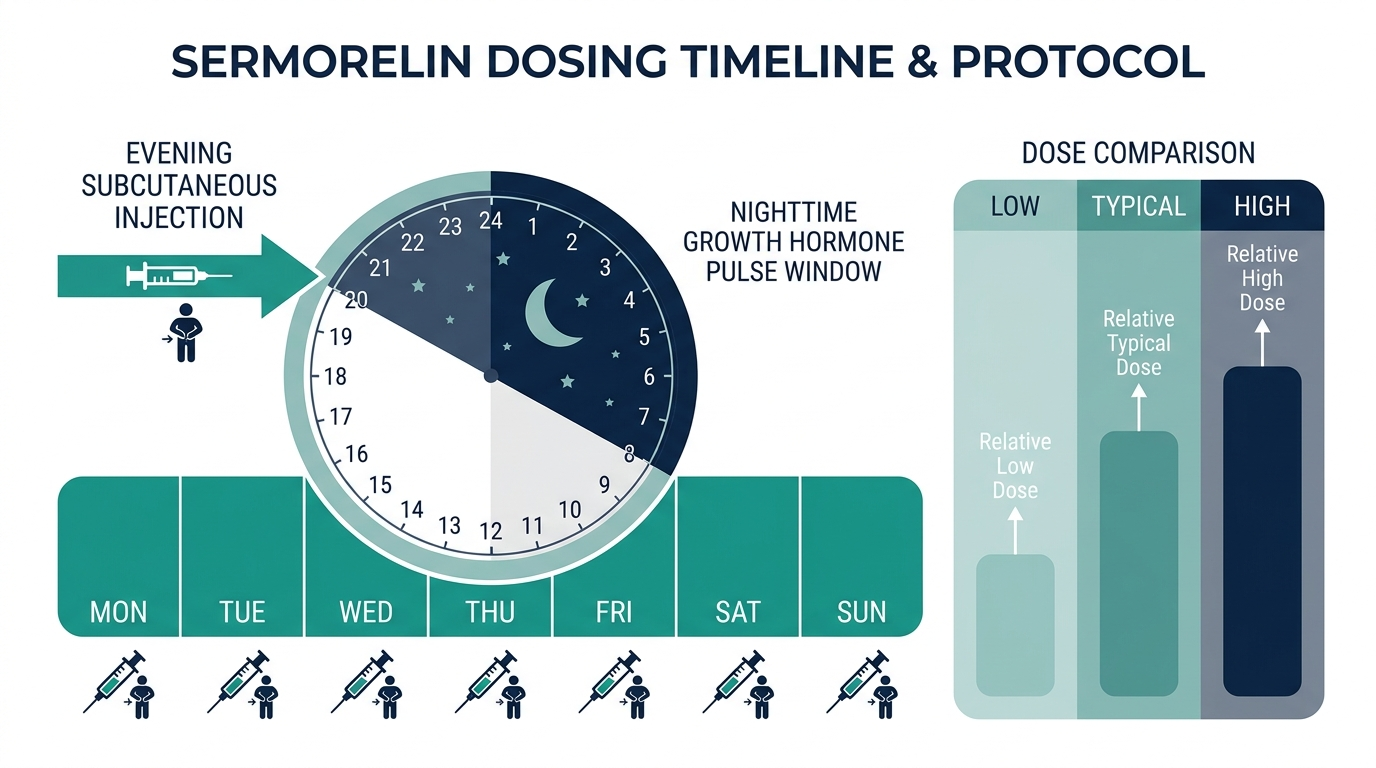
Short answer: Sermorelin is injected subcutaneously at 200 to 300 mcg, five nights per week, 30 to 60 minutes before bed, on an empty stomach (at least two hours after your last meal). Your prescribing physician sets the exact dose based on a baseline IGF-1 blood draw, titrates upward if needed over 4 to 6 weeks, and cycles therapy in 3 to 6 month blocks with rest periods to preserve pituitary receptor sensitivity.
Sermorelin protocols hinge on things clinics often skip checking, like your actual hormone panel. Want to see yours? One at-home Superpower draw checks 100+ biomarkers, physician-reviewed.
Everything below is what a responsible telehealth provider covers in a proper intake, and what most forum posts skip.
Why does the timing actually matter?
Most people hear “inject before bed” and treat it as a convenience preference, something you can swap for a morning shot when the schedule is easier. It is not a preference. The bedtime window is the pharmacological point of the whole approach.
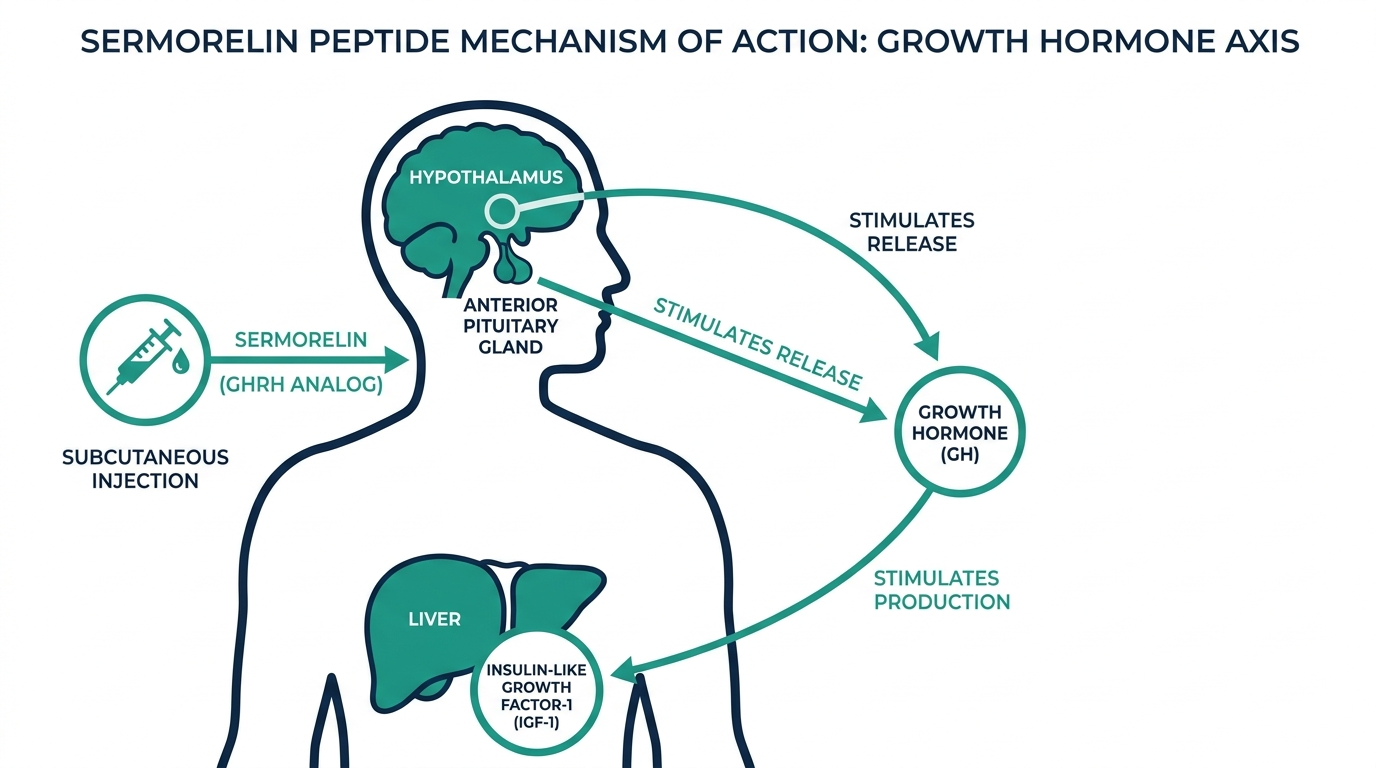
Your pituitary releases growth hormone in distinct pulses throughout the day, with the largest single pulse occurring during early slow-wave sleep, roughly 30 to 90 minutes after sleep onset. Somatostatin, the hormone that brakes GH secretion, drops significantly during these sleep stages. Sermorelin is a 29-amino-acid analog of growth hormone-releasing hormone (GHRH), and it stimulates the pituitary to fire that pulse. Dose it at 10 a.m. into high somatostatin tone, and you blunt the signal substantially. Dose it at 10 p.m. into the pre-sleep window, and you amplify a pulse that was going to happen anyway.
This is not a theoretical difference. A Khorram study cited in a 2020 PMC review found significant IGF-1 increases by week 2 of nightly bedtime administration, remaining elevated through week 12. The mechanism depends on aligning the exogenous signal with the body’s own rhythm.
The fasted-dosing rule follows the same logic. Insulin and growth hormone are counter-regulatory hormones. Eating raises insulin, and elevated insulin suppresses the GH response to sermorelin. The standard clinical guideline is to inject at least two hours after your last meal and wait 30 minutes before eating again, creating a window where insulin is low enough for the pituitary to respond fully.
Do not believe the people who say timing is less important than consistency. In sermorelin’s case, consistency matters, but timing determines whether the drug is working at something near its ceiling or well below it.
Full-body lab membership: 100+ biomarkers, doctor-reviewed, tracked over time.
What dose does a licensed clinic actually start you on?
The honest answer is: it depends on your baseline IGF-1 level, your age, and your prescriber’s clinical judgment. That said, the range in current clinical practice is narrow enough to describe clearly.
Most telehealth providers start adults at 200 to 300 mcg per injection. Specifically, 200 mcg is a conservative starting point for someone new to peptide therapy or with borderline-low IGF-1. 300 mcg is the most common default. A clinician may titrate up to 500 mcg if IGF-1 response at 8 to 12 weeks is subtherapeutic, meaning IGF-1 has not moved into the upper portion of the age-adjusted reference range. Doses above 500 mcg are uncommon outside of GH deficiency models and are not standard in adult optimization protocols.
The pediatric dose (used when the FDA approved sermorelin as Geref Diagnostic in 1997) was 30 mcg per kilogram of body weight, once daily at bedtime. Adult optimization protocols do not use weight-based dosing in the same way; they use IGF-1 targets as the titration guide.
One number worth keeping in mind: the Endocrine Society’s clinical practice guideline flags sustained IGF-1 levels above 250 ng/mL as associated with elevated risk of prostate, breast, and colorectal cancers in large population studies, including UK Biobank data on more than 400,000 participants. Your provider should not be chasing supra-physiologic IGF-1. The target is the upper end of the age-adjusted normal range, not above it.
The 5/7-day schedule: why two rest days are built in
The standard prescription for sermorelin is five injections per week, typically Sunday through Thursday, with Friday and Saturday as rest days. Some providers use a different five-day block; the specific days matter less than the principle behind them.
Two rest days per week exist to prevent GHRH receptor desensitization at the pituitary. Continuous, uninterrupted stimulation of any receptor class tends to downregulate responsiveness over time. A two-day break each week allows receptor sensitivity to recover without losing the cumulative IGF-1 signal that builds through the five active days.
Beyond the weekly structure, most protocols are designed in cycles. A common format is 3 to 6 months on, followed by a 4 to 8 week washout. Long-term longevity protocols sometimes run 9 to 12 months with a 4-week break, checking IGF-1 before and after the washout to confirm the axis is returning to pre-treatment baseline. The washout period also gives the hypothalamic-pituitary axis a chance to recalibrate naturally, which is something synthetic HGH injections do not allow because they suppress endogenous GH production entirely while sermorelin preserves it.
Personally, the cycling structure is one of the most underappreciated differences between sermorelin and exogenous HGH. You can run a sermorelin protocol, stop for a month, and your own GH axis picks back up roughly where it left off. Stop synthetic HGH after months of use, and the recovery is far less clean.
How to inject sermorelin: the step-by-step
This section is educational. Your clinic should provide written injection instructions and a training call with your prescription. Never self-inject a compounded medication without clinician guidance.
What your pharmacy ships:
A licensed compounding pharmacy (Strive Pharmacy, Empower Pharmacy, and Olympia Pharmaceuticals are among the most commonly named for sermorelin) supplies the reconstituted or lyophilized vial, bacteriostatic water (BAC water), insulin syringes, needles, and alcohol swabs as a complete kit. The standard concentration is 1 mg/mL in a multi-dose vial, sometimes dispensed as a lyophilized 6 mg vial you reconstitute yourself with 2 mL of BAC water to achieve 3,000 mcg/mL.
Reconstitution (if shipping lyophilized):
Allow the vial to reach room temperature. Wipe both stoppers with an alcohol swab and let them dry for 30 seconds. Draw 2 mL of BAC water into a syringe and inject it slowly down the inside glass wall of the peptide vial, not directly onto the powder. Let the vial sit; do not shake it. Swirling gently to complete dissolution is fine. Store reconstituted sermorelin at 2 to 8 degrees Celsius and use within 28 days.
Needle and syringe selection:
Use a U-100 insulin syringe with a 27 to 29 gauge needle, half-inch (12 mm) length. Fine gauge needles reduce injection-site reactions substantially compared to the 25 gauge many beginners assume they need.
Injection sites and rotation:
Subcutaneous injection goes into the fat layer just below the skin. The periumbilical abdomen (at least two inches from the navel) is the preferred site because it is accessible, has consistent fat depth, and is easy to pinch. Outer thighs and the flank are acceptable rotation sites. Rotating among three to four sites prevents lipohypertrophy, the small fatty deposits that form from repeated injection into the same spot.
Technique:
Pinch a fold of skin gently, insert the needle at roughly 45 degrees into the pinched tissue (some clinicians prefer 90 degrees for deeper fat; follow your provider’s guidance), inject slowly, and withdraw. Press lightly with a dry pad but do not rub, as rubbing disperses the peptide unevenly.
Dose calculation example:
If your vial is 1 mg/mL (1,000 mcg/mL) and your prescribed dose is 300 mcg, you draw 0.3 mL, which is 30 units on a U-100 syringe. If reconstituted to 3,000 mcg/mL (6 mg in 2 mL), a 300 mcg dose is 0.1 mL or 10 units. Confirm this math with your pharmacy insert; concentration varies by formulation.
A single decimal error in reconstitution math can change your effective dose by a factor of ten. This is the step that separates a supervised clinic prescription, where the pharmacy sets the concentration and labels the dose volume clearly, from a self-managed research vial where you do the math yourself.
Comparing delivery forms: why injection is still the clinical standard
| Form | Bioavailability | Notes |
|---|---|---|
| Subcutaneous injection | ~90 to 95% | Clinical standard; highest consistent IGF-1 response |
| Nasal spray | Variable, 0.1% to ~40% | Absorption inconsistent; suitable for lower-priority protocols |
| Sublingual troche | Lower than injection; oral mucosal absorption incomplete | Convenience trade-off; IGF-1 response weaker and less predictable |
| Oral capsule / tablet | Near zero | Digestive enzymes destroy the peptide before absorption |
Injection is the form with the clinical evidence base. Everything else is a convenience compromise. Troches and nasal sprays are commercially available through some telehealth platforms, including Strut Health at entry prices around $99 per month, and they may be appropriate for someone who genuinely cannot tolerate injections. They are not equivalent in efficacy. If a provider presents them as equally effective, ask for the IGF-1 data.
What sermorelin is not the same as (the comparisons worth knowing)
Sermorelin vs. synthetic HGH:
Synthetic HGH (somatropin) delivers exogenous growth hormone directly, bypassing the pituitary entirely. It produces larger and more immediate IGF-1 increases but suppresses the body’s natural GH production during use. Monthly cost ranges from $600 to $1,200 or more. Sermorelin stimulates your own pituitary to produce GH in a pulsatile, physiologic pattern, preserves natural production, costs $150 to $300 per month through telehealth, and has a cleaner safety profile because IGF-1 is self-limited by the pituitary’s own feedback loop.
Sermorelin vs. CJC-1295 / Ipamorelin:
CJC-1295 (without DAC) paired with Ipamorelin is now the more widely prescribed stack in optimization clinics, largely because CJC-1295 has a longer half-life than sermorelin’s 10 to 20 minutes. Sermorelin’s short plasma half-life means it clears almost entirely within 15 minutes, requiring precise bedtime timing. CJC-1295 without DAC has a half-life of roughly 30 minutes, which gives slightly more dosing flexibility. CJC-1295 with DAC (the Drug Affinity Complex version) extends half-life to approximately eight days via albumin binding, producing sustained elevation rather than pulsatile GH, and is generally considered too blunt a signal for most optimization protocols.
Sermorelin has the advantage of a longer human evidence base, including an original FDA approval (Geref Diagnostic, 1997, subsequently withdrawn from market in 2008 for commercial reasons, not safety) and clearer standing in compounding pharmacy regulations. As of June 2026, sermorelin does not appear on the FDA’s list of difficult-to-compound substances, giving 503A pharmacies a cleaner path to dispense it than many newer GHRH analogs.
The monitoring protocol: what bloodwork you actually need
Running sermorelin without monitoring IGF-1 is, frankly, guesswork. The molecule works entirely through downstream IGF-1 signaling, and you cannot feel IGF-1 moving in your blood. The only way to know whether your dose is working, working too hard, or doing nothing is a blood draw.
A competent provider runs this schedule:
- Baseline before dose one: IGF-1, comprehensive metabolic panel, fasting glucose, thyroid panel (TSH at minimum). Untreated hypothyroidism blunts the pituitary’s response to sermorelin significantly; fixing TSH first is not optional.
- Week 4 to 6 recheck: IGF-1 only. Sermorelin reaches a new IGF-1 steady state approximately 2 to 4 weeks after any dose change. If IGF-1 has not moved or has overshot the upper reference range, the dose is adjusted here.
- Week 8 to 12 confirmation: IGF-1 plus fasting glucose. GH therapy has a counter-insulin effect at higher doses; catching a fasting glucose drift early matters.
- Every 3 to 6 months on maintenance: Full panel including IGF-1, metabolic markers, and any symptoms prompting a closer look.
The upper bound to watch: IGF-1 above 250 ng/mL long-term is associated in large epidemiological studies with increased cancer risk. A good prescriber titrates to the upper end of the age-adjusted normal range and stops there.
Telehealth GLP-1 program with provider visits and pharmacy coordination.
What to expect week by week: a realistic timeline
The biggest source of abandonment in sermorelin therapy is expecting the wrong thing at the wrong time. Here is what actually changes and when.
Weeks 1 to 2: Subjective sleep changes are often the first signal, specifically deeper sleep, more vivid dreams, and feeling more rested at wake. This is not placebo; sermorelin-induced GH pulses amplify slow-wave sleep duration. IGF-1 is already rising in the blood at this point, even if you cannot feel it.
Weeks 3 to 4: Energy during the day tends to improve. Some patients notice reduced afternoon fatigue. Recovery from exercise begins improving at the tissue level, though most people do not register this consciously until around week 6.
Month 2: Faster post-workout recovery becomes noticeable. The Khorram study in the PMC review recorded a 1.26 kg increase in lean body mass in men over 16 weeks, with no change in total body weight; this is the body composition shift that starts here, not at week 1.
Months 3 to 4: Visible body composition changes, reduced fat accumulation, and improved skin quality if you are monitoring it. This is when IGF-1 bloodwork confirms what you are subjectively experiencing.
Months 5 to 6: Optimal checkpoint for full lab recheck and cycle-end decision. If IGF-1 is in range and the clinical picture is good, a 4 to 8 week washout followed by a new cycle is a standard approach.
One myth to address directly: the warm flush some patients feel immediately after injection is not sermorelin “working.” It is a brief vasodilatory response, common with GHRH analogs, that resolves within minutes. Therapeutic benefit, meaning a measurable IGF-1 rise and downstream tissue effects, builds over weeks of consistent dosing, not the 15 minutes after the shot.
When sermorelin is the wrong tool
Not everyone is a good candidate, and a provider who skips this conversation is cutting corners. Contraindications and conditions that reduce effectiveness:
Active malignancy or history of hormone-sensitive cancer. GH stimulation supports cell growth through IGF-1 signaling. Using sermorelin with active cancer or recent history of prostate, breast, or colorectal cancer is contraindicated. This is not a gray area.
Untreated hypothyroidism. The thyroid axis and GH axis are tightly linked. An underactive thyroid impairs the pituitary’s ability to respond to GHRH stimulation. TSH should be in range before starting.
Pituitary disease or pituitary tumor history. Sermorelin directly stimulates the pituitary. If the pituitary is structurally compromised, the response is unpredictable.
Pregnancy. Safety data does not exist for sermorelin in pregnancy; avoid.
Corticosteroids and other GH-axis suppressants. Chronic steroid use blunts pituitary sensitivity and can negate sermorelin’s effect entirely. Your prescriber should review your medication list before dosing.
Obesity as a response-limiting factor: Studies show elevated visceral fat blunts GHRH response, meaning heavier patients may need higher doses to achieve the same IGF-1 target. This is not a contraindication but is a clinically relevant variable.
Turn what you just learned into action.
Superpower lets you test 100+ biomarkers from home, then re-check them over time so you can actually see progress, physician-reviewed at every step.
Frequently asked questions
How long before bed should I inject sermorelin?
Inject 30 to 60 minutes before your planned sleep time, at least two hours after your last meal. The goal is to dose into a low-insulin, low-somatostatin window that amplifies the nocturnal GH pulse your pituitary will fire during early slow-wave sleep.
Can I eat after injecting sermorelin?
Wait at least 30 minutes after injection before eating. Most protocols recommend injecting, then going to bed without eating. The two-hour pre-injection fast plus the 30-minute post-injection window creates the clean metabolic state the peptide needs to work.
What happens if I inject every day instead of 5/7?
Some protocols do run daily dosing; it is not inherently dangerous. The 5/7 schedule’s rest days are designed to prevent GHRH receptor desensitization over weeks and months. Whether daily dosing meaningfully accelerates desensitization in humans is not settled by RCT data, but the precaution is standard clinical practice and costs nothing.
How quickly will my IGF-1 rise?
IGF-1 begins rising within 2 weeks of consistent dosing and reaches a new steady state approximately 2 to 4 weeks after any dose change. Full clinical evaluation of dose adequacy requires a blood draw at week 4 to 6.
Is sermorelin legal without a prescription?
No for therapeutic use. Sermorelin acetate is a prescription medication in the United States. It is dispensed by licensed 503A or 503B compounding pharmacies under a physician prescription. Buying it as a “research chemical” online is legal for the vendor to sell but transfers all risk, legal and medical, to you.
How is sermorelin different from ipamorelin?
Sermorelin is a GHRH analog: it mimics the hormone that tells the pituitary to release GH. Ipamorelin is a ghrelin mimetic and GH secretagogue: it triggers GH release through a different receptor class. The two work on separate pathways and are commonly combined (sermorelin or CJC-1295 plus ipamorelin) to produce synergistic GH pulses larger than either alone.
What if I feel nothing after six weeks?
First, check that the fasted bedtime timing is consistent. Second, run an IGF-1 draw before assuming the drug is not working; IGF-1 can rise substantially while you feel no subjective change, especially in the first cycle. Third, have your TSH checked. Untreated subclinical hypothyroidism is a common and fixable reason sermorelin underperforms.
Telehealth GLP-1 program with provider visits and pharmacy coordination.
Author: Vital Signs Today Editorial Team, [credential]”]. Educational content, not medical advice. Sources linked inline.
Primary sources:
– PeptideDeck: Sermorelin Dosage Guide
– PMC / Beyond the androgen receptor: GH secretagogues review (PMC7108996)
– Sermorelin.com: IGF-1 monitoring guide
– Sermorelin.com: Dosage guidelines
– Ivy Rx: 2026 sermorelin cost guide
– Strive Pharmacy: Compounded sermorelin clinical guide
– Healingmaps: Sermorelin cost 2026
– Eden Health: How to inject sermorelin
– Olympia Pharmaceuticals: Sermorelin dosage chart
– PubMed 18031173: Sermorelin in pediatric GH deficiency
– Peptide Deck: Sermorelin vs HGH
– TeleHealthAlly: Sermorelin legal status FDA 2026
– Genesis Lifestyle Medicine: How dosing and timing affect results
Related reading
Vital Signs Today may earn a commission if you buy through links on this page. It does not affect our editorial assessments.