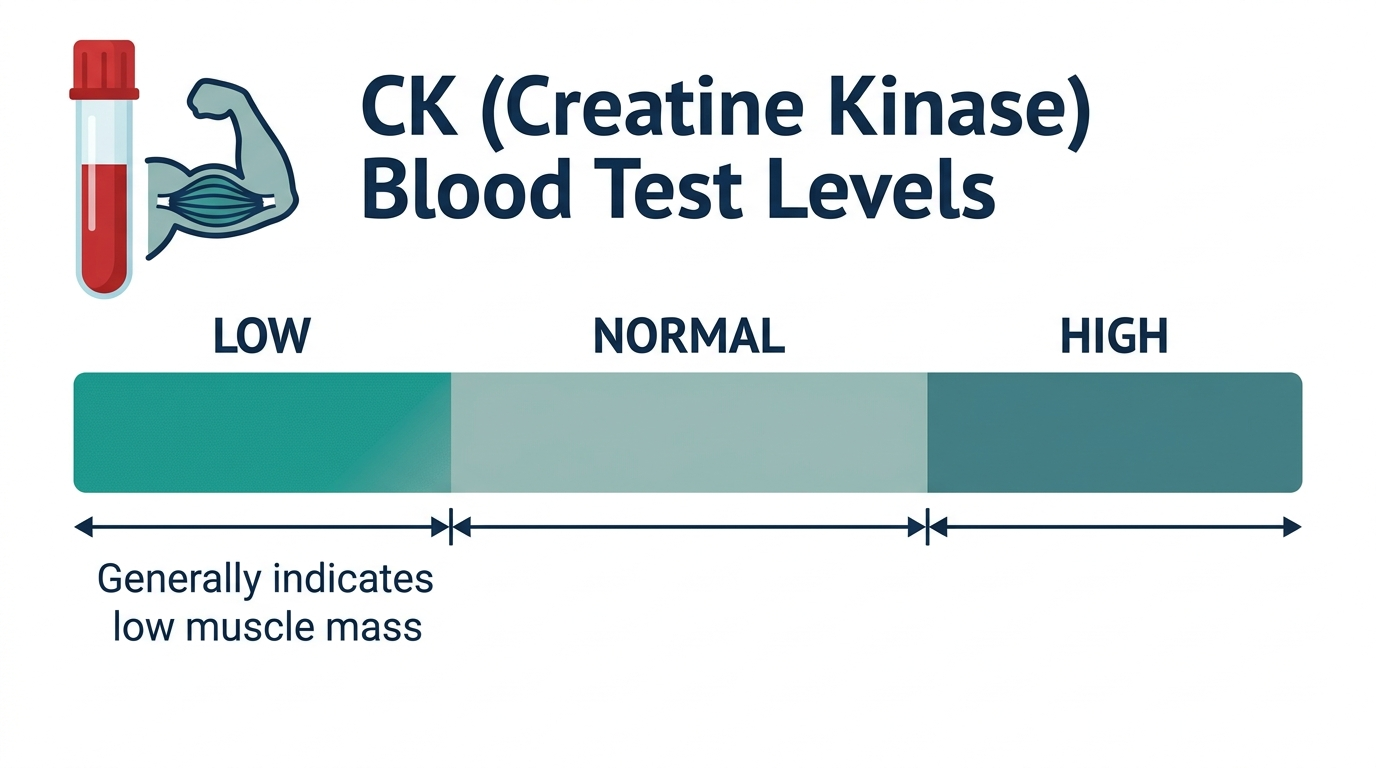
- A low creatine kinase (CK) result, usually meaning a value below your lab’s reference floor (often around 30 to 40 U/L), is most often harmless and reflects lower muscle mass rather than a disease.
- The most common causes of low CK are reduced muscle mass, older age, female sex, prolonged bed rest, low protein intake, an untreated underactive thyroid, and inflammatory conditions such as rheumatoid arthritis.
- Low CK rarely causes symptoms on its own, but in chronically ill patients it can signal muscle loss and poorer nutrition, so it should be read alongside your full clinical picture rather than in isolation.
Most people hear about creatine kinase only when it is too high. A low CK result is far less talked about, which is exactly why it tends to worry people who see it on a report. In the vast majority of cases, a low number is not a red flag. It usually tells your clinician something about your body composition, not about hidden damage. Below is a plain explanation of what the result means, why it happens, and the rare times it is worth a closer look.
What does a low CK result mean, and what is the cutoff?
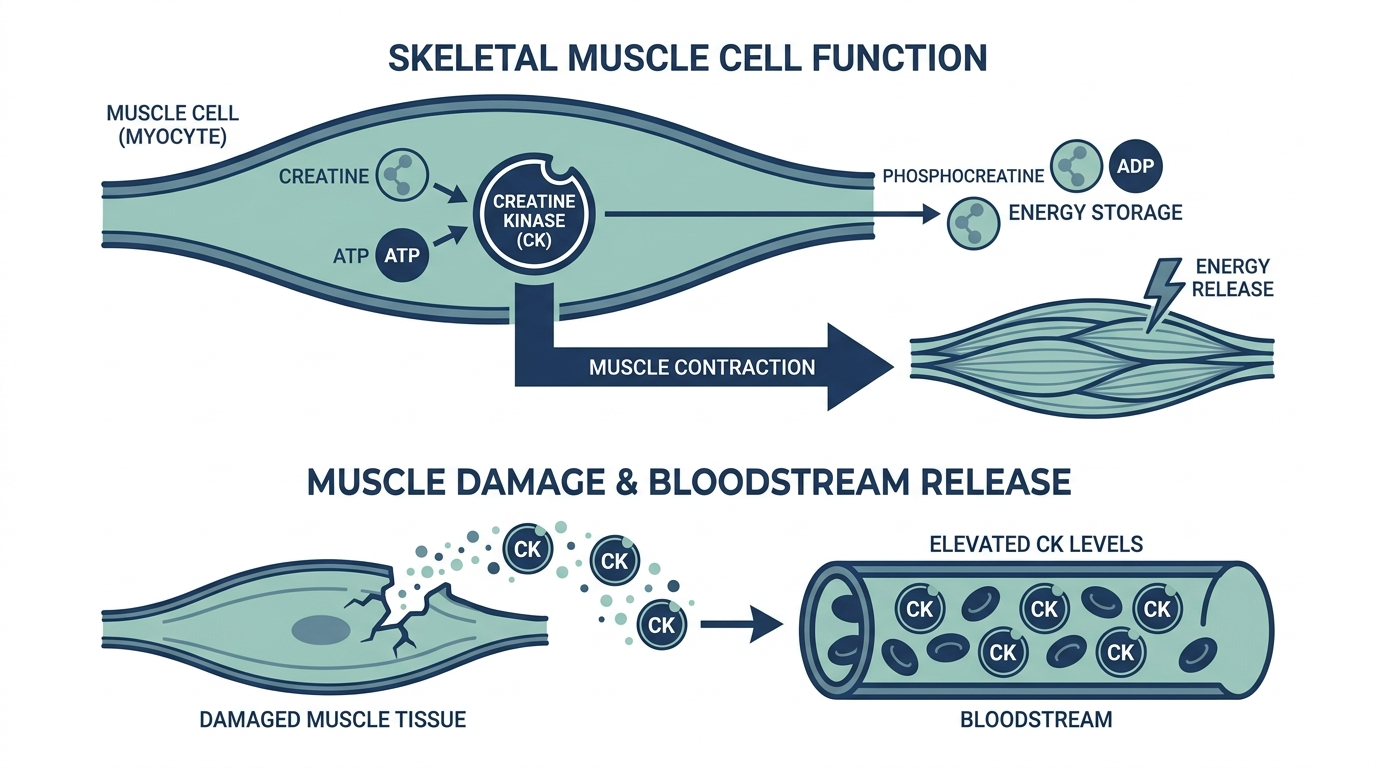
A low CK result means the amount of creatine kinase enzyme circulating in your blood is below the reference range your laboratory uses. There is no single universal cutoff because assay methods differ, but many adult labs use a lower limit somewhere around 30 to 40 U/L, with typical normal ranges often quoted near 30 to 170 U/L for adults (Cleveland Clinic; NCBI Clinical Methods). CK is an enzyme found mainly inside skeletal muscle, so the level in your blood largely mirrors how much muscle tissue you carry.
Low creatine kinase usually just reflects muscle mass. See it alongside your full metabolic picture. One at-home Superpower draw checks 100+ biomarkers, physician-reviewed.
This is the key idea: CK is a muscle marker before it is anything else. Less muscle in the body generally means less enzyme leaking into the bloodstream at baseline. That is why a fit, lean older adult and a young bodybuilder can both be healthy yet sit at opposite ends of the CK range. Always compare your number against the reference interval printed on your own report, since the floor your lab uses defines what counts as low for you.

What causes low CK levels?
The leading cause of low CK is simply having less muscle mass, which is why older adults, women, and people on prolonged bed rest commonly run lower (Cleveland Clinic). Beyond body composition, several medical situations are linked to reduced CK.
- Low muscle mass: Reduced muscle from aging, inactivity, amputation, or extended bed rest leaves less enzyme to release.
- Hypothyroidism that is treated: An underactive thyroid usually raises CK, but once treatment normalizes thyroid hormones, CK can settle to the lower end of normal.
- Rheumatoid arthritis and other rheumatic disease: CK activity tends to fall as inflammatory activity rises, and reduced CK in rheumatoid arthritis has been tied to muscle weakness (PubMed 8730112; Oxford Rheumatology).
- Steroid use: Corticosteroids and muscle wasting can lower CK activity in rheumatic conditions (PubMed 10941812).
- Low protein intake, malnutrition, and critical illness: Poor nutrition and severe acute illness reduce both muscle bulk and circulating CK.
What are the symptoms of low CK, or is it silent?
Low CK itself is essentially silent. The enzyme level dropping does not produce symptoms, because the low number is a consequence of an underlying state such as reduced muscle mass, not a cause of illness in its own right (Cleveland Clinic). You will not feel a low CK the way you might feel low blood sugar or low iron.
Any symptoms you do notice come from whatever is driving the result, not from the CK value. If reduced muscle mass is the reason, you might experience weakness, fatigue, slower recovery, or difficulty with stairs and standing from a chair. If an untreated thyroid problem is involved, you might notice cold intolerance, weight change, or low energy. The practical takeaway: treat a low CK as a clue that points you toward your overall muscle and nutrition status, then look for symptoms there rather than expecting the enzyme level to announce itself.
When is a low CK dangerous?
A low CK is rarely dangerous on its own, but in people with serious chronic illness it can be a marker of worse outcomes. In a study of 1,801 chronic kidney disease patients followed for a median of 6 years, those in the lowest CK tertile had a higher risk of death, with a fully adjusted hazard ratio of 1.37 (95% CI 1.02 to 1.86) compared with the highest tertile (PMC4889148). The researchers concluded that low CK likely reflects reduced muscle mass and poorer nutritional status, which themselves drive the risk.
That nuance matters. The CK number is not harming these patients; it is acting as a window into frailty and muscle wasting. So in a healthy adult, a low CK carries little concern. In someone who is chronically ill, malnourished, or rapidly losing muscle, the same result deserves attention because of what it represents. Context, not the digit alone, decides how much weight to give it.

The insider nuance most reports skip
Here is something clinicians weigh that lab printouts do not explain: CK is a moving target, not a fixed trait. Because the enzyme leaks from muscle during exertion, your value swings with what you did in the days before the draw. A blood test taken after a week of rest, illness, or low activity can read low simply because no muscle stress preceded it, not because anything is wrong.
This is why a single low CK rarely means much. What clinicians find informative is the trend over time and the company the result keeps. A low CK alongside normal thyroid tests, stable weight, and good strength is reassuring. A low CK alongside falling weight, weakness, or known kidney or rheumatic disease earns a second look. If your CK is low and you feel well, the most useful next step is usually to retest under normal conditions rather than to chase the number.
What to do next and when to see a doctor
For most people with a low CK and no symptoms, no urgent action is needed; the result can simply be rechecked at a routine follow-up (Cleveland Clinic). Still, a few situations warrant a conversation with your clinician.
- See a doctor if you also have new muscle weakness, unexplained weight loss, persistent fatigue, or difficulty performing everyday tasks.
- Mention it if you have rheumatoid arthritis, another rheumatic disease, thyroid disease, or chronic kidney disease, since low CK can carry more meaning in these settings.
- Bring your medication list, including any steroids, so your clinician can interpret the result in context.
- Ask about a repeat test taken under normal activity and nutrition, which often clarifies whether the low value was real or circumstantial.
Your clinician may also order thyroid tests, check your overall protein and nutrition status, or assess muscle strength to find the reason behind the number.
What CK is and its three isoenzymes
Creatine kinase is an enzyme that helps muscle cells produce energy quickly, which is why it lives mainly inside muscle tissue. When muscle cells are stressed or damaged, CK leaks into the blood, so the level tends to rise with muscle injury and sit lower when there is simply less muscle to leak from. That single fact explains most of what a CK result means.
CK comes in three forms, called isoenzymes, each concentrated in different tissue. Knowing them clarifies why the interpretation of a low result differs so much from a high one.
- CK-MM: the form found overwhelmingly in skeletal muscle, and the main contributor to the total CK on your report. Because it dominates, your total CK largely tracks your skeletal muscle mass and activity.
- CK-MB: concentrated in heart muscle, historically used to help detect heart injury, though troponin has largely replaced it for that purpose.
- CK-BB: found mainly in the brain and smooth muscle, and rarely relevant to a routine total CK reading.
For a low result, the practical point is that CK-MM from skeletal muscle is the driver. A low total CK is essentially a statement about how much skeletal muscle you carry and how recently it has been worked, rather than a signal about the heart or brain forms.

How CK is tested and what can move the number
Because CK responds strongly to muscle activity, the conditions around your blood draw shape the result more than most people realize. This is central to reading a low value correctly.
- Recent exercise: strenuous or unaccustomed exercise raises CK for a day or more, so a value drawn after a period of rest can read comparatively low. Timing relative to your last hard workout matters.
- Activity level in the days before: a stretch of illness, bed rest, or simple inactivity means less muscle stress and a lower baseline reading.
- Body composition: less overall muscle mass, common with aging, means a lower resting CK, which is why a low value is often just a reflection of build.
- Certain medications: corticosteroids are among the drugs that can lower CK activity, which is one reason a full medication list helps interpretation.
No special fasting is generally required for CK, but if you want a value that reflects your true baseline rather than a recent workout or a period of rest, it helps to test under your normal, steady activity level. This is exactly why clinicians so often suggest a repeat under ordinary conditions before reading anything into a single low result.
Markers a clinician reads alongside a low CK
A low CK is most informative in the company of a few companion tests that together describe your muscle and nutritional status.
- Thyroid tests (TSH, free T4): an underactive thyroid usually raises CK, so thyroid testing helps interpret both high and low readings and is judged on its own merits.
- Albumin and nutritional markers: because low CK can accompany poor nutrition and muscle loss, albumin and related markers help gauge whether frailty is part of the picture.
- Kidney function tests: in chronic kidney disease, a low CK has been associated with worse outcomes as a marker of reduced muscle mass, so kidney status adds context.
- Complete blood count and inflammatory markers: these help assess whether chronic illness or inflammation is contributing to muscle loss.
The recurring lesson is that CK is one instrument in an assessment of muscle and nutrition, not a standalone verdict. Its meaning comes from the pattern it forms with these companions and with how you feel and function.
Reading a low CK: three scenarios
Here is how a clinician tends to think through a low CK, which shows why context decides everything.
- Low CK, you are an older or lean adult, feel well, normal thyroid: the most likely explanation is simply lower muscle mass. This is common and reassuring, and usually needs nothing beyond a note for future comparison.
- Low CK after a week of rest or illness in an otherwise healthy person: the value may be circumstantial, reflecting little recent muscle activity. A repeat under normal activity often lands higher and clarifies the picture.
- Low CK with weight loss, weakness, or chronic kidney or rheumatic disease: here the number can act as a window into muscle wasting and poorer nutrition, so it earns closer attention to the underlying condition rather than to the enzyme itself.
In every case, the CK number opens a question about muscle and nutrition. The answer comes from your symptoms, function, and the conditions you carry, not from the digit alone.

How to raise a genuinely low CK the healthy way
When a low CK reflects low muscle mass, the constructive response is not to chase the enzyme but to build and preserve muscle, which raises CK naturally as a byproduct of a healthier body composition.
- Resistance training: regular strength work is the most direct way to build muscle mass over time, which tends to lift a low baseline CK.
- Adequate protein intake: sufficient dietary protein supports muscle maintenance and growth, and low protein intake is itself a cause of low CK.
- Stay active and avoid prolonged bed rest: extended inactivity accelerates muscle loss, so keeping moving preserves both muscle and CK.
- Treat underlying conditions: managing thyroid disease, inflammatory conditions, or nutritional gaps addresses the real driver behind a low value.
The goal is the healthy muscle and nutrition that a normal CK reflects, not the number for its own sake. A low CK is best treated as feedback about body composition, which points toward strength and nutrition rather than toward any treatment of the enzyme itself.
Low CK versus high CK: why the two point in opposite directions
It helps to see the low result against the more familiar high one, because the same enzyme tells very different stories at each end. A high CK usually means muscle is being damaged or stressed, since injured muscle cells spill their contents into the blood. Causes range from intense exercise and injury to muscle disease and, in the case of the CK-MB form, heart injury. A high value is a signal that something is releasing enzyme.
A low CK is the mirror image. It is not about damage but about supply. With less muscle to leak enzyme, or with little recent muscle activity, the baseline sits low. That is why a low CK is generally reassuring in a healthy person, while a high CK prompts a search for the source of muscle stress. Understanding this contrast dissolves a lot of the worry a low result can cause, since the low end simply reflects a quieter, smaller muscle reservoir rather than an active problem.
Common misconceptions about a low CK
A few myths cause needless concern when this number shows up on a report.
- “A low CK means something is damaging my muscles.” The opposite is closer to the truth. High CK reflects muscle release, while low CK usually reflects less muscle mass or little recent activity, not damage.
- “I need to fix my low CK number.” There is no treatment aimed at the enzyme itself. When it matters, the focus is on the underlying muscle and nutrition status, not the digit.
- “A low CK proves my thyroid and everything else is fine.” CK is nonspecific. A low or normal value does not confirm thyroid health or rule out other conditions, which are assessed with their own tests.
- “One low reading defines my baseline.” CK swings with recent activity, so a single value after rest or illness may not represent your true baseline. A repeat under normal conditions is often more telling.
The common correction is that a low CK is a contextual clue about muscle and nutrition, read alongside your symptoms and other labs, never a standalone alarm.
The bottom line on a low CK
For most people, a low CK is a benign finding that says more about body composition than about disease. Because creatine kinase lives mainly in skeletal muscle, a lower level usually reflects less muscle mass or little recent muscle activity, which is why older adults, women, lean people, and those coming off a period of rest commonly run low. The enzyme itself causes no symptoms, so anything you feel comes from the underlying state, not the number.
The value earns closer attention only in specific settings: alongside new weakness, unexplained weight loss, or in people with chronic kidney or rheumatic disease, where a low CK can act as a window into muscle wasting and poorer nutrition. Even then, the most useful move is often a repeat test under normal activity and nutrition, read together with thyroid, nutritional, and kidney markers. Interpreted in context, a low CK is a helpful pointer toward your muscle and nutrition status rather than a cause for alarm.
Don’t just read about CK, track it.
A single result is a snapshot. Superpower re-tests CK and 100+ markers over time so you can watch them move as you change sleep, food, and training.
Frequently asked questions
Is a low CK level something to worry about?
Usually no. In healthy people a low CK most often reflects lower muscle mass and is not a sign of disease (Cleveland Clinic). It deserves more attention only when paired with symptoms or with chronic illness such as kidney or rheumatic disease.
Can low muscle mass cause a low CK?
Yes. CK is stored mainly in skeletal muscle, so less muscle means less enzyme in the blood. Older adults, women, and people on prolonged bed rest commonly have lower CK for this reason (Cleveland Clinic).
Does low CK mean my thyroid is fine?
Not necessarily. An underactive thyroid usually raises CK, and the level often drops back toward normal after treatment. A low or normal CK does not by itself confirm thyroid health, so thyroid testing is judged separately.
Can rheumatoid arthritis lower CK?
Yes. CK activity tends to fall as inflammatory activity rises in rheumatoid arthritis, and reduced CK has been linked to muscle weakness in these patients (PubMed 8730112). Steroid treatment can also lower it.
Should I retest a low CK?
Often yes. CK swings with recent activity, so a single low reading after rest or illness may not reflect your baseline. A repeat test taken under normal activity and nutrition usually clarifies the picture.
Sources
- Cleveland Clinic, Creatine Kinase (CK) test
- NCBI Bookshelf, Clinical Methods: Creatine Kinase
- PMC, Low serum creatine kinase predicts mortality in chronic kidney disease
- PubMed, Low serum creatine kinase activity and muscle weakness in rheumatoid arthritis
- PubMed, Serum creatine kinase in patients with rheumatic diseases
- Oxford Rheumatology, Reduced serum creatine kinase activity in rheumatoid arthritis
This article is for general educational purposes and is not medical advice. It cannot diagnose or treat you and does not replace your clinician. Always discuss your lab results and any health decisions with a qualified healthcare professional.
Related: compare the best at-home biomarker and blood tests.
Vital Signs Today may earn a commission if you buy through links on this page. It does not affect our editorial assessments.