You feel tired in a way that sleep does not fix, maybe a little short of breath on the stairs, and someone suggests you might be anemic. So you book a test. But which one? Walk into a lab and there is a menu of blood tests with intimidating names, and it is genuinely confusing to know what actually flags anemia versus what just explains it.
Tired in a way sleep doesn’t fix? See the CBC, iron, and full panel that actually finds the cause. One at-home Superpower draw checks 100+ biomarkers, physician-reviewed.
Here is the short version before we go deeper. One common, inexpensive blood test detects anemia in almost everyone, and a small set of follow-up tests figures out why. Knowing the difference between those two jobs is the key to reading your own results without panic.
What blood test shows anemia?
The blood test that shows anemia is the complete blood count, almost always called the CBC, and specifically its hemoglobin and hematocrit values. Anemia is a condition in which your body does not have enough healthy red blood cells to carry oxygen, and the CBC measures exactly that (Cleveland Clinic). When people ask what blood test for anemia they should request, the answer is nearly always a CBC, because it is the standard front door to a diagnosis.
The single number that confirms anemia is hemoglobin, the iron-rich protein inside red blood cells that actually carries oxygen (MedlinePlus). If your hemoglobin is below the normal range, you are anemic. Everything else on the report helps explain the cause, but hemoglobin is what makes the call.
What is anemia in a blood test, and which numbers matter?
In a blood test, anemia shows up as a low hemoglobin and usually a low hematocrit on your CBC. These two numbers are the headline. If someone asks what is anemia in a blood test, the honest one-line answer is: not enough hemoglobin to move oxygen properly.
The CBC bundles several red-cell measurements that work together (MedlinePlus):
- Hemoglobin (Hgb). The amount of oxygen-carrying protein. This is the number that defines anemia.
- Hematocrit (Hct). The percentage of your blood that is made up of red blood cells. It tends to fall alongside hemoglobin.
- Red blood cell count (RBC). How many red cells you have.
- Mean corpuscular volume (MCV). The average size of your red cells, which is the first clue to what kind of anemia you have.
So when people search what blood tests show anemia, the technically correct answer is that they are all part of one test. The CBC is the panel, and hemoglobin is the value inside it that confirms the diagnosis.
What is the normal hemoglobin level, and when is it anemia?
Anemia is generally diagnosed when hemoglobin falls below about 13.5 grams per deciliter in men and below about 12.0 grams per deciliter in women (American Society of Hematology). Those are the widely cited cutoffs, and they exist because men naturally run higher hemoglobin than women.
For context on the normal ranges, Mayo Clinic lists roughly 13.2 to 16.6 grams per deciliter for adults assigned male at birth and 11.6 to 15.0 grams per deciliter for adults assigned female at birth, with a result below the standard range meaning anemia (Mayo Clinic). One important caveat: the lower limit of normal shifts with age, sex, pregnancy, and even altitude, so the reference range printed on your own report is the one that counts. A hemoglobin of 11.9 in a pregnant woman is read very differently from the same number in a healthy young man.
What blood test is for finding the cause of anemia?
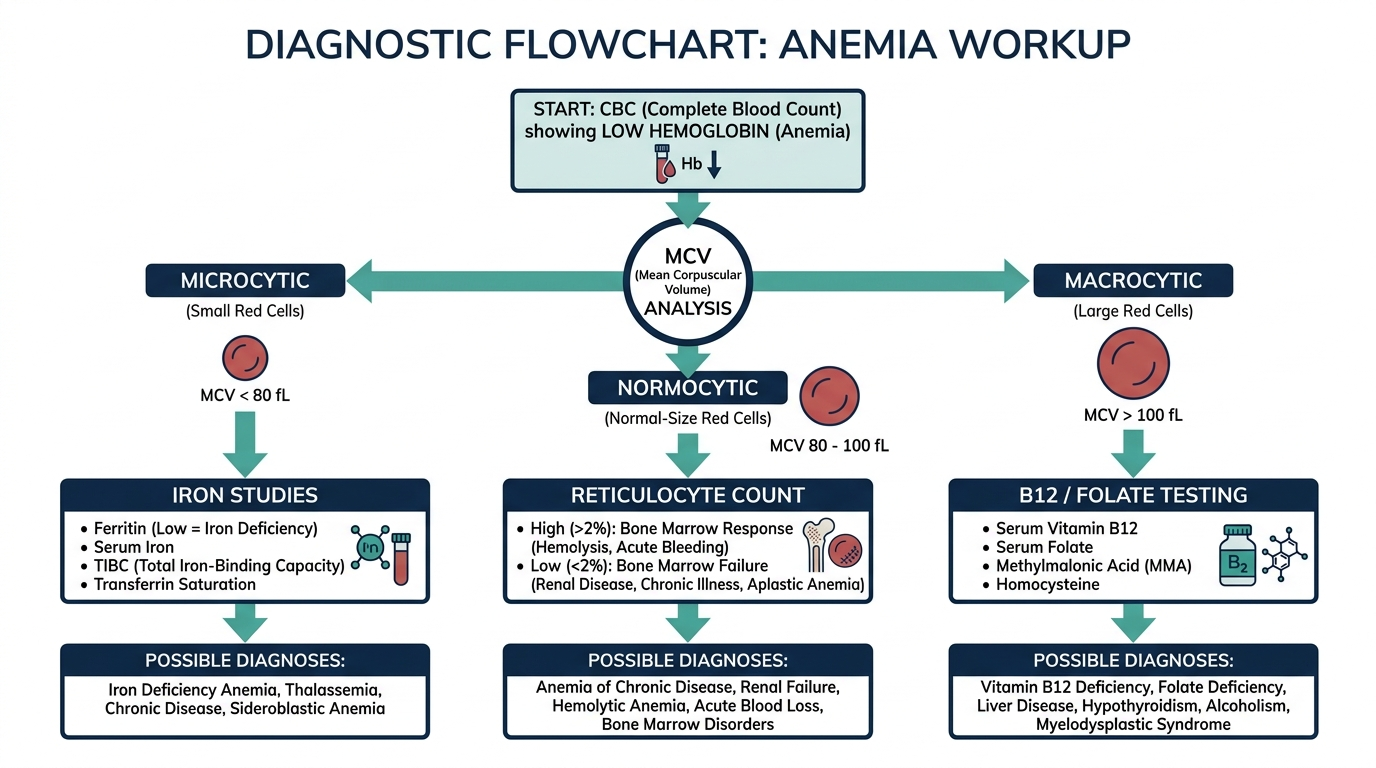
Once a CBC confirms anemia, the blood test that points to the cause depends on what the CBC already showed, and the workhorses are the MCV, the reticulocyte count, and iron studies including ferritin. The CBC tells you that you are anemic. These tests tell you why.
The logic flows like this. First, your clinician looks at MCV, the average red-cell size, to sort anemia into three buckets:
- Small cells (low MCV) point toward iron deficiency or thalassemia.
- Normal-sized cells point toward blood loss, chronic disease, or kidney problems.
- Large cells (high MCV) point toward vitamin B12 or folate deficiency.
Next comes the reticulocyte count, which measures immature red blood cells and reveals whether your bone marrow is responding (MedlinePlus). A low reticulocyte count suggests the marrow is not making enough new cells, as in iron deficiency or marrow failure. A high count suggests your body is actively replacing cells lost to bleeding or destruction, as in hemolytic anemia (MedlinePlus).
Finally, iron studies, especially ferritin, measure your body’s iron stores. Ferritin is often the most useful single follow-up test, because iron deficiency is by far the most common cause of anemia worldwide, and a low ferritin nails it down.

Why is hemoglobin measured together with MCV and ferritin?
Hemoglobin alone tells you that you are anemic, but it cannot tell you why, so it is read alongside MCV and ferritin to turn a yes-or-no answer into an actual diagnosis. A hemoglobin test can show how low and how severe your anemia is, but it cannot detect what is causing it (Cleveland Clinic). That is the entire reason a single number is rarely the end of the story.
Think of it as three questions answered by three numbers. Hemoglobin answers “am I anemic?” MCV answers “what size are the cells, and which category does this fall into?” Ferritin answers “is iron the problem?” Put them together and a vague complaint of fatigue becomes something like “iron deficiency anemia,” which is a problem with a clear fix. Reading hemoglobin in isolation is like seeing a low fuel gauge and never checking whether there is a leak.
The part most people never hear: a normal CBC does not always mean your iron is fine
Here is the insight that catches even careful patients off guard. You can have completely normal hemoglobin and still be running on empty when it comes to iron. Iron deficiency develops in stages, and your body protects hemoglobin until the very end. Your iron stores can be drained, ferritin can be low, and you can feel the classic symptoms of fatigue, brain fog, and hair shedding while your hemoglobin still sits comfortably inside the normal range. This is iron deficiency without anemia, and a standard CBC will sail through it without a single flag.
That matters because ferritin is not included in a routine CBC. It has to be ordered separately, and it often is not unless someone specifically asks. So if you have textbook iron-deficiency symptoms and your CBC came back normal, the next move is not to accept that nothing is wrong. It is to ask whether your ferritin was actually checked. A low ferritin with a normal hemoglobin is a real, treatable finding, and it is exactly the kind of thing that gets missed when a report just says everything looks normal.
The flip side is also worth knowing. A CBC can over-call too. Dehydration concentrates the blood and can make hemoglobin look falsely high, masking a mild anemia, while pregnancy dilutes the blood and can make hemoglobin look low when nothing is wrong. The number is only as good as the context around it, which is why your clinician interprets it rather than just reading it off the page.
What does a low hemoglobin result mean?
A low hemoglobin means your blood is carrying less oxygen than it should, which is the definition of anemia, and the causes range from common to serious. The most frequent culprit is iron deficiency, often from inadequate diet, heavy periods, or slow gastrointestinal bleeding. Other causes include vitamin B12 or folate deficiency, chronic kidney disease, chronic inflammatory conditions, and acute blood loss (MedlinePlus).
What a low hemoglobin does not do is diagnose itself. It tells you there is a problem and roughly how severe it is, but the cause comes from the follow-up tests above. A mildly low result in an otherwise healthy person with heavy periods is a very different situation from the same number in someone losing blood from the gut, and that is precisely why the cause matters more than the single value.

The main types of anemia the tests distinguish
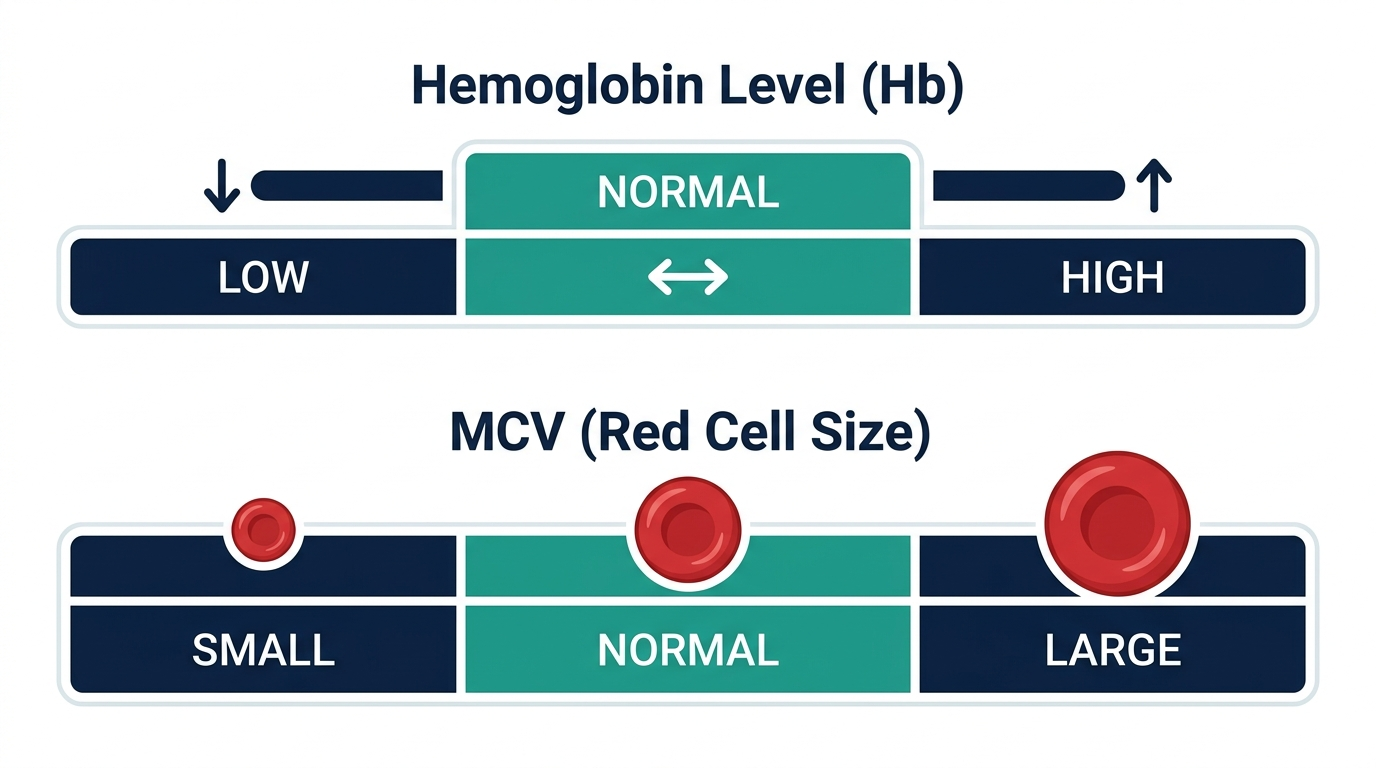
Anemia is not one disease, it is a shared endpoint of many different problems, which is exactly why the follow-up tests matter so much. Sorting anemia into types is how a clinician moves from a low hemoglobin to a real diagnosis and the right treatment. The MCV, the red-cell size, does most of the initial sorting.
- Iron deficiency anemia. The most common type worldwide. Red cells run small, and ferritin is low. Causes include inadequate dietary iron, heavy menstrual periods, pregnancy, and slow bleeding from the gut. This is the type most often behind an unexplained low hemoglobin.
- Vitamin B12 or folate deficiency anemia. Here the red cells run large, a high MCV, because the marrow cannot build cells properly without these vitamins. Causes include poor intake, absorption problems, and certain conditions or medications.
- Anemia of chronic disease. Long-running inflammation, infection, or illness can suppress red-cell production, usually with normal-sized cells. Ferritin can be normal or even high here because it rises with inflammation, which is a classic interpretation trap.
- Anemia from blood loss. Acute bleeding drops hemoglobin quickly, and the marrow responds by pushing out young cells, so the reticulocyte count climbs.
- Hemolytic anemia. Here red cells are destroyed faster than they can be replaced. The reticulocyte count is high as the marrow works overtime, and other markers of cell breakdown often rise.
- Anemia of kidney disease. Damaged kidneys make less erythropoietin, the hormone that signals the marrow to produce red cells, so production falls.
This is why a single hemoglobin number is only the beginning. The same low value can belong to any of these types, and each has a completely different cause and fix.
Symptoms of anemia and the red flags
Anemia symptoms come from tissues not getting enough oxygen, and they build so gradually that many people adapt without realizing anything is wrong. Recognizing the cluster is what prompts the test in the first place.
- Common symptoms: persistent fatigue and weakness, shortness of breath on exertion, pale skin, dizziness or lightheadedness, cold hands and feet, headaches, and a fast or pounding heartbeat as the heart works harder to move oxygen.
- Clues that point toward iron deficiency specifically: unusual cravings for ice or non-food items, brittle or spoon-shaped nails, hair shedding, and a sore or smooth tongue.
- Red flags that need prompt attention: chest pain, severe shortness of breath, fainting, or signs of active bleeding such as black or bloody stools. A very low hemoglobin can strain the heart, so these warrant urgent care rather than a routine appointment.
None of these symptoms proves anemia on its own, since each has other causes, but a cluster that persists is a solid reason to get a CBC and, when iron deficiency is suspected, a ferritin.
How to prepare and what can distort the result
A CBC is a routine draw that usually needs no fasting, but a few factors can move the numbers enough to mislead if you do not account for them.
- Hydration. Dehydration concentrates the blood and can make hemoglobin and hematocrit look falsely high, potentially masking a mild anemia. Being well hydrated gives a truer reading.
- Pregnancy. Blood volume expands in pregnancy, diluting the red cells and lowering hemoglobin, so a value that looks like anemia may be normal physiology. Pregnancy has its own reference ranges.
- Recent illness or inflammation. Ferritin rises with inflammation because it is an acute-phase protein, so a recent infection can push ferritin into the normal range even when iron stores are genuinely low. This is one reason a normal ferritin during illness does not fully rule out iron deficiency.
- Iron supplements and recent transfusion. Supplements can shift iron studies, and a recent transfusion changes the picture entirely, so tell your clinician about both.
- Altitude. People living at high altitude naturally run higher hemoglobin, which shifts the baseline.
The practical takeaway is to mention pregnancy, recent illness, and any iron supplements before the draw, since each changes how the numbers should be read.

Reference ranges and worked interpretation scenarios
Combining the headline numbers with the follow-up tests is where a diagnosis emerges. The table below gathers commonly cited adult figures. As always, the range on your own report governs, because labs differ.
| Test | Commonly cited reference | Direction that flags a problem |
|---|---|---|
| Hemoglobin (men) | About 13.2 to 16.6 g/dL | Low defines anemia |
| Hemoglobin (women) | About 11.6 to 15.0 g/dL | Low defines anemia |
| MCV (red-cell size) | About 80 to 100 fL | Low suggests iron deficiency, high suggests B12 or folate deficiency |
| Ferritin | Often normal from about 30 to 300 ng/mL | Below about 30 ng/mL is specific for iron deficiency |
| Vitamin B12 | Deficiency often set below about 200 pg/mL | Low can cause large-cell anemia |
| Folate | Deficiency often set below about 2 ng/mL | Low can cause large-cell anemia |
Here is how clinicians read the combinations:
- Low hemoglobin, low MCV, low ferritin. The classic pattern of iron deficiency anemia, which then prompts a search for the source of iron loss.
- Low hemoglobin, high MCV. Points toward B12 or folate deficiency, so those levels are checked next.
- Low hemoglobin, normal MCV, high reticulocytes. Suggests the marrow is responding hard, as in recent blood loss or hemolysis.
- Low hemoglobin, normal MCV, low reticulocytes, normal or high ferritin. Fits anemia of chronic disease, where inflammation both suppresses production and lifts ferritin, hiding any coexisting iron deficiency.
The last row is the most important trap. Because inflammation raises ferritin, a person can have both chronic disease and true iron deficiency, and the normal ferritin conceals the iron problem. This is exactly why results are interpreted in context rather than read off a chart.
Who should get tested, and what happens after an abnormal result
Testing makes sense when symptoms point to anemia, and also for groups at higher risk even without dramatic symptoms.
- People with symptoms: ongoing fatigue, breathlessness, or pallor that does not have another clear explanation.
- Higher-risk groups: people with heavy menstrual periods, those who are pregnant, people with gastrointestinal conditions that affect absorption or cause bleeding, and those on restrictive diets low in iron or B12.
- People with chronic conditions: kidney disease and chronic inflammatory conditions warrant monitoring, since both drive anemia.
After an abnormal CBC, the usual path is sensible and stepwise. First, the type is sorted using MCV, reticulocytes, and iron studies. Then the cause is pursued, which for iron deficiency in certain people can include looking for a source of bleeding. Finally, treatment is matched to the cause, whether that is iron replacement, vitamin supplementation, or managing an underlying disease. A repeat CBC weeks later confirms the response. The through line is that the diagnosis is not the low number, it is the reason behind it.
Common misunderstandings about anemia testing
A few myths lead people astray when they read their own results.
- “A normal CBC means my iron is fine.” Not necessarily. Iron stores can be depleted while hemoglobin stays normal, a state called iron deficiency without anemia, and ferritin is not part of a routine CBC, so it has to be requested.
- “Anemia always means I need iron.” Only some anemias are iron related. Giving iron for a B12 deficiency or anemia of chronic disease does not fix the problem and can obscure it. The type has to be identified first.
- “A high ferritin means my iron is good.” Ferritin rises with inflammation, so a normal or high value during illness can mask a real iron deficiency underneath.
- “Mild anemia is nothing to look into.” Even a mild, unexplained anemia can be the first sign of slow bleeding or another condition worth finding early, which is why the cause matters more than the size of the dip.
The thread through all of these is the article’s core message. One test, the CBC, tells you whether you are anemic, and a small set of follow-up tests tells you why. The diagnosis lives in the why, and that is what turns a vague tiredness into a problem with a clear, often simple, fix.
Turn what you just learned into action.
Superpower lets you test 100+ biomarkers from home, then re-check them over time so you can actually see progress, physician-reviewed at every step.
Frequently asked questions
Which blood test shows anemia?
The complete blood count, or CBC, is the blood test that shows anemia, and the hemoglobin value within it is what confirms the diagnosis (Cleveland Clinic). If you ask for one test, ask for a CBC.
What blood test for anemia should I ask for?
Start with a CBC, which measures hemoglobin and hematocrit. If anemia is found, your clinician may add a reticulocyte count and iron studies including ferritin to identify the cause (MedlinePlus).
What hemoglobin level is considered anemia?
Anemia is generally diagnosed when hemoglobin is below about 13.5 grams per deciliter in men and below about 12.0 grams per deciliter in women, though the exact cutoff varies by lab, age, and pregnancy (American Society of Hematology).
Can a blood test show anemia but not the cause?
Yes. A hemoglobin test can show that you are anemic and how severe it is, but it cannot detect the cause (Cleveland Clinic). Follow-up tests such as MCV, reticulocyte count, and ferritin point to why.
Can I be iron deficient with a normal CBC?
Yes. Iron stores can run low while hemoglobin stays normal, a state called iron deficiency without anemia. Because ferritin is not part of a routine CBC, you may need to ask for it specifically if you have symptoms (MedlinePlus).
This article is for general educational purposes and is not medical advice. It cannot diagnose or treat you and does not replace your clinician. Always discuss your lab results and any health decisions with a qualified healthcare professional.
Related reading
Vital Signs Today may earn a commission if you buy through links on this page. It does not affect our editorial assessments.