
If you have ever had blood drawn for a routine checkup, odds are the very first thing the lab ran was a CBC. It is the workhorse of modern medicine, the test ordered millions of times a day, and yet most people get the result back as a wall of acronyms (WBC, RBC, HGB, HCT, PLT) and have no idea what they are looking at. Here is the part worth knowing up front: a single CBC is a snapshot of three entirely different systems in your body, and learning to read it tells you more about your health than almost any other basic lab.
Most explainers list the components and stop. The more useful skill is understanding what each number is actually watching for, and which patterns make a clinician lean in.
What is a CBC blood test?
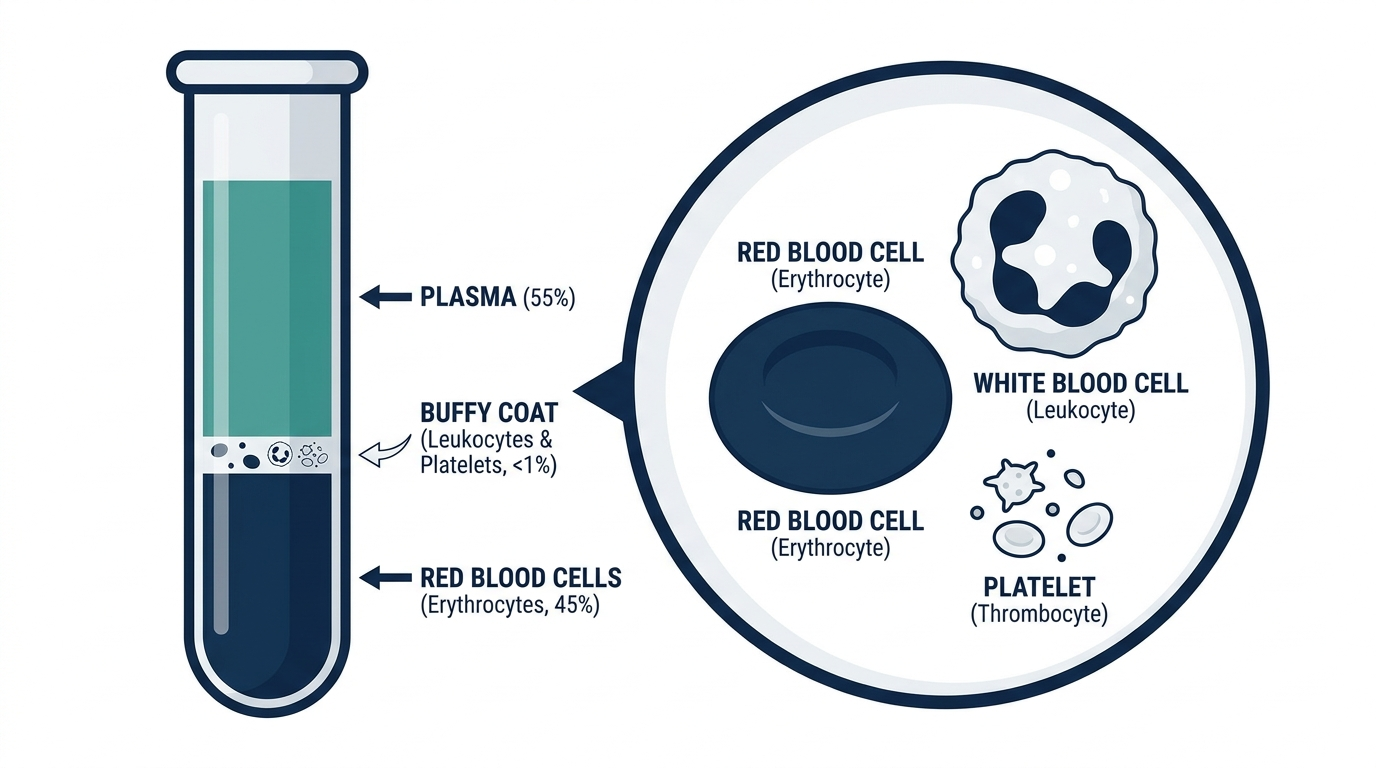
A CBC blood test, short for complete blood count, is a panel that measures the number, size, and concentration of the cells circulating in your blood: red blood cells, white blood cells, and platelets, plus the hemoglobin and hematocrit that go with your red cells (MedlinePlus). It is one of the most commonly ordered laboratory tests in all of medicine, run both as a routine health check and as the first step in working up almost any symptom (NCBI StatPearls).
In plain terms, the CBC is a population census of your blood. It counts how many of each cell type you have, measures how big they are, and flags when any group is too high, too low, or the wrong size. From those few numbers a clinician can spot anemia, infection, inflammation, clotting problems, and early signs of bone marrow trouble.
What does a CBC test for?
A CBC tests for problems across three separate cell lines at once, which is exactly why it is so useful. Each component answers a different question (Cleveland Clinic):
- Red blood cells (RBC), hemoglobin, and hematocrit. These are your oxygen-delivery system. Low values point toward anemia or blood loss, while high values can suggest dehydration or other red cell disorders.
- White blood cells (WBC). These are your immune system. A high count often signals infection or inflammation, and a low count can mean a bone marrow problem, an autoimmune condition, or the effect of certain medications (MedlinePlus).
- Platelets (PLT). These are your clotting system. Too few can mean easy bruising and bleeding; too many can raise clotting risk.
Because it touches oxygen transport, immunity, and clotting in a single tube of blood, the CBC works as both a broad screen when you feel fine and a focused diagnostic tool when you do not. It helps detect and monitor anemia, infections, inflammation, bleeding disorders, and blood cancers (NCBI StatPearls).
What does a CBC blood test show, component by component?
A CBC blood test shows a cluster of related numbers, and reading them in groups rather than one at a time is what makes the picture click. Here are the core values and typical adult reference ranges, which vary by lab, sex, and instrument (Cleveland Clinic):
- Red blood cell count (RBC): roughly 4.5 to 6.1 million cells/mcL for men and 4.0 to 5.4 million cells/mcL for women.
- Hemoglobin (HGB): about 13 to 17 g/dL for men and 11.5 to 15.5 g/dL for women. This is the protein that actually carries oxygen.
- Hematocrit (HCT): roughly 40 to 55 percent for men and 36 to 48 percent for women, the share of your blood made up of red cells.
- White blood cell count (WBC): generally 4,000 to 10,000 cells/mcL (MedlinePlus).
- Platelet count (PLT): about 150,000 to 400,000 cells/mcL.
Alongside the headline counts, the CBC reports red cell indices such as MCV (mean corpuscular volume, the average size of your red cells) and RDW (how much your red cells vary in size). Those size clues are how a clinician starts to tell one kind of anemia from another, long before any expensive follow-up test.
What is a CBC with differential, and why does it matter?
A CBC with differential adds a breakdown of your white blood cells into their five separate types, instead of giving you one lumped total. That extra detail is what turns a vague high white count into an actual lead (MedlinePlus). The five types and what each tends to flag:
- Neutrophils (the most common WBC): your front line against bacterial infection. A high count often means bacterial infection or inflammation.
- Lymphocytes: the B cells and T cells that fight viruses and target infected or abnormal cells. Shifts here can point toward viral illness or certain blood cancers.
- Monocytes: the cleanup crew that clears bacteria, viruses, and dead cellular debris.
- Eosinophils: tied to parasites, allergies, and some inflammatory conditions.
- Basophils: involved in allergic reactions and asthma (MedlinePlus).
A CBC with differential also flags immature or not-yet-fully-developed cells, which can be an early hint of a bone marrow or blood disorder (NCBI StatPearls). When a doctor says they want a CBC “with diff,” this is what they are after: not just how many soldiers you have, but which units.
What does a high or low CBC result mean?
An abnormal CBC value is a clue, not a verdict, and its meaning depends entirely on which component is off. The same direction of change means different things in different cell lines (MedlinePlus).
On the red side, low red blood cells, hemoglobin, or hematocrit usually point to anemia, blood loss, or low iron, and can leave you tired and short of breath; high values can reflect dehydration or, less commonly, a red cell disorder (Cleveland Clinic). On the white side, a high WBC count commonly signals infection or inflammation, while a low count can mean an autoimmune disorder, a bone marrow problem, or a medication effect (MedlinePlus). On the platelet side, a low count raises bleeding and bruising risk, and a high count can raise clotting risk.
Here is the insider point that rarely makes the patient handout. Experienced clinicians often learn more from the pattern across all three cell lines than from any single flagged number. One isolated value slightly outside the range is frequently noise: a recent infection, a stressful blood draw, normal day-to-day variation, or simply where your personal baseline sits. But when two or three cell lines move together, for example all of them dropping at once (a picture called pancytopenia), that combination is a far stronger signal that the bone marrow itself deserves a closer look. This is also why doctors so often repeat a CBC rather than react to one odd result. A trend over time beats a single snapshot almost every time, and chasing one mildly abnormal value in isolation is a classic way to generate anxiety and unnecessary tests.
Do you need to fast before a CBC, and what happens during the test?
For a CBC by itself, no special preparation is needed, and you do not have to fast (MedlinePlus). Fasting only becomes necessary when your CBC is bundled with other tests on the same draw, such as a glucose or cholesterol panel, so it is worth checking your specific order.
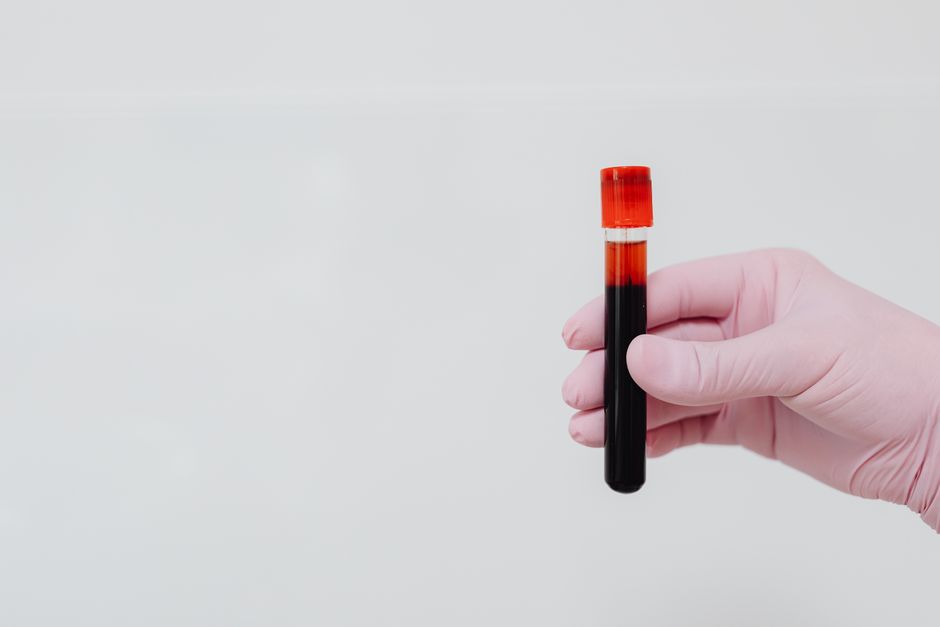
The test itself is quick and routine. A technician inserts a small needle into a vein, usually in your arm, and collects one tube of blood; an automated analyzer then counts and sizes your cells and prints the report, typically within hours (Cleveland Clinic). The most you are likely to feel is a brief sting and maybe a small bruise afterward.
The red cell indices: reading MCV, MCH, MCHC, and RDW
Beyond the headline counts, the CBC quietly reports a set of red cell indices that describe not how many red cells you have, but what they are like. These are where a clinician begins to classify anemia before ordering anything more expensive.
| Index | What it describes | Typical adult range | What it hints at |
|---|---|---|---|
| MCV | Average red cell size | About 80 to 100 fL | Small cells suggest iron deficiency; large cells suggest B12 or folate shortage |
| MCH | Average hemoglobin per cell | About 27 to 33 pg | Tracks with MCV; low in iron deficiency |
| MCHC | Hemoglobin concentration in cells | About 32 to 36 g/dL | High can flag spherocytosis; low can accompany iron deficiency |
| RDW | Variation in red cell size | About 11.5 to 14.5 percent | High separates iron deficiency from thalassemia trait |
The classic use is sorting anemia by cell size. A low MCV points toward microcytic causes like iron deficiency and thalassemia. A high MCV points toward macrocytic causes like B12 or folate deficiency and heavy alcohol use. A normal MCV with anemia (normocytic) often reflects chronic disease or acute blood loss. Adding RDW refines it further: a low MCV with high RDW leans iron deficiency, while a low MCV with normal RDW leans thalassemia trait. This is how two cheap numbers narrow a wide differential before any specialized testing.
Common CBC patterns and what they suggest
Because the CBC reads three systems at once, certain recognizable patterns emerge. None diagnoses anything alone, but each tells a clinician where to look:
- Low hemoglobin and hematocrit with low MCV. A microcytic anemia, most often iron deficiency, prompting an iron panel and a search for blood loss.
- Low hemoglobin with high MCV. A macrocytic anemia, raising B12 or folate deficiency, thyroid issues, or alcohol as considerations.
- High white cell count with a neutrophil predominance. Often bacterial infection or inflammation.
- High white cell count with a lymphocyte predominance. More typical of viral illness, and in some patterns a reason to look at the blood more closely.
- High eosinophils. Allergies, asthma, parasites, or certain drug reactions.
- Low platelets alone. Can reflect immune causes, medications, or a collection artifact, and is often rechecked.
- All three lines low (pancytopenia). A stronger signal that the bone marrow itself deserves evaluation.
The through-line is that the CBC rewards pattern reading. A single flagged value is a question, but a coherent pattern across counts and indices is where the diagnostic value lives.
The CBC is also most powerful when paired with a few companion tests. When it suggests iron deficiency, a ferritin level confirms whether iron stores are actually low, since ferritin can drop before the CBC changes. When it suggests a macrocytic anemia, B12 and folate levels pin down the cause. When inflammation is in the picture, markers like CRP add context. The CBC opens the investigation, and these targeted follow-ups close it, which is why clinicians rarely read a CBC in complete isolation.
Causes of high and low counts, by cell line
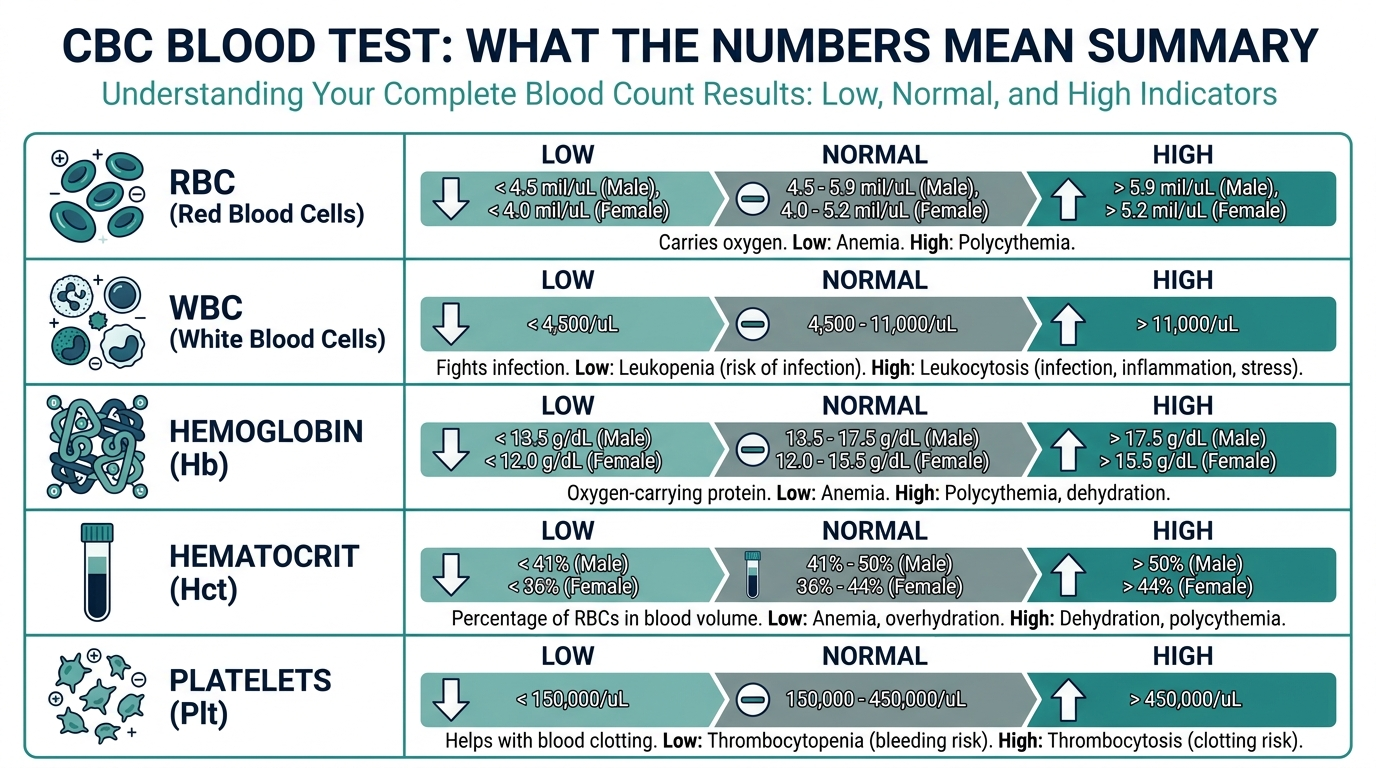
It helps to know what commonly pushes each count in each direction:
- Red cells (RBC, hemoglobin, hematocrit) low: iron, B12, or folate deficiency, blood loss, chronic disease, kidney disease, or bone marrow problems. High: dehydration (a relative rise), smoking, low oxygen from lung or heart conditions, living at high altitude, or a red cell disorder such as polycythemia.
- White cells low (leukopenia): certain viral infections, autoimmune disease, some medications including chemotherapy, and bone marrow problems. High (leukocytosis): infection, inflammation, physical stress, smoking, steroids, and, less commonly, blood cancers.
- Platelets low (thrombocytopenia): immune causes, medications, liver disease, or increased destruction, raising bleeding risk. High (thrombocytosis): iron deficiency, inflammation or infection (a reactive rise), or a bone marrow disorder.
Notice how often a common, benign cause sits at the top of each list. Dehydration, a recent cold, or iron deficiency explains far more abnormal CBCs than any rare disease, which is exactly why context and repeat testing matter so much.
What can distort a CBC result
A surprising CBC value is sometimes an artifact rather than a true change. Knowing the common ones prevents unnecessary worry:
- Dehydration concentrates the blood and can make red cell counts, hemoglobin, and hematocrit read falsely high.
- Recent intense exercise or acute stress can transiently raise the white cell count.
- Sample clumping. Platelets can clump in the collection tube and read falsely low; a repeat draw or a different anticoagulant clarifies it.
- Recent infection or vaccination can temporarily shift white cell counts.
- Time of day and recent meals cause minor fluctuations, part of why one borderline value is rarely acted on alone.
This is the practical reason clinicians so often say let us repeat that in a few weeks rather than launching a workup on a single odd number.

Who should get a CBC, and how often
The CBC is ordered in three broad situations: as part of a routine health check, to investigate symptoms such as fatigue, fever, unexplained bruising, or shortness of breath, and to monitor a known condition or a medication that affects blood counts. There is no fixed universal interval for a healthy adult, and it is commonly drawn as part of periodic care or whenever a symptom warrants it.
More frequent testing makes sense for specific groups: people being treated for anemia, those on medications like chemotherapy or certain immune drugs that suppress blood counts, people with chronic kidney disease or inflammatory conditions, and anyone under active evaluation for a blood disorder. In those cases a clinician sets the rhythm to catch a trend early. For everyone else, the most valuable use of the CBC is longitudinal: comparing today against your own prior results, since a stable personal baseline says more than a single reading against a broad population range.
What to do after an abnormal CBC
If a CBC value comes back out of range, a measured approach beats immediate alarm. First, put the number in context: any recent illness, dehydration, new medication, hard workout, or symptoms like fatigue, fever, or unusual bruising. Second, look at whether the abnormality is isolated or part of a pattern across cell lines and indices, since a cluster carries far more weight than a single flag. Third, expect your clinician to often repeat the CBC to confirm it is real and to check whether it is a trend or a blip. Fourth, when follow-up is warranted, the next test is usually targeted to the pattern: an iron panel and ferritin for a microcytic anemia, B12 and folate for a macrocytic one, or a peripheral blood smear when the automated numbers do not add up. Treating the underlying cause rather than the number is the goal, and a reassuring repeat result is one of the most common and welcome outcomes.
Common misconceptions about the CBC
- “A CBC checks for everything.” It does not. It reads red cells, white cells, and platelets. It does not measure cholesterol, blood sugar, kidney or liver chemistry, or thyroid function, which need their own tests.
- “One abnormal value means disease.” Usually not. A lone borderline number is often normal variation, dehydration, or a recent infection. The pattern and the trend matter far more.
- “A high white count always means infection.” Infection is common, but stress, smoking, steroids, and inflammation can all raise it, so context decides.
- “A normal CBC rules out cancer.” A normal CBC is reassuring for blood-related problems but does not exclude cancers elsewhere in the body, which it is not designed to detect.
- “I need to fast for a CBC.” A CBC alone requires no fasting. Fasting only applies if the same draw includes tests like glucose or a lipid panel.
How to read the layout of your CBC report
Once your CBC lands in a patient portal, the biology matters less than knowing how to navigate the page, because a confident read of the layout takes most of the anxiety out of an unfamiliar result. Nearly every CBC report is organized the same way, as a table with a few predictable columns, and understanding those columns lets you interpret almost any lab printout you will ever receive.
The first column is the test name or its abbreviation, such as WBC, RBC, hemoglobin, hematocrit, and platelets, along with the differential and the red cell indices. Next to it is your result, then the units, and then a reference range, which is the span the lab considers typical for the general population. The final piece is a flag, often an H for high or an L for low, or a value highlighted in a different color, marking any result that falls outside that range. Reading across a single row tells you the whole story for that one measurement: what was tested, your value, and whether it sits inside the expected band.
Two habits make this far more useful. First, remember that reference ranges vary slightly between labs and are usually set so that a small percentage of perfectly healthy people fall just outside them, which is why a mild flag on one line is often meaningless on its own. Second, if you have prior CBCs in the same portal, look at your own results over time rather than only against the reference range. A value that is technically flagged but has been steady for years reads very differently from one that has moved sharply since your last draw. The flag tells you a number is unusual for the population, but your personal trend tells you whether it is unusual for you.
How CBC results shift across life stages
A CBC does not read the same way for everyone, because normal blood counts change across the lifespan, and knowing this prevents a lot of unnecessary worry when a value sits near the edge of a range. The reference ranges printed on your report are typically set for general adults, so results in children, during pregnancy, and in older adults deserve context.
Pregnancy is the clearest example. Blood volume expands substantially, which dilutes the red cells and commonly lowers hemoglobin and hematocrit in a way that is expected rather than alarming, a pattern often described as the physiologic anemia of pregnancy. White cell counts also tend to run higher in pregnancy and around delivery, so a number that would prompt questions in a non-pregnant adult can be entirely normal here. This is why pregnancy results are interpreted against their own expectations rather than the standard adult range.
Children and older adults have their own patterns. Newborns and infants start with different normal values that shift as they grow, so pediatric labs are read against age-specific ranges instead of adult ones. In older adults, mild changes such as a slightly lower hemoglobin become more common, and the task is to distinguish an expected age-related drift from a genuine problem like a slow bleed or a nutritional deficiency. The unifying lesson is that a CBC value is only meaningful against the right comparison group, which is one more reason to interpret any borderline result with your clinician, who can apply the range that actually fits you.
Frequently asked questions
What does a CBC test for?
A CBC tests for problems in three blood systems at once: red blood cells and hemoglobin (oxygen delivery and anemia), white blood cells (infection and immune problems), and platelets (clotting and bleeding). It helps detect and monitor anemia, infection, inflammation, bleeding disorders, and blood cancers (NCBI StatPearls).
What does a CBC blood test show?
It shows the number of your red cells, white cells, and platelets, plus hemoglobin, hematocrit, and red cell size indices like MCV and RDW. Together these reveal whether any cell population is too high, too low, or the wrong size (Cleveland Clinic).
Do I need to fast before a CBC blood test?
No, a CBC on its own does not require fasting and needs no special preparation. You only need to fast if the same blood draw also includes tests that require it, such as a glucose or lipid panel (MedlinePlus).
What is the difference between a CBC and a CBC with differential?
A standard CBC gives a total white blood cell count. A CBC with differential breaks that total into the five white cell types (neutrophils, lymphocytes, monocytes, eosinophils, basophils) and can flag immature cells, giving your provider far more detail about what your immune system is doing (MedlinePlus).
Should I worry if one CBC value is slightly abnormal?
Usually not. A single value just outside the range is often normal variation, a recent infection, or lab-to-lab difference. Clinicians pay more attention to the pattern across cell lines and to trends over repeated tests than to one isolated number (Cleveland Clinic).
This article is for general educational purposes and is not medical advice. It cannot diagnose or treat you and does not replace your clinician. Always discuss your lab results and any health decisions with a qualified healthcare professional.
Related reading
Vital Signs Today may earn a commission if you buy through links on this page. It does not affect our editorial assessments.