
Educational content, not medical advice. GHK-Cu sold outside a licensed compounding pharmacy is labeled “for research use only” and is not approved for human injection. Talk to a licensed clinician before starting any peptide protocol.
Short answer: The lower abdomen, at least 2 inches from the navel, is the most cited primary site for subcutaneous GHK-Cu injection because its consistent subcutaneous fat depth of 8 to 12 mm and high vascular density give reliable absorption. That said, the injectable form sits in a legal grey zone in 2026: the FDA removed injectable GHK-Cu from its Category 2 “do not compound” list on April 15, 2026, but formal compounding approval is not finalized until the advisory panel reconvenes. For most people pursuing skin benefits, prescription-compounded topical GHK-Cu is the cleaner legal path right now.
Before adding an unregulated peptide to your routine, see what your own bloodwork says your body actually needs. One at-home Superpower draw checks 100+ biomarkers, physician-reviewed.
Why does anyone ask where to inject GHK-Cu?
GHK-Cu (glycyl-L-histidyl-L-lysine copper) is a tripeptide naturally present in human plasma. Loren Pickart isolated it from albumin in 1973, making one of the stranger observations in peptide science: when liver tissue from elderly patients was incubated with plasma from younger individuals, the older cells started behaving younger. The active factor was a small copper-binding peptide, and Pickart spent the next five decades mapping its biology.
The downstream research is legitimately striking. In a 2018 review, a trial with 71 women using GHK-Cu facial cream daily for three months showed increased skin density and thickness with reduced laxity, outperforming vitamin C (which improved collagen in 50% of subjects) and retinoic acid (40%). A thigh-application study found GHK-Cu improved collagen production in 70% of women treated. Human plasma levels of the peptide drop from roughly 200 ng/mL at age 20 to 80 ng/mL by age 60, which is the biological rationale for supplementing it.
Topical serums are openly sold and widely used. But a subset of users, usually from longevity forums, ask about injection: they believe bypassing the skin barrier delivers higher tissue concentrations and faster results. That question is reasonable on its face, and the answer involves both technique and regulatory reality.
Full-body lab membership: 100+ biomarkers, doctor-reviewed, tracked over time.

What GHK-Cu actually does at the cellular level
Understanding the injection question requires understanding what the molecule does, because where you inject affects what you get.
GHK-Cu works through a mechanism that is almost absurdly broad. A 2018 analysis found that GHK influences the expression of 31.2% of human genes, stimulating roughly 1,569 genes while suppressing 583. In skin specifically, the pathways that matter are: fibroblast stimulation (collagen, elastin, glycosaminoglycan synthesis), metalloproteinase upregulation to clear damaged collagen, anti-inflammatory suppression of IL-1β and TNF-α, and angiogenesis, the formation of new blood vessels that accelerate wound closure.
One insight that most “GHK-Cu guide” posts miss: the metalloproteinase effect is dose-dependent in a non-obvious way. A 2016 study found GHK-Cu significantly increased gene expression of MMP-1 and MMP-2 at the lowest concentrations tested. That is the “copper uglies” mechanism you occasionally see on forums, where anecdotal reports describe a short window of accelerated texture change before improvement. The dose is not neutral, and more is not unconditionally better.
The other thing rarely mentioned: GHK-Cu’s effects are local, not systemic, for tissue repair applications. Research consistently shows that wound healing outcomes require local injection, meaning subcutaneous delivery near the target tissue, not systemic delivery from a distant site. This matters enormously when someone asks “where to inject for skin.”
The injectable vs. topical question: what the absorption data actually shows
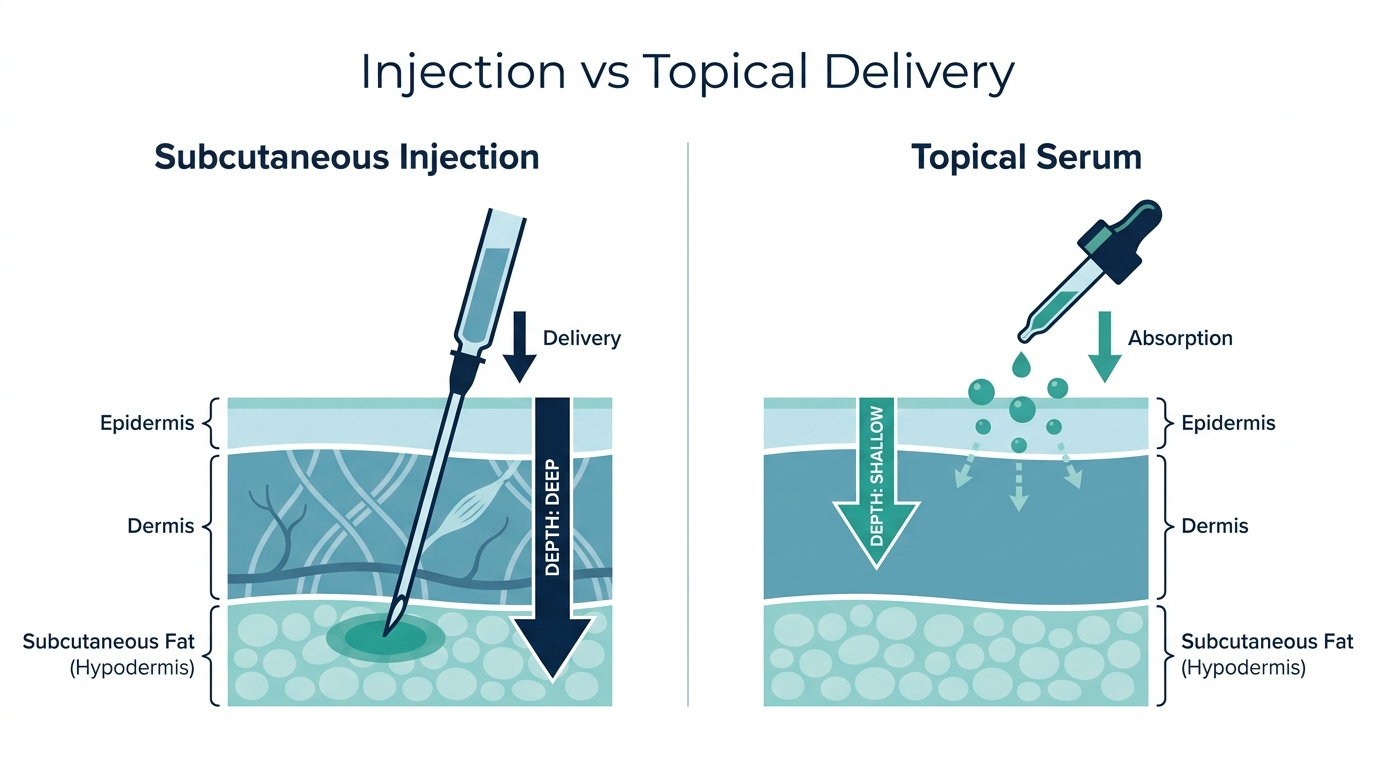
Injectable applications achieve tissue concentrations roughly 10 to 20 times higher than topical applications, at least in the tissue immediately surrounding the injection site. That is a real difference. The skin barrier, specifically the stratum corneum, limits how much of a topically applied tripeptide actually reaches fibroblasts in the dermis.
The counterintuitive part: this advantage disappears at distant skin targets. If you inject subcutaneously in the abdomen hoping to improve periorbital skin, you are not delivering the peptide to the right place. The molecule is not routed by the bloodstream to your face in meaningful concentrations. Local injection near the target tissue is the only logic that makes the injectable route pharmacologically coherent for cosmetic applications.
Microneedling with topical GHK-Cu closes much of this gap for facial skin. Creating microchannels at 0.5 to 1.5 mm depth and immediately applying a GHK-Cu serum achieves significantly deeper penetration than serum alone, with none of the reconstitution variables, needle sourcing, or regulatory exposure of a self-administered injection.
A 2024 multicenter study found that 0.05% GHK-Cu gel applied after fractional laser resurfacing produced 25% faster epithelial recovery and reduced erythema within 72 hours versus standard care, with IL-1β and TNF-α down 30%. This is the clinical evidence that actually exists: topical GHK-Cu applied after a procedure that creates controlled micro-injury. It is not for injectable protocols.

Where to inject GHK-Cu: sites by goal
For anyone pursuing injectable GHK-Cu through a licensed clinical channel (more on what that means in 2026 below), here is how injection site selection is approached by goal.
The core logic is simple: for local tissue repair, inject near the target tissue. For systemic circulation, inject in a site with high vascular density and consistent subcutaneous depth.
| Goal | Primary injection site | Secondary site | Why |
|---|---|---|---|
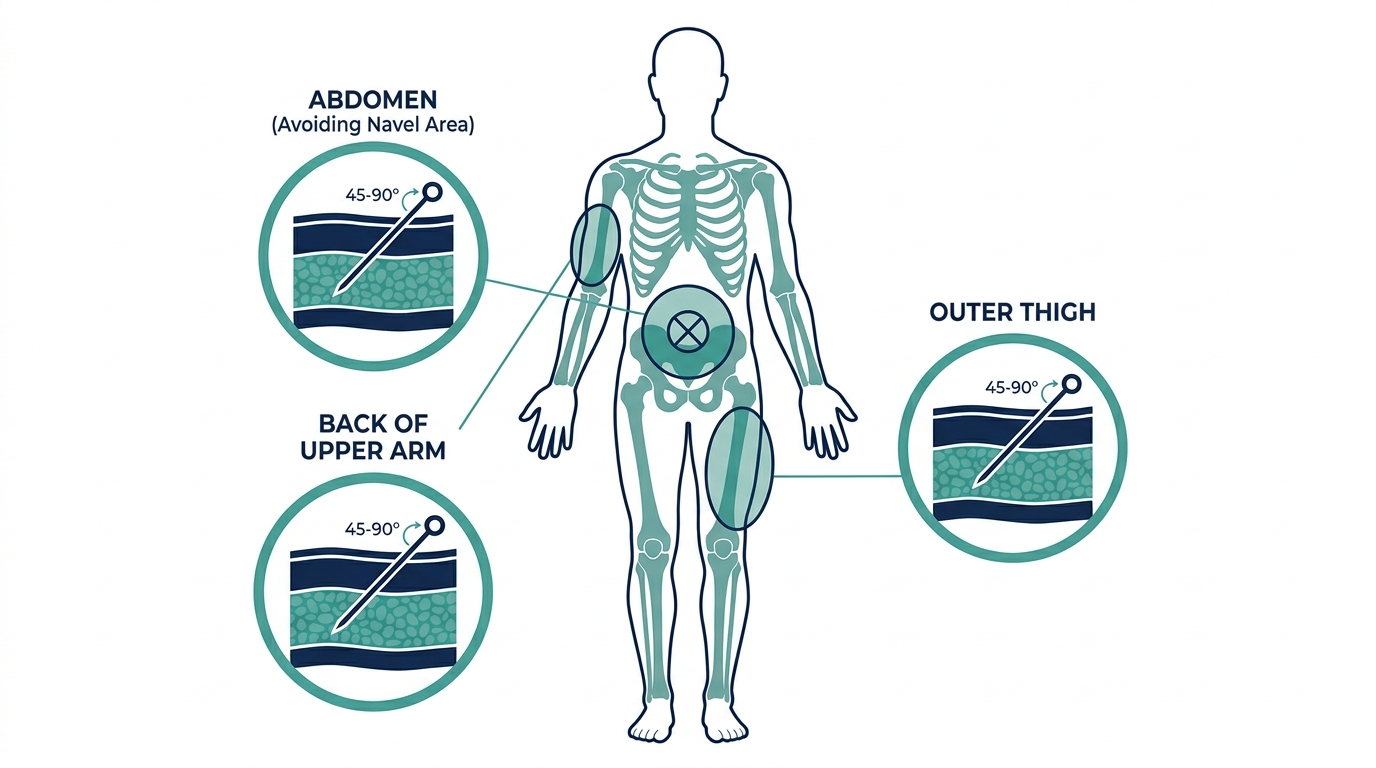
| General skin / anti-aging | Lower abdomen, 2+ inches from navel | Outer thigh, middle third | Consistent subcutaneous depth 8-12 mm, high vascular density |
| Hair growth support | Lower abdomen | Flanks | Systemic delivery; scalp injection not recommended without clinical supervision |
| Wound healing support | 1-3 cm from wound edge, subcutaneous | Opposite side for bilateral | Local delivery required; systemic alone insufficient |
| Scar reduction | Tissue bordering the scar | Abdomen for systemic support | Local concentration matters more than systemic |
| General wellness / longevity | Lower abdomen with rotation | Flanks, outer thighs | Consistent absorption, easy rotation |
Sites to avoid entirely:
- Within 2 inches of the navel (dense vascular and nerve networks)
- Inner thigh (femoral artery and nerve proximity)
- Directly over bone: shins, spine, clavicles
- Face and neck (minimal subcutaneous fat, dense innervation)
- Active skin conditions, lesions, or infection sites
- Existing scar tissue (absorption is unpredictable)
- Areas with visible surface veins
Subcutaneous technique: what a clinical protocol looks like
This is educational context, not a personal dosing protocol. Any actual injection protocol should come from a licensed clinician.
For subcutaneous delivery, the standard approach uses a 29 to 31 gauge insulin syringe with a 0.5-inch needle. The injection angle is typically 45 degrees for lean individuals, with a skin-fold pinch to gather 1 to 2 inches of tissue. People with higher body fat can use a steeper 90-degree angle and still stay within the subcutaneous layer. Target depth is 5 to 8 mm.
Slow injection matters more than most guides emphasize. A 10 to 15 second delivery for a 0.5 mL volume allows the solution to disperse gradually through subcutaneous tissue. Forcing it in quickly creates a pressure bolus that can push the solution into adjacent muscle or leak back through the injection tract.
Rotation is non-negotiable. Repeated injection in the same site causes lipodystrophy, fatty tissue breakdown that is both cosmetically obvious and permanent. A structured 4-quadrant rotation (left abdomen, right abdomen, left thigh, right thigh, with flanks as alternates) reduces lipodystrophy incidence from roughly 40% to less than 5%. Keep at least 1 inch (2.5 cm) between consecutive injection points within the same general area.
Personally, the injection technique requirements are where I think most people reading a web guide should pause and genuinely reconsider. Reconstituting lyophilized powder, hitting the correct concentration, rotating sites on a schedule, and sourcing bacteriostatic water are a competent pharmacist’s job description. Doing it yourself, with a research-grade vial that carries no pharmacy oversight, puts every one of those responsibilities on you.

The regulatory picture in 2026: what actually changed
Injectable GHK-Cu has had a complicated few years, and the status as of June 2026 matters if you are deciding between the grey-market route and waiting for the licensed clinical path.
Here is the actual timeline:
- November 2023: The FDA placed GHK-Cu (injectable) on the 503A Category 2 list, meaning compounding pharmacies could not legally prepare it. This was the crackdown.
- February 2026: HHS signaled that roughly 14 peptides, including GHK-Cu, would be re-evaluated for Category 1 (permitted for compounding) status.
- April 15, 2026: The FDA announced removal of injectable GHK-Cu from Category 2, with formal implementation expected in July 2026 when the FDA’s Pharmacy Compounding Advisory Committee (PCAC) reconvenes. BPC-157 and MOTS-c are on the same agenda.
- By February 2027: The PCAC review specifically covering GHK-Cu is scheduled to be complete, at which point formal Category 1 eligibility would be confirmed or adjusted.
What this does not mean: removal from Category 2 is not FDA approval. It is the removal of an active prohibition. Until the PCAC finalizes its review, injectable GHK-Cu is in a transitional state, no longer banned from compounding but not yet formally eligible. A compounding pharmacy launching injectable GHK-Cu programs today is doing so in that grey zone.
Non-injectable GHK-Cu, meaning topical formulations, has been separately noted for further consideration with a deadline of February 2027. Prescription-compounded topical GHK-Cu is currently the legally cleaner standard for licensed pharmacies.
Do not believe anyone telling you the April 2026 news means injectable GHK-Cu is “now legal” or “FDA-approved” with no caveats. The door is opening, but it has not yet opened all the way.
Hydrolyzed type I & III collagen peptides, third-party tested, unflavored.
Topical GHK-Cu: what to look for and who makes the real thing
The topical market ranges from genuine to cosmetic-label theater, and knowing the difference saves money and frustration.
Concentration matters, but context matters more. The research-validated range for topical GHK-Cu is roughly 0.05% to 3%. Products below 0.05% are unlikely to have meaningful effects. Products at 1% to 3% are in the territory where clinical trials observed wrinkle depth reduction of 32.8% and a 20 to 30% improvement in skin firmness over 12 weeks.
Named products with real clinical or formulation credibility:
- Skin Biology 3% GHK VIP Luxury Serum ($160): the highest-concentration widely available retail topical, from the company founded by Loren Pickart, the researcher who discovered GHK. That provenance matters, and the 3% concentration is at the upper end of clinically studied ranges.
- The Ordinary Multi-Peptide + Copper Peptides (about $32 for 30 mL): 1% GHK-Cu in a multi-peptide base including Matrixyl 3000 and Argireline. The most accessible entry point; the lower concentration is offset by the peptide stack.
- Platinum Skin Care 7% GHK-Cu Accelerant: an outlier at 7%, positioned as a clinical-strength option for post-procedure use alongside microneedling.
One formulation detail most review sites do not mention: GHK-Cu is destabilized by low pH. If you are layering it with a vitamin C serum (typically pH 2.5 to 3.5) or an AHA exfoliant, apply GHK-Cu on a separate routine or after a neutralizing toner. Applying it on top of a fresh low-pH layer degrades the copper chelation before it reaches the dermis.
For hair applications, Hairgenetix Copper Peptide Hair Growth Serum runs 10% GHK-Cu plus 5% AHK-Cu, backed by a published clinical trial with 120 participants showing 93% reduction in shedding and a gain of 12 hairs per cm squared at 150 days. That is a meaningful data set for a topical hair product.
Safety considerations that most guides underplay
GHK-Cu has a legitimate safety record in topical applications: nontoxic, non-irritant by independent laboratory classification, active at nanomolar concentrations. For most people using a well-formulated serum, the safety profile is excellent.
Injectable GHK-Cu adds a different layer of considerations, most of them not from the molecule itself but from the handling.
The populations who should not use GHK-Cu in any form without a clinician’s explicit oversight include: anyone with active or suspected cancer (GHK-Cu promotes angiogenesis, and while no causal link to cancer acceleration has been proven, the theoretical mechanism warrants caution), people with Wilson’s disease (a copper metabolism disorder), anyone under 18, and pregnant or breastfeeding women.
The “copper uglies” phenomenon deserves mention even though it is anecdotal: a subset of users report a window of apparent skin texture worsening in the first weeks of use, attributed to MMP upregulation clearing damaged collagen before new synthesis catches up. This is more commonly reported with high-concentration or injectable protocols than with moderate topical use. It typically resolves, but it is a real user experience to be aware of.
The contamination risk with grey-market injectable GHK-Cu is distinct from the molecule’s safety. Finnrick’s independent testing database, which now covers more than 8,000 tests across 225 vendors, regularly identifies purity shortfalls in research peptide vendors. A vial labeled as GHK-Cu with HPLC purity below 96% is delivering something other than what it claims, and there is no licensed pharmacist standing behind it.
Reconstitution and storage: where quality is won or lost
If GHK-Cu ever reaches you as a lyophilized (freeze-dried) powder through a licensed channel, the handling steps decide whether the peptide you paid for is still intact when it reaches tissue. This is a pharmacist’s competency, and it is the strongest practical argument for a clinical rather than a do-it-yourself route.
Lyophilized peptides are reconstituted with bacteriostatic water, which contains a small amount of benzyl alcohol that suppresses microbial growth and lets a vial be used across multiple draws. The water is added slowly against the inside wall of the vial, not squirted directly onto the powder, because a hard stream can shear the peptide and denature it. The vial is then swirled gently until dissolved, never shaken, since foaming and mechanical agitation degrade fragile peptide bonds.
Storage is equally unforgiving. Reconstituted peptide is kept refrigerated, protected from light, and used within a limited window rather than left at room temperature. Copper-containing peptides are particularly light-sensitive, which is why the finished solution should stay in an opaque or shielded vial. A peptide that has been repeatedly warmed, shaken, or exposed to light can look identical in the vial while having lost much of its biological activity. None of this is guesswork you want to be doing over a kitchen counter.
Dosing frequency, cycling, and why more is not better
The mechanism section above hinted at something important: GHK-Cu upregulates matrix metalloproteinases that clear old collagen before new synthesis catches up, and that effect is meaningful at low concentrations. The practical consequence is that flooding tissue with high or constant doses is not automatically superior and can produce the transient texture worsening that forum users call the copper uglies.
This is why any legitimate protocol built by a clinician tends to favor modest, spaced dosing rather than daily maximal loads, and often uses cycling, meaning a period of use followed by a rest period, so the tissue completes the remodeling cycle. The remodeling itself is not instant. Collagen turnover unfolds over weeks to months, which is why the human trials cited earlier measured skin density and wrinkle change at the three-month mark rather than after a few days.
Two takeaways follow. First, judge results on a monthly timescale, not a weekly one, because the biology is slow by design. Second, resist the instinct to escalate dose when early results feel slow, since the metalloproteinase dynamics mean the initial phase can look like it is going backward before it improves. Dose decisions belong with a licensed prescriber who can weigh your goal, your skin, and the concentration together.
How to track whether it is actually working
Because the effects are gradual and partly cosmetic, structured tracking separates a genuine response from wishful thinking. A few low-cost methods make the difference visible.
- Standardized photos. Same lighting, same angle, same distance, same time of day, taken every two weeks. Skin change is slow enough that side-by-side photos across two to three months reveal what the mirror hides day to day.
- A simple symptom or texture log. Note firmness, fine-line visibility, and any irritation on a fixed scale. Written records beat memory, which tends to overweight the most recent week.
- For hair applications, a fixed-density count. Photograph the same scalp region under the same parting and lighting so shedding and regrowth are comparable over months.
- Watch for adverse signs. Persistent redness, swelling, unusual pigment change, or any nodule at an injection site is a reason to stop and consult a clinician rather than push through.
Tracking also protects your wallet: if three months of honest documentation shows no change, that is useful evidence to stop rather than keep buying. Objective records turn an expensive experiment into a decision you can actually make.
How GHK-Cu compares to other regenerative peptides
People researching GHK-Cu injection sites are often weighing it against other peptides in the same regenerative conversation. A quick orientation helps set expectations, and each of these carries its own regulatory caveats as noted throughout this article.
- GHK-Cu is primarily a skin, hair, and wound-repair peptide, best evidenced in topical and local applications, acting through broad gene expression changes and copper delivery to fibroblasts.
- BPC-157 is discussed mainly for soft-tissue and gut-related repair. Like GHK-Cu, its injectable form has moved through the same FDA Category 2 re-evaluation, and human clinical evidence remains limited compared to the volume of anecdotal use.
- Collagen peptides taken orally occupy a completely different category. They are hydrolyzed dietary protein, widely available as supplements, and supported by trials for skin elasticity and joint comfort. They are the lowest-risk, most accessible option for someone whose goal is general skin and connective-tissue support without any injection.
The honest framing: GHK-Cu is not a shortcut that replaces the fundamentals. Sleep, protein intake, sun protection, and not smoking do more for skin collagen than any peptide, and they cost nothing. A peptide is an add-on to that foundation, not a substitute for it, and the cleanest version of it in 2026 remains a physician-guided topical rather than a self-injected research vial.
Curious what your own levels look like?
Baseline 100+ biomarkers today and retest as life changes, all in one membership with physician review.
Frequently asked questions
Where is the best place to inject GHK-Cu?
The lower abdomen, at least 2 inches from the navel, is the primary site most clinical guides recommend. It has consistent subcutaneous fat depth (8 to 12 mm in most body types), high vascular density, and is easy to rotate. The outer thigh is a reliable secondary site. For wound or scar applications, inject near the target tissue rather than a distant site, because GHK-Cu’s repair effects are largely local.
Is GHK-Cu legal to inject in 2026?
Injectable GHK-Cu was removed from the FDA’s 503A Category 2 “do not compound” list on April 15, 2026. It is in a transitional status: no longer actively prohibited from compounding, but formal PCAC approval is expected by February 2027. Research-grade injectable GHK-Cu sold online is labeled “for research use only” and is not approved for human use. The safest approach is to wait for licensed compounding pharmacies to formally offer it, which is expected within this regulatory cycle.
How deep should GHK-Cu be injected subcutaneously?
Target depth is 5 to 8 mm into the subcutaneous layer. Use a 29 to 31 gauge insulin syringe with a 0.5-inch needle. Lean individuals should inject at a 45-degree angle with a skin fold pinch; those with higher body fat can use 90 degrees and still land in the subcutaneous layer without going intramuscular.
Is topical GHK-Cu actually effective, or do you need injections?
Topical GHK-Cu has genuine clinical backing. Trials with 71 women showed improved skin density and thickness at 3 months, with wrinkle depth reduction of 32.8% versus control. The absorption limitation is real but can be largely overcome with microneedling or post-procedure application. For cosmetic skin goals, topical GHK-Cu combined with microneedling achieves results comparable to what most people seek from injection, without the regulatory exposure, reconstitution complexity, or sourcing risk.
What needle gauge is used for GHK-Cu injection?
29 to 31 gauge, 0.5-inch (12.7 mm) needle on a U-100 insulin syringe. This is fine enough to minimize pain and short enough to reach subcutaneous tissue without intramuscular penetration in most body compositions.
Can you inject GHK-Cu near the face?
Most clinical guidance advises against self-injection in the face and neck: minimal subcutaneous fat, dense innervation, and proximity to important structures make the margin for error narrow. Facial applications are the domain of licensed aesthetic clinicians using intradermal techniques, not subcutaneous home protocols. For facial skin goals, topical application and professional microneedling are safer paths.
What is the difference between subcutaneous and intradermal GHK-Cu injection?
Subcutaneous delivers the peptide into the fatty layer beneath the skin, targeting systemic circulation and general tissue repair. Intradermal delivers directly into the dermis, maximizing local skin concentration for rejuvenation goals. Intradermal technique requires more precision (a skilled hand, typically a licensed professional, and a shallower bevel angle) and is not recommended for self-administration. Most forum-documented injectable protocols use subcutaneous delivery because it is more forgiving technically.
Author: Vital Signs Today Editorial Team, [credential]”]. Educational content, not medical advice. Sources linked inline.
Primary sources:
– GHK-Cu gene expression and regenerative actions, PMC/NIH, 2018
– FDA 503A Category 2 removal announcement, PeptIQ, April 2026
– FDA removes 12 peptides from Category 2, Orrick legal analysis, 2026
– GHK-Cu injection sites by goal, PeptidesExplorer
– GHK-Cu injectable hydroxyapatite filler study, ScienceDirect, 2025
– GHK-Cu safety, dosing, and clinical evidence, Innerbody, 2026
– GHK-Cu topical vs injectable absorption, PLU Laboratories
– Finnrick independent peptide testing database
– Copper peptides in regenerative aesthetic dermatology, Wiley/JAAD, 2025
Related reading
Vital Signs Today may earn a commission if you buy through links on this page. It does not affect our editorial assessments.