Quick answer: A tb skin test (the PPD or Mantoux) works by injecting a tiny amount of tuberculosis protein just under the skin of your forearm, then having a clinician measure the raised bump 48 to 72 hours later. If your immune system has met TB before, it reacts and forms a firm, raised area called induration. The blood test (QuantiFERON-TB Gold) checks the same immune memory but uses a single tube of blood, gives a clear positive or negative from a lab, and does not require a return visit. Both detect TB infection, not active disease.
People mix these two tests up constantly, and the difference matters for your time, your money, and how trustworthy the result is. Below is exactly how each one works, what the numbers on a skin test reading actually mean, why false positives happen more than people expect, what to do if your result comes back positive, and the situations where the blood test quietly wins.
How does the tb skin test work?
The tb skin test works by placing 0.1 mL of purified protein derivative (PPD) into the top layer of skin on the inner forearm, using a fine needle angled almost flat. Done correctly, it raises a small pale blister called a wheal, about the size of a pea, that fades within minutes. That blister is the sign the dose went into the skin and not under it, which is the whole point. If the fluid goes too deep, the test is unreliable and has to be redone.
What you are really testing is immune memory. PPD is a mix of tuberculosis proteins. If your T cells have encountered TB bacteria before, whether from an old exposure, a latent infection, or in some cases a BCG vaccine, they recognize the proteins and trigger a slow, localized reaction at the injection site over the next two to three days. No memory, no reaction. The medical name for this is a delayed-type hypersensitivity reaction, and the word “delayed” is the part people forget. Nothing happens immediately. You walk out of the clinic with what looks like a mosquito bite and almost no sensation, and the real result builds quietly over the following days.
This is why the test is a two-trip process. You cannot read it on the spot. You come back during the 48 to 72 hour window so a trained person can feel and measure the response. Miss that window and the reaction can fade or change, and you start over. If you come back at 24 hours, you may be reading a bump that has not finished developing. If you wander in at 96 hours, you may be reading one that has already started to recede. The window is narrow on purpose.
The placement step, in plain order
Here is what actually happens during the placement visit, in sequence, so you know whether yours was done right:
- The clinician cleans the inner forearm, usually two to four inches below the elbow crease, away from veins and visible blemishes.
- They draw up exactly 0.1 mL of PPD (5 tuberculin units) and angle the needle bevel up, nearly parallel to the skin.
- They inject just under the surface so the fluid pools in the skin rather than the tissue below.
- A 6 to 10 mm pale wheal appears immediately. This is normal and expected, and it is not your result. It flattens out within ten to fifteen minutes.
- You leave the site uncovered. No bandage that presses on it, no scratching, no scrubbing in the shower.
If no wheal formed during placement, the dose likely went too deep, and an honest clinician will redo it on the other arm rather than send you home with a test that means nothing.
Reading the result: what induration actually means
The simplest way to actually get this done
Superpower is a full-body lab membership that runs 100+ biomarkers, has each result reviewed by a doctor, and tracks your numbers year over year (about $199/year). It is what we point readers to when they would rather get one clean, complete draw than chase single tests one at a time. Here is superpower reviewed in full.
The reading is the part most people get wrong on their own, because they look at redness. Redness is not what counts. The reader measures induration, the firm raised area you can feel with a fingertip, and they measure it across the forearm (perpendicular to the arm), in millimeters. Flat redness with no firmness underneath is read as 0 mm. A common technique is the ballpoint pen method: the reader draws a line toward the bump from each side and stops where the pen meets resistance, then measures the distance between the two marks. That margin of firm tissue is the number that gets recorded.
Here is the insider detail almost no one explains at the front desk: the cutoff for a positive is not one number. It slides based on who you are.
| Induration size | Counts as positive for |
|---|---|
| 5 mm or more | People with HIV, recent contact with active TB, organ transplant recipients, people with fibrotic changes on a prior chest X-ray, or those on immune-suppressing drugs (including long-term steroids and TNF blockers) |
| 10 mm or more | Recent immigrants (within 5 years) from high-TB countries, healthcare workers, residents and staff of prisons or shelters, IV drug users, children under 4, people with diabetes or other higher-risk conditions |
| 15 mm or more | People with no known risk factors |
So a 12 mm bump can be a clear positive for a nurse and a clean negative for a low-risk office worker on the same day. This is not a loophole or a clerical quirk. It is built into the way the test is interpreted nationwide, because the point is to balance the chance you truly have an infection against the chance the bump is noise. The higher your baseline risk, the smaller the bump needs to be before it is worth acting on.
What a positive does and does not mean
A positive does not mean you have tuberculosis disease. It means your body has been infected at some point and your immune system remembers it. The overwhelming majority of positive skin tests in the US represent latent TB infection, where the bacteria are present but walled off and dormant, you have no symptoms, and you cannot spread it to anyone. Active TB disease is a different animal: cough, fever, night sweats, weight loss, and contagiousness. The skin test cannot tell these apart. The next step after any positive is almost always a chest X-ray and a symptom check to separate latent infection from active disease, which we walk through further down.
A worked example
Say two people get tested on Monday and return Wednesday. Person A is a 30-year-old software engineer born in the US with no known exposures, and her reader measures 11 mm of firm induration. Because her cutoff is 15 mm, that reads negative, and she is done. Person B is a 45-year-old nurse who measures the exact same 11 mm. His cutoff is 10 mm, so the identical bump reads positive, and he moves on to a chest X-ray. Same physical result, two opposite outcomes, because risk category decides the line.
Why false positives happen (and the two-step test)
The single biggest cause of a confusing skin test is the BCG vaccine. BCG is a tuberculosis vaccine given routinely at birth in much of the world, though not in the United States. If you got it as a child, your skin test can react to the PPD and read positive even though you were never infected with TB. The skin test cannot tell the difference between vaccine memory and infection memory. This trips up a huge number of immigrants and people who grew up abroad, and it is the most common reason a healthy person gets sent down a rabbit hole of X-rays and worry for nothing.
The other source of confusion is the boosting effect. In some older adults, an immune reaction to TB has faded so much that the first skin test reads negative, but the act of testing wakes up the immune memory, so a second test weeks later reads positive. To avoid mistaking that for a new infection, many jobs use a two-step tb skin test for baseline testing: you do the test, read it, then repeat it one to three weeks later. If the second one is positive, it was an old infection being unmasked, not a recent one. If you are starting a healthcare or school role, this is often why you are asked to come in more than once. Our guide on TB testing for work, school, and healthcare jobs walks through which employers require the two-step version.
Other causes of a false positive
BCG is the headline, but it is not the only way the skin test misfires upward:
- Non-tuberculous mycobacteria (NTM). Exposure to environmental cousins of TB bacteria, common in soil and water, can cause a low-level cross-reaction and a small bump that means nothing.
- Repeated PPD testing over the years. The boosting effect described above can stack in people tested annually, nudging readings upward over time.
- Reader error. Measuring redness instead of firm induration, or eyeballing instead of palpating, inflates the number. This is a human-skill test as much as a biological one.
And the false negatives
False negatives happen too, and they are arguably more dangerous because they offer false reassurance. The main causes:
- Window period. A very recent exposure can read negative because the immune response takes 2 to 8 weeks to develop. If you were exposed last week, a test today may not catch it.
- Anergy. A weakened immune system, from HIV, advanced age, certain cancers, or immune-suppressing drugs, may not mount enough of a reaction even with a real infection.
- Technical failure. A dose injected too deep, an expired vial, or a reading done outside the 48 to 72 hour window can all hide a true infection.
- Very recent live-virus vaccines. Getting an MMR or similar live vaccine in the weeks before can briefly suppress the skin reaction.
No skin test is perfect, which is the practical case for the blood test.
The TB blood test: QuantiFERON Gold and when it wins
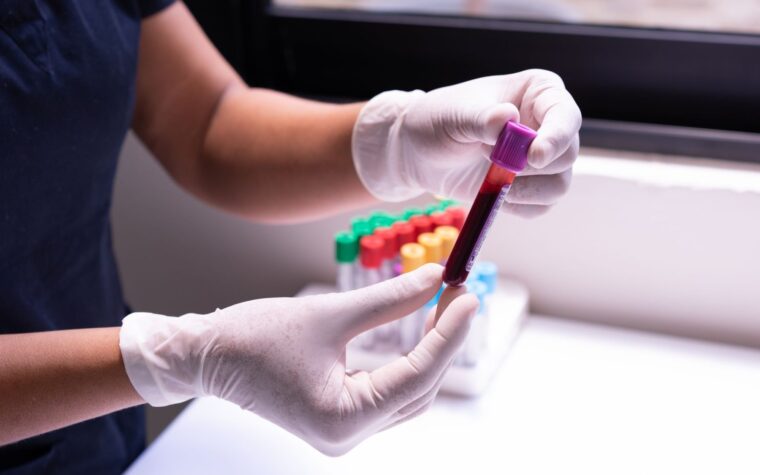
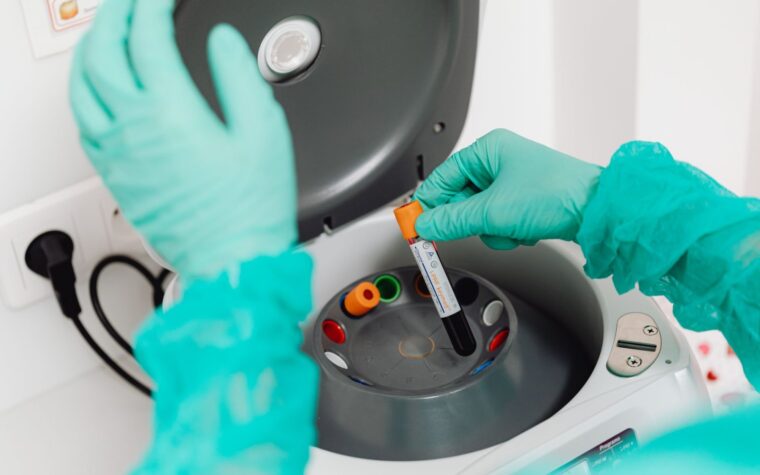
The blood test, usually QuantiFERON-TB Gold Plus or the T-SPOT.TB, measures the same immune memory but in a tube of blood instead of on your arm. These are called interferon-gamma release assays, or IGRAs. A lab exposes your white blood cells to TB-specific proteins and measures the interferon-gamma they release in response. One blood draw, one lab result, no return visit. The proteins used (ESAT-6 and CFP-10) are specific to the TB complex and are absent from the BCG vaccine and from most environmental mycobacteria, which is exactly why the blood test sidesteps the BCG problem.
The blood test wins clearly in three situations. First, if you had the BCG vaccine, because QuantiFERON uses proteins that BCG does not contain, so the vaccine does not cause a false positive. This alone makes it the smarter choice for most people who grew up outside the US. Second, if you are unlikely to return in 48 to 72 hours, since the skin test is useless if you skip the reading. Third, when you want an objective lab number instead of a measurement that depends on who is holding the ruler.
How to read a QuantiFERON result
A QuantiFERON report comes back as positive, negative, or indeterminate, with raw interferon-gamma values in the lab notes. Positive means TB infection is likely. Negative means it is unlikely. The third category, indeterminate, is the one that confuses people: it means the test could not be trusted, usually because the control samples did not behave as expected, often in people with very weak immune systems or because of a problem with how the tube was filled, shaken, or stored before reaching the lab. An indeterminate result is not a positive and not a negative. It is a do-over, and a good clinician will either repeat the blood test or switch to a skin test rather than guess.
The trade-off: cost and access
The trade-off is cost and access. A skin test is cheap and available almost anywhere, including many pharmacy clinics. A QuantiFERON draw costs more, has to go to a lab, and is not offered at every walk-in spot. There is also a logistics wrinkle most people never hear: QuantiFERON tubes have to reach the lab and be processed within a tight time window after the draw, so a clinic that does not run frequent lab couriers may not offer it at all. For a breakdown of what each option runs at different pharmacies and clinics, see how much a TB test costs at CVS, Walgreens, and clinics, and if you just need somewhere fast, where to get a TB test near you covers the practical options.
If you are getting blood drawn anyway, it is often smarter to capture a full baseline at the same visit rather than chasing single tests one at a time. Here is how a full-body panel compares.
Skin test vs blood test: a side-by-side
| Feature | TB skin test (PPD) | Blood test (QuantiFERON Gold) |
|---|---|---|
| Visits needed | Two (place, then read in 48 to 72 hrs) | One draw |
| Affected by BCG vaccine | Yes, can cause false positive | No |
| Result type | Measured induration in mm | Objective lab positive or negative |
| Turnaround | Read at 48 to 72 hrs, result same day | Usually 1 to 3 days from the lab |
| Typical cost | Lower, widely available | Higher, lab-based |
| Reader skill dependent | Yes, human measurement | No, machine-read in a lab |
| Best for | Quick, low-cost screening with no BCG history | BCG-vaccinated people, one-visit needs |
Neither test diagnoses active tuberculosis on its own. A positive result on either one means infection, and a clinician will follow up with a chest X-ray, symptom review, and sometimes a sputum test to decide whether you have latent or active TB. Talk to a clinician about any positive result rather than self-interpreting it.
Which one should you actually pick?
Decision guidance, stripped to the essentials:
- You were born or raised abroad and likely got BCG: choose the blood test. It is the single clearest case, because it removes the false-positive risk that follows you for life with a skin test.
- You have a known, reliable way to return in two to three days and want the cheapest option: the skin test is fine.
- You are testing on a tight job or school deadline and cannot guarantee a return visit: the blood test, because one trip is one trip.
- You have a severely weakened immune system: talk to your clinician. Either test can underperform, and they may order both or add imaging.
- You are a child under 5: the skin test is still often preferred in this age group, so follow the pediatrician’s lead rather than assuming the blood test is automatically better.
What happens after a positive result
A positive skin test or blood test is the start of a process, not a diagnosis, so do not panic at the word “positive.” Here is the standard path once either test comes back positive:
- Chest X-ray. This is the fork in the road. A clear chest X-ray with no symptoms points to latent TB infection. An abnormal X-ray, especially with cough or other symptoms, raises concern for active disease and triggers more testing.
- Symptom review. The clinician asks about cough lasting more than a few weeks, coughing up blood, fever, night sweats, and unexplained weight loss. These are the active-TB flags.
- Sputum testing, if active disease is suspected. Lab analysis of phlegm confirms whether live, transmissible bacteria are present.
- Treatment decision. Latent TB is commonly treated with a course of antibiotics taken over several months to keep it from ever becoming active. Active TB requires a longer, multi-drug regimen under public-health supervision.
The key reframe: most US adults who test positive have latent infection, feel fine, and are not contagious. Treatment exists to prevent a future problem, not to fight a current one. The decision to treat weighs your age, risk factors, and liver health, which is a real conversation to have with a clinician rather than a foregone conclusion.
Common mistakes people make with TB testing
After watching how these tests actually play out, the same avoidable errors show up again and again:
- Reading the bump yourself and panicking over redness. Redness is not the result. Only firm induration counts, and you almost certainly cannot measure it accurately on your own arm. Wait for the reader.
- Skipping the return visit. A skin test with no reading at 48 to 72 hours is a wasted appointment and your money down the drain. If you cannot commit to coming back, book the blood test from the start.
- Not mentioning a BCG vaccine. If you were vaccinated abroad and do not flag it, a positive skin test can send you into needless follow-up. Mention BCG up front and ask whether the blood test is the better fit.
- Scratching, bandaging tightly, or scrubbing the site. Irritating the spot can distort the reading. Leave it alone.
- Assuming a positive means active, contagious TB. In the US it usually means latent infection, which is silent and non-transmissible. The X-ray sorts this out.
- Testing too soon after a known exposure. Because of the 2 to 8 week window, a test done days after contact can falsely reassure. Ask about timing and possibly retesting.
Edge cases: uninsured, minors, employers, and Medicare
The standard path assumes an insured adult getting tested at a clinic, but plenty of real situations sit outside that.
Uninsured or paying cash
If you are uninsured, the skin test is usually the lower-cost route and is often available at county or local public health departments, sometimes free or at minimal cost, especially when testing is tied to a public-health reason. A cash QuantiFERON draw runs higher because of the lab processing. Discount lab marketplaces and direct-to-consumer ordering can bring the blood test price down, but you still pay for the draw and the lab work.
Minors and children
For young children, the skin test is frequently still preferred, and pediatric guidance leans on a clinician’s judgment about risk factors. A child under 4 has a lower induration cutoff (10 mm) precisely because young children are at higher risk if infected. Do not apply adult assumptions here. Follow the pediatrician.
Employer-required and pre-employment testing
Healthcare systems, schools, and some other employers require documented TB clearance, and the specifics vary by institution. Many now accept either a negative blood test or a completed two-step skin test for a baseline, then switch to annual symptom questionnaires rather than annual skin tests. If your employer is paying or requiring it, ask which test they accept before you book, so you do not pay for the wrong one.
Medicare and older adults
Coverage for TB testing under Medicare generally hinges on medical necessity, such as a known exposure, symptoms, or a documented risk factor, rather than routine personal curiosity. Older adults are also where the boosting effect and two-step testing matter most, so a single skin test in someone over 65 is more likely to mislead than the same test in a younger person.
FAQ
How long does a TB skin test take to read?
The skin test itself takes about a minute to place, but you must return 48 to 72 hours later for the reading, which is the part that produces the result. The reader feels for firm induration and measures it in millimeters in under a minute. If you miss the 48 to 72 hour window, the test has to be redone, so plan the return visit before you commit to the skin version.
Is the TB skin test or blood test more accurate?
For people who received the BCG vaccine, the blood test (QuantiFERON Gold or T-SPOT.TB) is more reliable because the vaccine does not cause a false positive on it. For people with no BCG history and a guaranteed return visit, the two tests perform comparably, and the skin test is cheaper. The blood test also removes reader subjectivity, since it is processed by a machine in a lab rather than measured by a person on your arm.
Can I shower or get the TB skin test wet?
Yes, you can shower and let water run over the site. The thing to avoid is scrubbing, scratching, or covering it with a tight bandage, since irritating the spot can distort the reading. Leave it uncovered and undisturbed until your return visit.
Does CVS do the QuantiFERON Gold test?
Most CVS MinuteClinic locations focus on the PPD skin test rather than the QuantiFERON Gold blood test. Availability of the blood version varies by location and is less common, so call ahead, and expect to be sent to a lab or a clinic that draws blood if you specifically need QuantiFERON.
Does CVS do TB blood tests?
CVS MinuteClinic primarily offers the skin (PPD) test. TB blood tests are more reliably ordered through Quest, Labcorp, urgent care, or your doctor, since they require a blood draw and lab processing rather than an in-clinic reading.
Does Labcorp do QuantiFERON Gold?
Yes. Labcorp processes the QuantiFERON-TB Gold blood test, as does Quest Diagnostics. You typically need a provider order, though some direct-to-consumer lab services let you order it yourself and visit a patient service center for the draw.
Does health insurance cover the QuantiFERON Gold test?
Often yes, especially when the test is medically indicated or required for a job, school, or known exposure. Coverage depends on your plan and the reason for testing, and a test ordered purely for personal screening may be billed to you. Check with your insurer before the draw to avoid a surprise bill.
How long after exposure should I get tested for TB?
The immune response that both tests detect takes 2 to 8 weeks to develop, so testing too soon after a known exposure can read falsely negative. The usual approach is to test once after the exposure and then retest about 8 to 10 weeks later if the first result is negative but the exposure was significant. A clinician managing a known contact will time this for you.
What does an indeterminate QuantiFERON result mean?
Indeterminate means the blood test could not be trusted in either direction, usually because the internal control samples did not respond as expected, often in people with weakened immune systems or because of a handling problem before the sample reached the lab. It is neither positive nor negative. The standard response is to repeat the blood test or switch to a skin test rather than treat an indeterminate as a result.
How long is the CITB health and safety test valid for?
The CITB Health, Safety and Environment test (a UK construction certification, not a medical TB test) is generally valid for two years from the date you pass it. It is unrelated to tuberculosis testing despite the similar abbreviation, so do not confuse a CITB pass with a TB clearance for a US healthcare or construction role.