
Last updated June 2026. Educational content, not medical advice. BPC-157 is not FDA-approved for human use. Talk to a licensed clinician before starting anything.
Short answer: Most research protocols dose BPC-157 at 250 to 500 mcg once or twice daily, for cycles of 4 to 12 weeks depending on the indication, with rest periods equal to or longer than the cycle. Twice-daily dosing is preferred for acute injuries because BPC-157’s plasma half-life is under 30 minutes after injection, making a single daily dose leave tissue concentrations near zero for most of the day.
Following a BPC-157 dosing cycle? See how your inflammation and recovery markers actually look right now. One at-home Superpower draw checks 100+ biomarkers, physician-reviewed.
That single pharmacokinetic fact, the short half-life, is what drives nearly every other decision in a BPC-157 dosing schedule. Before getting into specific numbers, though, two things matter more than any protocol chart: understanding which form you are taking (injectable vs. oral, and which salt), and knowing the rapidly changing legal landscape that now makes a licensed telehealth clinic the cleanest route for most people.
Why does the half-life matter so much for frequency?
BPC-157 is a pentadecapeptide, fifteen amino acids derived from human gastric juice. It is extraordinarily stable compared to most peptides and resists enzyme degradation remarkably well, which is part of why oral dosing has any effect at all. But pharmacokinetic data from a 2022 study published in Frontiers in Pharmacology puts plasma half-life under 30 minutes in rats following intravenous administration, and not dramatically longer with intramuscular dosing.
That is not a long window. GH secretagogues like CJC-1295 have modification strategies (the DAC version, for instance) that extend half-life to several days precisely because a 30-minute window is too short for once-daily dosing to maintain meaningful tissue levels. BPC-157 has no such modification in the forms currently available, which is why clinicians who work with it routinely split the daily dose into two administrations roughly 10 to 12 hours apart, rather than front-loading it all in the morning and calling it done.
The half-life argument sounds purely pharmacological, but it has a practical edge: if you are spending money on a therapy with a narrow activity window, splitting the dose is not optional fine-tuning. It is what makes the therapy work at all.
Full-body lab membership: 100+ biomarkers, doctor-reviewed, tracked over time.
What is the standard dosing frequency for BPC-157?
The short answer is: once or twice daily, depending on severity and goal. There is no FDA-approved protocol because BPC-157 has no FDA approval as a finished drug. What exists is a body of animal research plus accumulated clinical observation from telehealth practitioners who have worked with it in compounding contexts.
The range cited across the peer-reviewed animal literature is 6 to 50 mcg/kg for rodent studies. Human protocols derived from that range and from clinical practice typically land in the 250 to 500 mcg per administration window, delivered subcutaneously or intramuscularly.
Here is how dosing frequency maps to the most common indications:
| Indication | Typical frequency | Route | Cycle length |
|---|---|---|---|
| Acute tendon or ligament injury | 250 to 500 mcg twice daily | Subcutaneous near site | 6 to 10 weeks |
| Gut repair (leaky gut, IBD) | 250 to 500 mcg once or twice daily | Oral (fasted) | 4 to 8 weeks |
| Joint and cartilage recovery | 250 to 500 mcg once or twice daily | Subcutaneous near joint | 8 to 12 weeks |
| General systemic recovery | 250 mcg once daily | Subcutaneous | 4 to 6 weeks |
| BPC-157 + TB-500 “Wolverine” stack | BPC-157 at 250 to 500 mcg daily; TB-500 at 1,250 mcg twice weekly | Subcutaneous | 8 to 12 weeks |
The twice-daily split is essentially universal for acute musculoskeletal goals. Once-daily is used more often as a maintenance dose after the first few weeks of a cycle, or for gut-targeted protocols where local mucosal exposure matters more than sustained systemic levels.
Does timing within the day actually matter?
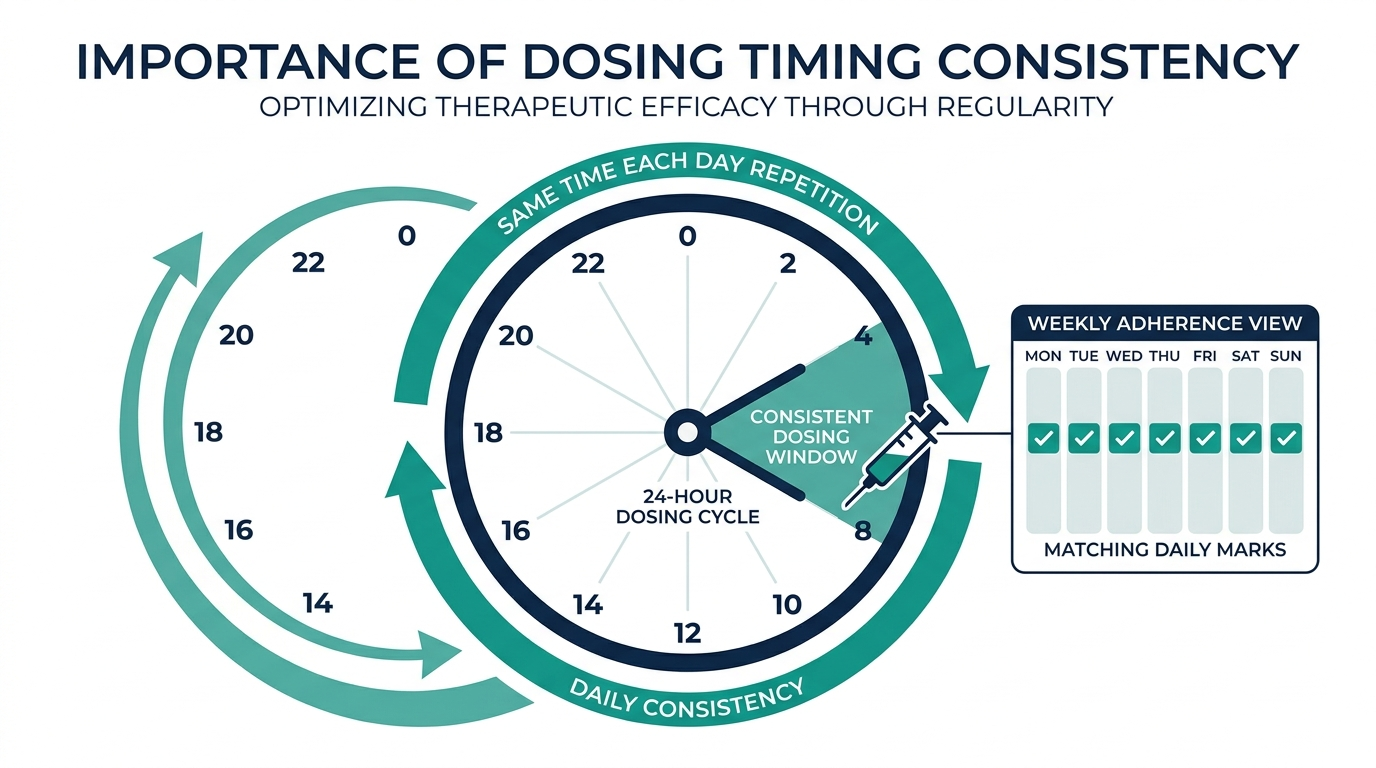
Personally, I think the timing debate is overweighted in online forums relative to what the evidence actually supports. There is no published data showing morning administration produces meaningfully better outcomes than evening. What the data does support is consistency, taking it at approximately the same intervals each day, which keeps tissue levels as steady as a compound with a short half-life can be.
Two timing principles have real rationale behind them, though:
First, for subcutaneous injection, fasted vs. fed state is irrelevant. The peptide bypasses the digestive system entirely, so whether you ate breakfast has no effect on absorption or activity. This distinguishes BPC-157 from GH secretagogues like CJC-1295 or ipamorelin, which are typically dosed fasted to avoid the insulin-GH interaction.
Second, for oral BPC-157 (capsules or liquid), an empty stomach matters more. The mechanism of oral BPC-157 in gut indications is primarily local mucosal contact as the peptide transits the GI tract. Food reduces gastric motility and alters the contact pattern, so the convention of dosing 30 minutes before meals or at least 2 hours after eating has a logical basis even if it has not been formally tested in humans.
What is the right cycle length?
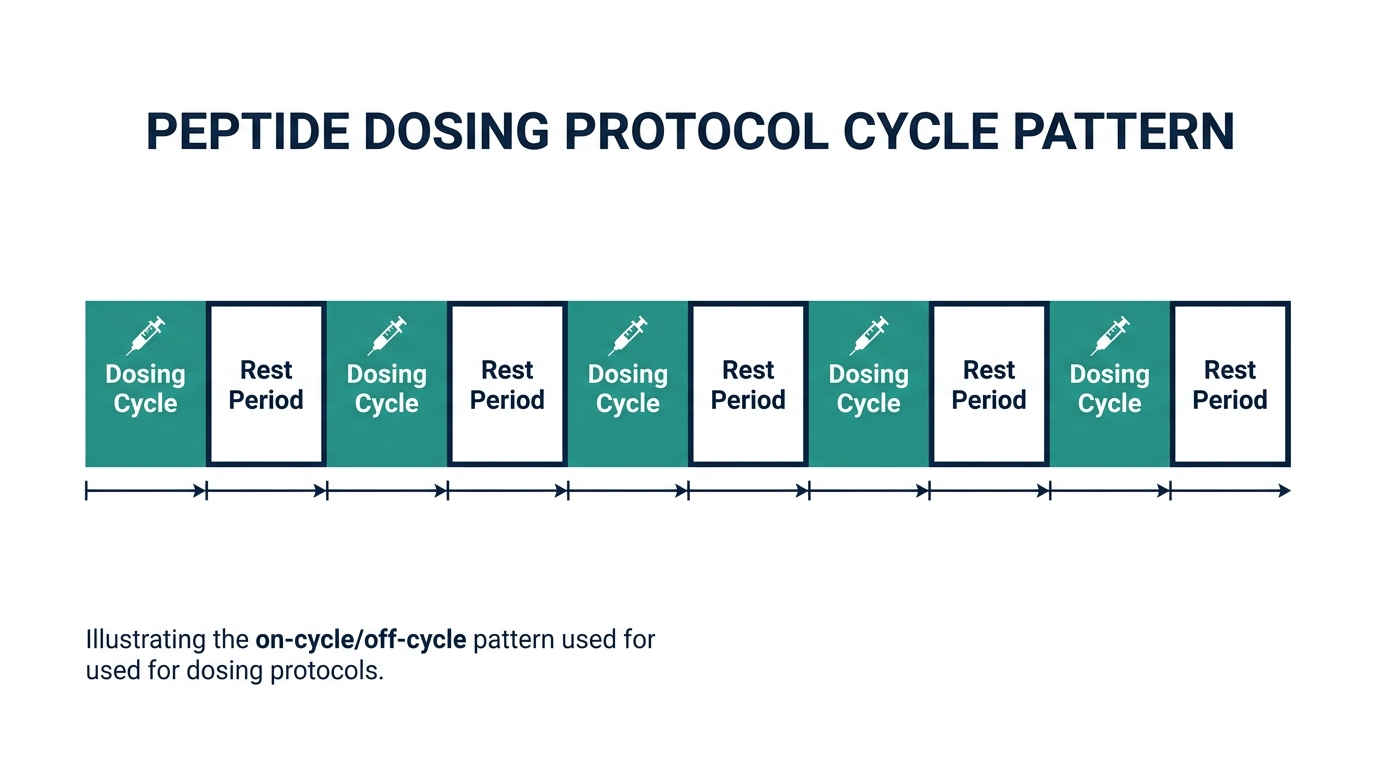
Standard protocols run 4 to 12 weeks, followed by a rest period at least as long as the cycle. The specific length depends on what you are treating.
Acute musculoskeletal injuries, a partial tendon tear, a rotator cuff strain, post-surgical soft tissue repair, are the indications where 6 to 10-week cycles appear most consistently in the literature and in clinical practice. A 2025 University of Zagreb Phase 2 trial evaluated subcutaneous BPC-157 at 250 mcg twice daily for rotator cuff tendinopathy over 12 weeks, reporting a 38% reduction in pain scores and a 29% improvement in shoulder range of motion compared to placebo. That trial does not establish a protocol for you, but it tells you researchers considered 12 weeks a reasonable duration and 250 mcg twice daily a reasonable dose.
Gut-targeted protocols generally run 4 to 8 weeks. Animal data on gastric ulcer healing, including a frequently cited 2004 PubMed study on BPC-157’s protective effects in rat gastric mucosa, shows effects appearing within days at low doses, which is part of why shorter cycles are considered adequate for GI indications.
For ongoing maintenance or prevention after a completed cycle, some practitioners use lower-dose intermittent dosing, 250 mcg every other day or twice weekly, rather than continuous daily dosing. The rationale is reducing receptor desensitization risk, though this is a precautionary convention rather than evidence-based guidance.
Rest periods matter because long-term safety data in humans does not exist. The absence of known problems after years of grey-market use is not the same as evidence of safety, and the approach of cycling with breaks reflects the honest position that nobody knows what continuous indefinite use does at the human level.
Oral vs. injectable: does the route change how often you take it?
Yes, meaningfully. The two routes have different mechanisms and different frequency logic.
Injectable BPC-157 (subcutaneous or intramuscular) reaches systemic tissue relatively quickly and is the preferred route for musculoskeletal and joint indications. The short plasma half-life argues for twice-daily dosing at these targets. There is also an important location detail many guides miss: for site-specific injuries, injecting subcutaneously near the target tissue, not necessarily at a random abdominal site, is the convention in protocols aimed at tendon or joint healing. The peptide’s mechanism involves localized upregulation of VEGFR2 (vascular endothelial growth factor receptor 2), promoting angiogenesis and new vessel formation at the injury site, and proximity appears to matter in animal models even if distance-dose comparisons have not been done formally in humans.
Oral BPC-157 works through a different mechanism. Because oral bioavailability is limited for systemic targets (the peptide acts primarily on the mucosa it contacts during transit), gut-localized goals respond well to oral dosing while distant-tissue goals do not. The arginate salt form is notable here: research suggests it dramatically improves oral absorption, with some sources citing up to 90% relative oral bioavailability compared to roughly 3% for the acetate form. Whether that difference translates to better systemic tissue effects or simply higher mucosal exposure is not yet clear, but it is the reason the arginate form is increasingly the commercial preference for oral BPC-157 products.
Do not believe any vendor who tells you oral and injectable BPC-157 are fully interchangeable for tendon or joint goals. The mechanism data and the animal study outcomes simply do not support that.
What about the BPC-157 and TB-500 stack?
The so-called “Wolverine stack” combines BPC-157 with TB-500 (thymosin beta-4), and it is the most commonly discussed combination protocol in the recovery and injury context. The logic is complementary mechanisms: TB-500 is believed to act systemically through actin polymerization modulation and broader cell migration signaling, while BPC-157 contributes localized angiogenesis and GH receptor upregulation. Each does something the other does not.
A typical combined protocol runs BPC-157 at 250 to 500 mcg daily alongside TB-500 at 2.0 to 2.5 mg per week (often split as 1.25 mg twice weekly), for an 8 to 12-week combined cycle. The usual structure is a higher-dose loading phase in weeks 1 to 4, then a reduced maintenance dose for weeks 5 onward.
One thing the stacking guides rarely say directly: combining two peptides doubles the things that can go wrong if either compound is counterfeit or misdosed. The value of sourcing from a verifiable, licensed compounding pharmacy becomes even clearer in a stacked protocol where you are trusting the identity and purity of two separate molecules simultaneously.
What is the legal status for accessing BPC-157 in 2026?
This is not a sidebar. It is the most practically important thing in this article right now, because the answer changed in 2026 in a way most guides have not caught up with.
The FDA placed BPC-157 on the 503A Category 2 list in November 2023, effectively prohibiting licensed compounding pharmacies from using it as a bulk drug substance. That forced anyone seeking it into grey-market “research use only” sources, with all the associated purity and accountability risks.
Then on April 22, 2026, the FDA removed BPC-157 from Category 2. HHS Secretary Kennedy had signaled in February 2026 that approximately 14 peptides previously classified as Category 2, including BPC-157, TB-500, CJC-1295, ipamorelin, and sermorelin, were expected to return to Category 1 (permitted) status. The Pharmacy Compounding Advisory Committee (PCAC) is scheduled to formally review BPC-157 at its July 23 to 24, 2026 meeting at the FDA White Oak Campus, Silver Spring, Maryland.
A positive PCAC recommendation will not immediately make compounded BPC-157 widely available, processing takes additional time, but the trajectory is clear. The door slammed in 2023 is being pried open through the licensed channel.
The practical implication is that waiting a few months for the legitimate compounding pharmacy route may be the rational choice for anyone who was previously relying on research-chemical vendors. The legal path and the quality-controlled path are converging.
Telehealth GLP-1 program with provider visits and pharmacy coordination.
What do the animal studies actually show about dosing?
Most of what practitioners know about BPC-157 dosing comes from rodent data, and it is worth being direct about what that transfer means and where it falls short.
The Sikiric group at the University of Zagreb has published the majority of BPC-157 animal research, and two structural features of their dosing methodology are relevant here. First, effective doses in rodents range from 10 ng/kg to 10 mcg/kg in many studies, with myotendinous junction research using 10 mcg/kg intraperitoneally and per-orally in drinking water. At standard allometric scaling from rat to human, 10 mcg/kg in a 250 g rat maps to somewhere in the 100 to 500 mcg range for a 70 kg human, which is how the clinical dose range was derived.
Second, and this is the methodological caveat almost nobody mentions: more than 80% of all records under “BPC 157” on Google Scholar and PubMed trace back to Sikiric’s group, and many experiments use only a single dose with no dose-response curve. Independent replications are sparse. The 2025 paper in Pharmaceuticals that reviewed BPC-157 angiogenesis and nitric oxide mechanisms noted this concentration of authorship explicitly as a limitation of the evidence base.
That is not a reason to dismiss the animal data, much of which is genuinely compelling for tendon and gut outcomes. It is a reason to hold the human dose translation with appropriate uncertainty, and to recognize that any practitioner claiming certainty about the optimal frequency, dose, or cycle length for humans is extrapolating beyond what the data technically supports.
Five common mistakes people make with BPC-157 frequency
-
Skipping the second daily dose for convenience. If you choose a twice-daily protocol for a musculoskeletal goal, one missed dose is not the end of the cycle. But routinely collapsing to once daily removes the pharmacokinetic rationale for splitting the dose in the first place. If twice daily is not sustainable for you, choose a once-daily protocol intentionally.
-
Running indefinite cycles without breaks. There are people who have been using BPC-157 continuously for years. The absence of documented problems is not the same as a safety profile. Cycle with breaks. Long-term human safety data simply does not exist.
-
Assuming oral and injectable dosing are equivalent. The routes have different mechanisms. Oral dosing at the same mcg as injectable does not produce the same systemic levels, and the arginate vs. acetate salt form matters more for oral delivery than most users realize.
-
Ignoring the salt form on oral products. If you are taking oral BPC-157 for gut-targeted goals, the acetate vs. arginate distinction is not marketing. The arginate form has meaningfully different absorption characteristics. Check the product label.
-
Treating protocol guides as prescriptions. Every dosing number in this article, and every protocol on every guide site, is derived from animal research and practitioner extrapolation. A licensed clinician who can adjust based on your labs, your weight, and your clinical response is not an unnecessary luxury. It is the correct standard.
Don’t just read about your health, track it.
A single result is a snapshot. Superpower re-tests 100+ markers over time so you can watch them move as you change sleep, food, and training.
Frequently asked questions
How often should you take BPC-157 per day?
Most protocols use once or twice daily. Twice daily (approximately 12 hours apart) is preferred for acute musculoskeletal injuries because BPC-157’s plasma half-life is under 30 minutes, meaning a single daily dose leaves tissue levels near zero for most of the day. Once daily is more common for maintenance phases or gut-targeted oral protocols.
What is the typical dose per injection?
250 to 500 mcg per administration is the most commonly cited range in both clinical protocols and the animal literature when scaled to human weight. Starting at the lower end (250 mcg) for the first 1 to 2 weeks is a common convention before increasing toward 500 mcg if tolerated.
How long should a BPC-157 cycle be?
Four to twelve weeks is the standard range. Acute tendon or joint injuries typically use 6 to 10-week cycles. Gut repair protocols often run 4 to 8 weeks. Twelve-week cycles appear in post-surgical and chronic injury protocols. Rest periods should equal or exceed the cycle length.
Should BPC-157 be taken on an empty stomach?
For injectable BPC-157, the fasted vs. fed state does not affect absorption because the peptide bypasses digestion. For oral BPC-157, taking it on an empty stomach improves mucosal contact and is generally recommended, particularly for gut-targeted use.
Is it better to inject near the injury or in the abdomen?
For site-specific tendon, joint, or muscle injuries, subcutaneous injection near the injury site is the convention, not random abdominal subcutaneous injection. The mechanism involves localized VEGFR2 upregulation and angiogenesis. For systemic or gut indications, abdominal subcutaneous injection is standard.
Can you take BPC-157 long-term without cycling?
Long-term human safety data does not exist. Continuous indefinite use is not recommended by most practitioners, and the standard of cycling with breaks reflects that uncertainty. The absence of documented problems in grey-market long-term users is not equivalent to a safety profile.
What is the legal status of BPC-157 in 2026?
BPC-157 is not FDA-approved as a finished drug. The FDA removed it from the 503A Category 2 restricted list in April 2026, and the Pharmacy Compounding Advisory Committee is scheduled to review it for Category 1 (permitted for compounding) status at the July 23 to 24, 2026 meeting. Research-use-only sales remain legal but place all accountability on the buyer. The licensed telehealth and compounding pharmacy route is the safest option currently available and is likely to expand post-PCAC.
Telehealth GLP-1 program with provider visits and pharmacy coordination.
Author: Vital Signs Today Editorial Team, [credential]”]. Educational content, not medical advice. Sources linked inline.
Primary sources:
– FDA Pharmacy Compounding Advisory Committee July 2026 meeting notice: https://www.fda.gov/advisory-committees/advisory-committee-calendar/july-23-24-2026-meeting-pharmacy-compounding-advisory-committee-07232026
– Frontiers in Pharmacology pharmacokinetics study (2022): https://www.frontiersin.org/journals/pharmacology/articles/10.3389/fphar.2022.1026182/full
– PubMed, protective effects of BPC-157 on gastric ulcer in rats (2004): https://pubmed.ncbi.nlm.nih.gov/15052688/
– MDPI, BPC-157 myotendinous junction study: https://www.mdpi.com/2227-9019/9/11/1547
– PMC, BPC-157 angiogenesis and nitric oxide mechanisms review (2025): https://pmc.ncbi.nlm.nih.gov/articles/PMC12567171/
– PeakedLabs BPC-157 dosage and protocol guide (2026): https://peakedlabs.com/blog/bpc-157-dosage-protocol-guide
– Loti Labs BPC-157 legal status 2026: https://lotilabs.com/resources/bpc-157-legal-status-2026-fda-update/
– Newtropin BPC-157 July 2026 FDA review: https://newtropin.com/blog/bpc-157-tb-500-fda-review
Related reading
Vital Signs Today may earn a commission if you buy through links on this page. It does not affect our editorial assessments.