Quick answer: GLP-1 medications work for weight loss by copying a gut hormone your body releases after you eat. They slow how fast your stomach empties, blunt the appetite signals in your brain, and improve how your body handles insulin, so you feel full sooner, stay full longer, and eat less without white-knuckling it. In the major trials, people lost an average of about 15% of their body weight on semaglutide (Wegovy) and roughly 20% or more on tirzepatide (Zepbound) over 68 to 72 weeks. They work, the effect is real, and the catch is that the weight tends to come back if you stop the drug without a plan.
What is a GLP-1 and what does it do for weight loss?
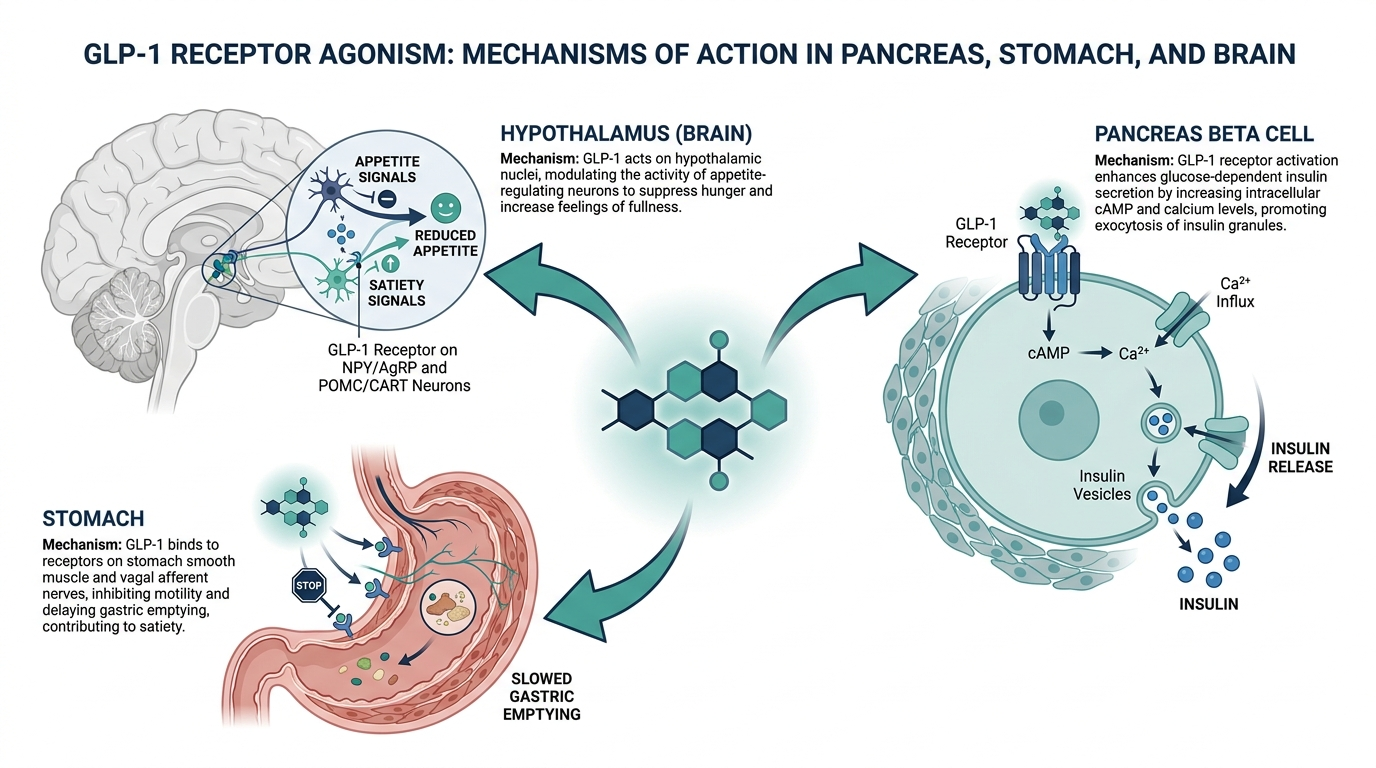
GLP-1 stands for glucagon-like peptide-1, a hormone your small intestine secretes within minutes of food hitting it. Its job is to tell your pancreas to release insulin, tell your liver to ease off making sugar, and tell your brain you have had enough. The problem is your natural GLP-1 breaks down in a couple of minutes. The drugs are engineered versions that survive for days, so the “I am full and satisfied” signal stays switched on far longer than nature intended.
Curious how GLP-1s change your body? A full biomarker panel shows exactly what’s driving your weight before you start any medication. One at-home Superpower draw checks 100+ biomarkers, physician-reviewed.
Functionally, that does three things for weight loss. First, your stomach empties more slowly, so a normal-sized meal sits with you and you are not hungry again at 3 p.m. Second, the appetite and reward centers in your brain quiet down, which is why people on these drugs describe “food noise” going silent. Third, blood sugar stabilizes, which reduces the crash-and-crave cycle that drives snacking. Eating less stops feeling like a fight, and a sustained calorie deficit is what actually moves the scale.
One precise distinction worth getting right. Semaglutide (Wegovy, and Ozempic off-label) is a pure GLP-1 receptor agonist. Tirzepatide (Zepbound, and Mounjaro off-label) is a dual agonist that hits both the GLP-1 and the GIP receptor, a second gut hormone. That extra mechanism is the leading theory for why tirzepatide tends to outperform semaglutide on weight.
Does GLP-1 actually work for weight loss, and how much?
Yes, and the data is unusually strong for a weight-loss drug. These are not the disappointing 3 to 5% pills of the past. The numbers below come from the pivotal phase 3 trials, where participants also received lifestyle counseling.
| Drug (brand) | Trial program | Average weight loss | Timeframe |
|---|---|---|---|
| Semaglutide 2.4 mg (Wegovy) | STEP | About 15% of body weight | 68 weeks |
| Tirzepatide (Zepbound) | SURMOUNT-1 | About 20 to 22% at the top dose | 72 weeks |
| Liraglutide (Saxenda) | SCALE | About 8% of body weight | 56 weeks |
To put 15 to 20% in human terms: a 220-pound person losing 18% drops nearly 40 pounds. That is in the same range as some bariatric surgery results, which is why these drugs reset the entire field. Roughly a third of people on tirzepatide in SURMOUNT-1 lost 25% or more. Averages hide a spread, though. A meaningful minority are “low responders” who lose under 5%, and clinicians usually reassess the plan if there is little movement by the third or fourth month at a therapeutic dose.
How fast does a GLP-1 work for weight loss?
You will usually notice appetite changes within the first one to two weeks, but visible weight loss is deliberately slow at the start. Every GLP-1 is dose-escalated. You begin at a low “starter” dose that is below the weight-loss target, purely to let your gut adjust and limit nausea, then step up every four weeks. So month one is mostly about tolerating the drug, not melting fat.
A realistic timeline looks like this:
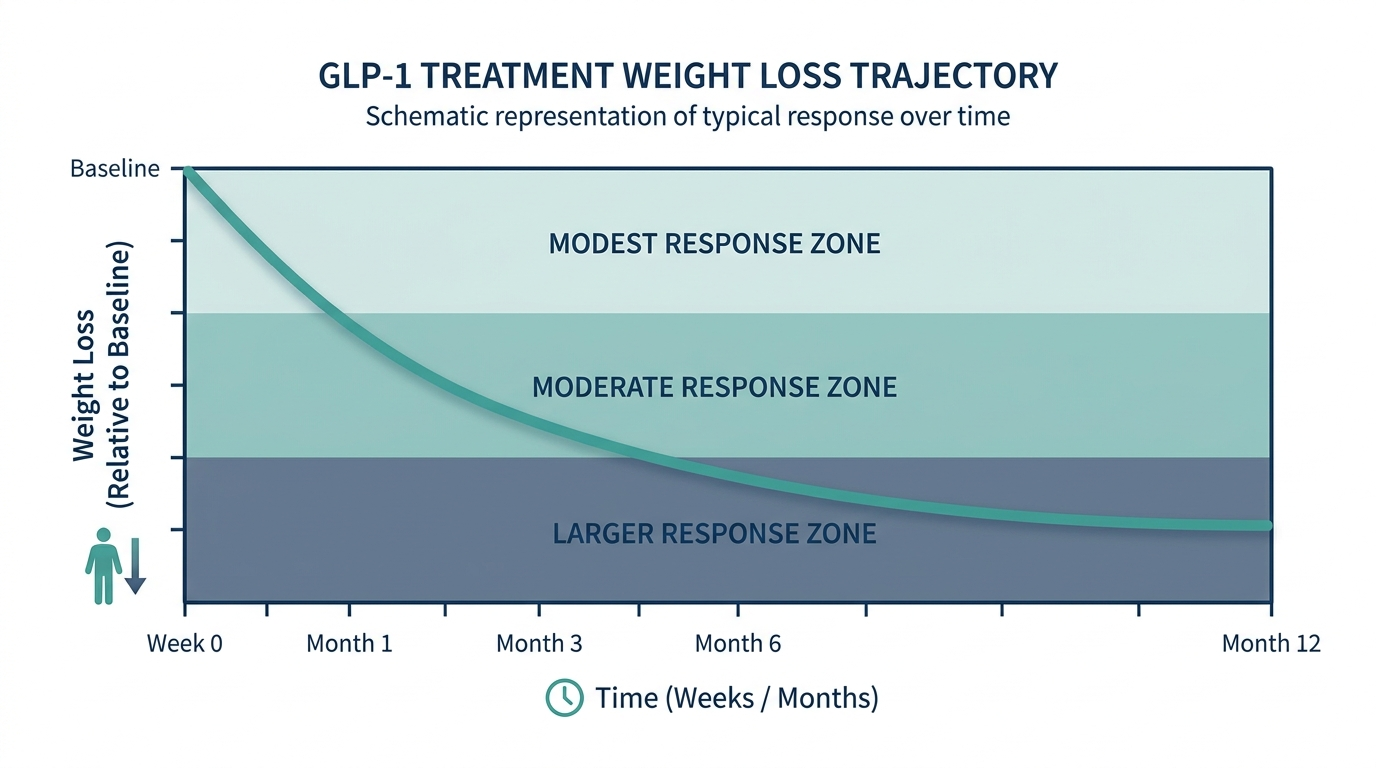
- Weeks 1 to 4: appetite drops, food noise fades, often 1 to 4 pounds down, some of it water.
- Months 2 to 4: as the dose climbs to a therapeutic level, loss accelerates to roughly 1 to 2% of body weight per month.
- Months 5 to 12: the bulk of the loss happens here, then it gradually plateaus as your body finds a new set point.
The trials ran for well over a year because that is how long the full effect takes. Anyone expecting a transformation in six weeks is on the wrong drug for the wrong reason.
Which is the best GLP-1 for weight loss?
For raw weight loss, tirzepatide (Zepbound) is currently the most effective option, based on its roughly 20%-plus average versus semaglutide’s roughly 15%. The head-to-head SURMOUNT-5 trial confirmed tirzepatide outperformed semaglutide directly. But “best” depends on more than the top-line number.
- Best for maximum loss: tirzepatide (Zepbound).
- Best track record and most studied: semaglutide (Wegovy), with years of cardiovascular outcome data behind it.
- Best if you cannot tolerate weekly stronger doses: sometimes liraglutide (Saxenda), though it is a daily injection and less effective.
- Best on cost: often a compounded version through telehealth, covered below.
The honest answer is that the best GLP-1 is the one a clinician matches to your labs, your tolerance, your other conditions, and your budget, then monitors. Someone with prediabetes, a history of pancreatitis, or a thyroid concern needs a different conversation than someone with 30 pounds to lose and no other issues. For a fuller breakdown across injectables, see what is the best injection for weight loss.
Which GLP-1s are FDA approved for weight loss?
Three are FDA approved specifically for chronic weight management: Wegovy (semaglutide), Zepbound (tirzepatide), and Saxenda (liraglutide). Ozempic and Mounjaro contain the same active ingredients as Wegovy and Zepbound, but they are FDA approved for type 2 diabetes, so using them for weight loss is off-label. That is legal and common, but it matters for insurance and supply.
Here is a distinction people get wrong constantly. Compounded semaglutide and tirzepatide are not FDA approved. They are made by licensed compounding pharmacies and legally prescribed by licensed clinicians, often at a fraction of brand cost, but they have not gone through the FDA’s approval process and quality can vary by pharmacy. That is not the same as the gray-market vials sold online as “research peptides,” which are unregulated and genuinely risky. If you go the compounded route, it should be through a clinician and a reputable pharmacy, not a website that ships you a mystery vial.
Is GLP-1 safe for weight loss, and what are the side effects?
For most adults who qualify, GLP-1s are considered safe under medical supervision, and the SELECT trial even showed semaglutide cut major cardiovascular events by about 20% in people with heart disease and obesity. Safe does not mean side-effect free. The vast majority of side effects are gastrointestinal and tend to peak during dose increases, then settle.
Common and usually manageable:
- Nausea, especially in the first weeks and after each dose step-up
- Constipation or diarrhea
- Reflux, burping, early fullness
- Fatigue while calorie intake adjusts
Less common but more serious, and the reason supervision matters: pancreatitis, gallbladder problems (rapid weight loss raises gallstone risk), and a boxed warning about a rare thyroid tumor seen in rodents, so these drugs are avoided in people with a personal or family history of medullary thyroid cancer or MEN2. There is also growing attention on muscle loss. Up to roughly a quarter to 40% of the weight lost can be lean mass if you do not eat enough protein and resistance-train. That is a real downside, not a footnote, because losing muscle slows your metabolism and makes regain easier. Talk to a clinician before starting or stopping any of these medications.
A practical note on the nausea, since it is the reason most people quit early. It tends to spike in the few days after each dose increase and then fade, so it helps to eat smaller meals, stop before you feel completely full, go easy on greasy and very rich foods, and stay ahead of fluids. If nausea is severe or lasting, that is a signal to talk to your clinician about slowing the escalation, not to push through it or to double up to “catch up.”
How to protect your muscle on a GLP-1
This is the difference between a lean result you keep and a soft one that rebounds, and it is almost entirely in your control. When appetite falls off a cliff, protein is usually the first thing to drop, because meat and eggs feel heavy when you are barely hungry. That is exactly backward. On a GLP-1 you need more attention on protein, not less, because you are eating less total food and losing weight fast, both of which put muscle at risk.
- Hit a protein target every day. A common clinical aim is roughly 0.7 to 1 gram of protein per pound of goal body weight, spread across meals. When solid food is hard, a protein shake is the easiest way to close the gap.
- Lift something heavy two to three times a week. Resistance training is the signal that tells your body to hold onto muscle while it burns fat. Cardio alone does not do this.
- Do not slash calories on top of the drug. The medication already creates the deficit. Under-eating further just accelerates muscle and energy loss.
- Track more than the scale. Bodyweight alone cannot tell you whether you are losing fat or muscle. Waist measurements, how your clothes fit, strength in the gym, and bloodwork give you the real picture.
That last point is where a lot of people fly blind. The scale going down feels like success, but if a big share of it is muscle, you are quietly making future regain easier and your metabolism slower. Knowing your baseline metabolic and body-composition markers before you start, then rechecking them, is how you catch that early instead of a year later.
The simplest way to actually get this done
Superpower is a full-body lab membership that runs 100+ biomarkers, has each result reviewed by a doctor, and tracks your numbers year over year (about $199/year). It is what we point readers to when they would rather get one clean, complete draw than chase single tests one at a time. Here is superpower reviewed in full.
What stalls people on a GLP-1, and the common mistakes
The drug rarely fails on its own. People stall for predictable, fixable reasons, and most of them have nothing to do with willpower.
- Treating it like a standalone fix. If you stop eating enough protein and stop moving, you lose muscle, your metabolism drops, and the scale stalls. Aim for protein at every meal and add resistance training. This is the single biggest predictor of who keeps the weight off.
- Stopping cold and regaining. In the STEP-1 extension, people who came off semaglutide regained about two-thirds of their lost weight within a year. The appetite hormones rebound. Coming off requires a tapering and maintenance plan, not a hard stop.
- An undiagnosed metabolic problem. A stalled scale is often a thyroid or insulin issue the drug cannot fix. Hypothyroidism, insulin resistance, PCOS, and perimenopause all blunt results, and none of them show up unless someone runs the labs.
- Self-dosing from the gray market. Skipping the escalation schedule to “speed things up” mostly buys you vomiting, and unregulated vials carry dosing and contamination risk.
- Dehydration and under-eating. Because hunger is gone, some people barely eat, get dehydrated, lose muscle, and feel terrible. Less is not more here.
This is the part the before-and-after photos skip. A GLP-1 removes the appetite barrier. Whether you build a lean, durable result behind that barrier depends on protein, training, and knowing your actual numbers. People who guess plateau. People who measure adjust.
What coming off a GLP-1 actually looks like
The uncomfortable truth is that obesity behaves like a chronic condition, and these drugs treat it rather than cure it. When you stop, the appetite-suppressing signal disappears and the biological pressure to eat returns, which is why the STEP-1 extension saw people regain about two-thirds of their lost weight within a year of stopping. That is not a personal failure, it is physiology reasserting a set point.
There are really three ways people approach the long game. Some stay on a maintenance dose indefinitely, the way someone stays on blood-pressure medication. Some taper slowly to the lowest dose that holds their weight, stepping down rather than quitting cold. And some try to come off entirely, which works best when they have spent months building the habits that carry the result: a locked-in protein routine, consistent resistance training, and enough sleep and stress control to keep appetite hormones calm. The people who regain fastest are almost always the ones who treated the drug as a temporary shortcut and changed nothing underneath it. Whichever path fits you is a conversation to have with your clinician before you start, not after the weight is already coming back.
How much does a GLP-1 cost, and will insurance cover it?
Cost is where most plans live or die. Brand-name list prices are high and insurance coverage for weight loss specifically is inconsistent, which is the gap telehealth compounding has filled.
| Route | Typical 2026 monthly cost (cash) | Notes |
|---|---|---|
| Brand Wegovy or Zepbound, no coverage | About $1,000 to $1,350 list, often lower with manufacturer savings programs | Manufacturer self-pay options have pushed some doses toward $499 to $650 |
| Brand with commercial insurance covering obesity | About $0 to $100 copay | Usually needs prior authorization and a BMI threshold |
| Compounded semaglutide via telehealth | About $150 to $300 | Not FDA approved, prescribed by a clinician |
| Compounded tirzepatide via telehealth | About $200 to $400 | Not FDA approved, prescribed by a clinician |
Insurance reality check: most plans require a BMI of 30 or more, or 27 plus a condition like type 2 diabetes or high blood pressure, plus a prior authorization. Medicare still does not cover GLP-1s for obesity alone. Whether your specific plan pays is worth confirming before you commit, and you can read more on whether Blue Cross Blue Shield covers weight loss injections. HSA and FSA dollars generally can be used when there is a prescription.
How to get a GLP-1 for weight loss the right way
You get a GLP-1 through a clinician who reviews your history, ideally pulls labs, prescribes the appropriate drug, starts you on the escalation schedule, and monitors you. There are three realistic paths.
- Your primary care doctor or an obesity-medicine specialist. Best if you want brand-name drugs run through insurance and you do not mind the prior-authorization paperwork.
- A legitimate telehealth clinic. Fastest access, often the most affordable through compounded options, with a real clinician behind it. This has become the default route for people whose insurance will not cover brand drugs.
- The gray market. Do not. Unregulated vials with no clinician, no dosing oversight, and no idea what is in them is how people end up hospitalized.
The difference between path two and path three is not subtle. A real clinic runs labs, screens you for the thyroid and pancreatitis contraindications, doses you correctly, and adjusts when you stall. A sketchy website does none of that. If you are weighing your options for the diabetes-labeled versions specifically, see how to get Ozempic for weight loss and whether Mounjaro is approved for weight loss.
Want a real clinician to run your GLP-1, not a mystery vial?
Joi + Blokes is a telehealth clinic that prescribes GLP-1 medication (Zepbound, compounded semaglutide and tirzepatide), hormone therapy (TRT, HRT), thyroid care and peptides after a real lab panel and clinician review, with no membership or consult fee (prescriptions from about $59/month, hormone and GLP-1 lab panels from $149). That lab-first model is exactly what catches the thyroid or insulin problems that stall people on these drugs. Here is Joi + Blokes reviewed in full.
Should I take a GLP-1 for weight loss?
You are a reasonable candidate if your BMI is 30 or higher, or 27 or higher with a weight-related condition like type 2 diabetes, prediabetes, high blood pressure, or sleep apnea, and diet and exercise alone have not worked. You are probably not a candidate if you have a personal or family history of medullary thyroid cancer or MEN2, a history of pancreatitis, or if you are pregnant or trying to be.
One nuance that gets missed. If your scale will not move no matter how clean you eat, the issue may not be a missing drug, it may be a metabolic number nobody has measured. A sluggish thyroid, high fasting insulin, or shifting hormones in perimenopause can each stall weight loss and quietly sabotage a GLP-1. Seeing your actual labs first is often smarter than guessing, and a full-body panel through a service like Superpower can flag exactly what is holding you back before you spend a year on the wrong plan.
The medication is a tool, not magic. Used through a clinician, alongside protein and resistance training, with your labs in view, it is one of the most effective weight-loss tools medicine has ever had. Used as a quick gray-market fix with no plan for what happens when you stop, it is a fast way to lose money and regain the weight. For the maintenance question specifically, see how long do you take Wegovy for weight loss.
Turn what you just learned into action.
Superpower lets you test 100+ biomarkers from home, then re-check them over time so you can actually see progress, physician-reviewed at every step.
FAQ
Do GLP-1s work for weight loss without diet and exercise?
They will produce some loss on their own because they cut appetite, but the trial results came with lifestyle support, and the people who keep weight off eat adequate protein and do resistance training. Skip those and you lose more muscle, your metabolism drops, and you stall sooner and regain faster.
What does a GLP-1 actually do in the body?
It mimics a natural gut hormone that slows stomach emptying, signals fullness to your brain, and improves insulin response. The combined effect is that you feel satisfied on less food and stop grazing, which creates the calorie deficit that drives weight loss.
How fast will I see weight loss on a GLP-1?
Appetite usually drops within one to two weeks, but real scale movement is gradual because the dose is increased slowly to limit nausea. Expect roughly 1 to 2% of your body weight per month once you reach a therapeutic dose, with most loss landing between months five and twelve.
Is GLP-1 safe for weight loss long term?
The longest-running data so far is reassuring under medical supervision, and semaglutide even reduced cardiovascular events in the SELECT trial. The main long-term concerns are muscle loss, gallbladder issues, and regain after stopping, all of which are managed with protein, training, monitoring, and a maintenance plan rather than a hard stop.
Which GLP-1 is approved for weight loss?
Wegovy (semaglutide), Zepbound (tirzepatide), and Saxenda (liraglutide) are FDA approved for weight management. Ozempic and Mounjaro share the same active ingredients but are approved for diabetes, so weight-loss use is off-label, and compounded versions are not FDA approved at all.
What is the best GLP-1 for weight loss?
Tirzepatide (Zepbound) produces the most weight loss on average, beating semaglutide head-to-head in the SURMOUNT-5 trial. The right choice for you still depends on your tolerance, other health conditions, cost, and what a clinician recommends after reviewing your history.
Why do people regain weight after stopping a GLP-1?
Because the drug suppresses appetite hormones that snap back once it leaves your system. In the STEP-1 follow-up, people regained about two-thirds of their lost weight within a year of stopping. That is why most clinicians treat it as ongoing therapy with a tapering and maintenance strategy.
Can I get a GLP-1 if my insurance will not cover it?
Yes. Many people use compounded semaglutide or tirzepatide through a telehealth clinic for roughly $150 to $400 a month, prescribed and monitored by a clinician. Manufacturer self-pay programs have also lowered some brand-name cash prices, so it is worth comparing both before assuming you are priced out.
Why is my weight stalling even on a GLP-1?
The most common hidden reasons are inadequate protein with muscle loss, dehydration from barely eating, or an undiagnosed thyroid, insulin, or hormone problem. A stalled scale is frequently a lab problem, not a willpower problem, so running a full metabolic panel is often the fastest way to find the real lever.
Vital Signs Today may earn a commission if you buy through links on this page. It does not affect our editorial assessments.