Quick answer: A function health second opinion is worth getting any time a result falls outside the reference range, contradicts how you feel, or triggers a significant treatment decision. Bring the PDF export of your Function Health results to a primary care physician or specialist, flag the specific biomarkers in question, and ask for confirmatory lab work through a clinical lab like Quest or Labcorp. Running a parallel panel through a service like Superpower is also a practical way to verify findings before acting on them.
When does a Function Health result actually need a second opinion?
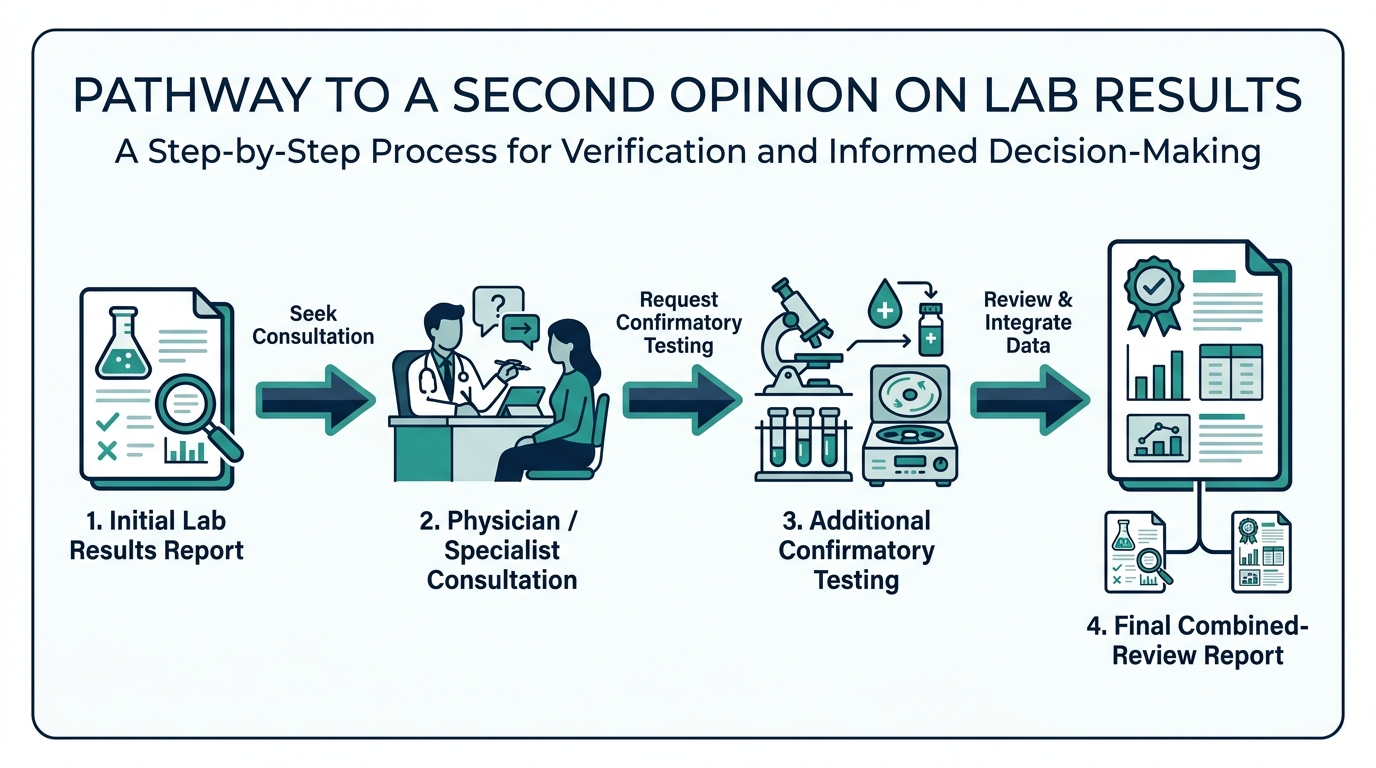
Not every out-of-range value requires a follow-up call to a specialist. Most labs flag results with a simple H (high) or L (low), but clinical significance depends on context: how far outside range, which direction, and what else is moving in the same panel.
Getting a second opinion on flagged results? Compare against a 100+ biomarker panel with its own physician review built in. One at-home Superpower draw checks 100+ biomarkers, physician-reviewed.
Seek a second opinion when any of these conditions apply:
- A result is moderately or severely outside the reference range, not just borderline (for example, a thyroid-stimulating hormone below 0.1 or above 10 mIU/L, not a marginal 4.6 when the range tops at 4.5).
- A result conflicts with your symptoms. If your ferritin comes back at 8 ng/mL and you have been exhausted for months, that warrants a full iron panel and a physician interpreting it in context, not just a dashboard flag.
- A result would change a medication, supplement protocol, or a major lifestyle decision. Acting on a single measurement of, say, testosterone or cortisol without confirmatory testing is a well-documented clinical pitfall.
- The Function Health clinician note says something like “discuss with your physician” or “repeat testing recommended.” That language is not boilerplate; it is a genuine signal to follow up.
- You have a family history or prior diagnosis that makes a particular biomarker high-stakes (BRCA carriers, familial hypercholesterolemia, hereditary hemochromatosis).
For a deeper look at how Function Health structures its biomarker output, see our guide to reading Function Health results.

What should you bring to a doctor when reviewing Function Health results?
Bring the full PDF export, not a screenshot of the dashboard. Function Health lets you download a complete report that includes reference ranges, units, and the date of draw. Your physician needs that format because the number alone is meaningless without the assay reference range and units.
Practical preparation steps:
- Download the PDF from your Function Health portal before the appointment. The PDF preserves the exact lab values and the ranges Function Health used. If your physician wants to order confirmatory labs through Quest or Labcorp, having the precise values and units helps them order the matching assay.
- Highlight the specific markers in question. A 100-plus biomarker panel handed to a primary care doctor with no context is overwhelming. Circle or annotate the three to five values you want explained. Physicians respond better to focused questions than to a stack of paper and a shrug.
- Note your draw conditions. Did you fast? Were you sick? Had you done intense exercise the night before? Creatine kinase, glucose, cortisol, and several other markers shift meaningfully based on those conditions. A physician needs that context to interpret the result correctly.
- Bring a list of current supplements and medications. Biotin (vitamin B7) supplementation, for example, is a known confounder for thyroid and cardiac troponin assays. If you are taking high-dose biotin, some thyroid results from immunoassay-based panels can be falsely low or high.
One thing most people do not realize: a Function Health clinician has already reviewed your results before they appear in your portal. That review is included in the membership cost. So you are not walking into your doctor's office with raw unreviewed data; you already have one clinical interpretation layer. The second opinion your physician provides adds a different lens, specifically one that includes your full medical history.
Should you show your doctor Function Health results?
Yes, and most physicians are more receptive than patients expect. The concern that "my doctor will dismiss it" is less common now that direct-to-consumer lab testing is mainstream. The more relevant friction is that Function Health uses a proprietary panel with some assays ordered in specific combinations that do not map one-to-one to standard clinical ordering codes.
When you show your doctor Function Health results, frame it this way: "I had some baseline labs done and a couple of results were flagged. I wanted to get your read and potentially order confirmatory tests." That framing positions the physician as the expert interpreting the data rather than defending their turf against a consumer product.
Situations where physician review adds the most value:
- Hormones (testosterone, estrogen, DHEA-S, cortisol): These are highly variable throughout the day and across the menstrual cycle. A single draw result is a snapshot, not a diagnosis. A physician may order a morning fasting cortisol, a timed draw, or a 24-hour urine collection to confirm an abnormality.
- Thyroid panel: TSH alone is a screening marker. If Function Health shows an abnormal TSH, your physician will want free T3, free T4, and potentially thyroid antibodies through a clinical lab before any clinical decision.
- Cardiac risk markers (ApoB, Lp(a), hsCRP): These are increasingly standard, but a cardiologist or preventive medicine physician who knows your family history and blood pressure history interprets them very differently than a generic dashboard flag.
- Nutrient markers (ferritin, B12, vitamin D, zinc): Low results here are often actionable with supplements, but high ferritin (above 300 ng/mL in women, above 400 ng/mL in men) can signal hemochromatosis, metabolic dysfunction, or chronic inflammation, and requires workup beyond just stopping iron pills.

How to verify Function Health results with another lab
The most direct way to get a function health second opinion is to order the same or equivalent tests through a second lab and compare. This is called confirmatory testing, and it is standard clinical practice before starting any long-term intervention.
Option 1: Order through your physician
Your doctor can order confirmatory labs through Quest Diagnostics or Labcorp, which are the two largest clinical reference labs in the US. These labs are CLIA-certified and their results are considered the clinical standard. Insurance often covers medically necessary confirmatory testing, though you will need your physician to document the indication. With insurance, many panels run $0 to $50 out of pocket. Without insurance, a targeted panel at a Quest Patient Service Center typically runs $30 to $120 cash depending on which markers you need confirmed.
Option 2: Use a competing direct-to-consumer service
If you want a second opinion without involving your primary care physician, running a parallel panel through another DTC lab service is a clean option. This works especially well if you want to cross-check not just one or two markers but a full baseline. The advantage is that you get a completely independent measurement from a different blood draw, which eliminates any draw-condition variability from the original Function Health sample.
| Service | Biomarkers | Price (2026) | Physician review | Year-over-year tracking |
|---|---|---|---|---|
| Function Health | 100+ | $499/year | Yes (clinician notes) | Yes |
| Superpower | 100+ | About $199/year | Yes (doctor reviews each result) | Yes |
| Quest Health (walk-in) | Varies by panel | $29 to $150 cash per panel | No | Manual tracking only |
| Any Lab Test Now | Varies | $35 to $200 cash per panel | No | No |
For a full breakdown of what Function Health charges versus alternatives, see our Function Health cost analysis.
The simplest way to actually get this done
Superpower is a full-body lab membership that runs 100+ biomarkers, has each result reviewed by a doctor, and tracks your numbers year over year (about $199/year). It is what we point readers to when they would rather get one clean, complete draw than chase single tests one at a time. Here is superpower reviewed in full.
What do Function Health clinicians actually review, and is that enough?
Function Health includes a medical team review with every result. A clinician looks at your panel, generates personalized notes, and flags anything that appears significantly abnormal. This is a genuine clinical review, not an algorithm generating templated copy.
What it is not is a replacement for a physician who has your full electronic health record, can order a physical exam, can correlate your results with your medication history, and can refer you to a specialist in the same healthcare system. The Function Health clinician is working from your lab panel and whatever health history you input into the platform. A primary care physician has more context and more tools.
The practical ceiling of a DTC panel review is the information the physician has access to. If you disclosed that you smoke or have a first-degree relative with coronary artery disease, a preventive medicine physician will interpret an LDL-P of 1400 nmol/L very differently than if you are a 28-year-old endurance athlete with no family history. The dashboard cannot always capture those nuances.
This is not a criticism of Function Health. It is a structural limitation of any asynchronous, remote clinical review. Knowing that limitation helps you use the service correctly: treat the Function Health clinician note as an informed first read, and your personal physician as the interpreter who adds your full clinical context.

Common results that are most often misread without a second opinion
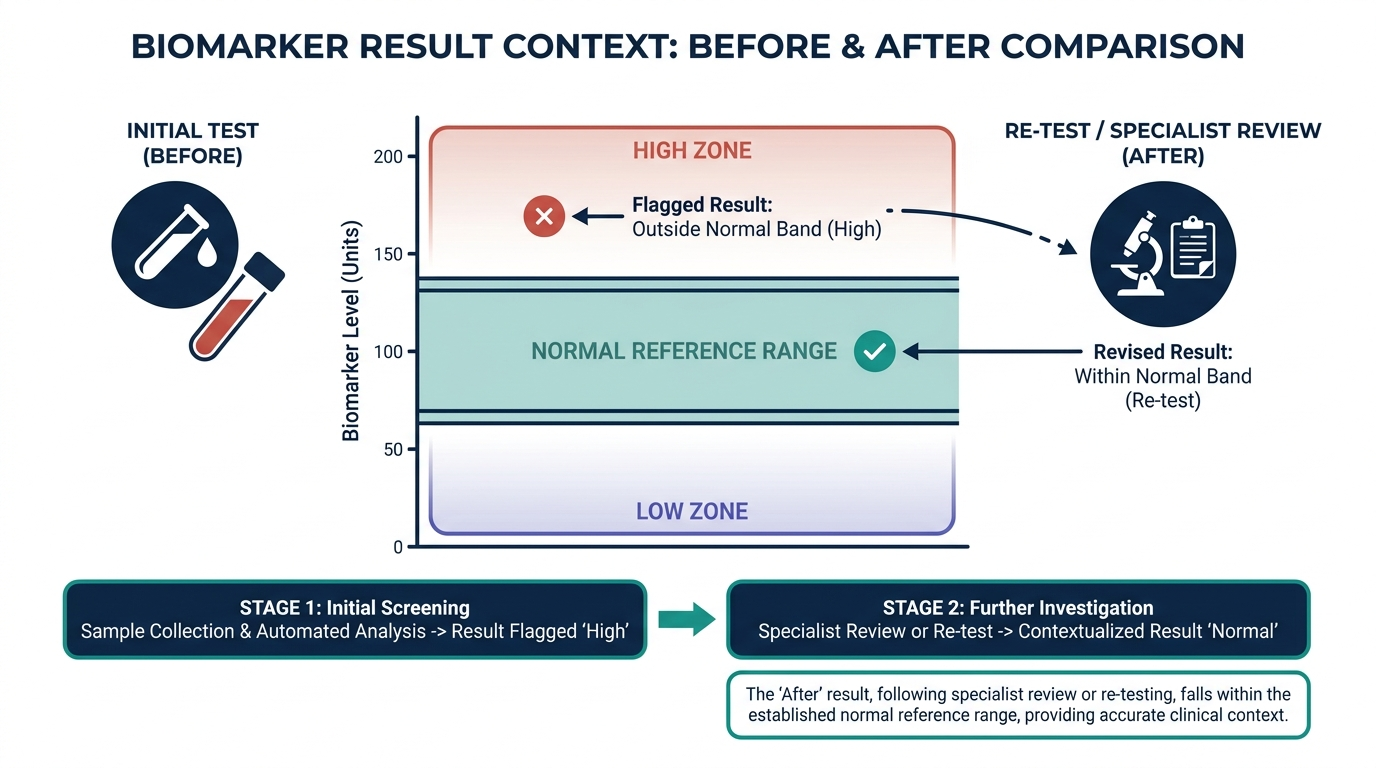
Some biomarkers on a 100-plus marker panel generate anxiety out of proportion to their actual clinical significance. Others are genuinely serious and often brushed off because the number does not look dramatic. Here are the ones where a second clinical eye matters most.
Lp(a) above 50 mg/dL
Lipoprotein(a) is genetically determined and largely unresponsive to diet or standard lipid medications. An elevated Lp(a) roughly doubles cardiovascular risk independent of LDL. Most people have never had it measured before their Function Health panel. A cardiologist or preventive medicine physician can put the number in context, discuss aspirin protocols, and monitor it correctly. Do not just accept a high Lp(a) without a specialist conversation.
Low free testosterone in men under 50
Function Health measures total and free testosterone. A low free testosterone in a man under 50 often reflects low sex-hormone-binding globulin (SHBG) or high SHBG rather than actual hypogonadism. Confirmatory testing should include a morning fasting draw (testosterone peaks before 10 a.m.), repeat measurement on a second day, LH, FSH, and prolactin. Many men have been sold testosterone replacement therapy based on a single afternoon draw.
Elevated homocysteine
Homocysteine above 15 micromol/L is associated with cardiovascular and cognitive risk, and it often responds to B-vitamin supplementation (B6, B12, folate). But elevated homocysteine can also signal a methylation variant (MTHFR), kidney disease, or hypothyroidism. A physician can rule out secondary causes before you start supplementing.
ANA (antinuclear antibody) positive
Function Health includes ANA testing. A low-titer positive (1:40) is present in roughly 25 to 30 percent of healthy adults and is clinically meaningless in isolation. A high-titer positive (1:160 or above), especially with a specific pattern (speckled, homogeneous), warrants rheumatology referral. People who see "positive" on an ANA result and panic have not been told that context. A rheumatologist or internist can interpret the titer and pattern immediately.
Slightly elevated PSA in men under 50
Prostate-specific antigen has a high false-positive rate, particularly for levels between 4 and 10 ng/mL. A single mildly elevated PSA is not a prostate cancer diagnosis. Confirmatory testing includes a repeat PSA after abstaining from ejaculation for 48 hours, PSA velocity over time, and potentially a free-to-total PSA ratio. A urologist interprets these in combination, not in isolation.
For more on interpreting individual biomarkers, our Function Health 100 biomarkers explained guide covers the full panel in plain language.
How to do a proper Function Health follow-up after getting a second opinion
A second opinion is not the end of the process; it is a calibration point. Here is how to close the loop effectively.
- Document what your physician said. Ask for a visit summary or after-visit notes. If your physician ordered additional labs, keep those results alongside your Function Health PDF so you have a single timeline of your markers.
- Update your Function Health health history. If the second opinion revealed something new (a diagnosis, a medication change, a relevant family history you had not entered), update the health history in your Function Health portal. The clinicians reviewing future draws will have better context.
- Retest at the right interval. Most biomarkers that prompted concern should be retested in 3 to 6 months after any intervention (dietary change, supplement, medication). Function Health's annual draw cadence may not be fast enough to track an active intervention. This is one scenario where having a second service running quarterly panels makes practical sense.
- Use HSA or FSA dollars. Confirmatory labs ordered through Quest or Labcorp, and the physician visit to review them, are both HSA/FSA-eligible expenses. If you have an HSA, use it. The out-of-pocket cost for a targeted confirmatory panel is typically $30 to $120 cash at a walk-in Quest location, and often $0 to $30 with insurance and a physician order.
For background on what Function Health includes in its standard membership, our Function Health review covers the full scope of the panel and service model.

Why two labs can give different numbers and both be correct
One of the most confusing experiences is getting a confirmatory result that does not exactly match your original panel, then wondering which one is wrong. Often neither is. Several legitimate sources of difference explain most discrepancies, and understanding them prevents both false alarm and false reassurance.
- Different assays and reference ranges. Labs use different testing platforms and calibration, so the same analyte can carry a slightly different reference interval from one lab to another. A value near the edge of the range at one lab can land just inside the range at another without either being an error. This is exactly why bringing the full report with units and ranges matters, not just the number.
- Biological variation between draws. Your body is not static. Many markers fluctuate day to day and even hour to hour. Hormones and inflammatory markers are especially variable, so a second draw a week later naturally reads differently.
- Pre-analytical conditions. Fasting status, time of day, recent exercise, hydration, and even how long the sample sat before processing all shift results. If your original panel was a fasting morning draw and your confirmatory test was a non-fasting afternoon draw, some differences are expected rather than suspicious.
The practical takeaway is that a meaningful change is one large enough to exceed both the normal biological variation of that marker and the analytical variation of the test. A clinician weighs this instinctively. It is why a single number rarely settles anything and why a trend, or an average of repeated measurements, is far more informative than one reading.
The right questions to ask when you sit down with a physician
A second opinion is only as good as the conversation. Walking in with precise questions turns an overwhelming stack of numbers into a focused clinical discussion. For each flagged marker, work through this short list.
- Is this result clinically significant or just statistically out of range? Being outside the population reference interval is not the same as needing treatment. Ask the physician to place the number on that spectrum.
- Does this need confirmatory testing before we act? For hormones, cardiac markers, and anything that would trigger a medication, the answer is usually yes. Ask which specific follow-up test they would order and why.
- Could a supplement, medication, or my draw conditions have skewed this? Biotin, recent illness, intense exercise, and timing all matter. Raise them proactively.
- What would you want to see on a repeat, and when? Establishing the retest interval up front keeps you from either overreacting now or forgetting to follow up later.
- Given my history, does this change my risk picture? The same number means different things for someone with a family history of early heart disease than for someone without one. This is the context a dashboard cannot supply.
Framing the visit around these questions also addresses the worry that a physician will be dismissive. You are not asking them to re-adjudicate a consumer product. You are asking them to apply clinical judgment and your medical history to specific, well-defined findings.
Building a cost-effective escalation ladder
Getting a second opinion does not have to be expensive or all-or-nothing. Think of it as a ladder, climbing only as far as the finding warrants, so you spend on confirmation in proportion to the stakes.
- Re-read the result in context first (free). Check whether it is borderline or dramatically off, whether related markers agree, and whether your draw conditions could explain it. Many flags resolve here.
- Order a single confirmatory test (low cost). For one borderline marker, a targeted repeat through a clinical lab is inexpensive and often settles the question, especially for markers known to fluctuate.
- Book a focused physician visit (moderate cost, often insured). When a result could change a medication or reflects a high-stakes history, a clinician who can order the right confirmatory panel and interpret it against your record is worth the appointment.
- Escalate to a specialist (highest cost, reserved for clear signals). A genuinely high Lp(a), a high-titer autoimmune marker, or a concerning prostate or cardiac pattern justifies a cardiologist, rheumatologist, or urologist. Reserve this rung for findings that truly need subspecialty judgment.
Matching the response to the finding is the whole skill. Treating every out-of-range flag as a specialist emergency wastes money and generates anxiety, while brushing off a serious signal because the number looks small is the opposite failure. A structured ladder keeps you calibrated and lets HSA or FSA funds cover the confirmatory steps efficiently.
Don’t just read about your health, track it.
A single result is a snapshot. Superpower re-tests 100+ markers over time so you can watch them move as you change sleep, food, and training.
FAQ
Can I share my Function Health results directly with my doctor?
Yes. Download the PDF from your Function Health portal and bring it to your appointment. Most physicians can read a standard lab report format. If your physician wants to input results into your EHR, they may need to manually enter key values, since Function Health does not currently integrate directly with Epic or Cerner. The PDF export has everything they need to do this.
Will my doctor take Function Health results seriously?
Most will, particularly in urban markets where DTC lab testing is increasingly common. The labs Function Health uses are CLIA-certified reference labs, so the technical quality of the results is not in question. What physicians sometimes push back on is the volume of testing and the framing around optimal versus normal ranges. Come with specific questions rather than asking your physician to review 100 biomarkers from scratch.
Does Function Health include a physician consultation?
Function Health includes clinician review of your results, which appears as notes in your portal. It does not include a real-time consultation or a face-to-face appointment. If you want to discuss results live with a physician, you need to book a separate appointment through your own provider or use a telehealth service.
How do I find a doctor who understands functional medicine labs?
Search for board-certified physicians with additional training in preventive medicine, integrative medicine, or longevity medicine. The Institute for Functional Medicine (IFM) has a practitioner finder on its website. Concierge primary care practices often have physicians comfortable interpreting extended panels. Some telehealth services specializing in men's or women's health (Hone Health, Midi, Parsley Health) also have clinicians experienced with DTC panels.
What if my doctor says my Function Health results are wrong?
Ask them to be specific. "Wrong" could mean the result is a known false positive for the assay used, the reference range Function Health uses differs from the clinical standard, or the result is technically accurate but clinically insignificant. Each of those is a different situation. Request confirmatory testing through a clinical lab before dismissing the result entirely, especially if your symptoms match what the result suggests.
How long does it take to get a second opinion on lab results?
A primary care appointment for lab review typically takes 1 to 3 weeks to schedule unless you have a same-day telehealth option. Confirmatory labs through Quest or Labcorp are walk-in at most Patient Service Centers; results come back in 24 to 72 hours for most standard markers. Add those two timelines together and you are looking at 2 to 4 weeks from deciding you want a second opinion to having one.
Is it worth running Superpower alongside Function Health to get a second opinion?
It is worth it specifically if you want an independent blood draw with physician review at a lower annual cost, and you want to track the same markers quarterly rather than annually. Running both services in the same year gives you two independent data points from two separate draws, which is actually stronger evidence than repeating the same assay at the same lab. See our breakdown of what Superpower costs to see if the math works for your situation.
Can Function Health results be used as a baseline before starting a new medication?
Yes, and this is one of the highest-value uses of a comprehensive panel. Baseline labs before starting statins (LFTs, CK, glucose), hormone therapy (CBC, metabolic panel, lipids), or immunosuppressants give you a pre-treatment reference point. Talk to the prescribing clinician about which specific markers they want tracked, since not every Function Health biomarker is relevant to every drug class.
Vital Signs Today may earn a commission if you buy through links on this page. It does not affect our editorial assessments.