
Quick answer: Hormone replacement therapy (HRT) is not a weight-loss drug, and on its own it usually does not make the number on the scale drop much. What HRT does do, in the right person, is reverse the weight changes that menopause or low testosterone causes: it moves fat off the belly, protects lean muscle, and makes diet and exercise work again instead of feeling pointless. So the honest answer to does HRT help with weight loss is yes for body composition and the midsection, mostly no for big scale drops. Most research shows estrogen therapy prevents the average 1 to 2 pounds a year of menopausal gain and trims visceral (belly) fat, while testosterone therapy in deficient men can drop several percent of fat mass over a year. If you want real fat loss, HRT is a supporting lever, not the engine, and the engine is usually a GLP-1 medication plus correcting whatever else your labs flag.
How does HRT help with weight loss in the first place?
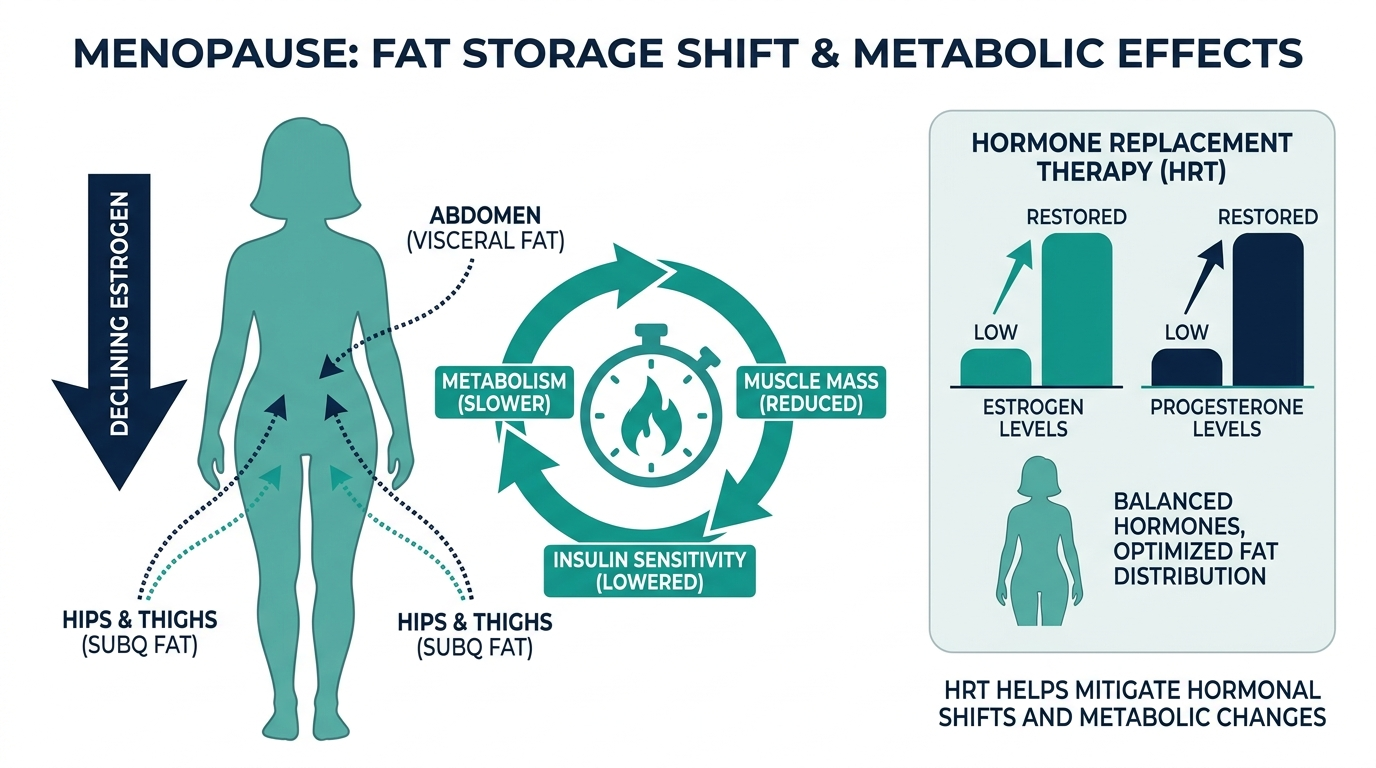
HRT helps by fixing the hormonal reasons your body started storing fat differently, not by burning calories directly. To understand how does HRT help with weight loss, you have to look at what the missing hormone was doing before it dropped.
Wondering if hormone therapy will actually move the scale for you? See where your own hormone levels stand first. One at-home Superpower draw checks 100+ biomarkers, physician-reviewed.
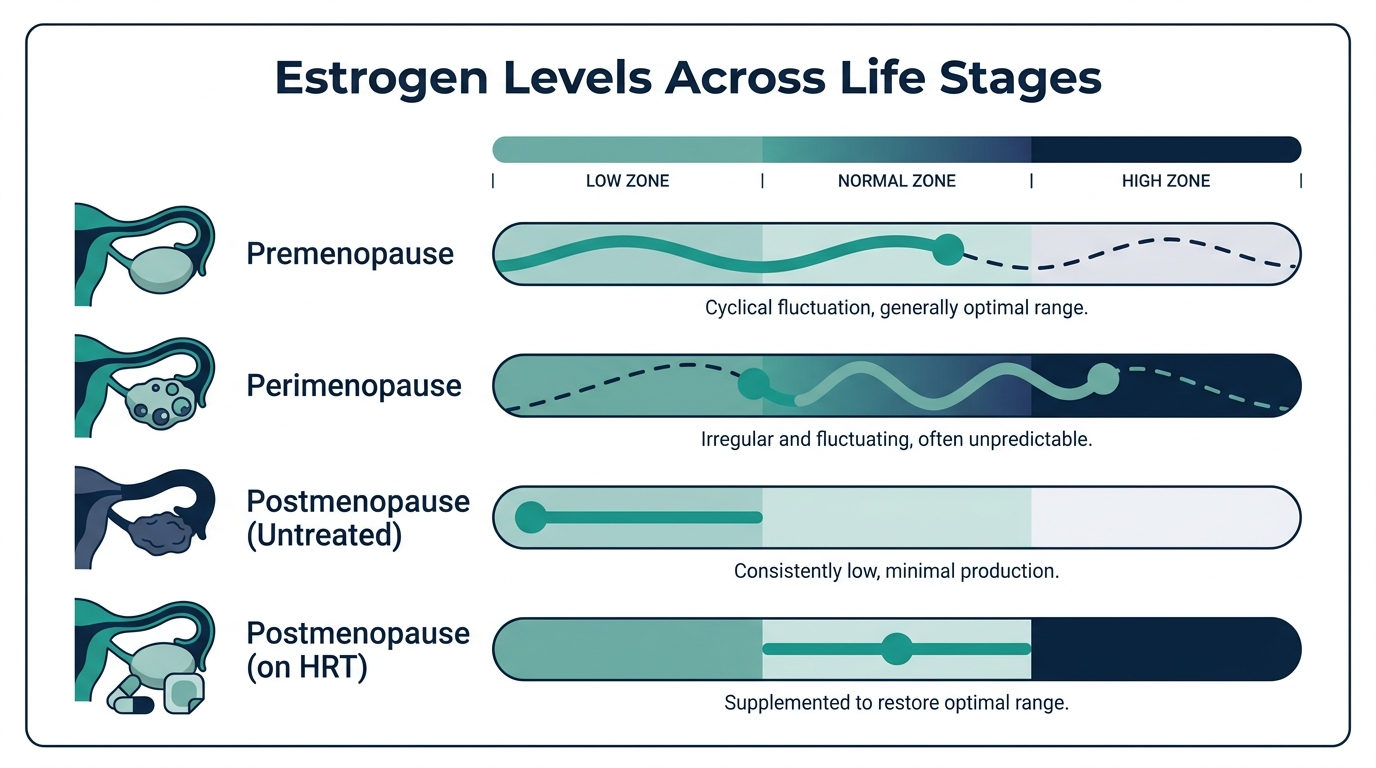
When estrogen falls during perimenopause and menopause, three things happen at once. Fat distribution shifts from the hips and thighs toward the abdomen, so even women whose total weight barely changes suddenly carry it as a harder belly. Insulin sensitivity drops, so the same carbs spike blood sugar more and store more readily. And resting metabolism dips slightly as muscle is lost faster. Estrogen replacement blunts all three. It does not flip you back to age 30, but it stops the slide.
In men, the hormone in question is testosterone. Low testosterone drags down lean muscle, energy, and motivation to train, and it shifts fat to the trunk. Restoring testosterone to a normal range in genuinely deficient men rebuilds muscle, which raises the calories you burn at rest, and lowers fat mass. The mechanism is more anabolic than fat-burning: you gain metabolically active tissue, and the fat budget tightens around it.
The other hormones people lump under “HRT” matter too. Thyroid hormone sets your whole metabolic rate, cortisol drives belly fat and cravings when chronically high, and insulin is the master fat-storage signal. None of those are fixed by estrogen or testosterone, which is exactly why some people start HRT and see nothing move. The hormone they replaced was not the one holding them back.
Does HRT cause weight loss or weight gain?
HRT does not directly cause weight gain, and the belief that it does is one of the most stubborn myths in women’s health. When researchers pooled the controlled trials of menopausal hormone therapy, women on HRT gained no more weight than women on placebo, and several studies found slightly less fat and less belly fat in the treated group. So on the question of does HRT cause weight gain or loss, the controlled evidence leans toward neutral-to-favorable on fat, not gain.
Where the confusion comes from is timing. Women start HRT in their late 40s and early 50s, which is precisely the age when weight creeps up for everyone because of falling estrogen, lost muscle, worse sleep, and a slower metabolism. The HRT gets blamed for weight that menopause itself was causing. If anything, the woman on HRT is gaining less than she would have without it.
Two real caveats. First, some women retain a little water and feel bloated in the first weeks, especially on certain progestogens, and they read that as fat gain. It usually settles. Second, oral estrogen passes through the liver first and can nudge appetite or fluid differently than a patch or gel, which skip that first pass. So does HRT cause weight loss is best answered as: it can cause modest fat and waist loss, occasional early water retention, and almost never true fat gain.
What HRT helps with weight loss, and which HRT is best?
The HRT that helps weight the most is transdermal estradiol (a patch or gel) for women and clinically dosed testosterone for deficient men, because both target visceral fat and protect muscle. There is no single magic formulation, but the route and the partner hormone matter. To answer what is the best HRT for weight loss and which HRT is best for weight loss, here is how the common options compare.
| HRT type | Who it is for | Effect on weight and fat | Notes |
|---|---|---|---|
| Transdermal estradiol (patch or gel) | Perimenopausal and menopausal women | Reduces visceral (belly) fat, helps preserve muscle, weight roughly neutral | Skips liver first-pass, lower clot risk than pills, generally the preferred route |
| Oral estradiol | Menopausal women who prefer a pill | Similar fat effect; slightly more fluid retention and appetite effect for some | Higher clot risk than the patch; still not a cause of true weight gain |
| Estrogen plus progesterone or progestin | Women with a uterus (progestogen protects the uterine lining) | Fat effect similar to estrogen alone; some progestins feel more bloating | Micronized (body-identical) progesterone tends to be better tolerated |
| Testosterone therapy (TRT) | Men with lab-confirmed low testosterone | Can drop 3 to 5 percent of fat mass and add lean muscle over 6 to 12 months | Only helps if you are genuinely deficient; not a fat burner for normal levels |
| Thyroid hormone (levothyroxine) | People with an underactive thyroid | Restores normal metabolic rate; can release several pounds of water if you were hypothyroid | Not HRT in the sex-hormone sense, but a common hidden cause of a stalled scale |
For women, micronized progesterone plus a transdermal estradiol is the combination most clinicians reach for when comfort and a clean metabolic profile both matter. For men, the goal is simply to land testosterone back in a healthy physiologic range, not to push it high, because supraphysiologic dosing brings its own problems without extra fat loss.
One nuance worth knowing: the form of progesterone you are on changes how your body handles it, which is the same logic behind whether progesterone helps with weight loss and why some women feel puffier on certain progestins than on body-identical micronized progesterone.
How long does HRT take to work for weight loss?
HRT takes about 3 to 6 months to show a measurable effect on body composition, and the changes are gradual rather than dramatic. If you are asking how long does HRT take to work for weight loss because you expect the scale to move in week two, reset that expectation now.
The early symptoms HRT treats, hot flashes, sleep, mood, and energy, often improve in 2 to 6 weeks. Better sleep and energy alone can help weight indirectly, because exhausted people eat more and move less. The fat-distribution change is slower. Studies tracking waist circumference and visceral fat on estrogen therapy generally see meaningful shifts at the 6-month and 12-month marks, not the 6-week mark. For men on testosterone, fat mass keeps dropping and lean mass keeps building across the first full year, then plateaus.
The practical timeline:
- Weeks 1 to 6: symptom relief, possible mild water retention, no real fat change yet.
- Months 2 to 3: energy and sleep stabilize, training feels productive again, waist may start to ease.
- Months 4 to 12: visceral fat and waist measurements improve, body composition shifts even when the scale barely moves.
Because the change shows up in the mirror and the tape measure before it shows up on the scale, measure your waist, not just your weight, or you will quit something that is actually working.
What stalls people on HRT, and the common mistakes
The single biggest reason HRT “fails” for weight is that the person never had a sex-hormone problem to begin with. They had an insulin, thyroid, cortisol, or pure calorie problem, started estrogen or testosterone hoping it would melt fat, and got nothing because the lever they pulled was not connected to the load. This is the guessing trap, and it is expensive in both money and months.
The common mistakes:
- Expecting HRT to be a weight-loss drug. It is a replacement therapy. It restores what is missing; it does not create a calorie deficit.
- Skipping labs. Starting HRT without checking estradiol, FSH, total and free testosterone, TSH and free T4, fasting insulin, and a metabolic panel means you are treating a guess. If your TSH is high, your stall is thyroid, not estrogen.
- Ignoring muscle. HRT protects muscle but does not build it for you. Without resistance training and adequate protein, you lose the very tissue that keeps your metabolism up.
- Blaming HRT for menopausal weight and quitting. The gain was coming regardless; stopping HRT does not reverse it and often makes symptoms worse.
- Buying gray-market hormones online. Unsupervised dosing without labs is how people end up with the wrong dose, the wrong hormone, and no one tracking their blood pressure, lipids, or clot risk.
The fix for all of this is the same. Measure first. A panel tells you whether your weight problem is estrogen, testosterone, thyroid, insulin, cortisol, or simply more calories than you think, and then you treat the actual cause. If the scale will not move no matter what you eat, it is usually worth seeing your real numbers before you start any hormone. An at-home thyroid and hormone test from Everlywell is one low-friction way to rule the obvious culprits in or out, and a fuller full-body lab panel covers the metabolic markers a single thyroid test misses.
Want a real clinician to run your hormones, not a guess?
Joi + Blokes is a telehealth clinic that prescribes hormone therapy (HRT and TRT), thyroid care, GLP-1 medication and peptides after a real lab panel and clinician review, with no membership or consult fee (prescriptions from about $59/month, hormone and GLP-1 lab panels from $149). For HRT to actually help your weight, you need the right hormone confirmed by labs and supervised dosing, which is exactly what this kind of clinic does instead of leaving you to self-experiment. Here is Joi + Blokes reviewed in full.
HRT versus GLP-1 medication for real fat loss
If your goal is to actually lose a meaningful amount of fat, a GLP-1 medication does far more than HRT, and the two work on completely different problems. HRT corrects a hormone deficiency; a GLP-1 creates the appetite suppression and metabolic shift that produces a real calorie deficit. They are not competitors so much as different tools, and many people who are deficient in both estrogen or testosterone and overweight end up on both.
Here is the honest scale of effect. Estrogen therapy mostly prevents gain and trims the waist. Testosterone in deficient men drops a few percent of fat. A GLP-1 is in another league.
| Treatment | Typical fat or weight effect | Best for |
|---|---|---|
| Estrogen HRT | Weight roughly neutral, less visceral fat, smaller waist | Menopausal women whose belly fat and stall track with low estrogen |
| Testosterone (TRT) | About 3 to 5 percent fat loss plus muscle gain over a year | Men with lab-confirmed low testosterone |
| Semaglutide (Wegovy) | Around 15 percent average body weight in the STEP trials | Real, sustained fat loss when diet alone has failed |
| Tirzepatide (Zepbound) | Around 20 percent or more in the SURMOUNT trials | The strongest current option for substantial weight loss |
A word on the medications, because the market is confusing. Wegovy (semaglutide) and Zepbound (tirzepatide) are FDA-approved for weight loss, and Ozempic and Mounjaro are the same molecules approved for diabetes and used off-label. Compounded semaglutide and tirzepatide, which are cheaper and often run roughly $150 to $300 a month cash, are not FDA-approved products; they are legally prescribed through licensed clinicians and pharmacies, and quality depends entirely on the pharmacy. That distinction matters, and it is one reason to get any GLP-1 through a supervised clinician rather than a random website. If you are weighing the injectable options specifically, this breakdown of the best injection for weight loss goes deeper. Talk to a clinician before starting or stopping any of these medications.
Who actually benefits from HRT for weight, and who should look elsewhere
HRT helps your weight if, and only if, a sex-hormone deficiency is part of your problem. The clearest candidates are menopausal women whose belly fat, stalled scale, hot flashes, and poor sleep all arrived together, and men with lab-confirmed low testosterone, low energy, and creeping trunk fat. For these people, replacing the hormone removes a real obstacle.
Several groups need a more specific answer than “try HRT”:
- PCOS: the core driver is insulin resistance, not low estrogen. Hormonal birth control manages symptoms, but weight responds far more to insulin-targeting steps and often a GLP-1. Some women find certain pills suit them better than others, which is the whole question of what birth control causes weight loss versus gain.
- Hypothyroidism: if your TSH is high, your stall is thyroid, and the fix is thyroid hormone, not estrogen. Correcting it can release retained water and restore your metabolic rate, which is the point of whether thyroid medication causes weight loss.
- Perimenopause with intact cycles: estrogen swings wildly here rather than simply falling, so timing and formulation matter, and a clinician should guide it.
- Insulin resistance without menopause: HRT will not touch this. Diet, training, and sometimes metformin or a GLP-1 are the levers.
The broader point about menopausal hormone therapy and weight is covered in more depth in this piece on whether hormone replacement therapy helps with weight loss. The common thread across all of these is that the right treatment depends on which hormone is actually off, and you cannot know that without testing.
Don’t just read about your health, track it.
A single result is a snapshot. Superpower re-tests 100+ markers over time so you can watch them move as you change sleep, food, and training.
FAQ
Will HRT help with weight loss if I am already eating well?
It can, but modestly. If you are eating well and still gaining belly fat through menopause, that pattern often reflects falling estrogen, and HRT can help shift fat off the midsection and make your existing effort show results again. It will not produce large scale drops by itself.
Can HRT cause weight loss on its own?
Rarely in any big way. HRT can produce a small reduction in fat mass and waist size, especially testosterone in deficient men, but it does not create the calorie deficit needed for substantial weight loss. Think of it as removing a brake, not pressing the accelerator.
Does HRT help weight loss more for women or men?
Testosterone therapy in genuinely deficient men tends to change body composition more, because it builds metabolically active muscle and drops fat by several percent. Estrogen therapy in women is more about preventing gain and redistributing fat away from the belly than producing loss.
Which HRT is best for weight loss?
For women, transdermal estradiol (patch or gel) with micronized progesterone is the combination most clinicians favor because it targets visceral fat and is well tolerated. For men, clinically dosed testosterone aimed at a normal range works best. The best choice for you depends on your labs.
Will HRT cause weight gain?
The controlled evidence says no. Women on HRT in trials gained no more than women on placebo, and often a little less fat. Early water retention can feel like gain but usually settles within a few weeks.
How long does HRT take to work for weight loss?
Symptoms like sleep and energy improve in 2 to 6 weeks, but fat and waist changes take 3 to 6 months and keep developing through the first year. Measure your waist, not just the scale, to see it.
Is HRT or a GLP-1 better for losing weight?
For actual fat loss, a GLP-1 medication is far stronger, with semaglutide averaging around 15 percent and tirzepatide around 20 percent or more in trials. HRT corrects a hormone deficiency that may be part of the problem. People who are both deficient and overweight often use both under a clinician.
Can I get HRT without going to an in-person clinic?
Yes. Telehealth clinics now prescribe HRT, TRT, thyroid care and GLP-1 medication after a lab panel and a clinician review, which is safer than self-dosing gray-market hormones. The key is that real labs and supervision are part of it, not just a checkout page.
What labs should I check before starting HRT for weight?
At minimum estradiol and FSH (women), total and free testosterone (men), TSH and free T4, fasting insulin and glucose, and a lipid panel. These tell you whether your weight problem is a sex-hormone issue, a thyroid issue, an insulin issue, or something else, so you treat the right cause.
Vital Signs Today may earn a commission if you buy through links on this page. It does not affect our editorial assessments.