Quick answer: A cbc blood test (complete blood count) measures the three main cell types in your blood: red blood cells that carry oxygen, white blood cells that fight infection, and platelets that clot wounds. It is one quick draw, usually back in a few hours to a day, and it does not require fasting. Doctors use it to screen for anemia, infection, inflammation, and clotting problems, and most components come with a printed normal range so you can see where you land at a glance. A standard CBC reports about a dozen numbers, and the most useful ones are often the size and shape indices, not the raw counts.
What is a CBC blood test, and what does it actually measure?
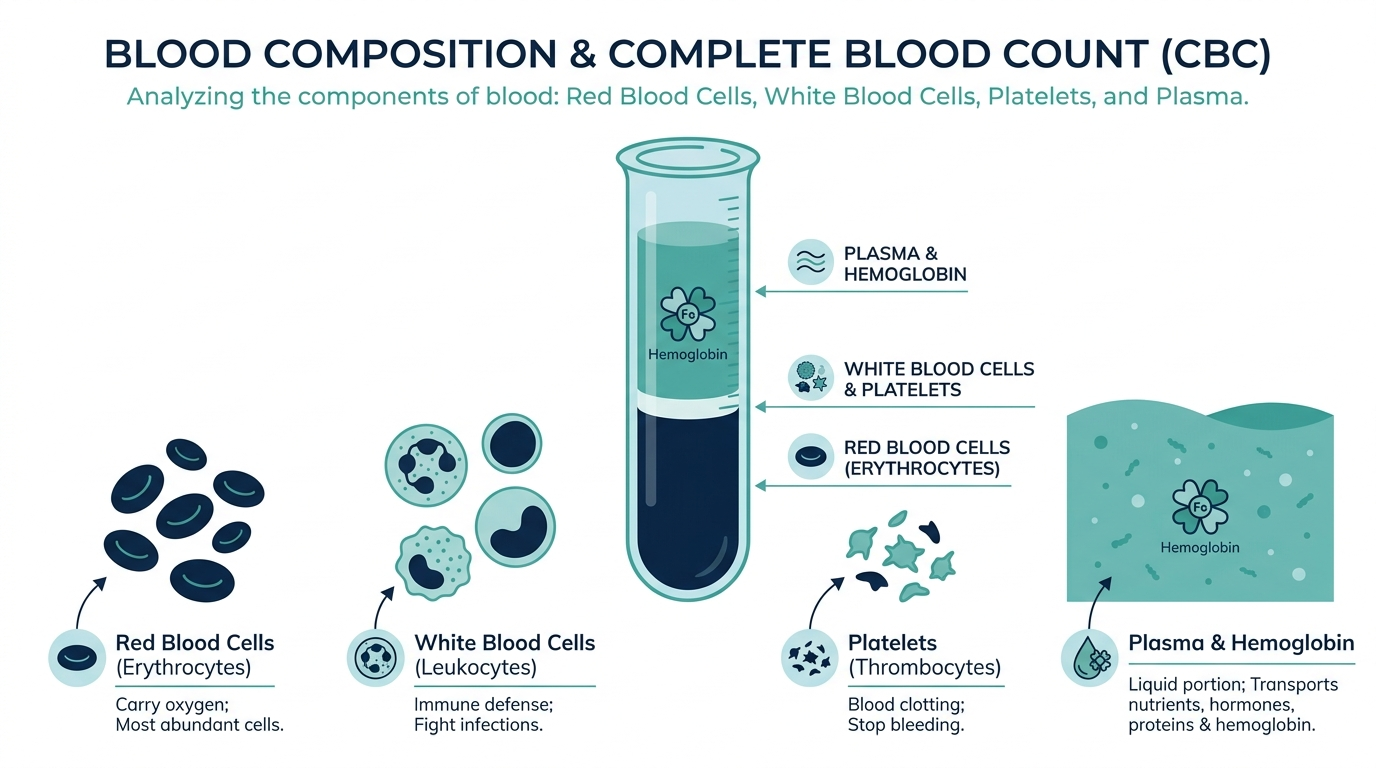
A cbc blood test is a single tube of blood run through an automated analyzer that counts and sizes your blood cells. It is the most ordered lab test in the country for a reason: it touches a huge range of conditions, from a simple iron deficiency to a serious infection, with one cheap, fast draw.
A CBC checks your red cells, white cells, and platelets, but that’s just 3 of the 100+ biomarkers a full panel can cover. One at-home Superpower draw checks 100+ biomarkers, physician-reviewed.
Here is the part most people miss. The CBC does not just count cells. It reports the size, shape, and concentration of those cells, and those secondary numbers (called indices, like MCV and RDW) are often where the real story hides. A normal-looking hemoglobin with an oddly low MCV, for example, can flag early iron deficiency before you ever feel tired. A clinician who only glances at the headline counts and ignores the indices is reading half the test.
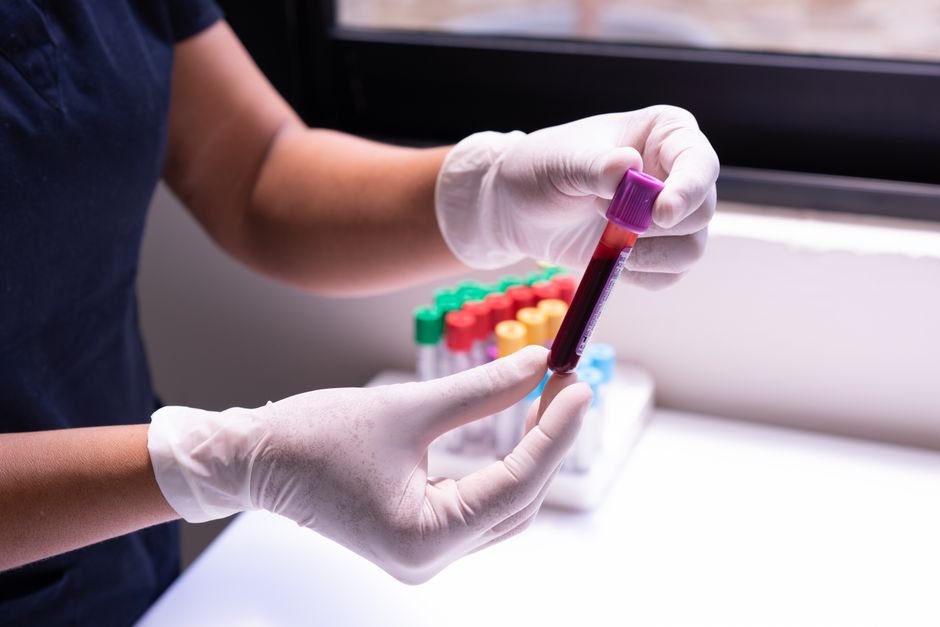
The blood goes into a lavender-top tube that contains EDTA, an anticoagulant that keeps the sample from clotting so the analyzer can count individual cells. That detail matters more than it sounds: if the tube is underfilled or sits too long, platelets can clump and the machine reports a falsely low platelet count, which is why a good lab re-runs a suspicious platelet result by hand before it ever reaches your chart.
Most CBCs today are ordered “with differential” (often labeled a CBC with auto differential). The differential breaks your white blood cells into their five types, which tells a clinician whether an elevated count points toward a bacterial infection, a virus, an allergic reaction, or something else entirely. A CBC ordered without the differential gives you a total white count and nothing about its makeup, which is far less useful when you are actually trying to figure out why someone is sick.
CBC with differential vs CBC without differential: which one do you need?
A CBC without differential gives you the totals: how many white cells, red cells, and platelets, plus the red cell indices. A CBC with differential adds the breakdown of white cells into their five subtypes. For almost every real clinical question, you want the differential, and that is why most ordering systems default to it.
The distinction shows up on your bill and your printout. Here is how the two compare.
| Feature | CBC without differential | CBC with differential |
|---|---|---|
| White cell total (WBC) | Yes | Yes |
| Five-part white cell breakdown | No | Yes (neutrophils, lymphocytes, monocytes, eosinophils, basophils) |
| Red cell counts and indices | Yes | Yes |
| Platelet count | Yes | Yes |
| Tells bacterial from viral infection | No | Often, from the neutrophil and lymphocyte pattern |
| Typical cash price | About $25 to $45 | About $29 to $60 |
| Common lab code | CBC, CBC w/o diff | CBC w/ auto diff, CBC w/ diff |
There is also an “auto” versus “manual” differential. The automated differential is the analyzer’s count and covers the vast majority of cases. When the machine sees something it cannot classify (immature cells, odd shapes, very high or very low counts), it flags the slide for a manual differential, where a technologist looks at a stained smear under a microscope and counts cells by eye. That manual review is how genuinely abnormal results get caught, so if your report says “smear reviewed,” a human looked at your blood.
The CBC components and normal ranges, in plain English
Every line on a CBC report is one of these measurements. Reference ranges vary slightly by lab, sex, and altitude, so use the range printed on your own report as the final word. The values below reflect common US adult ranges.
| Component | What it measures | Typical adult range | What out of range often means |
|---|---|---|---|
| White blood cells (WBC) | Total infection-fighting cells | 4,000 to 11,000 cells/mcL | High: infection, inflammation, stress. Low: viral illness, some medications. |
| Red blood cells (RBC) | Oxygen-carrying cells | 4.2 to 5.9 million cells/mcL | Low: anemia, blood loss. High: dehydration, smoking, low oxygen. |
| Hemoglobin (Hgb) | Oxygen-carrying protein | 13.5 to 17.5 g/dL (men), 12.0 to 15.5 g/dL (women) | Low: anemia. High: dehydration, lung or heart conditions. |
| Hematocrit (Hct) | Percent of blood that is red cells | 38.8% to 50% (men), 34.9% to 44.5% (women) | Tracks closely with hemoglobin. |
| Platelets (PLT) | Clotting cell fragments | 150,000 to 450,000/mcL | Low: bleeding risk. High: inflammation, clotting risk. |
| MCV | Average red cell size | 80 to 100 fL | Low: iron deficiency. High: B12 or folate deficiency, alcohol. |
| MCH | Hemoglobin amount per red cell | 27 to 33 pg | Tracks with MCV, helps classify anemia. |
| MCHC | Hemoglobin concentration per cell | 32 to 36 g/dL | Low: iron deficiency. High: rare cell disorders. |
| RDW | Variation in red cell size | 11.5% to 14.5% | High: mixed or early nutritional anemia. |
If your report includes the differential, you will also see five white cell subtypes, each reported as both a percentage and an absolute count. The absolute count is the one that matters clinically, because a percentage can shift just because another cell line moved. The table below lays out what each subtype tracks.
| White cell type | Typical share of WBC | What a high count often points to |
|---|---|---|
| Neutrophils | 40% to 70% | Bacterial infection, inflammation, physical stress |
| Lymphocytes | 20% to 40% | Viral infection, certain chronic conditions |
| Monocytes | 2% to 8% | Recovery from infection, chronic inflammation |
| Eosinophils | 1% to 4% | Allergies, asthma, parasitic infection |
| Basophils | 0.5% to 1% | Allergic reactions, rare blood disorders |
A clinician reads these together, not one at a time. That pattern reading is exactly why you want a human looking at the whole picture rather than scanning for a single red flag.
What each red cell number actually tells you
The red cell side of the CBC is built to answer two questions: do you have enough oxygen-carrying capacity, and if not, why. Hemoglobin and hematocrit answer the first. The indices answer the second.
Hemoglobin and hematocrit
Hemoglobin is the protein that actually carries oxygen, and it is the single most important anemia number on the panel. Hematocrit is the percentage of your blood volume made up of red cells, and it usually runs at roughly three times the hemoglobin value. When both are low, you are anemic. When both are high, the usual culprit is dehydration, which concentrates the blood and inflates both numbers without any real change in red cell mass.
RBC count, MCV, and MCH
The red blood cell count is the raw number of cells, and on its own it is less useful than the indices that describe them. MCV (mean corpuscular volume) is the average size of a red cell, and it sorts anemia into three buckets that point a clinician straight at the cause: small cells (low MCV) usually mean iron deficiency or thalassemia, normal-size cells often mean acute blood loss or chronic disease, and large cells (high MCV) point toward B12 or folate deficiency, alcohol use, or certain medications. MCH (mean corpuscular hemoglobin) is the amount of hemoglobin in an average cell and tends to move with MCV.
RDW, the early-warning index
RDW (red cell distribution width) measures how uniform your red cells are in size. It is underrated. When the body starts running short on iron, it makes a new crop of smaller cells while the older normal-size cells are still in circulation, so the size spread widens and RDW climbs before the MCV or hemoglobin ever drop out of range. A rising RDW with a still-normal hemoglobin is one of the earliest lab hints of developing iron deficiency, and it is exactly the kind of signal a snapshot reading misses but a year-over-year trend catches.
What the white cell and platelet numbers mean when they move
The white cell count is your immune system’s activity meter, and the direction it moves tells a story. A high total white count (leukocytosis) most often means infection or inflammation, but stress, hard exercise, smoking, pregnancy, and steroids all push it up too, which is why a mildly elevated count in an otherwise well person is rarely alarming. A low total white count (leukopenia) commonly follows a viral illness, but it can also come from certain medications, autoimmune conditions, or a problem with the bone marrow.
The differential is what turns a vague “your white count is up” into something useful. A high neutrophil count with a high total points toward a bacterial infection. A high lymphocyte share points toward a virus. A high eosinophil count points toward allergies or a parasite. This is the practical payoff of ordering the differential, and it is why a clinician treating a fever wants it.
Platelets, the clotting line
Platelets are cell fragments that plug damaged vessels and start clots. A low platelet count (thrombocytopenia) raises bleeding risk, and once it falls well below 50,000 the risk of spontaneous bleeding climbs. A high platelet count (thrombocytosis) is most often reactive, meaning it rises temporarily in response to infection, inflammation, iron deficiency, or recent surgery, and settles once the trigger resolves. A persistently high count deserves follow-up. One practical trap: clumped platelets in the tube can fool the analyzer into reporting a fake low count, so a surprising thrombocytopenia in a healthy person is often just a redraw, not a diagnosis.
A worked example: reading a real CBC line by line
Numbers in isolation rarely tell you much. Patterns do. Here is how a clinician would actually read two contrasting reports.
Report A, a 34-year-old woman who feels tired. Hemoglobin 11.2 (low), hematocrit 34% (low), MCV 76 (low), MCH 24 (low), RDW 16.5% (high), platelets 410,000 (high-normal), white count and differential normal. Read as a group, this is a textbook iron-deficiency picture: low hemoglobin, small pale cells (low MCV and MCH), a widened size spread (high RDW) from the body churning out new small cells, and a reactive bump in platelets that often rides along with iron deficiency. No single number diagnoses it, but the constellation is unmistakable, and the next step is an iron panel and ferritin, not a panic.
Report B, a 28-year-old man with three days of fever. White count 14,500 (high), neutrophils 82% (high), lymphocytes 11% (low), everything red and platelet normal. This is the bacterial-infection signature: total white count up, driven specifically by neutrophils. A viral illness would more often show a normal or low total count with a higher lymphocyte share. The CBC does not name the bug, but it tells the clinician which direction to treat while cultures cook.
Notice what both readings share. The diagnosis lives in the relationship between numbers, not in any one flag, which is why a flagged value is a prompt to talk to a clinician, not a verdict.
Does a CBC blood test require fasting?
No. A cbc blood test does not require fasting, and you can eat and drink normally before it. This is a common point of confusion, so it is worth being clear: the question “is cbc test fasting” comes up constantly, and the answer is the same every time.
The mix-up usually happens because CBCs are so often drawn at the same visit as a lipid panel or a glucose test, and those do ask you to fast for 9 to 12 hours. If your order includes cholesterol or fasting glucose, follow the fasting instructions for those tests. The CBC itself rides along just fine on a full stomach. When you do not know which tests are bundled, ask the ordering office rather than guessing, because showing up fed when a lipid panel needed fasting means a repeat draw.
One thing that genuinely does affect a CBC is hydration. A hard workout with no water can mildly concentrate your blood and nudge hemoglobin and hematocrit up. It will not turn a normal result abnormal, but if you are tracking subtle trends, drinking water normally and not testing right after intense exercise keeps your numbers comparable from draw to draw.
How long does a CBC blood test take, and how long to get results?
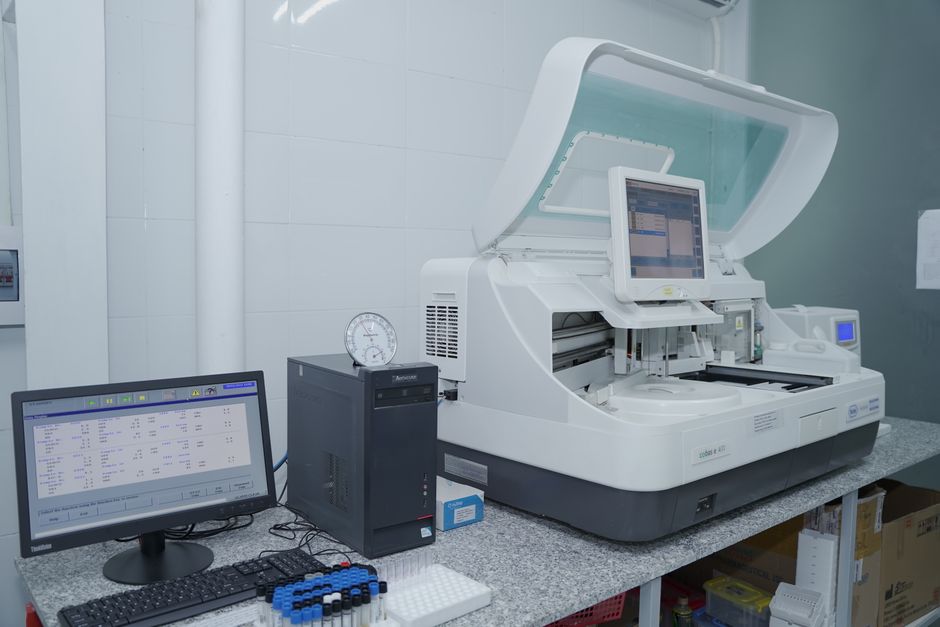
The draw itself takes about five minutes, and how long does a cbc blood test take from check-in to walking out is usually 15 to 30 minutes at a lab like Quest or Labcorp. The CBC is one of the fastest panels to process because the analyzer is fully automated.
For turnaround, here is what to expect on how long to get cbc results:
- Same day to next morning at most outpatient labs and many urgent care centers.
- Within an hour at a hospital or ER, where CBCs are run on site as a stat test.
- 1 to 3 business days if your sample is shipped to a central lab, which is common for at-home and direct-to-consumer kits.
If a value is critically high or low, the lab is required to flag it and call your ordering clinician quickly, often before you even see the number in your portal. For typical results, expect them to post to your patient portal within a day. If you want context on what a broader draw runs, see How Much Does Blood Work Cost? Real 2026 Prices With and Without Insurance.
What does a CBC blood test cost, and how does setting change the price?
A standalone CBC is one of the cheapest lab tests there is, but what you actually pay depends almost entirely on where it is run and who is billing. The same physical test can cost ten times as much depending on the setting, and that gap is the single biggest thing people get wrong about lab pricing.
| Where you get it | Typical cost for a CBC | Notes |
|---|---|---|
| Direct-to-consumer lab (cash) | $29 to $60 | You order online, draw at a partner lab, results in an app. |
| Discount or membership lab | $10 to $35 | Cheapest cash route, often bundled in a panel. |
| Doctor’s office through insurance | $0 to $50 out of pocket | Often covered, but applies to your deductible if not preventive. |
| Hospital outpatient lab | $100 to $300 billed | Same test, far higher list price before insurance adjustments. |
| Emergency room (as part of a workup) | Bundled into the ER bill | Run stat, but you pay ER pricing on top. |
The lesson mirrors the rest of the lab world: a CBC through a discount cash lab might run $15, while the identical panel billed through a hospital outpatient department can hit $250 before any insurance discount. If you are uninsured or on a high-deductible plan, paying cash at a direct-to-consumer or discount lab is often cheaper than running it through insurance, because the cash price can be lower than what counts against your deductible. Always ask for the cash price before you assume insurance is cheaper.
Can I get a CBC without a doctor?
Yes, in most states you can order a cbc blood test without a doctor through direct-to-consumer lab services. You order online, the platform’s physician authorizes the order on the back end, you walk into a partner lab for the draw, and results land in an app. Cash prices for a standalone CBC commonly run about $29 to $60, and a few states still restrict direct ordering, so check your state at checkout.
People also ask where to buy hemoglobin test kit options for testing at home. Fingerstick hemoglobin meters exist and sell for roughly $30 to $90 at pharmacies and online, but they only estimate hemoglobin, not the full count. They are useful for tracking a known anemia between lab visits, not for the complete picture a real CBC gives you. For anything diagnostic, a venous draw analyzed by a lab is the standard.
The simplest way to actually get this done
Superpower is a full-body lab membership that runs 100+ biomarkers, has each result reviewed by a doctor, and tracks your numbers year over year (about $199/year). It is what we point readers to when they would rather get one clean, complete draw than chase single tests one at a time. Here is superpower reviewed in full.
How to read your own CBC results without panicking
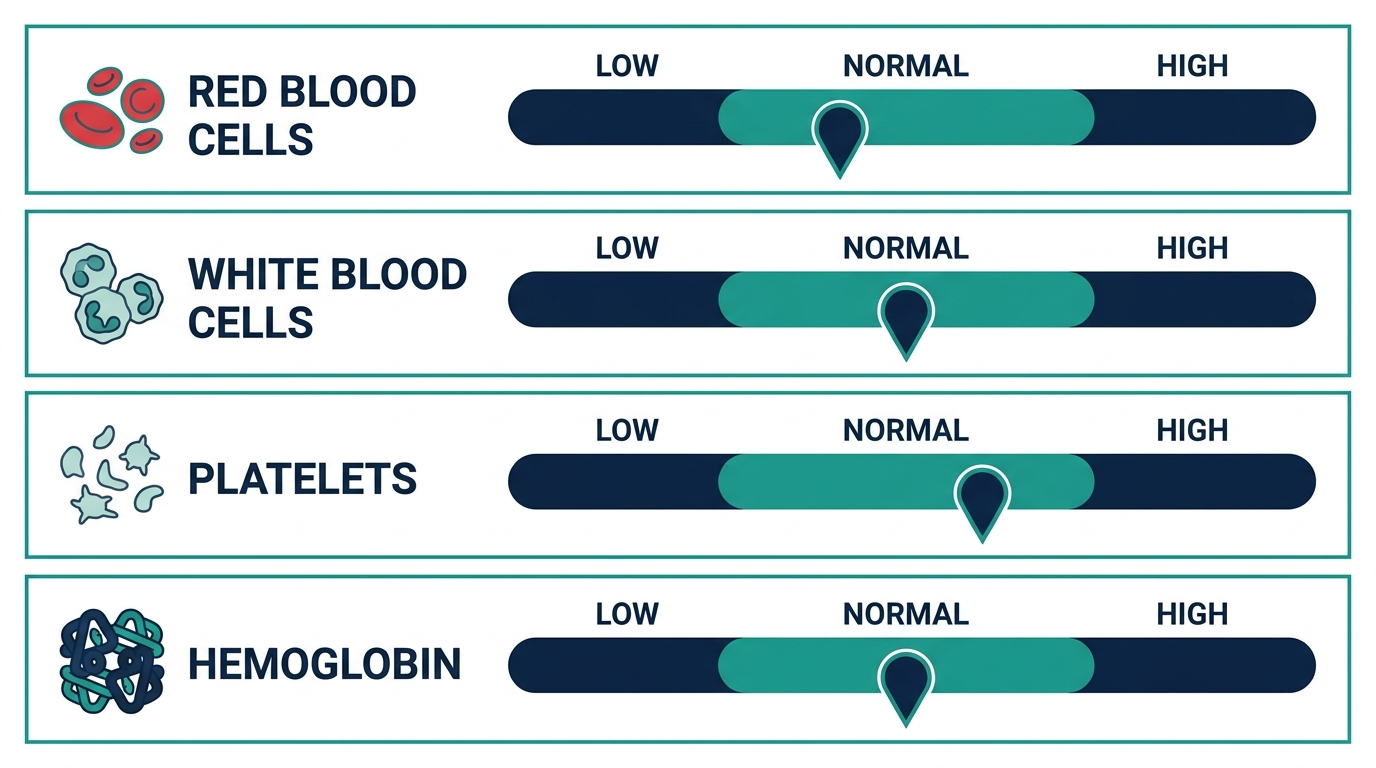
Start with the flags. Labs mark values outside the reference range with an H (high) or L (low), so a clean report with no flags is reassuring at a glance. A single value sitting barely outside the range is common and rarely an emergency on its own, especially for borderline white cell counts that move with everyday stress or a minor cold.
Read the cells in groups, the way a clinician does:
- Red cell story: hemoglobin, hematocrit, RBC, MCV, and RDW together tell you whether you are anemic and what kind.
- White cell story: total WBC plus the differential point toward infection type or, rarely, something that needs follow-up.
- Platelet story: too low raises bleeding risk, too high can signal inflammation or clotting risk.
One out-of-range number in isolation usually means far less than a pattern across several. If a value is flagged, talk to a clinician about your results rather than self-diagnosing from a single line. A CBC is also most valuable over time: one snapshot is a data point, but the same numbers tracked year over year reveal trends that a single draw cannot. That is the case for thinking about a complete blood panel rather than one-off tests, and for knowing the biomarkers worth tracking beyond the basic count.
Common mistakes people make with a CBC blood test
A CBC is simple to order and easy to misread. These are the errors that come up again and again.
- Treating one flag as a diagnosis. A lone borderline value, especially a white count nudged up by a cold or stress, is not a disease. The pattern across several numbers is what matters.
- Fasting when you did not need to. The CBC itself needs no fast. People skip breakfast for no reason, or worse, fail to fast for a lipid panel bundled with it and have to come back.
- Ignoring the indices. Reading only hemoglobin and skipping MCV, MCH, and RDW throws away the part of the test that explains the cause of an anemia.
- Comparing results across different labs. Reference ranges differ slightly between labs, so a value that is “high” at one lab may be normal at another. Track trends within the same lab when you can.
- Panicking over a low platelet count without a redraw. Clumped platelets in the tube routinely cause a falsely low result. A surprising thrombocytopenia in a healthy person is often an artifact, not a bleeding disorder.
- Ordering a CBC without the differential to save a few dollars. The differential is where most of the diagnostic value lives. Skipping it to save money usually means re-testing later.
Edge cases: pregnancy, children, athletes, and ongoing conditions
The standard adult ranges do not apply to everyone, and assuming they do leads to false alarms.
Pregnancy. Blood volume expands during pregnancy, which dilutes red cells and produces a mild, expected drop in hemoglobin and hematocrit called physiologic anemia of pregnancy. White counts also run higher than usual. These shifts are normal, and prenatal care uses pregnancy-specific thresholds rather than the standard chart.
Children. Pediatric ranges differ by age, sometimes dramatically. Newborns run high hemoglobin that falls over the first months, and young children normally show a higher lymphocyte share than adults. A pediatric CBC must be read against age-matched ranges, which is why a lab report for a child should always carry pediatric reference values.
Athletes and altitude. Endurance athletes can show a slightly low hematocrit from expanded plasma volume, sometimes called sports anemia, even though their oxygen delivery is fine. People living at high altitude run higher hemoglobin and hematocrit because their bodies make more red cells to compensate for thinner air. Both are normal adaptations.
Chronic conditions and medications. Kidney disease lowers red cell production and causes anemia. Chemotherapy and some immune-suppressing drugs lower white cells and platelets, which is exactly why patients on them get frequent CBCs to monitor counts. In these cases the CBC is a tracking tool, and the meaningful number is the change from the patient’s own baseline, not the population range.
Who should get a CBC, and how often?
A CBC is part of routine adult physicals for good reason: it is cheap, fast, and catches common problems early. For a healthy adult with no symptoms, a CBC every one to two years as part of a general check is reasonable, and many people get one annually bundled into other screening labs.
You have a stronger reason to test sooner if you have symptoms that map to what the CBC measures: persistent fatigue, paleness, or shortness of breath (anemia), frequent or lingering infections (white cell problems), or easy bruising and bleeding (platelet problems). Anyone managing a chronic condition, taking a medication that affects blood counts, or recovering from significant blood loss will get CBCs on a schedule their clinician sets.
If you are getting blood drawn anyway, it is often smarter to capture a full baseline at once rather than chase single tests one at a time. Here is how a full-body panel compares if you want the CBC read alongside the rest of your numbers.
Don’t just read about your health, track it.
A single result is a snapshot. Superpower re-tests 100+ markers over time so you can watch them move as you change sleep, food, and training.
FAQ
Is a CBC blood test fasting required?
No. The CBC does not require fasting. You only need to fast if it is bundled with a lipid panel or fasting glucose test, so check your full order with the ordering office.
What is a CBC with auto differential health test?
It is a standard CBC plus an automated breakdown of your white blood cells into their five types (neutrophils, lymphocytes, monocytes, eosinophils, basophils). That breakdown helps a clinician tell a bacterial infection from a viral one or an allergic response.
What is the difference between a CBC with and without differential?
Both report your total white, red, and platelet counts. The version with differential adds the five-part white cell breakdown, which is where most of the diagnostic value lives. Most orders default to the differential, and it costs only a few dollars more.
What do MCV and RDW mean on my results?
MCV is the average size of your red blood cells, and it sorts anemia by cause: small cells point to iron deficiency, large cells to B12 or folate deficiency. RDW measures how much your red cells vary in size, and a high RDW can be one of the earliest signs of developing iron deficiency, sometimes before hemoglobin drops.
Where can I buy a hemoglobin test kit?
Fingerstick hemoglobin meters are sold at pharmacies and online for about $30 to $90. They estimate hemoglobin only, so they are for tracking a known condition, not for getting the full blood count a lab CBC provides.
How long do CBC results take to come back?
Most outpatient labs return CBC results the same day or by the next morning, hospitals run them within about an hour, and mailed-in or at-home samples take 1 to 3 business days.
How much does a CBC blood test cost?
Cash prices run about $29 to $60 at a direct-to-consumer lab and as low as $10 to $35 at discount labs. The same test billed through a hospital outpatient department can reach $100 to $300 before insurance, so ask for the cash price if you are paying out of pocket.
Can a CBC detect cancer?
A CBC does not diagnose cancer, but abnormal patterns, such as a very high or very low white count, unexplained anemia, or a low platelet count, can be an early clue that prompts further testing. It is a screening and monitoring tool, not a definitive cancer test, and any concerning pattern needs follow-up with a clinician.
Can I order a CBC without seeing a doctor first?
In most states, yes, through a direct-to-consumer lab service that handles physician authorization for you. Standalone CBC cash prices commonly run about $29 to $60. If you want the bigger picture, here is what Superpower tests for and how much Superpower costs.
Vital Signs Today may earn a commission if you buy through links on this page. It does not affect our editorial assessments.