Quick answer: When you search blood test near me, your fastest options are the two national lab chains, Quest Diagnostics and Labcorp, plus retail clinics like CVS MinuteClinic and most urgent care centers. Quest and Labcorp both take walk-ins, but you will almost always wait less if you book a slot online first. Cash prices run roughly $29 to $150 for common panels without insurance, and a phlebotomist can usually have you out the door in 10 to 15 minutes. If you want a full picture rather than one or two markers, an at-home or membership draw often beats the trip.
Where to find a blood test near me, and who is fastest?
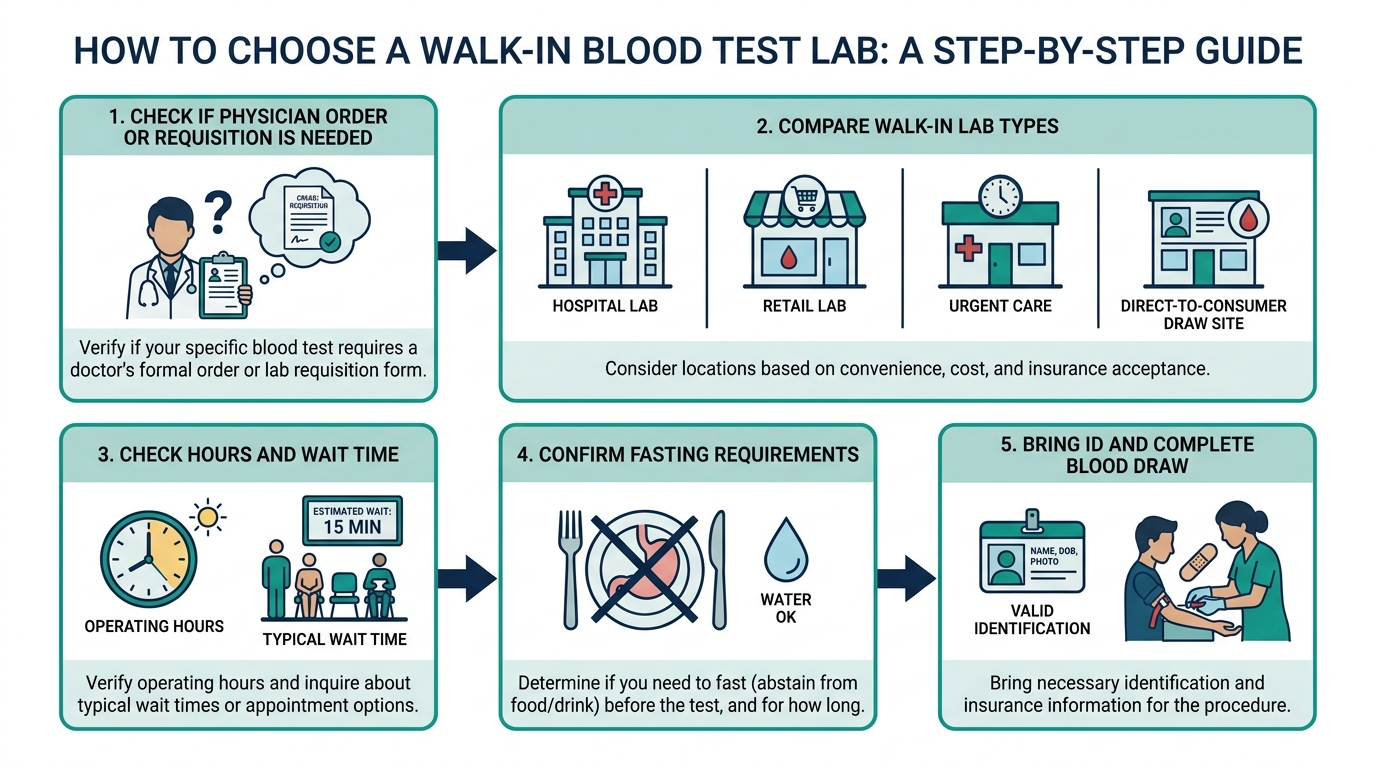
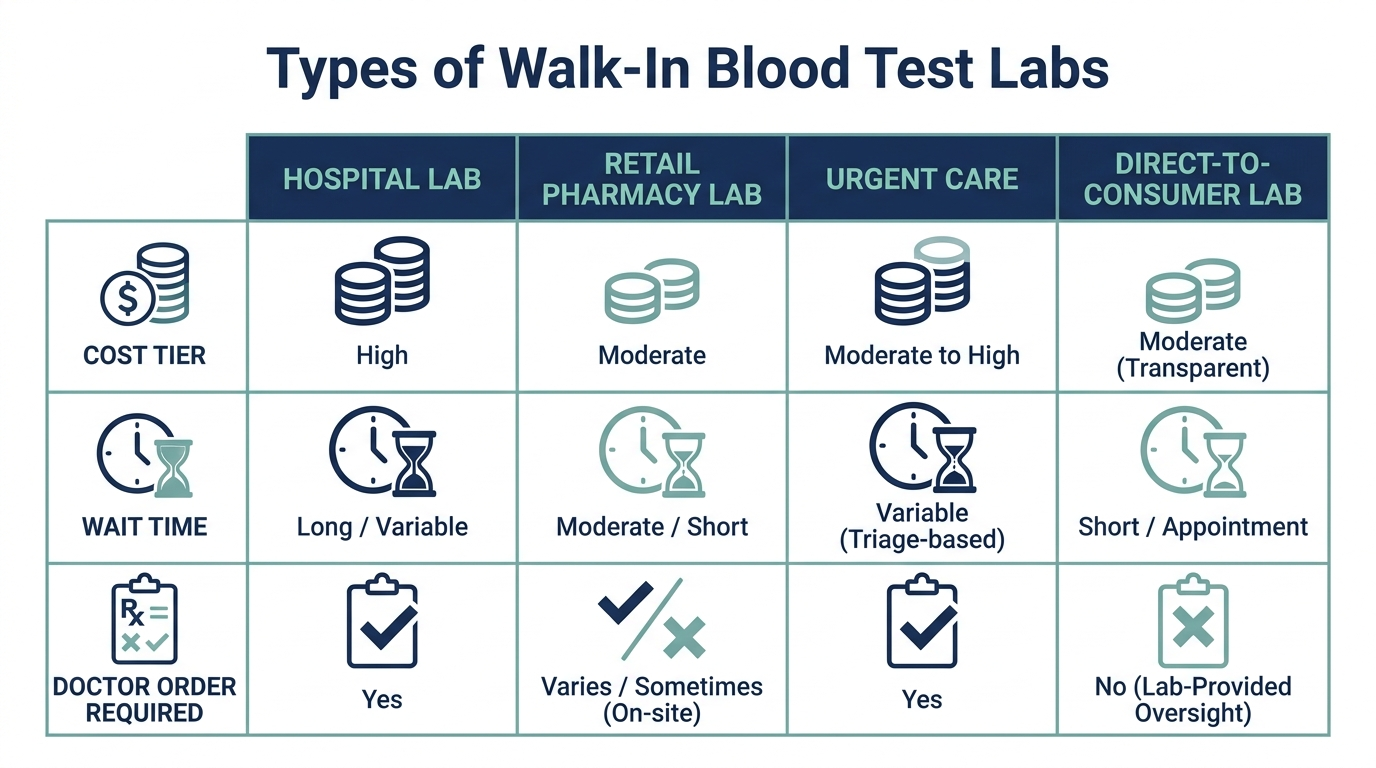
When you search blood test near me, the places that draw blood fall into four buckets, and they are not interchangeable. Quest and Labcorp run the dedicated patient service centers, the storefronts whose only job is collecting samples. Retail clinics inside CVS, Walgreens, and some grocery pharmacies handle a narrower menu. Urgent care centers draw blood when it relates to a visit. Hospitals and outpatient labs handle the complex or stat orders.
Standing in line at a walk-in lab for one panel? See how a single draw can cover 100+ biomarkers instead. One at-home Superpower draw checks 100+ biomarkers, physician-reviewed.
- Quest Diagnostics and Labcorp patient service centers. The default answer to who does blood work near me. They have the widest test menu, run almost every insurance, and post results to an app. There are thousands of locations, so one is usually within a short drive.
- CVS MinuteClinic and pharmacy clinics. Convenient for a small set of tests like A1C, cholesterol, or a basic metabolic panel, but they do not do everything. Call ahead before you assume they run the panel you need.
- Urgent care. Good when blood work is part of a same-day problem, a possible infection or dehydration, for example. They are not built for routine annual screening and tend to cost more.
- Hospital outpatient labs. Reliable and able to handle anything, but the slowest and priciest setting for a routine draw. Save these for orders your doctor specifically routes there.
For a standard annual screen, a Quest or Labcorp service center is almost always the right call. The one thing nobody tells you: the chain your insurer counts as in-network matters more than which is closer. Quest and Labcorp negotiate separately with each plan, so the lab two miles farther away can be the one that gets fully covered. Check your insurer’s directory before you pick, not after you get the bill.
How many locations are actually near you
Density is the quiet advantage of the national chains. Between them, Quest and Labcorp operate thousands of patient service centers across the country, and in most metro areas you have several within a 15-minute drive. That matters because it gives you leverage on two fronts: you can pick the in-network chain without driving across town, and you can pick the location with the shortest posted wait or the only Saturday hours. In rural areas the picture thins out, and a hospital outpatient lab or a pharmacy clinic may be the only practical option, which is exactly where an at-home draw starts to look attractive.
Match the setting to the reason you are getting drawn
People waste time and money by sending a routine question to the wrong building. A fasting lipid panel for your annual physical does not belong at urgent care, where you pay a visit fee on top of the draw. A possible strep or flu with a fever does not belong at a standalone Quest center, which cannot treat you. The rule of thumb: routine and scheduled goes to a Quest or Labcorp service center, sick and same-day goes to urgent care or your primary care office, and complex or doctor-routed goes wherever the order specifies.
Can I go to Quest without an appointment?
Yes, you can go to Quest without an appointment, and the same is true at Labcorp. Both chains accept walk-ins at their patient service centers during posted hours. The catch is the wait. Walk-ins are slotted around people who booked online, so on a busy Monday morning you can sit for 45 minutes behind a screen of scheduled appointments.
Booking online is free and takes two minutes on the Quest or Labcorp site or app. You pick a location, a date, and a 15-minute window, then walk in near that time and get pulled quickly. If your test requires fasting, an early booked slot is worth it, because nobody enjoys waiting two hours into a fast with a walk-in crowd ahead of them.
One real-world tip from sitting in these waiting rooms: even with an appointment, bring the lab order or have it sent electronically by your doctor, plus a photo ID and your insurance card. Missing the order is the number one reason people get turned away and told to come back, appointment or not.
Walk-in versus appointment: a quick comparison
| Factor | Walk-in | Booked appointment |
|---|---|---|
| Typical wait | 10 to 45+ minutes, peaks worst | 0 to 10 minutes near your slot |
| Cost | Same draw price | Same draw price, booking is free |
| Best for | Off-peak mid-morning, flexible schedule | Fasting tests, tight schedule, Saturdays |
| Risk | Long queue on Mondays and at open | Late arrival can forfeit the slot |
The honest summary: booking does not save you money, it saves you time and the misery of a long fast in a crowded room. If your schedule is flexible and you can hit a quiet window, walking in is fine. If you are fasting, traveling on a deadline, or it is a weekend, book the slot.
What to bring so you are not turned away
Show up with three things and you will rarely have a problem: a photo ID, your insurance card if you want the test billed to insurance, and the lab order itself. The order is the one people forget. Sometimes it is a paper requisition your doctor handed you, sometimes it is sent electronically and already waiting in the lab system under your name. If you are not sure it went through, call the ordering office before you drive over. A wasted trip on an empty stomach is the most avoidable mistake in this whole process.
What are typical hours, and when are walk-in labs least busy?
Most Quest and Labcorp service centers open early, often 7:00 or 7:30 a.m. on weekdays, and close mid to late afternoon. A subset offer Saturday morning hours, which book up fast. Retail pharmacy clinics tend to run longer into the evening but with a thinner test menu, and urgent care often stays open nights and weekends.
The early open exists for a reason. Many panels, a lipid panel or fasting glucose for example, ask for an 8 to 12 hour fast, so the 7 a.m. slot lets you draw before breakfast and get on with your day. Worth knowing: A1C does not need fasting and triglycerides do, which is why a clinic may tell you to fast for one cholesterol-related test but not for a hemoglobin A1C drawn the same morning.
If you want the shortest wait, aim for mid-morning Tuesday through Thursday, after the pre-work fasting rush clears and before the lunch crowd. The first 30 minutes after opening and the last hour before close are the worst for walk-ins.
Busy times versus dead times
| Time window | Crowd level | Why |
|---|---|---|
| Open to 8:30 a.m., Mon and Fri | Heaviest | Fasting patients front-load before work |
| Mid-morning, Tue to Thu | Lightest | Fasting rush cleared, lunch not yet |
| Around lunch | Moderate | Working patients use their break |
| Last hour before close | Heavy and rushed | Stragglers, staff winding down |
| Saturday morning (where offered) | Heavy, books out | Only weekend option, limited slots |
Hours and weekend availability differ location to location, so confirm on the chain’s site for your specific center rather than assuming. The pattern above holds almost everywhere, but a center near a hospital or a large employer can run busier all day.
How does a blood test near me actually work, step by step?
The visit itself is short and almost always the same, whether you walk in or book. Knowing the steps removes the friction, especially the fasting and check-in parts where people stumble.
- Get the order. A clinician orders the test, or you order direct through a consumer portal. The order tells the lab exactly which panel to run.
- Prep if needed. If a test requires fasting, stop eating 8 to 12 hours before, water and most medications are usually fine. Confirm with the order or the ordering office.
- Check in. Arrive with ID, insurance card, and the order. Many centers use a kiosk where you scan in and wait for your name.
- The draw. A phlebotomist seats you, ties a tourniquet, cleans the site, and draws one or more tubes. It takes a couple of minutes and a small pinch.
- Results. The lab processes the sample and posts results to its app or portal, usually within 1 to 3 business days for routine panels.
- Review. Read the results against the reference ranges, then bring anything flagged or unexpected to a clinician who knows your history.
That last step is the one people skip. A number outside the reference range is a prompt to ask a question, not a diagnosis on its own. Context, your history, medications, and how you felt that week, is what turns a lab value into useful information.
How much does a blood test cost near me without insurance?
Cash prices vary more by setting than by the blood itself. The draw is the same; the markup is not. With insurance, a screening panel ordered by your doctor is often fully covered, though a coding quirk can change that, which I will get to. Here are realistic 2026 cash ranges for common tests by setting.
| Setting | Common panel cash price | Speed and notes |
|---|---|---|
| Quest or Labcorp service center | $29 to $150 | Fast draw, widest menu, app results in 1 to 3 days |
| CVS MinuteClinic / pharmacy clinic | $60 to $130 | Limited menu, evening hours, fast for what they offer |
| Urgent care | $100 to $300+ | Includes a visit fee, best for same-day symptoms |
| Hospital outpatient lab | $150 to $500+ | Highest markup for routine work, handles anything |
| At-home or membership draw | $50 to $200 | Mobile phlebotomist or kit, no commute, broad panels |
The insider detail that catches people: a test billed as preventive screening is usually free under most plans, but if your doctor codes it as diagnostic, because you mentioned a symptom or have a relevant condition, the same draw can land you a copay or full charge. If a preventive panel comes back with a bill you did not expect, ask the ordering office how it was coded before you pay. A single word in the order can flip a free test into a billed one.
A worked cost example
Say you want a lipid panel, a comprehensive metabolic panel, a complete blood count, and a thyroid check. Order them as four separate cash tests at a service center and you might pay roughly $30 to $45 each, call it $140 all in, and still walk out with a thin slice of your health. Order the same markers as one bundled panel and the per-marker cost usually drops, because you pay for one draw and one processing run instead of four line items. Now compare that to a hospital outpatient lab, where a single comprehensive metabolic panel that costs about $29 cash at a discount lab can be billed at $200 to $250 once a facility fee is layered on. Same tube of blood, wildly different bill. The lesson: bundle when you can, and never assume the hospital lab and the storefront lab charge anything alike.
Ways to lower the cost
- Use HSA or FSA dollars. Lab work is a qualified expense, so paying with pretax funds effectively discounts the bill.
- Ask for the cash price even with insurance. For some tests the cash rate at a discount lab beats your deductible-stage copay. Compare before you hand over the card.
- Bundle markers. One broad panel almost always beats several single orders on price per result.
- Confirm the coding. If a preventive test should be free, make sure the order is coded as screening, not diagnostic.
If you are paying cash for several individual tests, the math often tips toward a single broad draw. Three or four separate orders at $40 each add up fast, and you still only see a sliver of your health. This is also where a complete blood panel earns its keep, because it bundles the markers most people actually want in one stick.
How do I find a blood test near me online?
The fastest path is the chain’s own locator, not a generic map search. Both Quest and Labcorp have a find-a-location tool on their site and app where you enter your ZIP, see nearby centers with hours, and book a slot in the same flow. That beats a plain map search because it shows live appointment availability and tells you which services each center offers, since not every location runs every test.
- Confirm in-network first. Check your insurer’s directory to see whether your plan favors Quest or Labcorp, then search only that chain. This one step prevents most surprise bills.
- Use the chain locator. Enter your ZIP on the Quest or Labcorp site, filter for the services you need, and read the posted hours.
- Book the slot. Pick a time, ideally mid-morning midweek or an early fasting slot, and note the address.
- Check the order is in the system. Make sure your clinician sent the order, or bring the paper requisition.
If you are ordering tests yourself without a doctor, the same portals let you buy many panels direct and route you to a nearby center for the draw. At-home services skip the locator entirely by sending the draw to you or mailing a kit.
When does an at-home or membership draw beat going in?
Going to a lab near you is the right move when a doctor ordered a specific test, when you need it covered by insurance, or when you need a result fast for a same-day issue. But the walk-in model has a blind spot: it answers exactly the question on the order and nothing more. You leave knowing your cholesterol and nothing about the 90 other markers that quietly shape how you feel.
That is the gap at-home and membership services fill. A mobile phlebotomist comes to you, or you visit a partner lab once, and instead of one or two numbers you get a wide baseline reviewed by a clinician. For anyone tracking health year over year rather than chasing a single complaint, capturing everything in one draw is simply more efficient than booking a new walk-in every time a question comes up. If you are already deciding which markers matter, our guide to the biomarkers worth tracking and our breakdown of what a complete health panel includes are good places to start.
At-home is not the same as a finger-prick kit
Two very different things hide under the at-home label, and the distinction matters. A mail-in finger-prick kit collects a few drops you blot onto a card, fine for a handful of markers but limited by how little blood it captures and how the sample ages in transit. A mobile phlebotomist draw, by contrast, is a full venous draw done at your kitchen table, the same tube quality as a service center, which is why it can run a broad panel. If you want depth and reliability without leaving home, the mobile venous draw is the one to look for, not the finger-prick card.
The simplest way to actually get this done
Superpower is a full-body lab membership that runs 100+ biomarkers, has each result reviewed by a doctor, and tracks your numbers year over year (about $199/year). It is what we point readers to when they would rather get one clean, complete draw than chase single tests one at a time. Here is superpower reviewed in full.
Whichever route you take, a blood test is data, not a diagnosis. Bring anything unexpected to a clinician who can read it against your history before you act on a number in isolation. For the cost comparison specifically, see how much Superpower costs against paying per test at a walk-in lab.
Common mistakes people make booking a blood test near me
Most bad lab experiences trace back to a few avoidable errors. Knowing them ahead of time saves a wasted trip, a surprise bill, or a result you cannot trust.
- Picking by distance instead of network. The closest lab is not the cheapest if your plan favors the other chain. Check in-network status first.
- Forgetting the order. No order, no draw at most centers. It is the top reason people get turned away even with an appointment.
- Eating before a fasting test. A morning coffee with cream can throw off a lipid panel. Black coffee and water are usually fine, but confirm.
- Assuming a preventive test is free. A diagnostic code instead of a screening code can turn a covered test into a bill. Ask how it was coded.
- Walking in at the worst time. Monday at open with a fast going is the longest wait of the week. Aim mid-morning midweek.
- Going to the hospital lab for routine work. The same panel can cost several times more once a facility fee lands. Save the hospital lab for orders routed there.
- Trusting a finger-prick kit for a deep panel. Tiny samples limit what can be measured reliably. For a broad baseline, get a venous draw.
Edge cases: uninsured, minors, employer-required, and Medicare
The standard advice shifts in a few specific situations. Here is how each one changes the move.
Uninsured or high-deductible
If you are paying out of pocket, compare cash prices directly and lean toward discount labs and bundled panels. A consumer-ordered panel at a service center or a membership draw often costs less than an insured visit while you are still in your deductible. Pay with HSA or FSA funds if you have them.
Minors
A child usually needs a parent or guardian present, the ordering clinician’s requisition, and sometimes a pediatric-experienced phlebotomist for a smooth draw. Call ahead to confirm the center draws children and on which days, since not every location staffs for it.
Employer-required or pre-employment
When an employer requires a test, they usually specify the lab and cover the cost, and the order comes through them, not your doctor. Do not pay out of pocket or use your insurance for these without checking, since that can complicate billing. Bring the paperwork the employer provided.
Medicare
Medicare covers many medically necessary lab tests with no out-of-pocket cost when ordered by a clinician and run at a participating lab, but screening frequency limits apply, for example how often a given test is covered per year. Confirm the test is covered for your situation and that the lab accepts Medicare assignment before the draw.
Which option should you pick? A quick decision guide
To cut through the choices, match your situation to the setting.
- Routine annual screening, insured. Book an early slot at your in-network Quest or Labcorp center. Fast if the panel requires it.
- Same-day symptom, possible infection. Urgent care or your primary care office, where they can treat as well as test.
- A few markers, paying cash. A discount lab or consumer portal, and bundle them into one panel if you can.
- A full baseline you will track over time. A membership or at-home venous draw that runs a broad panel with clinician review.
- Rural area, few labs nearby. A mobile phlebotomist draw can save a long drive while still capturing a deep panel.
- Complex or doctor-routed order. Go where the order specifies, often a hospital outpatient lab.
The thread running through all of it: decide what question you actually want answered first. A single ordered test points you to a walk-in lab; a full picture of where your health stands points you to a broad, reviewed draw. Get that straight and the rest of the choice falls into place.
Turn what you just learned into action.
Superpower lets you test 100+ biomarkers from home, then re-check them over time so you can actually see progress, physician-reviewed at every step.
FAQ
Who does blood work near me if I do not have a doctor’s order?
Quest and Labcorp both let you order many tests directly through their consumer portals without a physician visit, and at-home services include the order for you. Retail clinics can also order a small set on the spot. For anything insurance should cover, you still need a clinician’s order.
Can I go to Quest without an appointment on a weekend?
Some Quest locations offer Saturday morning hours and accept walk-ins, but availability is limited and those slots fill quickly. Use the Quest site to confirm weekend hours at your specific center, since most are weekday-only.
How long do results from a blood test near me take?
Routine panels from Quest or Labcorp typically post to their app within 1 to 3 business days. Simple tests can be same day, while specialized or send-out tests may take a week or more.
Do I need to fast before a blood test?
It depends on the test. Lipid panels and fasting glucose usually ask for 8 to 12 hours of fasting, while A1C and many others do not. Follow the instructions on your order, and when in doubt, book an early slot and fast just in case.
Is Quest or Labcorp cheaper near me?
Neither is reliably cheaper on cash price, and ranges overlap for most common panels. What actually decides your cost is which chain is in-network for your plan, since that determines whether the test is covered or billed. Check your insurer’s directory, then price the specific panel at the in-network chain.
Can I use my HSA or FSA for a blood test?
Yes, lab work is a qualified medical expense, so you can pay with HSA or FSA funds at a lab, pharmacy clinic, or for an at-home draw. Keep the receipt in case your plan administrator asks for documentation.
Can I get a blood test at CVS or Walgreens?
CVS MinuteClinic and some pharmacy clinics run a limited set of tests like A1C, cholesterol, and basic metabolic panels, often with evening hours. They do not offer the full menu a Quest or Labcorp center does, so call ahead to confirm they run the specific panel you need.
How accurate are at-home blood tests compared to a lab?
A mobile phlebotomist venous draw is the same sample quality as a service center, since it collects the same tubes processed at an accredited lab. Mail-in finger-prick kits are more limited because the small sample and shipping time constrain which markers can be measured reliably. For a broad, dependable baseline, choose a venous draw over a finger-prick card.
Why did my free preventive blood test come with a bill?
Most likely the order was coded as diagnostic rather than screening, which happens when you mention a symptom or have a relevant condition on file. The same draw is free as preventive screening but billable as diagnostic. Ask the ordering office how it was coded and whether it can be corrected before you pay.
Can a minor get a blood test without a parent present?
In most cases a minor needs a parent or guardian present along with the clinician’s order, and some centers want a phlebotomist experienced with children. Call the location first to confirm they draw minors and on which days, since staffing varies.
Vital Signs Today may earn a commission if you buy through links on this page. It does not affect our editorial assessments.