
Last updated 18 June 2026. Educational content, not medical advice. Selank is not FDA-approved for human use in the United States. Talk to a licensed clinician before using any peptide.
Short answer: Selank is a synthetic heptapeptide derived from the immune peptide tuftsin, approved in Russia since 2009 for generalized anxiety disorder and neurasthenia. It works through at least four distinct neurochemical pathways, including GABA-A modulation, serotonin reuptake slowing, enkephalin protection, and BDNF upregulation, and has produced anxiolytic effects comparable to low-dose benzodiazepines in Russian clinical trials without the sedation, dependence risk, or cognitive blunting those drugs carry. As of April 2026, the FDA removed Selank from its Category 2 restricted-compounding list, with a Pharmacy Compounding Advisory Committee review scheduled for July 23 to 24, 2026 that could open a legal prescription route through licensed US pharmacies.
Before trying an unapproved anxiety peptide, a full panel can check the thyroid and cortisol markers that often drive anxiety. One at-home Superpower draw checks 100+ biomarkers, physician-reviewed.
Why is Selank getting so much attention right now?
Selank has been sitting in Russian psychiatric practice for over 15 years, mostly invisible to Western audiences because the primary literature is published in Russian. That changed in 2025 and 2026 for two converging reasons.
First, the grey-market peptide vendor collapse. Peptide Sciences shut down on March 6, 2026, Science.bio folded in January 2026, and the Amino Asylum warehouse was raided by federal agents in June 2025. The researchers and biohackers who used those platforms started looking for compounds with more clinical backing, and Selank, with its real Russian approval history, stood out from the crowd of unvalidated research chemicals.
Second, the regulatory thaw. On February 27, 2026, HHS Secretary Robert F. Kennedy Jr. announced that roughly 14 peptides previously placed on the FDA’s restricted Category 2 compounding list would return to Category 1 permitted status. Selank was explicitly named in that group. The FDA’s formal 503A Category 2 removal followed, with a PCAC hearing set for July 23 to 24, 2026. If the committee approves, licensed US compounding pharmacies could dispense Selank via prescription for the first time.
That combination of clinical track record and approaching legal accessibility is driving interest faster than anything in the nootropic space this year.
Full-body lab membership: 100+ biomarkers, doctor-reviewed, tracked over time.
What exactly is Selank, and where did it come from?
Selank is a heptapeptide with the amino acid sequence Thr-Lys-Pro-Arg-Pro-Gly-Pro (TKPRPGP). Researchers at the Institute of Molecular Genetics of the Russian Academy of Sciences developed it in the 1990s under the direction of Nikolai F. Myasoedov by taking tuftsin, a naturally occurring tetrapeptide (Thr-Lys-Pro-Arg) derived from immunoglobulin G that activates macrophages and natural killer cells, and adding a stabilizing C-terminal Pro-Gly-Pro tripeptide to the end.
That extra tripeptide was not cosmetic. The native tuftsin tetrapeptide is cleaved by blood peptidases within minutes. The Pro-Gly-Pro tail shields the core sequence from enzymatic degradation, extending its biological half-life enough to allow meaningful CNS activity after intranasal administration. The same tripeptide tail appears in Semax, its sister molecule from the same laboratory, which suggests the Russian researchers had a deliberate engineering strategy: take biologically active natural fragments and armor them with Pro-Gly-Pro for real-world durability.
Russia approved Selank as a prescription pharmaceutical in 2009 for the treatment of generalized anxiety disorder (GAD) and neurasthenia, the clinical term for nervous exhaustion characterized by fatigue, irritability, and difficulty concentrating. It is sold under the brand name Selank in Russia and several Commonwealth of Independent States countries, available as both a nasal spray and an injectable solution. No equivalent approval exists in the US, EU, or UK.
The parent tuftsin tetrapeptide, by the way, plays a genuine immunological role in healthy humans, and some researchers think Selank’s immune-modulating effects are not a side note but part of the same anxiolytic mechanism, operating through cytokine networks that talk directly to the central nervous system.
What is Selank used for? The approved indications and the off-label uses
Selank occupies two distinct clinical spaces: the formal Russian approvals and the broader off-label research use that Western interest is largely focused on.
Approved in Russia:
- Generalized anxiety disorder (GAD) as defined by DSM-IV criteria
- Neurasthenia, a clinical syndrome of mental fatigue, diffuse anxiety, and somatic complaints without a primary organic cause
- Anxiety-asthenic disorders with immune dysfunction components
Off-label and research use:
- Cognitive enhancement in healthy individuals, particularly working memory, attention, and verbal fluency
- PTSD and chronic stress, where animal studies show Selank blunts stress-hormone dysregulation and reduces avoidance behavior
- Depression comorbid with anxiety, where the serotonergic effects add a mood dimension beyond pure anxiolysis
- Nootropic stacking, most commonly paired with Semax to cover both the anxiolytic and the cognitive stimulation axes simultaneously
- Neuroinflammation reduction, extrapolated from the gene-expression studies showing altered cytokine signaling
The honest distinction between these two categories matters. The Russian clinical data is real institutional medicine. The Western nootropic use is, at this point, enthusiast inference from preclinical science and Russian-language literature. Both deserve to be on the page, and neither deserves to be exaggerated.
How does Selank actually work? (Four pathways, not one)
Most articles pick one mechanism and run with it. Selank is genuinely multi-modal, and understanding all four pathways explains both why it works differently from standard anxiolytics and why the effects can be hard to predict individually.
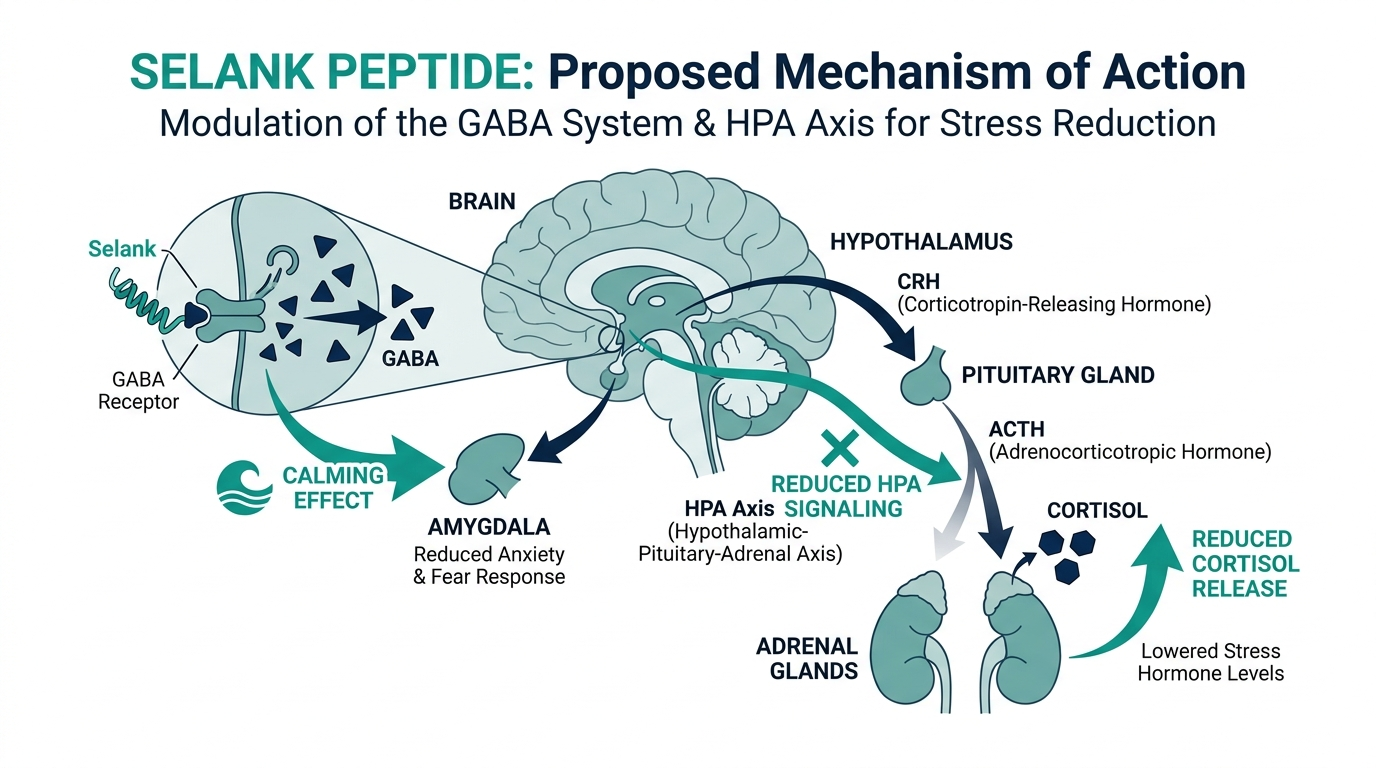
Pathway 1: GABA-A receptor modulation. The most precisely mapped molecular action of Selank is interaction with the benzodiazepine site of the GABA-A receptor complex, functioning as a positive allosteric modulator. Electrophysiological studies show preferential activity at the alpha-1-beta-2-gamma-2 and alpha-2-beta-3-gamma-2 receptor configurations. This is the same receptor class targeted by benzodiazepines like diazepam, which explains the comparable anxiolytic potency. The difference is that Selank appears to avoid the sedation and receptor downregulation that comes from full agonism, acting as a modulator rather than a direct agonist.
Pathway 2: Serotonin system modulation. Selank does not simply “boost serotonin.” It exhibits biphasic effects: at nanomolar concentrations it enhances 5-HT1A receptor binding, while at micromolar concentrations it produces competitive inhibition. Separately, synaptosomal preparations treated with Selank show reduced serotonin reuptake velocity, a mechanism that parallels SSRIs but appears more nuanced and concentration-dependent.
Pathway 3: Enkephalin preservation. One of Selank’s earliest-identified mechanisms is inhibition of enkephalin-degrading enzymes. Enkephalins are endogenous opioid peptides that regulate pain, stress response, and mood. Studies show that at 100 micrograms per kilogram in mice, Selank produced anxiolytic behavior in the open-field test and increased the half-life of plasma leu-enkephalin. By blocking the enzymes that normally cleave enkephalins, Selank prolongs their availability without adding exogenous opioids, a meaningful distinction.
Pathway 4: BDNF upregulation. Brain-derived neurotrophic factor promotes neuronal survival, synaptic plasticity, and learning. Selank elevates BDNF levels in the hippocampus, an effect that overlaps with both its cognitive-enhancement and antidepressant properties. This also distinguishes Selank from classic benzodiazepines, which have no BDNF effect and may actually suppress neuroplasticity with long-term use.
One study analyzed changes in the expression of 84 genes involved in GABAergic neurotransmission and found 45 genes showed significant expression changes one hour after Selank administration, with 22 genes still altered at three hours. That is a wide transcriptional footprint for a molecule with seven amino acids.
What does the actual clinical evidence show?
Selank’s evidence base is real but geographically concentrated, and the intellectual honesty here is important.
A randomized controlled trial published in European Psychiatry enrolled 20 patients aged 24 to 52 with GAD by DSM-IV criteria. They received intranasal Selank at 2,700 micrograms per day. The results split into two response phenotypes: 40% were rapid responders, with Hamilton Anxiety Rating Scale (HARS) mean total score dropping from 20.3 to 7.0 at day three; and 60% were conventional responders, reaching a HARS score of 6.2 from a baseline of 16.1 by day 14. Both changes were statistically significant at p less than 0.01.
A second study compared Selank to medazepam (a benzodiazepine) in 62 patients with GAD and neurasthenia, 30 on Selank and 32 on medazepam. The anxiolytic effects of both drugs were rated as similar on psychometric scales, but Selank additionally showed antiasthenic and mild psychostimulant effects that medazepam did not. In plain terms: equal anxiety reduction, but Selank also cleared the fatigue and mental fog that often accompany anxiety, while medazepam did not.
Healthy volunteer studies showed improved memory consolidation, attention, and information processing after 14-day Selank courses, which is where the nootropic interest comes from.
The major gap is the obvious one: these are small Russian trials from the 2000s and 2010s. There are no large-scale, multicenter, independently funded, English-language randomized controlled trials. The preclinical animal data is extensive and coherent. The human clinical data is real but limited in scale. Anyone claiming Selank is “proven” for anxiety is overclaiming, and anyone dismissing it as “just a research chemical with no evidence” is ignoring the institutional clinical history.
How is Selank delivered, and why does the route matter?
Selank is available in two forms: an intranasal spray and a subcutaneous or intramuscular injectable. The route difference is not trivial.
The intranasal route is what was used in the Russian clinical trials and is the standard of care in Russian prescriptions. Intranasal delivery achieves rapid absorption through the nasal mucosa and, critically, provides direct CNS access via the olfactory pathway, bypassing first-pass hepatic metabolism. This means more of the molecule reaches the target tissue with lower systemic doses. Effects from intranasal Selank are typically reported within 15 to 30 minutes, compared to 1 to 2 hours for subcutaneous injection.
The injectable route produces slower onset but potentially longer duration and is the format used in some research contexts.
Both formats require pharmaceutical-grade sterile preparation. This is not a peptide you can buy as a powder and dissolve in tap water. Contamination, pH, and sterility all matter for a compound you introduce to mucosal tissue or inject. This is precisely why the movement toward licensed compounding pharmacies matters: they operate under 503A sterility and potency standards that research-chemical vendors do not.
For context on dosing ranges from Russian clinical use: the trials used 2,700 micrograms per day intranasally, typically split across two to three administrations. This educational reference should not substitute for a clinician’s prescription, which would account for individual factors not captured in population averages.
Selank vs. Semax: the two Russian nootropic peptides compared
Selank and Semax come from the same laboratory at the Institute of Molecular Genetics and share structural features, including the Pro-Gly-Pro stabilizing tail, but they have clearly differentiated pharmacological profiles that make them complementary rather than interchangeable.
| Feature | Selank | Semax |
|---|---|---|
| Parent molecule | Tuftsin (immune peptide) | ACTH(4-7) fragment |
| Sequence | TKPRPGP | MEHFPGP |
| Russian approval | 2009, GAD and neurasthenia | 1994, stroke and optic nerve atrophy |
| Primary mechanism | GABA-A modulation + enkephalin preservation | BDNF upregulation + dopaminergic sensitization |
| Primary effect | Anxiolytic, calming, anti-fatigue | Cognitive stimulation, neuroprotection, focus |
| BDNF effect | Moderate upregulation (hippocampus) | Strong upregulation (hippocampus, multiple regions) |
| Sedation risk | Minimal | None reported |
| Dependence risk | Not documented | Not documented |
| Common stack | Often combined with Semax | Often combined with Selank |
| FDA Category 2 removal | April 2026 | April 2026 |
The practical frame: if anxiety and stress are the primary concern, Selank is the choice. If cognitive drive, focus, and neuroplasticity are the goal, Semax leads. Because their mechanisms do not overlap, many researchers use both, and the combination is widely cited as the most balanced nootropic peptide stack from the Russian pharmacological tradition.
Personally, the Selank-first framing makes sense for most beginners because high cognitive drive layered on top of unaddressed anxiety tends to feel worse, not better. Resolve the floor before you build the ceiling.
What is the legal and regulatory status of Selank in 2026?
The regulatory picture has moved fast in 2026, and understanding the sequence of events matters.
Before 2023, Selank occupied a legal grey zone in the US: not FDA-approved, not explicitly controlled, sold freely as “for research use only.” In November 2023, the FDA placed multiple peptides on the 503A Category 2 list, a designation meaning “substances that may present significant safety risks” and effectively banning them from licensed compounding pharmacies. Selank was among them.
Then the political winds shifted. On February 27, 2026, HHS Secretary RFK Jr. announced that roughly 14 of the 19 Category 2 peptides would return to Category 1 status, explicitly naming Selank among those expected to be permitted. The FDA followed with a formal document removing Selank from Category 2, effective April 23, 2026. A Pharmacy Compounding Advisory Committee meeting scheduled for July 23 to 24, 2026 is the next formal step before licensed pharmacies can compound and dispense Selank under physician prescription.
What this means in practical terms: Selank is not yet a legally prescribable compound at US compounding pharmacies as of June 2026. It may become one after the July PCAC hearing if the committee approves it. In the interim, it remains a research-use-only compound in the US, not approved for human use.
Do not believe any telehealth platform claiming to prescribe or compound Selank “legally” right now, in June 2026, citing the RFK announcement as settled law. The announcement signals intent; the July meeting is the mechanism; and a favorable PCAC decision plus formal FDA rulemaking is the actual legal change. The gap between an HHS press release and a licensed pharmacy being allowed to fill a prescription is not trivial.
What are the side effects and safety profile?
Selank’s safety profile, assessed from Russian clinical trials and pharmacovigilance data accumulated since 2009, is notably clean compared to the benzodiazepine class it partially resembles.
Reported side effects from clinical use and research are:
- Mild transient nasal irritation with intranasal administration (the most common complaint, usually resolving within the first few doses)
- Occasional mild headache in the first days of use
- Rare and transient drowsiness, primarily in individuals with high pre-existing anxiety
What Selank does not appear to produce, based on the clinical record, is dependency, withdrawal symptoms, tolerance requiring dose escalation, cognitive impairment, or cardiovascular changes. Unlike benzodiazepines, which downregulate GABA-A receptors with chronic use and create a physiological dependence cycle, Selank’s positive allosteric modulation mechanism appears to avoid that downregulation pattern. The word “appear” matters here: the longest human trials are weeks to a few months in duration, not years, so long-term effects are genuinely unknown.
The populations excluded from all published trials are pregnant women, breastfeeding women, and children. No safety data exists for these groups, and the standard clinical advice is to avoid Selank entirely if you fall in any of these categories.
One aspect of Selank’s safety profile that genuine insiders pay attention to: because it modulates the serotonin system, combining it with SSRIs, SNRIs, or MAOIs raises a theoretical serotonergic interaction risk that has not been formally studied. If you are currently on an antidepressant, this is not the compound to add without a real conversation with a prescriber, not a forum thread.
What are the realistic expectations? A week-by-week frame
Selank is not a fast-acting anxiolytic like a benzodiazepine taken acutely before a stressful event. The clinical trial data gives a rough timeline:
Days 1 to 3: Roughly 40% of trial participants experienced rapid, abrupt anxiety reduction in this window, with HARS scores dropping from approximately 20 to 7. For the other 60%, minimal change.
Days 3 to 14: The majority of conventional responders reached significant reduction (HARS scores around 6 from baseline 16) by day 14. This is the primary therapeutic window based on the Russian clinical data.
Beyond day 14: Russian prescribing practice typically involves cycles of 14 to 28 days rather than indefinite daily use. No formal data exists on what happens past 30 days.
Day 0 (the part nobody talks about): The baseline you start from matters more than any weekly timeline. Selank has shown its largest effects in individuals with clinically elevated anxiety. In people with subclinical or mild baseline anxiety, the effect size is smaller and harder to distinguish from placebo. Knowing your starting point is not optional.
Don’t just read about your health, track it.
A single result is a snapshot. Superpower re-tests 100+ markers over time so you can watch them move as you change sleep, food, and training.
Frequently asked questions
What is Selank peptide used for?
Selank is approved in Russia as a prescription drug for generalized anxiety disorder (GAD) and neurasthenia. Off-label, it is researched for cognitive enhancement, PTSD, stress reduction, and nootropic stacking, primarily in combination with Semax. In the US it is currently a research-use-only compound, with a potential legal prescription route through licensed compounding pharmacies pending a FDA committee review in July 2026.
Is Selank FDA-approved?
No. Selank is not FDA-approved in the United States. It was removed from the FDA’s Category 2 restricted-compounding list in April 2026, and a Pharmacy Compounding Advisory Committee meeting scheduled for July 23 to 24, 2026 may open a legal prescription path through US compounding pharmacies. That decision has not yet been made as of June 2026.
How does Selank compare to benzodiazepines?
A Russian study of 62 patients found Selank’s anxiolytic effects comparable to medazepam (a benzodiazepine) on psychometric scales, with the additional finding that Selank also produced antiasthenic and mild psychostimulant effects that the benzodiazepine did not. Selank does not appear to produce the sedation, cognitive impairment, or physical dependence associated with benzodiazepine use, though it has not been tested in head-to-head trials with modern SSRIs or SNRIs.
What is the difference between Selank and Semax?
Both are Russian-developed heptapeptides from the same laboratory with the same Pro-Gly-Pro stabilizing tail, but they have opposite primary profiles. Selank is derived from tuftsin and is primarily anxiolytic and calming. Semax is derived from ACTH and is primarily cognitively stimulating and neuroprotective. They are frequently stacked together precisely because their mechanisms do not overlap.
How is Selank administered?
In Russian clinical practice, Selank is administered as an intranasal spray, which provides rapid absorption through the nasal mucosa and direct CNS access via the olfactory pathway. Injectable forms exist for research contexts. Intranasal was the route used in the clinical trials that established its GAD efficacy.
Can you get Selank through a doctor in the US?
Not yet, as of June 2026. The FDA removed Selank from its restricted-compounding list in April 2026, and a PCAC hearing in late July 2026 may formally permit licensed compounding pharmacies to dispense it by prescription. If that ruling is favorable, telehealth platforms with licensed prescribers and verified compounding pharmacies will likely offer it. Until then, no licensed US pharmacy can legally compound Selank.
Does Selank cause dependence or withdrawal?
Based on clinical data from Russian use since 2009, Selank has not been associated with physiological dependence or withdrawal symptoms. This distinguishes it from benzodiazepines, which cause receptor downregulation and physical dependence. The mechanism difference, positive allosteric modulation rather than full agonism at GABA-A, may explain this. Long-term safety data beyond a few months of use does not exist.
Telehealth GLP-1 program with provider visits and pharmacy coordination.
The bottom line: what is Selank actually worth paying attention to?
Selank occupies a genuinely unusual position in the anxiety treatment landscape. It is not a supplement, not a drug in the US, and not a research chemical with zero clinical backing. It sits in the middle: a real pharmaceutical approved in one country’s healthcare system, with a coherent multi-pathway mechanism, a 15-year safety record at the population level, and a regulatory status in the US that is actively shifting toward legality.
The honest framing is this: Selank has a stronger evidence base than almost anything sold in the Western nootropic market, and a weaker evidence base than any FDA-approved anxiety drug. It is meaningfully better validated than most peptides people are currently injecting from grey-market vials. It is not a substitute for a real clinician evaluation, for therapy, or for FDA-approved medications where those are clinically appropriate.
For people who have tried standard anxiety medications and found the side effect profile unacceptable, or who want a compound that addresses both the anxiety and the mental-fatigue dimension without sedation, Selank has a plausible case. That case gets meaningfully stronger once a licensed prescription pathway exists in the US.
The July 2026 PCAC decision is worth tracking. If it goes the way the FDA’s April removal of Selank from Category 2 suggests it will, the conversation about Selank shifts from “research chemical you buy from unaccountable vendors” to “prescription compound you access through a clinician,” and that shift changes almost everything about how to think about it.
Telehealth GLP-1 program with provider visits and pharmacy coordination.
Author: Vital Signs Today Editorial Team, [credential]”]. Educational content, not medical advice. Sources linked inline.
Primary sources:
– Selank GAD clinical trial, European Psychiatry, Cambridge Core
– Selank enkephalin enzyme inhibition, PubMed
– Selank GABAergic gene expression, PMC
– Selank efficacy and mechanisms, ResearchGate
– FDA peptide reclassification 2026, Amanecia Health
– RFK Jr. peptide announcement, Medical Specialists MN
– Pharmacist’s analysis of peptide reclassification, Pharmacy Times
– Selank benefits and safety, Innerbody 2026
– Selank vs Semax comparison, LIVV Natural
– Selank serotonin effects, RethinkPeptides
Related reading
Vital Signs Today may earn a commission if you buy through links on this page. It does not affect our editorial assessments.