
Educational content, not medical advice. Selank is not FDA-approved in the United States. Talk to a licensed clinician before using any peptide.
Short answer: Selank is a synthetic heptapeptide (seven amino acids: Thr-Lys-Pro-Arg-Pro-Gly-Pro) developed in the 1990s at Russia’s Institute of Molecular Genetics. It was engineered from tuftsin, a natural immune peptide, and has been registered in Russia as a prescription anxiolytic since 2009. In clinical trials comparing it to phenazepam, a potent benzodiazepine, Selank produced comparable anxiety reduction on the Hamilton Anxiety Rating Scale while showing no withdrawal, no tolerance escalation, and no cognitive impairment.
Selank isn’t FDA-approved in the US. See what your own thyroid and stress hormone markers actually show first. One at-home Superpower draw checks 100+ biomarkers, physician-reviewed.
What exactly is Selank, and where did it come from?
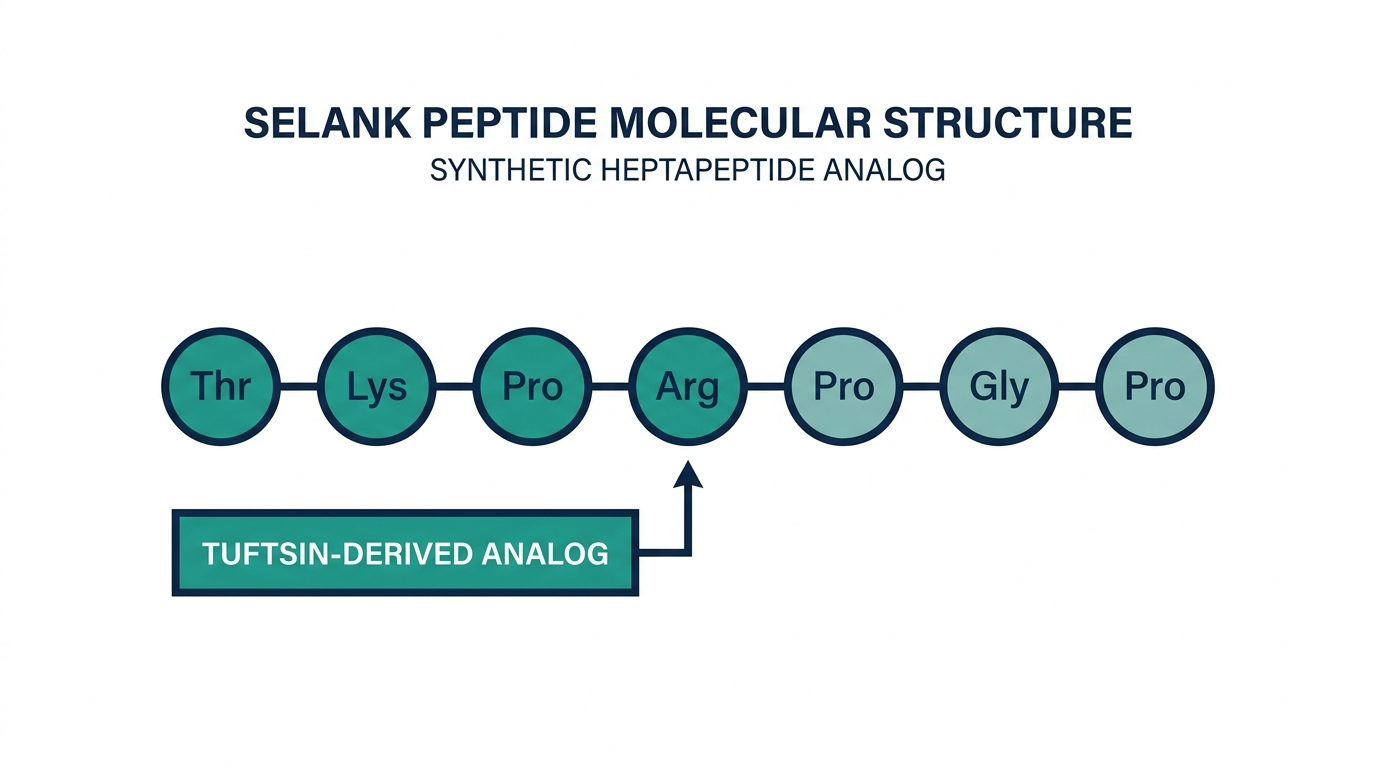
Selank began as a problem-solving exercise in Soviet pharmacology: can you take a peptide the body already makes, modify it for stability, and use it to treat anxiety without the addiction liability of benzodiazepines?
The starting material was tuftsin, a tetrapeptide (Thr-Lys-Pro-Arg) naturally produced when macrophages cleave a fragment of immunoglobulin G. Tuftsin has known immune-activating properties but breaks down in minutes inside the body. Researchers at the Institute of Molecular Genetics of the Russian Academy of Sciences solved that fragility by attaching a C-terminal tripeptide, Pro-Gly-Pro, to the tuftsin backbone. The result, a seven-amino-acid chain now called Selank (also designated TP-7), is structurally stable enough to survive in plasma long enough to cross into the central nervous system.
The “Sel” in Selank comes from the Russian word for the compound’s original series designation, not from any therapeutic meaning.
Russia approved Selank as a prescription drug in 2009 for generalized anxiety disorder (GAD) and neurasthenia. It is also approved in several other CIS states. In the United States, it carries no FDA approval; the FDA has classified it as a research compound with immunogenicity warnings citing a lack of robust human safety data by US regulatory standards.
That gap between Russian approval and US non-approval is not unusual for peptide drugs, but it does matter for how you interpret the research below.
How does Selank work on the brain?
Selank does not work through one clean pathway, which is part of what makes it interesting and part of what makes it hard to characterize quickly. At least four documented mechanisms are at work simultaneously.
GABAergic modulation. A 2016 study published in PMC showed that Selank alters the expression of genes involved in GABAergic neurotransmission in ways strongly correlated with GABA itself (r = 0.86, p 0.05 at one hour post-administration). At that one-hour mark, 45 genes showed significant mRNA changes, with 25 responding similarly to both Selank and GABA. By three hours, 95% of affected genes had shifted direction from suppression to upregulation, suggesting a biphasic modulation rather than simple sedation. The Gabre and Gabrq subunit genes showed approximately 20-fold decreases at one hour, then 16-fold and 13-fold increases respectively by three hours. That is not how a sedative works; it is more like a recalibration.
Enkephalin stabilization. Selank inhibits enkephalinase, the enzyme that degrades endogenous enkephalins (natural opioid-like peptides). By slowing enkephalin breakdown, Selank allows the brain’s own calming compounds to stay active longer, without introducing an exogenous opioid.
Serotonin modulation. Research has documented that Selank influences serotonin metabolism in the hypothalamus, contributing to mood stabilization effects that distinguish it from pure anxiolytics. This serotonergic component is one reason users and researchers report an antidepressant-adjacent quality, not present in classical benzodiazepines.
BDNF upregulation. A 2019 study in the Bulletin of Experimental Biology and Medicine showed Selank protected against ethanol-induced memory impairment by regulating BDNF content in the hippocampus and prefrontal cortex of rats. BDNF (brain-derived neurotrophic factor) is the brain’s primary growth factor for new connections; most anxiolytics either ignore it or suppress it.
Personally, the BDNF finding strikes me as the most underreported aspect of Selank. Most drugs that calm the brain do so at the cost of sharpening it. Selank appears to do both simultaneously, at least in animal models, and that is a genuinely unusual profile.
Full-body lab membership: 100+ biomarkers, doctor-reviewed, tracked over time.
What does the clinical evidence actually show?
Selank has more human clinical data than most research peptides, because Russian regulatory approval required it. The data is not voluminous by FDA standards, and most of it comes from one country with one regulatory culture, so calibrate accordingly.
The most-cited study enrolled 62 patients with GAD and neurasthenia, randomized to either intranasal Selank (n=30) or medazepam, a standard benzodiazepine (n=32). The result: anxiolytic effects were comparable, but the Selank group also showed what the researchers called “antiasthenic and psychostimulant effects,” meaning reduced fatigue and mild cognitive activation. Medazepam produced sedation. Selank did not.
A second study, in 70 patients, used oral phenazepam alone versus phenazepam combined with intranasal Selank. The combination group showed better overall efficacy and significantly mitigated the classic benzodiazepine side effects: memory loss, attention deficits, asthenia, and daytime drowsiness were all reduced in the combined group. The implication is that Selank was actively countering the cognitive cost of the benzodiazepine it was paired with.
A third trial, published in ScienceDirect as P-1114 on GAD treatment response patterns, documented that 40% of patients were rapid responders, with Hamilton Anxiety Rating Scale scores dropping from a mean of 20.3 to 7.0 within the first one to three days of treatment (p less than 0.01). That is a substantial drop and a fast one.
The honest caveat: no Phase 3 randomized controlled trial meeting FDA or EMA standards for anxiolytic approval has been completed for Selank. The Pharmacy Compounding Advisory Committee review scheduled for July 23 to 24, 2026 will use Russian data as supporting evidence, but the FDA’s bar is not the same as Roszdravnadzor’s.
How does Selank compare to benzodiazepines?
The comparison that drives most of the interest in Selank comes down to a single question: what do you give up when you trade a benzodiazepine for this peptide?
| Feature | Benzodiazepines | Selank |
|---|---|---|
| Anxiolytic effect | Strong, well-documented | Comparable in head-to-head trials |
| Dependence risk | High; WHO Schedule IV | No signals in available studies |
| Withdrawal syndrome | Yes, can be severe | None reported in Russian clinical data |
| Tolerance development | Yes, often within weeks | Not documented |
| Cognitive impairment | Yes (memory, attention, psychomotor) | None reported; may improve cognition |
| Sedation | Yes, often dose-dependent | Not observed at standard doses |
| BDNF effect | Typically suppressed | Upregulated (animal studies) |
| FDA approval status | Approved for anxiety | Not approved |
| Legal US route | Prescription | Prescription via compounding pharmacy (pending PCAC July 2026) |
| Typical cost via telehealth | Varies widely | Approximately $150 to $300/month |
The mechanism explains the gap. Benzodiazepines bind directly to the benzodiazepine site on GABA-A receptors, producing rapid, potent sedation at the cost of receptor downregulation over time, which creates tolerance, and receptor hypersensitivity on withdrawal. Selank does not bind that same site; instead it modulates the GABAergic system allosterically and through gene expression changes. That different attachment point is probably why the dependence signature is absent.
Do not believe that Selank is simply “a natural benzodiazepine.” It is structurally and mechanistically distinct. The fact that it produces anxiety relief through overlapping neurochemistry does not mean it carries the same risks. But the human safety data is thin by US standards, and the FDA’s immunogenicity warning (the risk the body mounts an immune response against a synthetic peptide) is not just bureaucratic caution.
What is Selank used for beyond anxiety?
Anxiety and GAD are the core indication, but the research has followed its mechanism into several adjacent areas.
Cognitive and memory support. A 2003 study found Selank significantly accelerated the learning process in rats with poor initial learning ability after a single dose. A separate study documented positive memory effects in alcohol-intoxicated rodents, suggesting protective properties rather than purely anxiety-focused ones. The BDNF upregulation finding points toward neuroplasticity enhancement as a distinct mechanism, not just a side effect of reduced anxiety.
Immune modulation. Because Selank retains structural properties from tuftsin, its parent immune peptide, it has documented effects on the immune system. Studies have shown Selank enhances phagocytic activity of monocytes and neutrophils, modulates interleukin-6 (IL-6) expression, and influences the Th1/Th2 cytokine balance. This immune component distinguishes Selank from every other anxiolytic in clinical use; there is no benzodiazepine that modulates cytokine expression.
PTSD and trauma-related anxiety. Some clinicians and researchers have used Selank in trauma contexts, citing its ability to reduce anxiety acutely without blunting emotional processing. A sedating anxiolytic can make PTSD treatment harder by reducing engagement with traumatic material; if Selank reduces arousal without sedation, the theoretical fit for exposure therapy contexts is better.
Selank as part of a nootropic stack with Semax. The two peptides appear frequently together in both the research literature and clinical practice. Semax, another Russian peptide, works primarily through BDNF and NGF upregulation via the CREB pathway and dopaminergic sensitization. Some users report that Semax produces mild cognitive overstimulation or irritability; Selank’s GABAergic calming effect smooths that out. The two peptides have been studied in combination, and the complementary mechanisms make the pairing logically coherent even if robust combination trial data is absent.
How is Selank administered, and does the route matter?
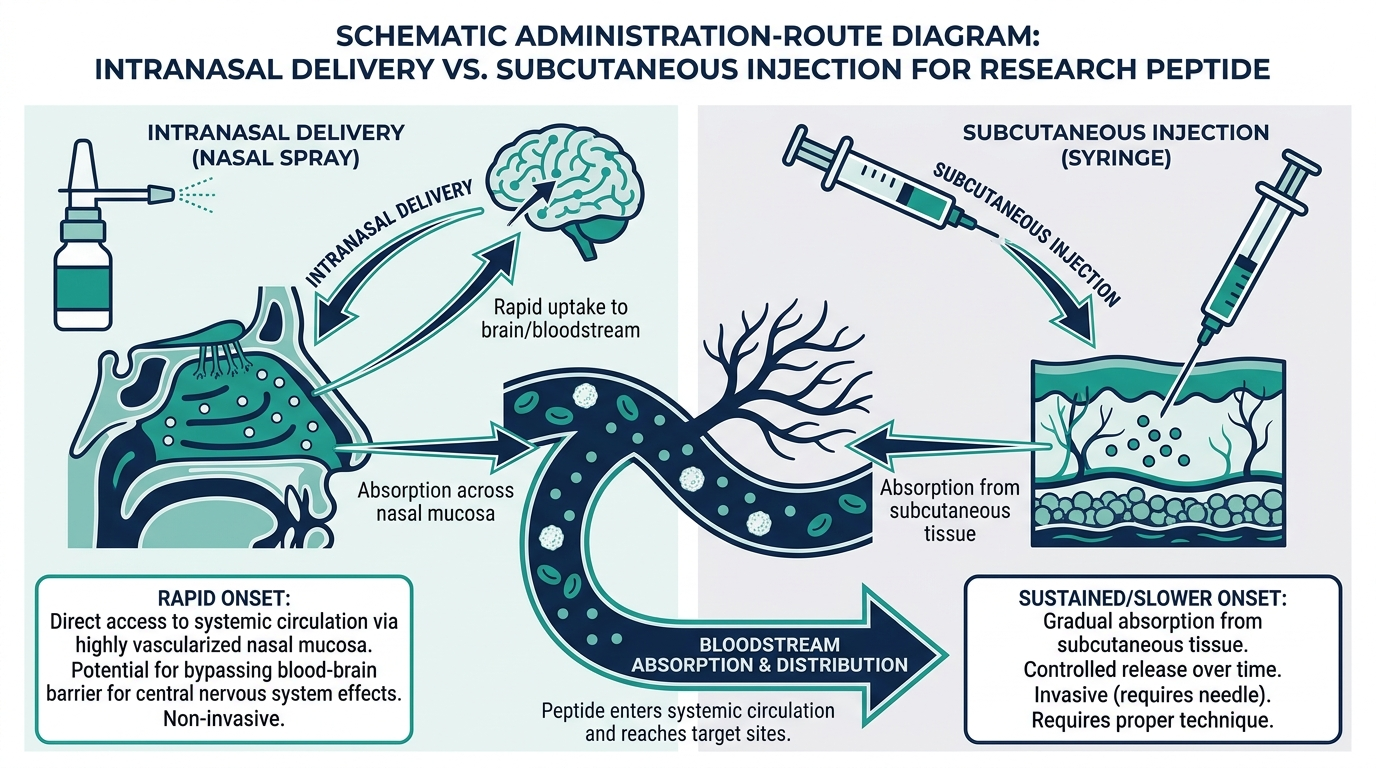
Selank has two main delivery routes: intranasal spray and subcutaneous injection, and they do not produce identical effects in animal models.
Intranasal administration takes advantage of the olfactory pathway, which provides direct access to the central nervous system without full systemic circulation. Onset of effects has been reported within 30 to 90 minutes in intranasal human use, notably faster than SSRIs. Research-reported intranasal dose ranges run from 300 mcg once or twice daily up to 2,700 mcg daily in split doses, depending on the study context. A typical research-use intranasal cycle runs 14 to 21 days on, with one to three weeks off.
Subcutaneous injection delivers a standard dose typically cited at 250 to 500 mcg per day, five days per week, with a common four-weeks-on/four-weeks-off cycle. Interestingly, animal studies suggest the two routes affect GABA and NMDA receptors differently: injectable Selank shows more prominent effects on GABA receptor binding, while intranasal Selank appears to primarily influence NMDA binding sites. Whether that mechanistic difference matters clinically in humans is not established.
The intranasal route is clearly simpler to use and avoids the preparation requirements of an injectable. But “simpler” does not mean “better characterized.” Most of the clinical trial data used to support Russian approval involved intranasal administration.
Important: this is educational context about how Selank has been administered in research and clinical settings. Setting any personal dosing protocol is a clinician’s job, not something to derive from a web article.
Telehealth GLP-1 program with provider visits and pharmacy coordination.
What is the legal status of Selank in the United States in 2026?
This is where things have been moving fast, and the answer has changed at least twice in two years.
In November 2023, the FDA placed Selank on the 503A Category 2 list, effectively banning it from compounding pharmacies. Category 2 means “may present significant safety risks,” and the FDA cited immunogenicity concerns and limited US-standard human safety data. That ban removed Selank from most US telehealth menus overnight.
Then in February 2026, HHS Secretary Robert F. Kennedy Jr. announced that approximately 14 peptides previously on the Category 2 list, including Selank, would be reclassified to Category 1 status, which permits licensed compounding pharmacies to prepare them under a physician’s prescription. In practice, this means a telehealth clinic can again prescribe Selank from a registered 503A compounding pharmacy, provided the formal reclassification is confirmed.
The FDA’s Pharmacy Compounding Advisory Committee meeting on July 23 to 24, 2026 is the official gate for that confirmation. Until a Federal Register notice formalizes the reclassification, pharmacies compounding Selank are operating in a zone of regulatory uncertainty. Most compliant providers are waiting for the formal notice before stocking it.
What this means practically: Selank is not FDA-approved, and it will not be after July regardless of what the PCAC decides. Category 1 approval allows compounding, not drug approval. The safest legal access path is a licensed telehealth clinic that sources from a named, verifiable 503A compounding pharmacy and requires a clinical intake. That is also the only route where a clinician is accountable for your protocol and lab monitoring.
Research-chemical vendors selling Selank “for laboratory use only” are operating in the same grey zone as other research peptides: legal to sell, not legal for self-administration, and not subject to any pharmaceutical quality controls that protect you.
What are the known side effects and safety concerns?
Russian clinical data and the clinical reports from US telehealth providers that have prescribed Selank describe a generally benign profile. The most commonly reported effects include headache, nasal irritation after intranasal use, nausea, dizziness, and injection site reactions. The 62-patient and 70-patient trials cited above reported no serious adverse events.
The FDA’s standing concern is immunogenicity: because Selank is a synthetic peptide that the immune system may not recognize as self, there is a theoretical risk of the body mounting an antibody response. That risk is not specific to Selank; it applies to any exogenous peptide. The FDA notes a lack of controlled human trials by US standards to quantify that risk reliably.
Documented contraindications from clinical practice include pregnancy, breastfeeding, and active cancer diagnosis. The immune-modulating properties of Selank (IL-6 changes, Th1/Th2 shifts) create theoretical concerns in immunocompromised patients or those on immunosuppressants that warrant clinical discussion before use.
The 2019 Springer study on BDNF and memory noted no adverse events in its experimental models at standard doses, and chronic toxicity data from Russian preclinical work reported no organ-level findings. But none of this is a substitute for individual clinical evaluation.
Turn what you just learned into action.
Superpower lets you test 100+ biomarkers from home, then re-check them over time so you can actually see progress, physician-reviewed at every step.
Frequently Asked Questions
What does Selank peptide do?
Selank is an anxiolytic and nootropic peptide derived from tuftsin. In clinical trials, it reduced anxiety scores comparably to benzodiazepines while also showing mild cognitive-activating effects. It works through at least four pathways: GABAergic modulation, enkephalin stabilization, serotonin regulation, and BDNF upregulation. Unlike benzodiazepines, it has not shown dependence, withdrawal, or cognitive impairment in available studies.
Is Selank legal in the United States?
Selank is not FDA-approved. From November 2023 through early 2026, it was on the FDA’s 503A Category 2 list, which banned it from compounding pharmacies. In February 2026, HHS announced a reclassification to Category 1 for Selank and approximately 13 other peptides, pending formal confirmation at the FDA’s Pharmacy Compounding Advisory Committee meeting on July 23 to 24, 2026. The legal US route, once confirmed, is a prescription from a licensed clinician dispensed by a registered 503A compounding pharmacy.
How does Selank compare to SSRIs for anxiety?
SSRIs typically take four to six weeks to reach therapeutic effect and require daily dosing. Intranasal Selank has shown onset within 30 to 90 minutes in some reports, and it does not require weeks of titration. SSRIs carry their own discontinuation syndrome. Selank does not have a documented withdrawal profile. No head-to-head trial of Selank versus an SSRI has been published; the comparisons available are to benzodiazepines, not SSRIs.
What is the difference between Selank and Semax?
Both are Russian-developed nootropic peptides, but their mechanisms differ. Selank is primarily anxiolytic: it calms via GABAergic modulation and enkephalin stabilization. Semax is primarily cognitive and neuroprotective, working through BDNF and NGF upregulation via the CREB pathway and dopaminergic sensitization. In research and clinical practice they are often paired because Semax’s stimulating cognitive effects can be complemented by Selank’s anxiety-reducing profile.
Does Selank cause dependence or withdrawal?
Russian clinical data report no dependence, no tolerance escalation, and no withdrawal syndrome after Selank discontinuation. The mechanistic basis for this is that Selank does not bind directly to the benzodiazepine site on GABA-A receptors, the binding site responsible for benzodiazepine dependence. It modulates the GABAergic system allosterically, which is a different attachment point with a different risk profile. That said, the long-term human safety data meeting US regulatory standards does not yet exist.
Can you take Selank as a nasal spray?
Yes, intranasal administration is one of two main routes used in research and clinical settings. The nasal route allows the peptide to travel along olfactory pathways and reach the brain without full systemic circulation. In the Russian clinical trials supporting its approval, intranasal administration was the primary route used. Dose ranges in those contexts ran from 300 mcg to 2,700 mcg daily in split doses, depending on the study protocol.
What is Selank made from?
Selank is a synthetic peptide derived from tuftsin, a tetrapeptide (Thr-Lys-Pro-Arg) that the body produces naturally when macrophages cleave a fragment of immunoglobulin G. Researchers at Russia’s Institute of Molecular Genetics extended tuftsin’s structure with a C-terminal Pro-Gly-Pro sequence to improve metabolic stability. The result is a seven-amino-acid chain that retains tuftsin’s immune-modulating properties while adding central nervous system activity not present in the parent peptide.
Telehealth GLP-1 program with provider visits and pharmacy coordination.
Author: Vital Signs Today Editorial Team, [credential]”]. Educational content, not medical advice. Sources linked inline.
Primary sources:
- Selank GABAergic gene expression study (PMC 2016)
- Selank, BDNF, and memory protection in rats (Springer 2019)
- Efficacy of Selank in GAD and neurasthenia (ResearchGate)
- P-1114 rapid vs slow responders in GAD treatment with Selank (ScienceDirect)
- GABA, Selank, and Olanzapine gene expression in IMR-32 cells (Frontiers Pharmacology 2017)
- FDA bulk drug substances under 503A
- FDA Peptide Reclassification 2026 overview (Purefico MedSpa)
- Selank benefits and safety overview (Innerbody 2026)
- Selank vs Benzodiazepines comparison (NAD Treatment Center)
- Selank mechanisms (Palmetto Peptides)
Related reading
Vital Signs Today may earn a commission if you buy through links on this page. It does not affect our editorial assessments.