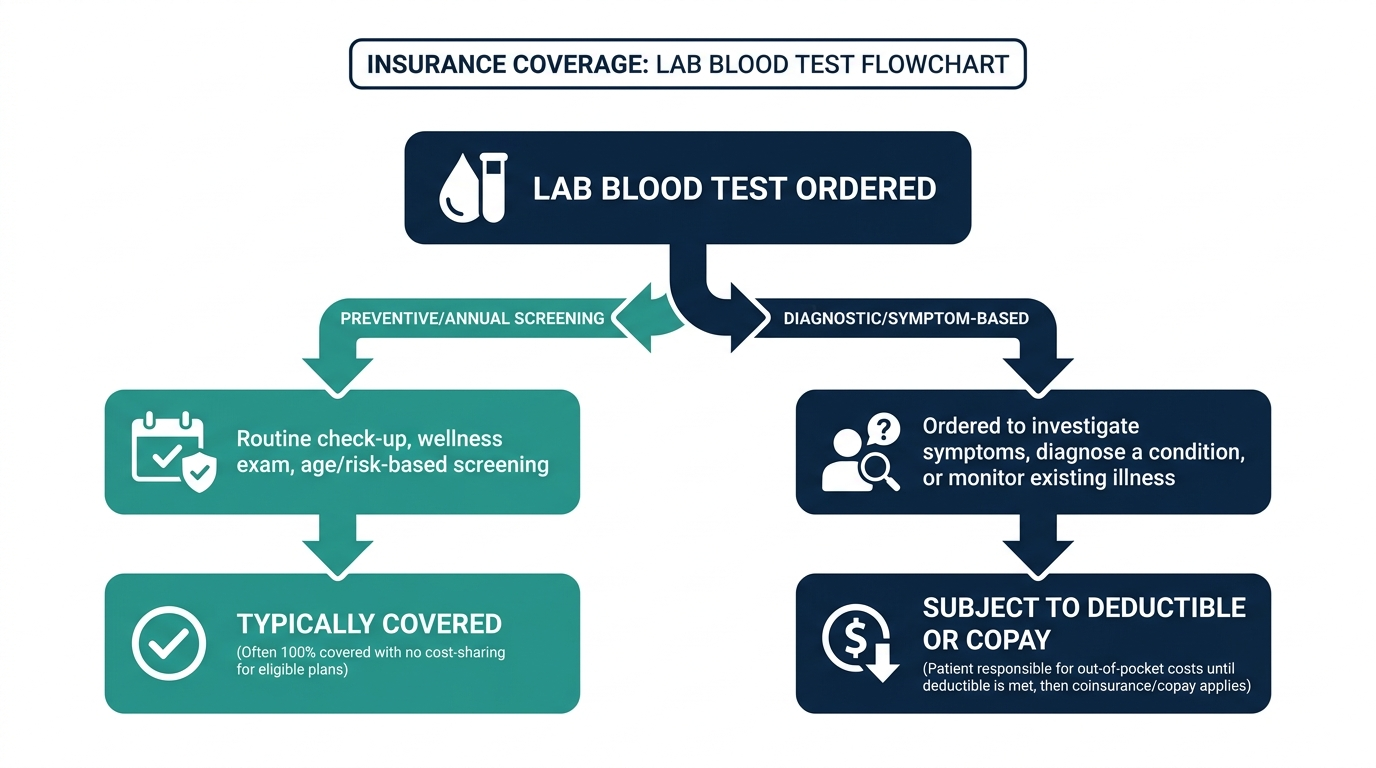
Quick answer: In most cases insurance covers blood work, but coverage depends entirely on why the test was ordered and how it gets coded. So does insurance cover blood work for free? Preventive screening tied to an annual physical is usually covered at 100% with no copay under ACA rules, while diagnostic blood work ordered because you have a symptom or an existing condition is subject to your deductible and coinsurance. The single biggest reason people get surprise lab bills is a test coded as diagnostic when they assumed it was preventive.
Does insurance cover blood work, and what decides whether you pay?
Insurance covers blood work when the test is medically necessary, but “covered” and “free” are two different things. The deciding factor is the diagnosis code your clinician attaches, not the test itself: the same cholesterol panel can cost you $0 or land on your deductible depending on a single code.
Insurance only covers blood work tied to a diagnosis. See what a 100+ biomarker panel finds before something becomes a diagnosis. One at-home Superpower draw checks 100+ biomarkers, physician-reviewed.
Here is the insider piece a layperson rarely hears. Lab orders carry an ICD-10 diagnosis code. If your doctor codes the visit as a routine wellness screening (a Z-code like Z00.00 for a general adult exam), the lab is billed as preventive and the ACA forces most plans to pay 100% with no cost sharing. Code it against a symptom or condition (high cholesterol, fatigue, an existing thyroid problem) and the same draw becomes diagnostic, running through your deductible first.
This is why a “free” annual physical can still generate a bill. You mention you have been tired, the doctor adds a thyroid panel coded to that complaint, and that one test is billed as diagnostic even though everything else was preventive. Nothing went wrong; the coding simply reflected the clinical reason.
Preventive vs diagnostic, in plain terms
- Preventive: ordered with no symptoms, as routine screening. Usually $0 on ACA-compliant plans. Examples: lipid panel at your annual physical, diabetes screening if at risk, certain STI screens.
- Diagnostic: ordered to investigate a symptom, monitor a known condition, or follow up an abnormal result. Subject to deductible and coinsurance. Examples: a repeat A1C for diabetes, a thyroid panel for fatigue, iron studies for anemia.
A single order can carry both codes at once: a routine lipid panel (preventive, $0) plus a thyroid panel for the fatigue you mentioned (diagnostic, deductible). So “my visit was preventive” does not guarantee “my whole bill is zero.” Each test stands on its own code, so you can predict your bill before the needle goes in.

How blood work billing actually works, step by step
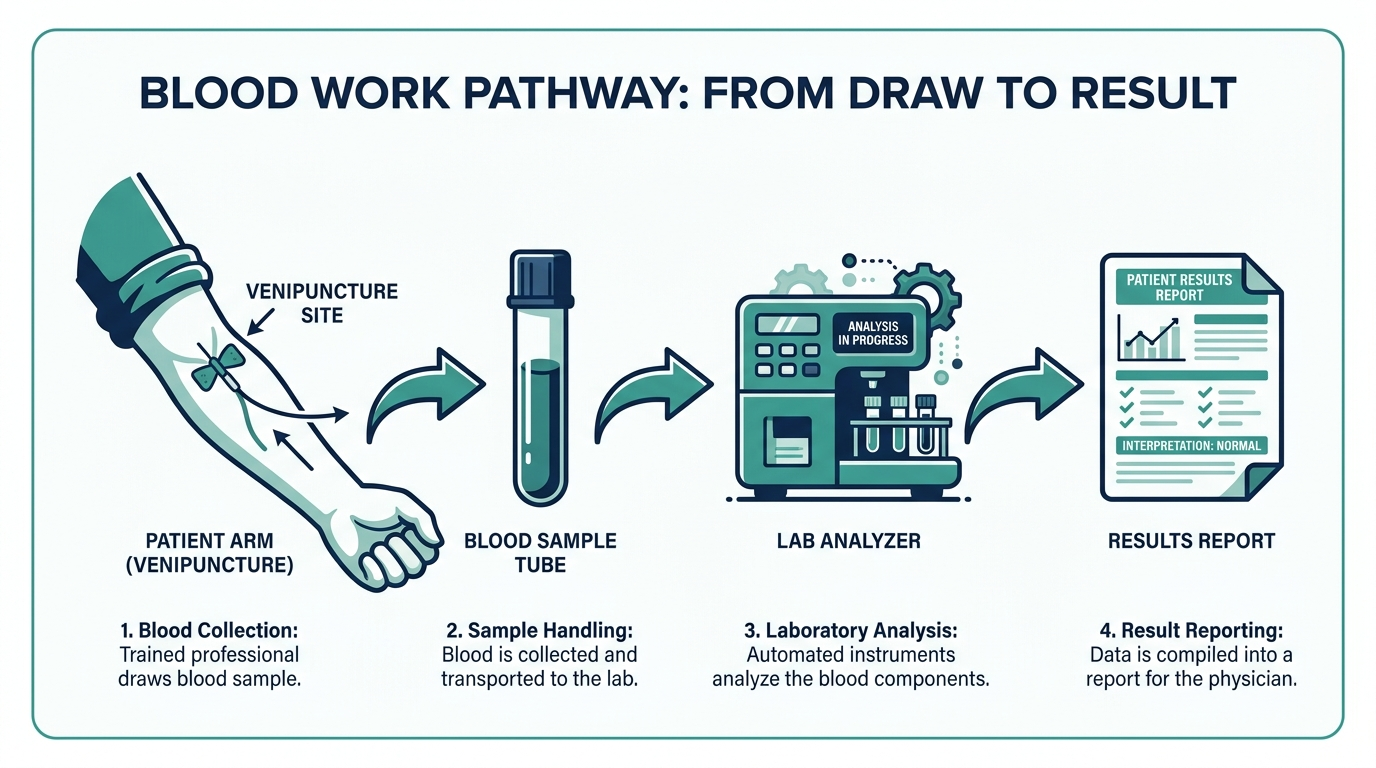
To see why two people get the same panel and two different bills, follow a single draw through the system. Each step decides part of the cost:
- The order and its diagnosis code. Your clinician attaches at least one ICD-10 code explaining why. This is the most important moment for your wallet: preventive Z-code or symptom-based code, decided here.
- The draw and the CPT codes. Each test has its own CPT procedure code (80053 for a comprehensive metabolic panel, 83036 for hemoglobin A1C). A “panel” is a bundle of these.
- The lab runs and bills. The lab sends a claim to your insurer using those CPT and ICD-10 codes.
- The insurer adjudicates. Your plan checks coverage, medical necessity, network status, and your deductible, then applies the negotiated in-network rate, not the lab’s sticker price.
- The EOB arrives, then the bill. You get an Explanation of Benefits (not a bill) showing what was charged, allowed, and paid. The lab then bills you for your share.
The gap between step 3 and step 4 is where most surprise charges live. A lab might bill $250 for a metabolic panel, but in-network the allowed amount might be $35, and you owe only a piece of that. Out-of-network, the negotiated rate vanishes and you can owe far more, swinging a bill by hundreds of dollars on identical tests.
Why a “panel” is really a bundle of billed codes
A panel is not one test with one price. It is a bundle of analytes, each with its own CPT code, so your insurer can cover some lines and deny others.
| Panel | CPT code | What it bundles | Typical cash price |
|---|---|---|---|
| Basic metabolic panel (BMP) | 80048 | 8 markers: glucose, calcium, electrolytes, kidney function | $10 to $35 |
| Comprehensive metabolic panel (CMP) | 80053 | 14 markers: BMP plus liver enzymes and proteins | $15 to $45 |
| Lipid panel | 80061 | Total, LDL, HDL cholesterol, triglycerides | $10 to $40 |
| Complete blood count (CBC) | 85025 | Red and white cells, hemoglobin, platelets | $10 to $35 |
| Hemoglobin A1C | 83036 | Three-month average blood sugar | $10 to $40 |
| TSH (thyroid) | 84443 | Thyroid-stimulating hormone | $15 to $50 |
This is why “add a couple of tests while we are at it” can quietly stack up. Each add-on is a separate CPT line: a CMP, CBC, lipid panel, A1C, and TSH ordered together are five billed codes, and on a diagnostic visit every one runs against your deductible.
Why a “free” blood test still gets billed
A free preventive test becomes a charge for a handful of specific reasons. Once you know them, you can spot the trap before it happens:
| Reason it got billed | What happened | Can you fix it? |
|---|---|---|
| Coded diagnostic, not preventive | A symptom you mentioned attached a non-Z diagnosis code to the test | Sometimes, if it was a genuine miscoding. Ask billing to review. |
| Test not on the ACA preventive list | The panel went beyond what counts as a covered screening | No. Those extras are cost-shared by design. |
| Out-of-network lab | Your blood was sent to a lab your plan does not contract with | Going forward, yes. Request an in-network lab next time. |
| Wrong screening frequency | You had the same screening sooner than the plan’s covered interval | No, unless there was a documented reason for the early repeat. |
| Add-on tests during a physical | Extra tests ordered “while we are at it” fall outside the preventive bundle | Partly. The core physical stays free; the extras are billed. |
The first is the most common by far. You go in for a wellness visit, casually mention you have been sleeping badly, and the doctor orders a test to check. That test now carries a symptom code, the definition of diagnostic. Your physical is still free; the add-on is not. This is not a billing error, because the code is medically accurate.
Are blood tests covered by health insurance at 100%?
Some are, many are not, and the line is preventive versus diagnostic. The Affordable Care Act requires most plans to fully cover a specific list of preventive services with no copay, coinsurance, or deductible, even before you have met your annual deductible. That list includes screening for high cholesterol, type 2 diabetes (at-risk adults), hepatitis, HIV, and certain prenatal labs.
Outside that list, most blood tests run through normal cost sharing: you pay until you hit your deductible, then a percentage (coinsurance) until you reach your out-of-pocket max. A basic metabolic panel might show as $0 if preventive, or a $40 to $120 charge against your deductible if diagnostic. Two rules protect you: use an in-network lab (Quest and Labcorp for most major plans, but confirm yours, because out-of-network means the full chargemaster rate), and if cost matters, ask before the draw, “Is this being coded as preventive or diagnostic?” For a fuller picture of cash versus insured pricing, see our breakdown of How Much Does Blood Work Cost? Real 2026 Prices With and Without Insurance.
Which blood tests are actually on the free preventive list?
The free-at-100% category is narrower than most people assume: it covers screening labs recommended for the general or at-risk population, not anything you are curious about. As of 2026, when you meet the age or risk criteria, it commonly includes lipid (cholesterol) screening for at-risk adults, type 2 diabetes screening, hepatitis B and C, HIV, syphilis and other STI screening, and certain prenatal labs (blood typing, anemia and infection screening in pregnancy).
Notice what is not on that list. A full “check everything” wellness panel, vitamin D, testosterone, comprehensive thyroid panels, and most micronutrient testing are not blanket-covered preventive services. Asked for with no symptoms, they are usually diagnostic or not covered, which is why direct-pay testing exists.

Does health insurance cover diagnostic tests and lab tests for conditions?
Yes, but they are cost-shared, not free. When you have a symptom or known condition, the lab work to investigate or manage it is generally covered. What you pay depends on where you are in your deductible and your coinsurance rate. A few realistic 2026 scenarios:
| Situation | How it is coded | What you typically pay |
|---|---|---|
| Lipid panel at annual physical, no symptoms | Preventive (Z-code) | $0 |
| Thyroid panel ordered for fatigue | Diagnostic | Deductible applies, often $30 to $90 |
| A1C to monitor diagnosed diabetes | Diagnostic | Deductible or coinsurance |
| Comprehensive metabolic panel, out-of-network lab | Diagnostic, out-of-network | Possibly $100+ at full rate |
On a high-deductible plan, diagnostic labs feel like paying cash until the deductible is met, though those payments count toward your deductible and out-of-pocket max. To see what a thorough workup contains, our guide to a complete blood panel walks through each test, and our piece on the biomarkers worth tracking covers what is useful over time.
A worked example: the same panel, three different bills
Take one comprehensive metabolic panel (CPT 80053), list price around $150 to $250 at a hospital. Same panel, three bills:
- Person A gets it at their annual physical, no symptoms, in-network. Coded preventive. They pay $0.
- Person B gets the same panel to check fatigue, in-network, with an unmet $2,000 deductible. The $35 allowed rate goes against the deductible: about $35.
- Person C gets the identical panel sent to an out-of-network hospital lab. No negotiated rate applies, so they are billed the chargemaster price: $180 or more.
Same test, same blood. The $0 to $180+ spread came entirely from coding and network status, two things you control at the visit. Timing matters too: once you have met your deductible, a $60 diagnostic panel costs only the coinsurance (about $12 at 20%) instead of the full $60, which is why people who know a big workup is coming cluster tests into one plan year after the deductible is met.
The simplest way to actually get this done
Superpower is a full-body lab membership that runs 100+ biomarkers, has each result reviewed by a doctor, and tracks your numbers year over year (about $199/year). It is what we point readers to when they would rather get one clean, complete draw than chase single tests one at a time. Here is superpower reviewed in full.
Why in-network labs matter more than almost anything else
If you change one habit after reading this, make it this: confirm the lab is in-network before your blood is sent off. Network status often matters more to your final bill than preventive versus diagnostic, because it controls whether the negotiated rate applies at all. The trap: your doctor is in-network and your visit is covered, but the office may ship your blood to whatever lab they contract with, which is not always one your plan does. When that lab bills your insurer, the plan may pay little or nothing, and the lab can balance-bill you the difference at full price.
How to lock in an in-network lab
- Name the lab. Tell the office to send your blood to Quest or Labcorp, whichever your plan lists as in-network, and confirm before the draw.
- Check your plan’s lab directory. Log in to your insurer’s site or call the number on your card; for most major plans it is Quest or Labcorp, not both.
- Watch out for hospital draws. Blood drawn inside a hospital or hospital-owned clinic often routes to the hospital’s own lab at hospital pricing. A standalone service center is usually far cheaper.
- Ask about reference labs. Some send-out tests go to a third “reference” lab that may be out-of-network even when your main lab is not.
One legal note: the federal No Surprises Act (since 2022) shields you from surprise out-of-network bills in emergencies and from out-of-network providers at an in-network facility, but routine outpatient blood work you schedule yourself, sent to an out-of-network standalone lab, often falls outside its protections. Confirm the lab up front.
Does health insurance cover allergy, drug, fertility, hearing, and dyslexia testing?
Allergy testing is usually covered when a doctor documents a clinical reason (recurring reactions, suspected food allergies, unexplained hives). Both skin-prick and blood allergy testing (often an IgE test) are typically covered as diagnostic. Where people get caught is volume: an IgE panel can test dozens of allergens at once, each billed separately, so it stacks up fast, and skin testing is often cheaper out of pocket. Coverage for the rest varies more, because medical necessity is harder to establish:
- Drug testing: covered when medically necessary (monitoring a prescribed controlled medication, evaluating a suspected overdose). Pre-employment and court-ordered screens are not a medical benefit; you or the requesting party pay.
- Fertility testing: depends heavily on your state and plan. Many cover the initial diagnostic blood work (hormone levels, AMH) even when they exclude treatment like IVF.
- Hearing tests: a diagnostic test for a medical reason (sudden hearing loss, ear infection follow-up) is generally covered. Routine screening for hearing aids may not be, and the aids themselves are often excluded for adults.
- Dyslexia testing: the messiest. Insurers frequently deny it as “educational.” Coverage is more likely when a physician orders a neuropsychological evaluation tied to a medical concern.
The pattern: document a medical reason and coverage improves; if the purpose is administrative, educational, or legal, expect to pay.

Medicare and Medicaid: how coverage differs
Government plans follow the same preventive-versus-diagnostic logic with their own rules, and tend to be more generous on covered lab tests than commercial high-deductible plans.
Medicare. Part B covers medically necessary diagnostic lab tests, and for clinical lab services it generally pays 100% of the approved amount, meaning $0 out of pocket for the lab itself when ordered by a participating provider. That differs from most commercial plans, where diagnostic labs hit a deductible. Medicare also covers a set of preventive screenings at no cost (cardiovascular, diabetes for at-risk beneficiaries, hepatitis), but with frequency limits: a test run too soon can be denied. Medicare Advantage (Part C) must cover at least what Original Medicare does but may use its own in-network labs.
Medicaid. Medicaid covers medically necessary lab work, usually with little or no cost, but specifics vary by state. For children, the EPSDT benefit requires Medicaid to cover a broad range of screening and diagnostic services, including blood work, at no cost. The practical move is to use a provider and lab that participate in your state’s program, because going outside it can mean no coverage at all.
How to read your EOB so a bill never surprises you
The Explanation of Benefits is the most misread document in health care. It is not a bill; it is your insurer’s receipt showing how a claim was processed, and it arrives before the actual bill, so reading it tells you what you will owe and whether something went wrong.
| EOB line | What it means | Why you care |
|---|---|---|
| Amount billed (charged) | The lab’s sticker price | Almost never what you actually pay. Ignore the scary number here. |
| Allowed amount | The negotiated in-network rate | This is the real price your share is calculated from. |
| Plan paid | What insurance covered | $0 here on a diagnostic test usually means you have not met your deductible. |
| Deductible / coinsurance | The portion applied to you | This is what you owe and what the upcoming bill should match. |
| You may owe / patient responsibility | Your final share | Compare this to the bill. They should agree. |
| Reason / remark codes | Why something was denied or adjusted | A denial code here is your starting point for an appeal. |
Two moves protect you. If the “allowed amount” is missing or equals the full billed amount, the lab may have been out-of-network, your cue to question it. And never pay a lab bill until you have matched it against the EOB’s “patient responsibility” line, because labs sometimes bill the full charge before the adjustment posts. If the bill is higher, ask for a rebill after the claim.
How to appeal a denied or miscoded lab claim
If a lab test was denied or coded wrong, you have a real path to fix it, and most people give up too early. The order of operations that works:
- Read the remark code on the EOB. “Not medically necessary,” “out-of-network,” and “frequency exceeded” each call for a different response, so identify yours first.
- Call the ordering office before the insurer. If it looks like a wrong diagnosis code, the cheapest fix is the doctor’s billing office resubmitting with the correct code. This is a corrected claim, not an appeal, and often resolves the bill quietly.
- Do not pay the lab yet. Paying first makes you chase a refund later. Ask them to hold the balance while it is reviewed.
- File a formal appeal if the code was correct but coverage was denied. Submit a written appeal, attach the doctor’s notes showing medical necessity, and cite the EOB. Plans must give you a defined appeals process by law.
- Escalate to an external review if the internal appeal fails. Under the ACA you can request a free independent external review, and the insurer must abide by the outcome.
Set expectations honestly. If you reported a symptom and the test was correctly coded diagnostic, there is nothing to appeal. Appeals win only when the facts were wrong: a true miscoding, a mislabeled out-of-network lab, or a necessary test denied without the notes attached.
Using an HSA or FSA to pay for blood work
HSAs and FSAs are the most underused tool for blood work costs, especially anything insurance will not cover. Both let you pay with pre-tax dollars, discounting the test by your tax rate.
| Feature | HSA | FSA |
|---|---|---|
| Who can have one | Anyone on a qualifying high-deductible health plan | Anyone whose employer offers it |
| Funds roll over | Yes, indefinitely, and the balance is yours to keep | Mostly use-it-or-lose-it each year |
| Covers diagnostic blood work | Yes | Yes |
| Covers direct-pay lab memberships | Usually yes | Usually yes |
The practical play: pay deductible-hitting diagnostic labs from the account rather than after-tax cash; direct-to-consumer panels and most memberships also qualify. With an FSA, the use-it-or-lose-it rule makes a year-end lab test a smart way to spend down a balance you would otherwise forfeit; an HSA carries forward, so there is no December deadline.
Edge cases: uninsured, minors, employer-required, and high-deductible plans
Standard coverage rules bend in a few common situations. Here is how each plays out.
- Uninsured. With no plan there is no negotiated rate, so a walk-in bill can be high. Skip traditional billing: discount cash labs and direct-to-consumer companies post flat prices (often $29 to $150 for common panels) and accept HSA or FSA funds, frequently cheaper than even an insured high-deductible bill.
- Minors. Children’s medically necessary blood work is covered like an adult’s, and Medicaid’s EPSDT covers pediatric screening at no cost. Some adolescent testing (certain STI screens) can be ordered confidentially, but an EOB can still reveal it to a parent on the plan.
- Employer-required testing. Pre-employment screens, DOT physicals, and most workplace drug tests are not a medical benefit, so your health plan will not pay. Ask the employer to cover it.
- High-deductible health plans (HDHP). Preventive screening is still free, but every diagnostic lab lands fully on you until the deductible is met. The flip side: an HDHP almost always pairs with an HSA, so you at least pay pre-tax. Price the cash option first.
- Two insurance plans (coordination of benefits). The primary pays first, then the secondary may pick up part of the rest. Give both insurers’ information at the draw, or the claim bounces between them.
Who should choose what: a quick decision guide
Match yourself to the closest case.
- You have symptoms or a known condition. Go through insurance; it is medically necessary and counts toward your deductible and out-of-pocket max.
- You are due for routine screening at a physical. Use the free preventive bundle; keep the visit clearly preventive and ask before adding any symptom-based test.
- You are curious and have no symptoms. Insurance usually will not cover “just checking,” so compare a cash discount lab against your plan; with an HDHP, cash is often cheaper and HSA-eligible.
- You want a broad, repeatable baseline. A flat-fee, full-panel membership that runs many biomarkers and tracks them year over year is usually better value than dozens of single diagnostic tests insurance would not cover anyway.
- You are on Medicare or Medicaid. Use a participating provider and lab, lean on the no-cost screenings, and watch frequency limits.
- You have already met your deductible. Cluster remaining diagnostic labs into this plan year while you only pay coinsurance, before it resets in January.
Don’t just read about your health, track it.
A single result is a snapshot. Superpower re-tests 100+ markers over time so you can watch them move as you change sleep, food, and training.
FAQ
Is Function Health covered by insurance?
No. Function Health is a membership you pay for directly, so is Function Health covered by insurance is a flat no; it is not billed through your plan. You may be able to use HSA or FSA funds, as with most direct-to-consumer lab memberships.
Does health insurance cover blood tests ordered by a specialist?
Yes, as long as the specialist is in-network and the test is medically necessary, the tests they order are covered like any diagnostic lab. The doctor’s specialty does not change whether a test is preventive or diagnostic; the clinical reason does.
Why did I get billed when my physical was free?
Almost always because one test ordered during the visit was coded to a symptom you mentioned, which makes it diagnostic. The preventive portion stays free, but any diagnostic test attached to a complaint runs through your cost sharing.
Can I use an HSA or FSA for blood work?
Yes. HSA and FSA dollars can pay for medically related lab tests, including diagnostic blood work and many direct-pay memberships, one of the few ways to make cash-pay testing pre-tax.
What is the difference between a copay, deductible, and coinsurance for lab tests?
A copay is a flat fee, though pure lab work often does not carry one. A deductible is what you pay before the plan shares costs, where diagnostic labs apply first. Coinsurance is the percentage you pay after the deductible is met (for example 20%) until you hit your out-of-pocket maximum.
Does insurance cover blood work if I have no symptoms?
Only if the test is on the ACA preventive screening list and you meet the criteria, in which case it is free. For a non-preventive test with no symptoms, insurance generally will not cover it, and a cash discount lab or direct-pay panel is usually the better deal.
Why is the lab bill higher than what my EOB says I owe?
Usually because the lab billed you before the insurance adjustment posted, or the claim went out-of-network with no negotiated rate. Match the bill against the patient-responsibility line on your EOB, and if it is higher, ask the lab to rebill after the claim processes.
Does insurance cover blood work at an urgent care or walk-in clinic?
Yes, if the clinic and its lab are in-network and the test is medically necessary, it is covered like any diagnostic lab, subject to your deductible and coinsurance. The catch is the same as anywhere else: confirm both the clinic and where they send the sample are in-network, because a walk-in clinic may route bloods to a lab your plan does not cover.
Vital Signs Today may earn a commission if you buy through links on this page. It does not affect our editorial assessments.