Your appointment card says “fasting required,” so you skipped breakfast, skipped your coffee, and showed up at the lab cranky and a little dizzy. Then the person next to you mentions they ate a full meal an hour before their cholesterol test and nobody blinked. So which is it? Does fasting actually matter, and for which tests?
The fasting rules keep changing depending who you ask. Once you’re ready, see the full panel a single draw can cover. One at-home Superpower draw checks 100+ biomarkers, physician-reviewed.
Here is the short version most pamphlets bury. Only a handful of blood tests genuinely need an empty stomach, the fasting rules have quietly changed for one of the most common tests of all, and the single biggest mistake people make has nothing to do with food.
What are the blood tests that require fasting?
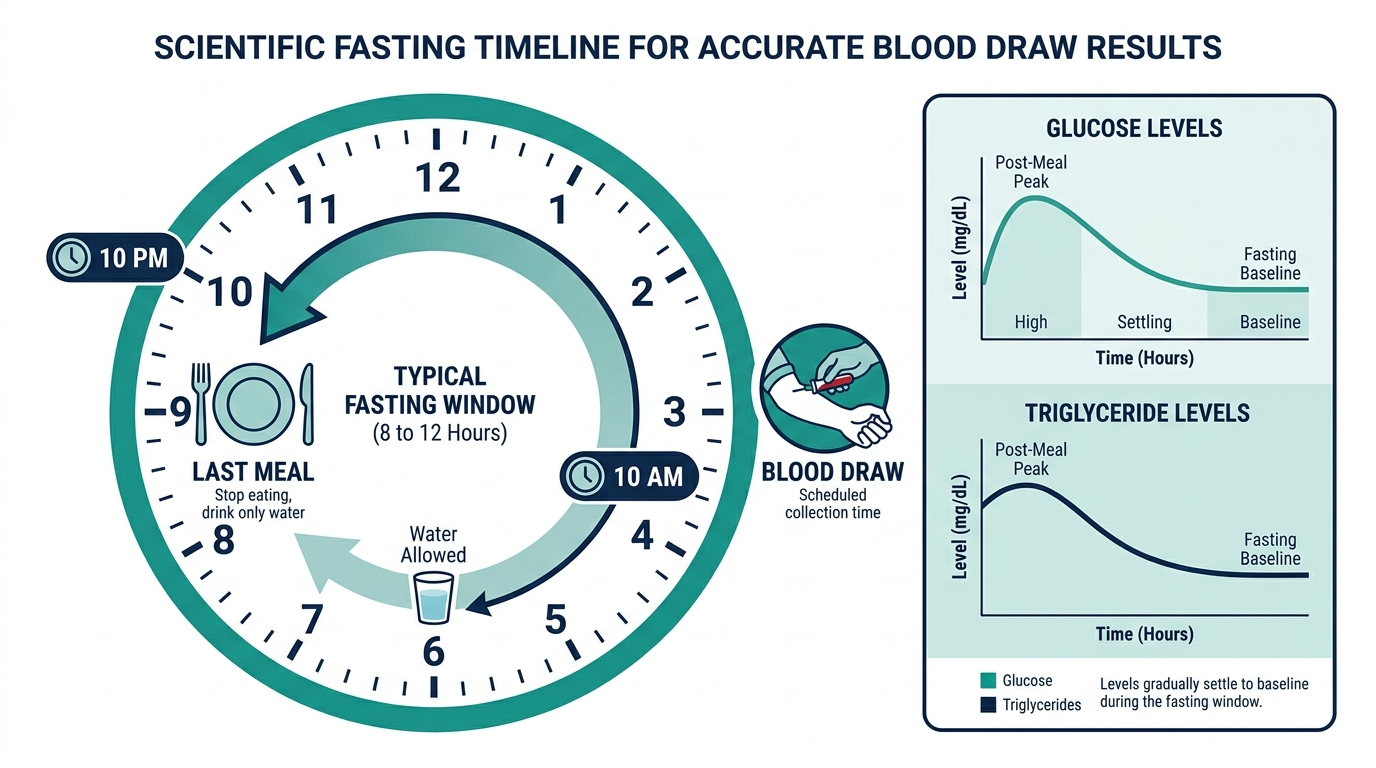
The blood tests that require fasting are a short, specific list: a fasting blood glucose test, a lipid panel in many cases, a basic metabolic panel, certain liver and kidney function tests, and an iron (serum iron) test. For these, you typically avoid everything except plain water for 8 to 12 hours beforehand (MedlinePlus). The exact list and timing depend on what your clinician ordered, which is why the instruction sheet you got is the rule that actually counts.
Why fast at all? When you eat or drink anything with calories, your bloodstream absorbs sugar, fat, and other nutrients within minutes, and that temporarily shifts the levels of certain substances the lab is trying to measure (Cleveland Clinic). Fasting gives the lab a clean, stable baseline rather than a snapshot of your last meal. The catch is that this only matters for tests where food genuinely moves the number, which is a smaller group than most people assume.
Which blood tests require fasting, one by one?
The tests most likely to come with a fasting instruction are the ones below. Here is what each measures and why an empty stomach helps.
- Fasting blood glucose. This measures your blood sugar to screen for or monitor diabetes, prediabetes, and gestational diabetes. Because eating spikes blood sugar almost immediately, this is the test where fasting matters most. The standard fasting window is at least 8 hours (MedlinePlus).
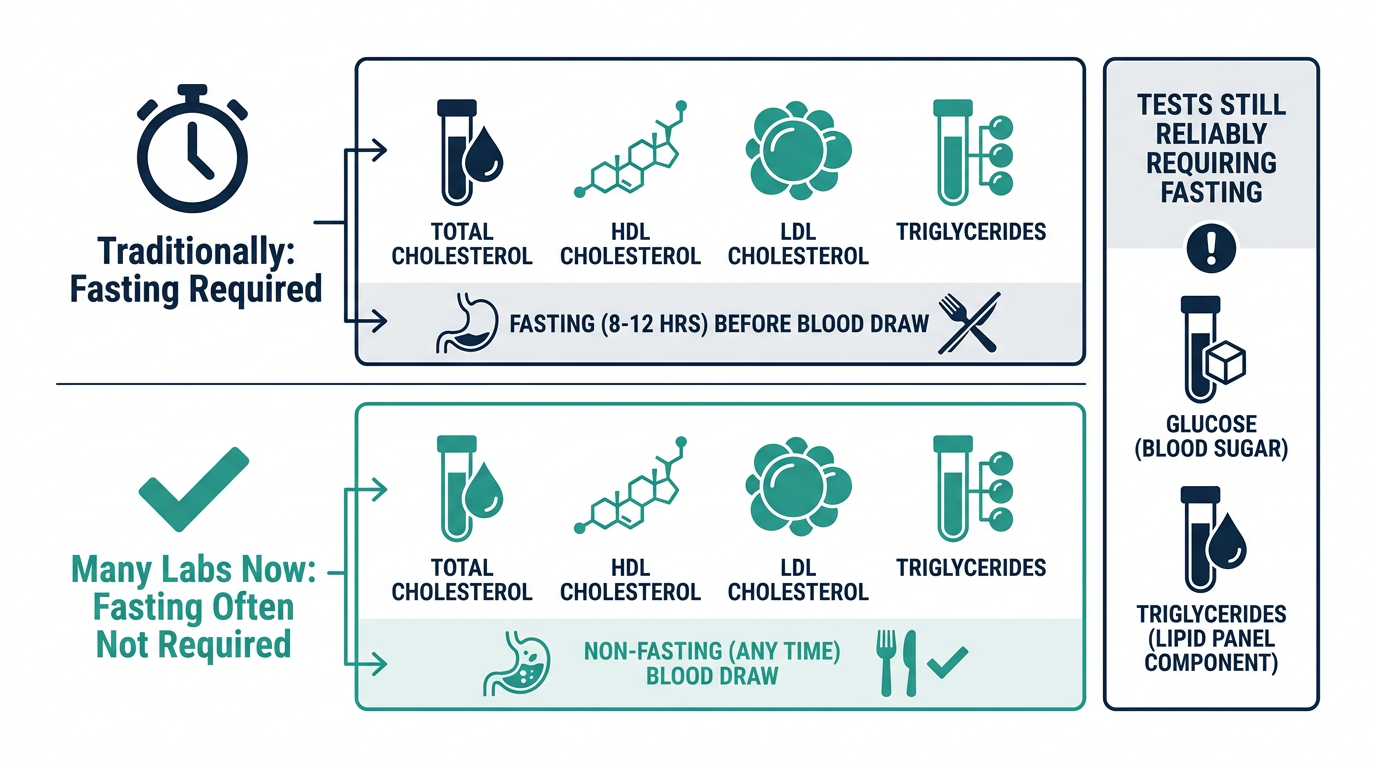
- Lipid panel (cholesterol and triglycerides). Cleveland Clinic still advises fasting 10 to 12 hours in most cases, because triglycerides in particular climb after a meal (Cleveland Clinic). But this is the test where the rules are shifting, and the section below explains why your clinician may now skip it.
- Basic metabolic panel (BMP). This checks blood sugar, electrolytes, and kidney markers to show how several organs are working. Because it includes glucose, a fasting sample is often requested (MedlinePlus).
- Liver and kidney function tests. Liver function tests and a renal function panel may be ordered fasting, partly because they are commonly drawn alongside glucose or lipids in one blood draw (MedlinePlus).
- Iron (serum iron) test. Some providers ask you to avoid food, drink, and iron supplements for 12 hours, because iron levels swing depending on what and when you last ate (Cleveland Clinic). Others do not require fasting at all, so this one genuinely varies.
Notice the pattern. The tests that require fasting almost all involve something food moves quickly: sugar, fat, or iron. A test of something stable, like your blood type or most thyroid markers, generally does not.
How long do you have to fast before a blood test?
For most fasting blood tests, the window is 8 to 12 hours, and your clinician will give you the exact number for your specific test (MedlinePlus). A fasting glucose generally needs at least 8 hours, while a lipid panel is often pushed to 10 to 12 hours because triglycerides take longer to settle (Cleveland Clinic).
This is the real reason fasting tests are almost always booked first thing in the morning. The 8 to 12 hour window lines up neatly with overnight sleep. If your last bite is at 8 p.m. and your appointment is at 8 a.m., you have fasted 12 hours without being awake and hungry for a single one of them. Schedule a fasting draw for the afternoon and you are signing up for a miserable, food free day. Book the earliest morning slot you can.
Does a blood test require fasting if it is just a lipid panel?
Not necessarily anymore, and this is the most important update in this whole article. For years, fasting before a cholesterol test was treated as non-negotiable. Then large studies showed the difference between fasting and nonfasting results is small enough that it rarely changes how a doctor treats you. A joint consensus statement from the European Atherosclerosis Society and the European Federation of Clinical Chemistry and Laboratory Medicine concluded that fasting is not routinely required for a standard lipid profile (European Atherosclerosis Society / EFLM consensus).
The numbers behind that shift are reassuring. After a normal meal, total cholesterol changes by only about 8 mg/dL and triglycerides by roughly 26 mg/dL on average, and HDL barely moves at all (European Atherosclerosis Society / EFLM consensus). Nonfasting samples predict cardiovascular risk about as well as fasting ones, which is why many systems have made nonfasting testing the default for routine screening (PMC, nonfasting lipid testing).
So why does your local lab slip still say “fast 12 hours”? Two reasons. First, guidelines and printed forms lag behind the evidence by years. Second, fasting still has a place when triglycerides are very high. The consensus recommends a follow-up fasting sample when a nonfasting triglyceride level comes back above about 440 mg/dL (5 mmol/L) (European Atherosclerosis Society / EFLM consensus). The honest takeaway: if you are being screened and your clinician is fine with nonfasting, you do not have to suffer through an empty stomach. If they specifically want fasting, follow that, because they may be tracking your triglycerides closely.
What blood tests do not require fasting?
Most blood tests do not require fasting at all, which surprises a lot of people who assume they should skip breakfast before any draw. A complete blood count (CBC), most thyroid tests, and many vitamin and hormone tests can be done after a normal meal, because the substances they measure are not meaningfully changed by your last snack.
The practical danger here is overcorrecting. People hear “fasting blood test” once and then starve themselves before every appointment, including draws where it does nothing but make them lightheaded. If your instructions do not say to fast, eat normally and stay hydrated, because well hydrated veins are easier to draw from. When in doubt, the answer is one phone call to the lab or clinic, not a guess and a skipped meal.
What can you eat or drink while fasting, and what trips people up?
While fasting for a blood test you can drink plain water, and you generally should. Water is allowed, encouraged even, because staying hydrated makes your veins easier to find and keeps the draw quick (Cleveland Clinic). Everything with calories or flavor is off the table: no juice, soda, milk, or anything you chew.
Now the insider part, the mistakes that quietly ruin fasting results even when people think they did everything right.
- Black coffee is not “free.” This is the single most common slip. Even plain black coffee with zero calories can affect your results, so it counts as breaking your fast (Cleveland Clinic). The “but it’s just black” rationalization sends people back for a repeat draw constantly.
- Gum, mints, and smoking break the fast too. Chewing gum, mints, and smoking should all be avoided during the fasting window, even though none of them is technically a meal (MedlinePlus).
- Do not stop your medications on your own. It is usually safe to keep taking prescribed medications during a fasting blood test, but you should ask your provider first rather than skipping a dose to “fast properly” (Cleveland Clinic). Stopping a medication can do far more harm than a slightly off lab value.
- Skip the gym beforehand. Intense exercise during the fasting window is discouraged, so save the workout for after your draw (MedlinePlus).
- Iron supplements deserve special care. If you are getting an iron test, some providers want you to skip iron supplements for 12 hours beforehand, because a recent dose can artificially inflate the reading (Cleveland Clinic).
The throughline: fasting is not only about food. It is about giving the lab a stable, unstimulated baseline, and coffee, nicotine, and a hard workout all stimulate your body in ways that can nudge the numbers.
The part most people never hear: when fasting backfires
Here is what experienced clinicians know that rarely makes the patient handout. Fasting longer than asked, or fasting when you have diabetes, can actually distort your results rather than perfect them. If you take insulin or certain diabetes medications and you fast for an extended stretch, your blood sugar can drop dangerously low, which is both unsafe and gives a misleading glucose reading. This is exactly why MedlinePlus stresses asking your provider about your medications before any fasting draw rather than improvising (MedlinePlus).
There is also a dehydration trap. Some people interpret “nothing but water” as “nothing at all” and show up parched, which concentrates the blood and can throw off several values while making the draw harder. The instruction allows water for a reason. Drink it.
And remember the bigger picture: the trend in medicine is toward less fasting, not more. The move to routine nonfasting lipid testing exists because the inconvenience and risk of fasting often outweighed the tiny gain in accuracy (PMC, nonfasting lipid testing). If a fasting instruction does not match what you have read here, that is a question worth asking, not a rule to silently endure.

The biology: why food actually moves these specific numbers
Fasting rules make more sense once you see what happens in the bloodstream right after you eat. Within minutes of a meal, your gut absorbs sugar, fat, and other nutrients and delivers them into circulation. That absorption is exactly what a few tests are trying to measure at a stable baseline, which is why food, not the test itself, is the variable being controlled.
- Glucose spikes fast and high. Carbohydrate in a meal raises blood sugar almost immediately, and it can stay elevated for an hour or more. A glucose drawn after eating tells you about your last meal, not your baseline sugar control, which is why fasting glucose is the test where an empty stomach matters most (MedlinePlus).
- Triglycerides ride on dietary fat. Fat from a meal is packaged into particles that circulate for hours, so triglycerides climb after eating and take the longest to settle. This is why lipid panels historically carried the strictest fasting window (Cleveland Clinic).
- Serum iron swings with intake. Iron levels shift depending on what and when you last ate, and a recent supplement can inflate the reading, which is why some providers ask you to hold food and iron pills beforehand (Cleveland Clinic).
Contrast that with the stable markers. Your blood type, your hemoglobin, most thyroid hormones, and many vitamins do not lurch around after a sandwich, so those tests do not need fasting. The rule of thumb: if a meal changes the number fast, fasting is on the table. If it does not, eat.
Fasting requirement at a glance
Here is the practical summary in one place, so you can match your instruction sheet against the general pattern.
| Test | Fasting typically needed? | Usual window |
|---|---|---|
| Fasting blood glucose | Yes | At least 8 hours (MedlinePlus) |
| Oral glucose tolerance test | Yes | Roughly 8 to 16 hours before the drink (StatPearls) |
| Lipid panel | Increasingly no for screening | 10 to 12 hours if requested (EAS/EFLM consensus) |
| Basic metabolic panel | Often, because it includes glucose | 8 to 12 hours (MedlinePlus) |
| Serum iron | Varies by provider | Up to 12 hours if requested (Cleveland Clinic) |
| HbA1c | No | None; drawn any time of day |
| CBC, most thyroid tests | No | None |
The overriding rule stays the same: the instruction your clinician gave you wins, because they know what they are tracking and why.
HbA1c: the diabetes test that skips fasting entirely
If fasting is a hardship for you, it is worth knowing that the most convenient diabetes test does not require it at all. HbA1c reflects your average blood sugar over roughly the past two to three months by measuring how much glucose has attached to your hemoglobin. Because it is an average rather than a snapshot, a recent meal does not change it, so it can be drawn at any time of day without fasting.
That convenience is real, but HbA1c is not interchangeable with a fasting glucose in every situation. It can be misleading in conditions that change red blood cell turnover, such as anemia or recent blood loss, where the average it reports no longer maps cleanly onto blood sugar. And it is not the right tool for diagnosing diabetes in pregnancy, where an oral glucose tolerance test remains the standard. So the fasting versus nonfasting choice is not only about comfort, it is about which test answers the specific question your clinician is asking.
A simple prep timeline that prevents repeat draws
Most botched fasting tests come down to timing and a couple of overlooked slips. This sequence keeps it clean.
- The night before: eat your normal dinner and note the time you finish. Counting your window from that last bite is what tells you when you have hit 8 or 12 hours.
- Book the earliest morning slot: an 8 a.m. draw after an 8 p.m. dinner covers a 12 hour fast almost entirely during sleep, so you are never awake and hungry.
- Water only, and plenty of it: plain water is allowed and encouraged, because well hydrated veins are easier to draw and dehydration can skew several values (Cleveland Clinic).
- No coffee, gum, mints, or cigarettes: even black coffee counts as breaking the fast, and gum, mints, and smoking should be avoided in the window (MedlinePlus).
- Keep your medications unless told otherwise: continue prescribed drugs and ask your provider rather than skipping a dose to fast (Cleveland Clinic).
- Skip the workout and hold iron pills if testing iron: intense exercise is discouraged during the window, and a recent iron supplement can inflate a serum iron reading.
Special situations that change the fasting advice
The standard rules assume a healthy adult. Several groups need a different approach, and this is exactly where improvising causes trouble.
- People with diabetes on insulin or sulfonylureas. Fasting longer than asked can drop blood sugar dangerously low, which is both unsafe and produces a misleading glucose. The right move is to confirm the plan with your provider before the draw rather than fasting by instinct (MedlinePlus).
- Pregnancy and gestational diabetes screening. The oral glucose tolerance test used in pregnancy has its own fasting and timing rules, and it is the preferred test rather than HbA1c, so follow the prenatal instructions precisely (StatPearls).
- Children and older adults. Both tolerate long fasts poorly. A short overnight window and an early appointment are kinder and just as accurate, and dehydration risk is higher, so water matters more.
- Anyone prone to fainting at draws. A long fast plus dehydration raises the odds of feeling faint. Hydrating well and sitting or lying for the draw helps.
Common misconceptions about fasting for blood work
- “I should fast before every blood test to be safe.” No. Most tests do not need it, and needless fasting just leaves you lightheaded and harder to draw from. Fast only when your instructions say so (MedlinePlus).
- “Longer fasting gives more accurate results.” Not true, and it can backfire. Over fasting can lower blood sugar, cause dehydration, and distort several values rather than sharpen them.
- “Black coffee does not count.” It does. Even calorie free black coffee can affect results and breaks the fast (Cleveland Clinic).
- “Water will dilute my results, so I should avoid it.” The opposite. Water is allowed and encouraged, and skipping it concentrates the blood and makes the draw harder.
- “A cholesterol test always needs fasting.” Not anymore for routine screening, since nonfasting results predict risk about as well, though a very high nonfasting triglyceride may prompt a fasting recheck (EAS/EFLM consensus).
Don’t just read about your health, track it.
A single result is a snapshot. Superpower re-tests 100+ markers over time so you can watch them move as you change sleep, food, and training.
Frequently asked questions
Do all blood tests require fasting?
No. Most blood tests do not require fasting. Only a specific group does, mainly fasting glucose, many lipid panels, a basic metabolic panel, some liver and kidney tests, and iron tests (MedlinePlus). Always follow the instructions for your particular test rather than fasting by default.
How many hours do I need to fast before a blood test?
Usually 8 to 12 hours, with the exact window set by your clinician (MedlinePlus). A fasting glucose typically needs at least 8 hours, and a lipid panel is often 10 to 12 hours (Cleveland Clinic).
Can I drink black coffee while fasting for blood work?
No. Even plain black coffee can affect your results and counts as breaking your fast. Stick to plain water only during the fasting window (Cleveland Clinic).
Does a cholesterol test still require fasting?
Often no longer. Major guidance says fasting is not routinely required for a standard lipid profile because nonfasting results predict risk about as well (European Atherosclerosis Society / EFLM consensus). Some clinicians still request fasting, especially if your triglycerides are high, so follow their specific instruction.
Can I take my regular medications before a fasting blood test?
Usually yes, but ask your provider first. It is generally safe to continue prescribed medications during a fasting draw, and you should not skip a dose just to fast (Cleveland Clinic).
This article is for general educational purposes and is not medical advice. It cannot diagnose or treat you and does not replace your clinician. Always discuss your lab results and any health decisions with a qualified healthcare professional.
Related reading
Vital Signs Today may earn a commission if you buy through links on this page. It does not affect our editorial assessments.