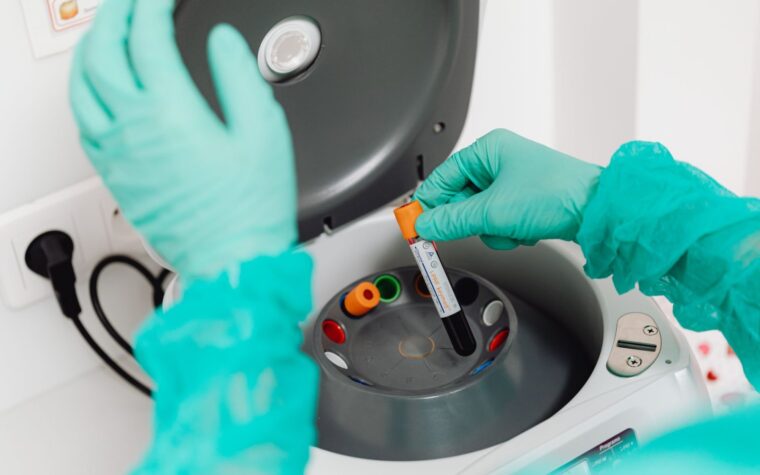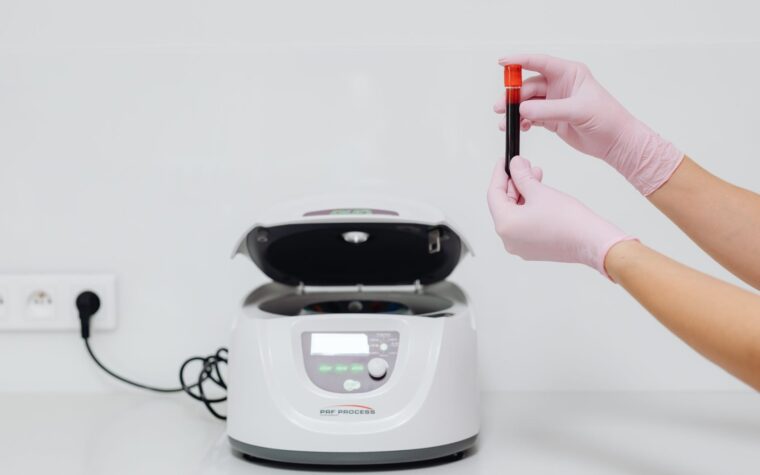
Your clinic calls with a blood pregnancy test result, and it does not match what your body is telling you. The number says positive but you feel nothing, or it says negative and your period is still nowhere to be found. Naturally the first question is the obvious one: can a blood pregnancy test be wrong?
A blood pregnancy test can still be wrong. Curious what else your bloodwork could confirm? One at-home Superpower draw checks 100+ biomarkers, physician-reviewed.
Here is the short, honest answer that most pages bury. Blood hCG tests are among the most reliable tests in all of medicine, but reliable is not the same as infallible. They fail in specific, well documented ways, and once you understand those ways, a confusing result stops being scary and starts making sense.
Can a blood pregnancy test be wrong?
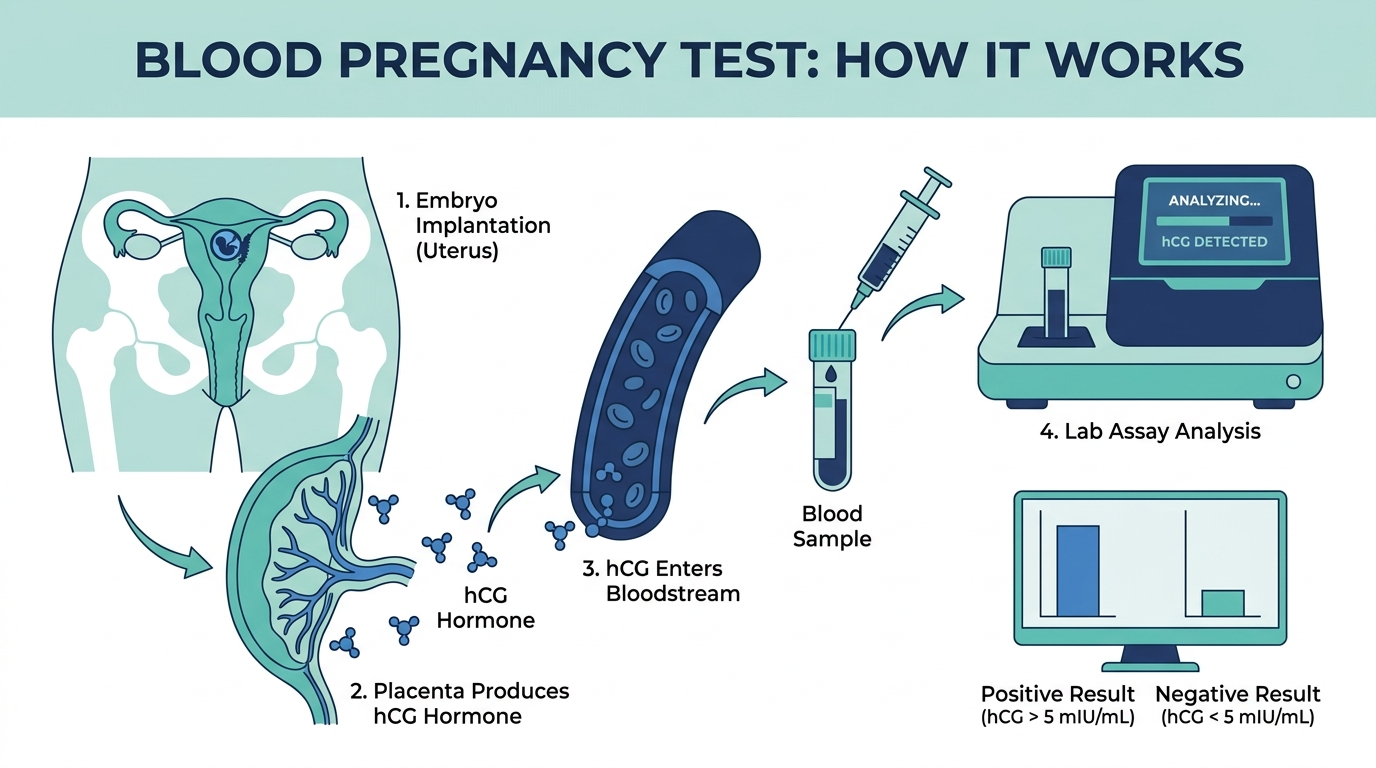
Yes, a blood pregnancy test can be wrong, but it is uncommon and almost always happens for a reason you can name. A blood test measures human chorionic gonadotropin (hCG), the hormone your body produces once a fertilized egg implants, and it is slightly more sensitive than a urine test, detecting pregnancy within about seven to 10 days after conception (Cleveland Clinic). Because it can pick up smaller amounts of hCG earlier, it is the test clinics trust most.
So when people ask whether a blood test pregnancy test can be wrong, the useful framing is not “is it accurate” but “what are the handful of situations that throw it off.” There are essentially two failure modes: a false negative, where you are pregnant but the test says you are not, and a false positive, where the test says you are pregnant but a viable pregnancy is not present. Each has its own short list of causes.
How does a blood pregnancy test work, and when is it used?
The simplest way to actually get this done
Superpower is a full-body lab membership that runs 100+ biomarkers, has each result reviewed by a doctor, and tracks your numbers year over year (about $199/year). It is what we point readers to when they would rather get one clean, complete draw than chase single tests one at a time. Here is superpower reviewed in full.
A blood pregnancy test looks for human chorionic gonadotropin, the hormone produced by the cells that go on to form the placenta once an embryo implants. Those cells release hCG into your bloodstream, its level climbs steeply in the first weeks, and the lab assay detects it (Cleveland Clinic). Because the hormone appears in blood before it builds up enough to show reliably in urine, the blood version can confirm a pregnancy a little earlier.
There are two forms of the test, and knowing which one you had explains a great deal about what your result can and cannot tell you:
- Qualitative hCG answers a single yes-or-no question: is hCG present. This is what most clinics run to confirm a pregnancy, and it is considered very accurate (MedlinePlus).
- Quantitative beta hCG measures the exact concentration. One number is a snapshot; two numbers a couple of days apart show whether the hormone is rising the way a healthy early pregnancy should (Cleveland Clinic).
Clinics reach for a blood test in a few specific situations: to confirm a positive home test, to date or monitor a very early pregnancy, to help evaluate bleeding or pain that could signal an ectopic pregnancy or miscarriage, and as a routine check before certain medications, imaging, or surgery that could affect a pregnancy. In each case the goal is the same, to replace guesswork with a number the care team can act on.
What makes a blood pregnancy test give a false negative?
The overwhelming cause of a false negative is testing too early, before your hCG has risen enough to register (Cleveland Clinic). hCG starts to build up only once the fertilized egg implants in the uterus, roughly six to 10 days after conception, and it climbs from there. Test before that window and there simply is not enough hormone in your blood yet, no matter how good the test is.
This is why a single negative does not close the case. When pregnancy is still suspected after a negative hCG result, the standard move is to repeat the test about a week later (MedlinePlus). By then hCG, which roughly doubles every two days in early pregnancy, has had time to climb into detectable range.
So if you are wondering whether blood tests for pregnancy can be wrong in the early direction, the answer is yes, but timing is the culprit far more often than the test itself. A few other situations can blunt a result, including very dilute samples and, rarely, the laboratory quirk covered in the insider section below.
A concrete example makes the timing point stick. Someone tests four days before a missed period because they cannot wait, gets a negative, and assumes they are in the clear. A week later the period still has not come, a repeat blood test is clearly positive, and an ultrasound later confirms a normally progressing pregnancy. Nothing was wrong with the first test. It was simply run before there was enough hCG to detect. This is the single most common way a blood pregnancy test appears to be wrong, and it is entirely about timing rather than test failure.
What makes a blood pregnancy test give a false positive?
A false positive, where the test flags hCG but there is no ongoing pregnancy, is rarer than a false negative but more unsettling. The most common benign explanation is a chemical pregnancy, an early loss that happens shortly after the fertilized egg attaches to the uterine wall (Cleveland Clinic). In that case the test was not wrong at the moment it was taken. hCG really was present, the pregnancy simply did not continue.
Beyond that, the documented causes of a positive hCG result without a viable pregnancy include:
- Fertility medications. Some fertility drugs contain hCG itself, so a test can read positive purely because of the medication rather than a pregnancy (Mayo Clinic).
- Hormone shifts and supplements. Raised hormone levels, such as after menopause or while taking certain hormone supplements, can produce a false positive (MedlinePlus).
- Tumors that make hCG. Certain ovarian tumors in women and testicular tumors in men can raise hCG, along with trophoblastic tumors and a hydatidiform (molar) pregnancy (MedlinePlus).
- An ectopic pregnancy or miscarriage, which also raise hCG and will read positive even though the pregnancy is not viable (MedlinePlus).
Notice the pattern. Most of these are not the test malfunctioning. The test correctly detected hCG. The hCG was just coming from somewhere other than a healthy intrauterine pregnancy. That distinction matters, because it means a positive result is almost always telling the truth about hCG, even when the clinical story turns out to be different from what you expected.
How accurate is a blood pregnancy test really?
Very accurate, and more so than the home urine test most people start with. A blood test is slightly more sensitive than a urine test and can confirm pregnancy a few days earlier because it detects lower concentrations of hCG (Cleveland Clinic). The qualitative hCG blood test, which simply answers yes or no to whether hCG is present, is considered very accurate (MedlinePlus).
To put the false positive risk in real numbers: false positive serum hCG results are estimated to occur in roughly 1 in 1,000 to 1 in 10,000 tests (PubMed). That is rare by any standard. So when someone asks whether blood tests can be wrong for pregnancy, the data says the odds of a true false positive are low, and most surprising results trace back to timing, medication, or a pregnancy that is real but not progressing normally.
There is also a second, more informative version of the test. A quantitative blood test (often called beta hCG) measures the exact amount of hormone, not just its presence. Because hCG roughly doubles every two days in early pregnancy, a single number is a snapshot, while two numbers a couple of days apart tell a story (Cleveland Clinic). Levels that fail to rise can suggest a problem, and unusually high levels can point to twins or to a complication. This is why a confusing result is often resolved not by a better test but by a second test on a different day.
Could a positive result mean something other than a healthy pregnancy?
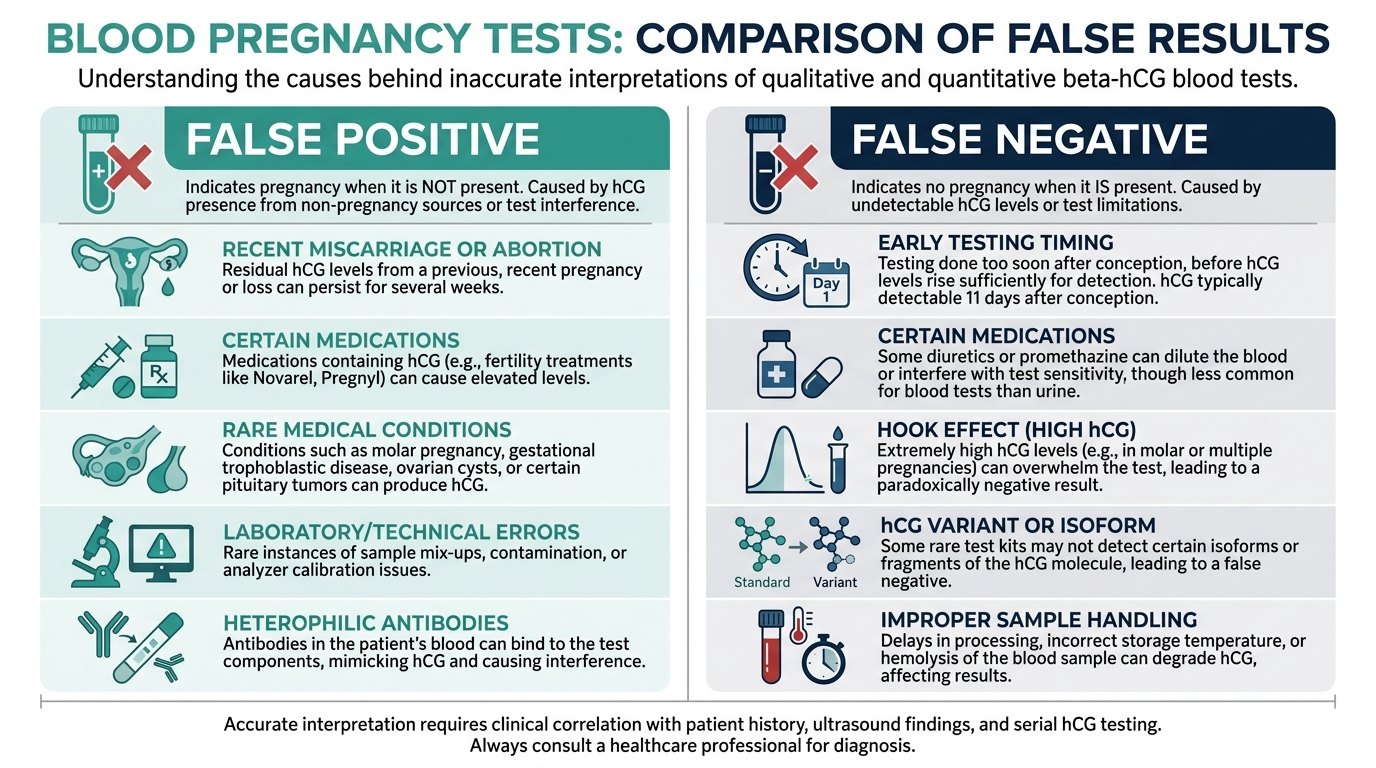
Yes, and this is the most important thing to understand about a positive hCG. A positive result confirms hCG is present, but it does not confirm a viable pregnancy sitting safely in the uterus. The same hormone shows up in an ectopic pregnancy, a miscarriage in progress, a molar pregnancy, and certain hCG producing tumors (MedlinePlus).
This is exactly why your clinician does not stop at a single positive. They look at the actual hCG number, repeat it to see whether it is rising appropriately, and often pair it with an ultrasound. A positive test plus a normal doubling trend plus an ultrasound showing a pregnancy in the right place is the full picture. Any one piece alone, including a strongly positive blood test, can mislead if you read it in isolation. The blood test is the opening line of the story, not the whole story.
What do rising or falling hCG numbers mean?
This is where the quantitative test earns its place. In a healthy early pregnancy, hCG rises briskly, roughly doubling every two to three days in the first weeks, so the pattern across two draws matters more than any single value (Cleveland Clinic). Three broad trends tell three different stories:
- Rising as expected. A level that climbs at the normal pace is reassuring and is what clinicians hope to see in the earliest weeks.
- Rising too slowly, plateauing, or falling. hCG that does not climb the way it should can point to a pregnancy that is not progressing, such as a miscarriage or an ectopic pregnancy, and it warrants close follow-up (MedlinePlus).
- Unusually high. Higher than expected levels can simply mean twins, but they can also accompany a molar pregnancy, so the number is read alongside symptoms and ultrasound.
There is also a level at which imaging takes over from the lab. Once hCG climbs past a certain threshold, a transvaginal ultrasound should be able to see a pregnancy inside the uterus. If the hormone is high enough that a pregnancy should be visible but the uterus looks empty, clinicians treat that mismatch as a red flag for an ectopic pregnancy, a situation that needs prompt attention rather than a wait-and-see week (MedlinePlus).
The insider detail: how a very high hCG can fool the test (the hook effect)
Here is the counterintuitive failure that surprises even some clinicians: a pregnancy hormone level so high it makes the test read negative. It is called the hook effect, and it is the answer to one of the strangest versions of “could a pregnancy blood test be wrong.”
Modern hCG tests work like a molecular sandwich. The hormone is grabbed by a capture antibody on one side and tagged by a tracer antibody on the other, and that complete sandwich is what the machine reads as positive. When hCG levels are extremely high, above roughly 500,000 mIU/ml, there is so much hormone that both antibody types saturate before they can pair up properly. The unpaired tracer gets washed away with the excess, and the result comes back falsely low or even negative (PMC).
The reason this matters clinically is that the hook effect tends to appear precisely when hCG is sky high, which is exactly the scenario you do not want to miss. A published case described an 18 year old with a molar pregnancy and classic ultrasound findings whose initial pregnancy tests came back negative. The truth only emerged after the lab diluted the sample, dropping the hormone into the range the test could read, at which point it turned positive (PMC). The practical lesson for patients: if your clinical picture screams pregnancy or molar pregnancy but the test says no, that mismatch is itself a finding. A good lab will think to dilute the sample. The hook effect is rare, but it is the cleanest example of why a result that contradicts the obvious should never be the end of the conversation.
What should you do if your result does not feel right?
Repeat the test and talk to your clinician, rather than trusting or dismissing a single number. If the result was negative but your period has not arrived, retest in about a week, when hCG has had time to climb (MedlinePlus). If the result was positive but something feels off, your clinician can order a quantitative beta hCG and repeat it in a couple of days to watch the trend (Cleveland Clinic).
Tell your clinician about anything that can shift hCG, including fertility treatment, hormone supplements, and recent pregnancy loss, because those details change how a result should be read (Mayo Clinic). The single biggest mistake is treating one blood test as a verdict. In pregnancy testing, the trend over time and the clinical picture almost always outrank any one result.
Turn what you just learned into action.
Superpower lets you test 100+ biomarkers from home, then re-check them over time so you can actually see progress, physician-reviewed at every step.
Frequently asked questions
Can a blood test be wrong for pregnancy?
Yes, but it is uncommon. The most frequent error is a false negative from testing too early, before hCG has risen enough to detect (Cleveland Clinic). True false positives are rare, estimated at about 1 in 1,000 to 1 in 10,000 tests, and often trace back to medications, hormone shifts, or a pregnancy that is not viable (PubMed).
Could a blood pregnancy test be wrong and say negative when I am pregnant?
Yes. Testing too early is the main reason, since hCG only starts building about six to 10 days after conception (Cleveland Clinic). Rarely, extremely high hCG can also cause a falsely negative result through the hook effect (PMC). Retesting in a week is the standard next step (MedlinePlus).
What can cause a false positive blood pregnancy test?
Common causes include a chemical pregnancy, fertility drugs that contain hCG, and raised hormone levels from menopause or supplements (Cleveland Clinic, MedlinePlus). Certain ovarian, testicular, and trophoblastic tumors can also raise hCG (MedlinePlus).
Is a blood pregnancy test more accurate than a urine test?
Generally yes. A blood test is slightly more sensitive and can detect pregnancy a few days earlier because it picks up lower amounts of hCG (Cleveland Clinic). A quantitative blood test also measures the exact hCG level, which a home urine test cannot do.
Does a positive blood test always mean a healthy pregnancy?
No. A positive result confirms hCG is present, not that a viable pregnancy is in the uterus. The same hormone appears in ectopic and molar pregnancies, miscarriage, and some tumors, which is why clinicians repeat the test and use ultrasound to confirm (MedlinePlus).
Do I need to fast for a blood pregnancy test?
No. An hCG blood test does not require fasting or any special preparation, because food and drink do not affect the hormone the test measures. You can have it drawn at any time of day.
How long after conception can a blood test detect pregnancy?
A blood test can usually detect hCG about seven to 10 days after conception, once the embryo has implanted and the hormone has begun to build, which is often a few days before a home urine test turns positive (Cleveland Clinic).
This article is for general educational purposes and is not medical advice. It cannot diagnose or treat you and does not replace your clinician. Always discuss your lab results and any health decisions with a qualified healthcare professional.
Related reading
Vital Signs Today may earn a commission if you buy through links on this page. It does not affect our editorial assessments.