Quick answer: Spironolactone is not a weight-loss drug, and it does not burn fat. It is a potassium-sparing diuretic, so it can make the scale drop a few pounds in the first week or two by pushing out retained water and sodium. That is fluid loss, not fat loss, and it usually plateaus fast. Some people with PCOS do lose modest weight while taking it, but that is mostly from less bloating and better hormone balance rather than from the drug melting fat. If real fat loss is the goal, spironolactone is the wrong tool.
Does spironolactone cause weight loss, or is it just water?
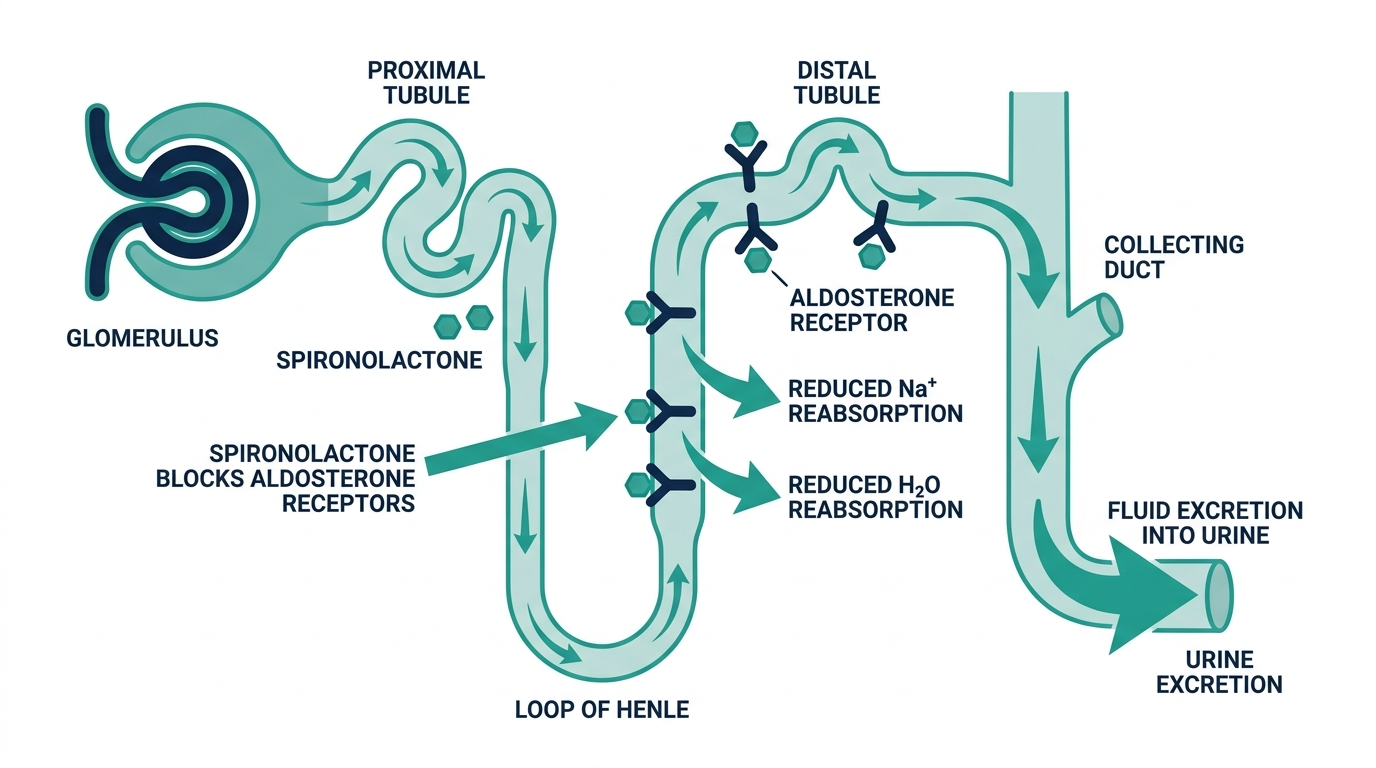
For most people, any early weight change on spironolactone is water, not fat. The drug blocks aldosterone, the hormone that tells your kidneys to hold onto sodium and water. When you block it, your body sheds some of that retained fluid, which is why doctors prescribe it for heart failure, high blood pressure, and fluid-heavy conditions like ascites.
If spironolactone isn’t the reason the scale moved, bloodwork can help you find what actually is. Want to check your own numbers? One at-home Superpower draw checks 100+ biomarkers, physician-reviewed.
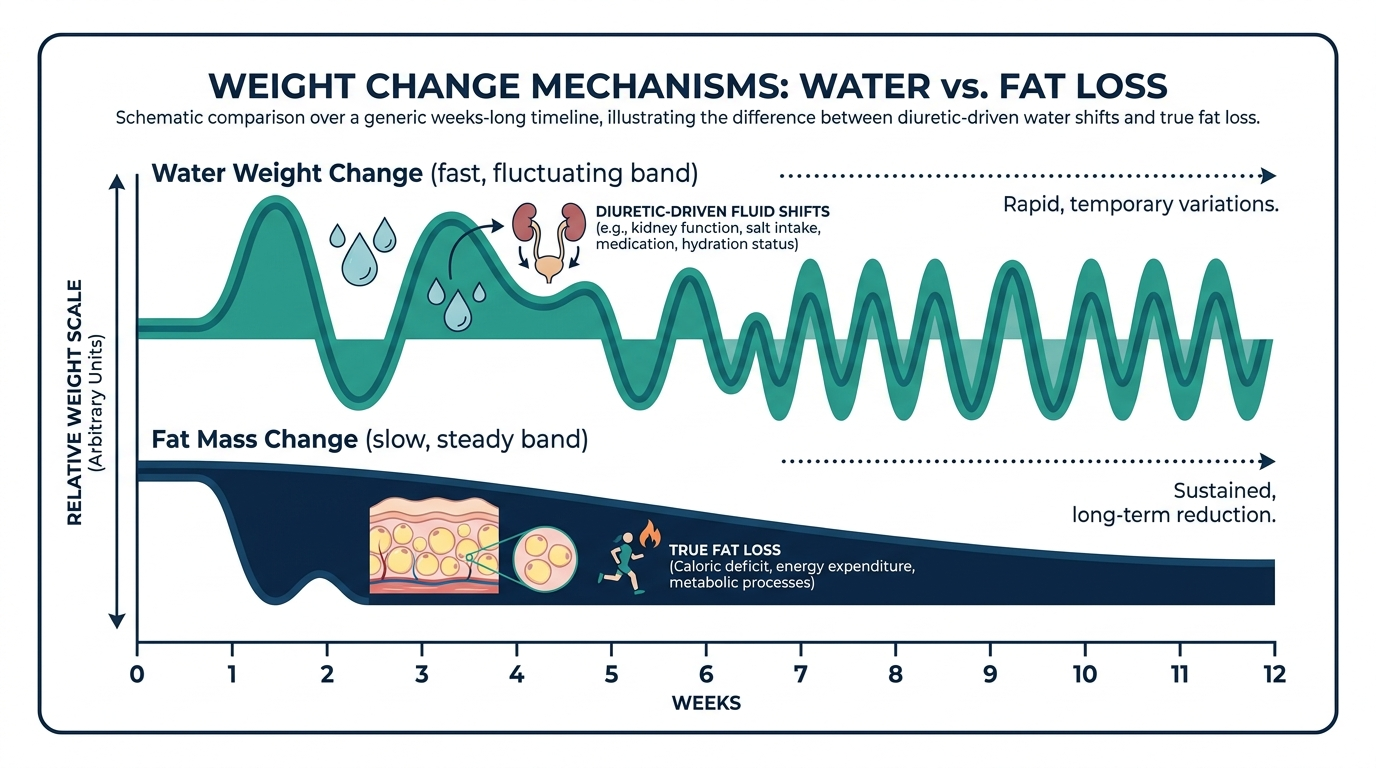
Here is the part a lot of people miss. That fluid drop is real on the scale but cosmetic on the body. You might see two to five pounds vanish in the first week, then nothing. Your fat cells did not change. You simply carried less water. The moment your fluid balance resets, the scale settles, and some people even drift back up a pound or two because the body re-regulates sodium.
Spironolactone also has no meaningful effect on appetite, metabolic rate, or how many calories you burn at rest. Compare that to drugs that actually target weight, like the GLP-1 medications Wegovy (semaglutide) and Zepbound (tirzepatide), which slow stomach emptying and quiet appetite signals in the brain. Spironolactone does none of that. So when people ask can spironolactone cause weight loss, the honest answer is yes in the narrow, temporary, water-only sense, and no in the way most people actually mean.
The water-weight physics: why it drops, then stalls
It helps to understand why the early drop is so fast and then stops so completely. Your body holds a fairly tight range of sodium and the water that follows it. Aldosterone is the hormone that tells the kidneys to reabsorb sodium, dragging water back into the body with it. Spironolactone blocks aldosterone, so the kidneys let more sodium and water go, and you offload a few pounds of fluid over the first days. But this is a one-time correction, not a running process. Once your fluid volume settles at its new baseline, there is nothing left to release, and the scale flattens. A single salty meal, a hard workout, or a menstrual cycle can swing that fluid number by a pound or two in either direction, which is why day-to-day scale readings on a diuretic are noisy and easy to misread as progress or failure. None of it reflects a change in fat mass, which moves far more slowly and only in response to a real calorie deficit.
Will spironolactone cause weight loss for everyone who takes it?
No. Plenty of people take spironolactone and see no change on the scale at all, and a smaller group actually gains weight. The direction depends on why you were retaining fluid in the first place and what else is going on in your body.
Three rough buckets cover most people:
- Fluid-overloaded patients (heart failure, high blood pressure, leg swelling): these people often see the most early scale movement because they had the most retained water to lose.
- Acne and hormonal-skin patients (often younger women on low doses): usually little to no weight change, since they were not fluid-overloaded to begin with.
- PCOS patients: mixed. Some lose a few pounds from reduced bloating and androgen effects, some stay flat, and a few gain if their insulin resistance is the real driver and goes untreated.
Weight gain on spironolactone is less common but it happens, sometimes from increased appetite or from the body compensating. If you are gaining instead of losing, that is worth flagging to your clinician rather than pushing the dose up on your own.
Does spironolactone help with weight loss in PCOS?
In PCOS, spironolactone can help with weight indirectly, but it is treating symptoms, not the engine. Polycystic ovary syndrome is driven largely by insulin resistance and excess androgens (male-pattern hormones). Spironolactone is an anti-androgen, so it blocks testosterone-like effects, which is why it works so well for PCOS acne, unwanted facial hair, and hair thinning.
The weight piece is subtler. By calming androgen activity and reducing fluid retention, some women with PCOS feel less bloated and a bit lighter, and a few pounds come off. But spironolactone does almost nothing for insulin resistance, which is the actual reason weight is so stubborn in PCOS. That is why clinicians often pair it with metformin or, increasingly, a GLP-1, where the real metabolic work happens. If you want the deeper comparison, see does Metformin cause weight loss and how the insulin angle differs.
So does spironolactone cause weight loss in PCOS? It can contribute modestly, but if the scale will not move, the missing lever is almost always insulin and metabolic health, not the spironolactone dose.
What spironolactone is genuinely good at
It is worth stating plainly what this drug does well, because a lot of people take it for the right reason and then judge it by the wrong one. Spironolactone is a genuinely effective anti-androgen. For hormonal acne along the jaw and chin, for unwanted facial hair (hirsutism), and for androgen-driven hair thinning in women, it is a first-line option that dermatologists reach for often. It is also a workhorse for high blood pressure and for fluid overload in heart failure and liver disease. Those are real, evidence-backed jobs.
Take a concrete example. A 28-year-old woman with PCOS starts spironolactone for stubborn cystic acne. Over the first two weeks she notices the scale dip about three pounds and feels less puffy. By month three her skin is dramatically clearer, but her weight has settled right back near where it started. Nothing went wrong. The drug did exactly what it is good at, cleared the androgen-driven acne and shed some fluid, and did nothing for the insulin resistance that was holding her weight in place. If she measures that fluid drop as fat loss, she sets herself up for disappointment. If she measures it as the acne win it actually is, the drug looks like a success.
How much weight could spironolactone realistically take off?
For most people, expect zero to about five pounds, almost all of it water, almost all of it in the first one to two weeks. There is no large clinical trial showing spironolactone produces sustained fat loss, because that is not what the drug does. Any number you see online above that range is either water weight, a confounded PCOS case, or wishful thinking.
Put it next to drugs that were actually studied for weight, and the gap is stark. The STEP trials for semaglutide (Wegovy) showed roughly 15 percent average body-weight loss over about 68 weeks. The SURMOUNT trials for tirzepatide (Zepbound) showed north of 20 percent at the higher doses. Those are fat-loss results from drugs designed for the job. Spironolactone is not in that conversation.
| Medication | Approved for weight loss? | Typical weight effect | What it actually does |
|---|---|---|---|
| Spironolactone | No | 0 to ~5 lb, mostly water, then plateaus | Diuretic and anti-androgen, no fat-burning effect |
| Metformin | No (off-label) | Modest, often 2 to 6 lb | Improves insulin sensitivity |
| Wegovy (semaglutide) | Yes (FDA-approved) | ~15% average (STEP trials) | GLP-1, suppresses appetite, slows gastric emptying |
| Zepbound (tirzepatide) | Yes (FDA-approved) | ~20%+ average (SURMOUNT trials) | Dual GLP-1 and GIP, strong appetite control |
The takeaway from that table is simple. If you want fat loss with real evidence behind it, the on-label GLP-1 drugs are in a different league, and they are FDA-approved for exactly this. Compounded semaglutide and compounded tirzepatide are not FDA-approved, though licensed clinicians and pharmacies can legally prescribe and compound them, often at lower cash cost. That distinction matters and we come back to it below.
Can spironolactone help with weight loss as part of a bigger plan?
Spironolactone can play a supporting role, but never the lead. The honest use case is narrow: a woman with PCOS or hormonal acne who is also on a real metabolic plan and happens to feel less bloated. The spironolactone handles skin and androgen symptoms while the actual weight work comes from diet, training, insulin management, or a GLP-1.
What spironolactone will not do, no matter the dose:
- Burn stored fat
- Raise your metabolic rate
- Suppress appetite
- Fix insulin resistance
- Produce sustained loss past the initial water drop
If your prescriber put you on it for blood pressure, heart failure, acne, or PCOS symptoms, that is a legitimate reason to take it. Just do not expect it to double as a weight-loss drug, and never raise your own dose chasing the scale. Higher doses mostly raise your side-effect and potassium risk, not your fat loss.
What stalls people: the mistakes that waste months
The biggest mistake is treating a diuretic like a fat burner and getting discouraged when the early scale drop stalls. Here is where people go wrong, in order of how often I see it.
- Chasing the water-weight illusion. They lose four pounds in week one, assume it is working, then panic when week three is flat. Nothing broke. The water was a one-time event.
- Ignoring insulin resistance. Especially in PCOS, the scale will not move until insulin is addressed. Spironolactone does not touch it. This is the single most common stall.
- Never checking the thyroid. An underactive thyroid (hypothyroidism) quietly holds weight on and is wildly common in women. A stalled scale despite real effort is often a TSH and free T4 problem, not a willpower problem.
- Self-dosing the wrong drug. People stack spironolactone, random supplements, and gray-market peptides bought online, with no labs, no clinician, and no idea what their hormones are doing.
- Skipping baseline labs. They guess instead of measuring. Insulin, fasting glucose, HbA1c, thyroid panel, and sex hormones tell you in one blood draw whether your problem is hormonal, metabolic, or simply calorie balance.
That last point is the whole game on this site. Most people fail at weight loss because they are guessing instead of measuring. If the scale will not move no matter what you eat, the fix is rarely another over-the-counter trick. It is finding out which number is off.
Want a real clinician to run the numbers, not a guess?
Joi + Blokes is a telehealth clinic that prescribes GLP-1 medication (Zepbound, compounded semaglutide and tirzepatide), hormone therapy (TRT, HRT), thyroid care, and peptides after a real lab panel and clinician review, with no membership or consult fee (prescriptions from about $59/month, hormone and GLP-1 lab panels from $149). If spironolactone is treating your acne or PCOS symptoms but the scale will not budge, this is where you find out whether insulin, thyroid, or hormones are the real reason. Here is Joi + Blokes reviewed in full.
When an on-label GLP-1 path beats off-label experimentation
If your real goal is fat loss, a supervised GLP-1 path beats stacking off-label drugs every time. The reason is not just that GLP-1s work better. It is that a clinician runs labs first, so you treat the actual problem instead of guessing.
Wegovy and Zepbound are FDA-approved for weight management and have the trial data (STEP and SURMOUNT) to back the numbers. They are also expensive through retail pharmacy, often $1,000 or more a month without insurance coverage. That price is why the compounded market exists. Compounded semaglutide often runs roughly $150 to $300 a month cash, and compounded tirzepatide somewhat more, prescribed through licensed telehealth clinicians and compounding pharmacies. Compounded versions are not FDA-approved, so the safety and supervision around them matter a great deal.
This is exactly where the gray market gets people hurt. Buying peptides or semaglutide from an unregulated website with no labs, no dosing oversight, and no one watching your potassium, glucose, or thyroid is how a manageable problem becomes a dangerous one. Talk to a clinician before starting or stopping any of these medications. A real telehealth clinic does the blood panel, reviews your history, and picks the medication that fits your actual numbers.
If you want to see where other off-label options land, it is worth reading does Wellbutrin cause weight loss and does Jardiance cause weight loss, since both come up constantly in the same conversations and each works through a completely different mechanism than spironolactone.
Side effects and who should not take spironolactone
The side effect that matters most is high potassium (hyperkalemia), which can affect your heart rhythm and is the main reason spironolactone needs monitoring. Because it is potassium-sparing, your kidneys hold onto potassium, and levels can climb, especially if you have kidney issues, take ACE inhibitors or ARBs, or load up on potassium supplements.
Common and notable effects include:
- Frequent urination, especially early, since it is a diuretic
- Menstrual changes and breast tenderness from the anti-androgen action
- Breast enlargement in men (gynecomastia), which is dose-related and a reason it is used less in men
- Dizziness or low blood pressure from fluid loss
- High potassium, the one that needs blood tests to catch
It is generally avoided in pregnancy because of the anti-androgen effect on a developing fetus, and used cautiously in anyone with significant kidney disease. The practical point: spironolactone is a real drug with real monitoring needs, which is one more reason not to treat it as a casual weight-loss aid.
What monitoring on spironolactone usually looks like
Because the main risk is rising potassium, clinicians typically check a baseline potassium level and kidney function before starting, then recheck after a dose change or if you add another drug that affects potassium, such as an ACE inhibitor or an ARB. If you use a salt substitute or take potassium supplements, that is worth mentioning, since those can stack with the drug’s potassium-sparing effect. This monitoring is routine and not a reason for alarm, but it is exactly the kind of oversight the gray market skips. It is one more argument for getting anything in this category, spironolactone included, through a clinician who is actually watching your numbers rather than a website that just ships pills.
The smarter first step if the scale will not move
Before adding or adjusting any drug for weight, get a baseline blood panel so you know what you are actually fighting. A stalled scale almost always traces to one of a handful of measurable culprits: insulin resistance, an underactive thyroid, low or imbalanced sex hormones, or simple calorie surplus you cannot see without tracking. One blood draw separates these in a way that no amount of guessing will.
This is the difference between self-experimenting and treating the right problem. If the scale will not move no matter what you eat, it is usually worth seeing your actual numbers first. Here is how a full-body blood panel works and what it can flag before you waste another three months on a drug that was never going to do the job. If 500 mg of metformin keeps coming up in your research too, see is 500mg of metformin a low dose for weight loss, since dosing confusion is its own common stall.
Don’t just read about your health, track it.
A single result is a snapshot. Superpower re-tests 100+ markers over time so you can watch them move as you change sleep, food, and training.
FAQ
Does spironolactone cause weight loss right away?
Any quick drop in the first one to two weeks is water weight from its diuretic effect, not fat. It typically plateaus fast and does not continue. If you saw three or four pounds disappear early, that is fluid leaving, not fat cells shrinking.
Will spironolactone cause weight loss if I take a higher dose?
No, and raising the dose mostly raises your risk of high potassium and other side effects without producing more fat loss. Spironolactone has no fat-burning mechanism at any dose. Never increase it on your own to chase the scale.
Does spironolactone help with weight loss for PCOS specifically?
It can help modestly by reducing bloating and androgen effects, but it does not treat the insulin resistance that drives PCOS weight gain. The real progress in PCOS usually comes from addressing insulin, often with metformin or a GLP-1, while spironolactone handles acne and hair symptoms.
Can spironolactone cause weight gain instead?
Yes, a minority of people gain weight on it, sometimes from increased appetite or the body re-regulating fluid. If you are gaining rather than losing, mention it to your clinician rather than adjusting the dose yourself.
Is spironolactone a good weight-loss drug compared to Ozempic or Wegovy?
No, they are not in the same category. Wegovy (semaglutide) and Zepbound (tirzepatide) are FDA-approved for weight management with average losses around 15 to over 20 percent in the STEP and SURMOUNT trials. Spironolactone has no comparable data and is not a weight-loss drug.
How long does the water-weight loss from spironolactone last?
Usually just the first one to two weeks. Once your body resets its sodium and fluid balance, the scale stabilizes, and some people drift back up a pound or two as fluid re-regulates. There is no sustained loss beyond that initial shift.
Should I stop spironolactone if I am not losing weight?
Do not stop on your own, since it is usually prescribed for acne, PCOS symptoms, or blood pressure rather than weight. Talk to your clinician about whether it is still doing its actual job and what to add for real weight loss. Stopping abruptly can bring back the symptoms it was controlling.
Can spironolactone help with weight loss if I also have a thyroid problem?
It will not fix a thyroid problem, and an underactive thyroid is a very common hidden reason the scale will not move. If you suspect this, get a TSH and free T4 checked. Treating the thyroid, not adjusting spironolactone, is what moves the weight in that case.
What weight-loss option actually works if spironolactone is not it?
Start by measuring, with labs for insulin, glucose, thyroid, and hormones, then match treatment to what is actually off. For many people that means an FDA-approved GLP-1 like Wegovy or Zepbound, or a clinician-supervised compounded version, prescribed after a real panel rather than bought from the gray market.
Does spironolactone reduce bloating?
Yes, for many people it does, because it is a diuretic that helps the body release retained fluid. That reduced puffiness is often what people mistake for weight loss. It is a genuine comfort benefit, especially for those who retain fluid cyclically, but it is not the same as losing fat.
How long does spironolactone take to work for acne?
Skin usually takes longer than the scale. Most people see meaningful acne improvement over roughly two to three months of consistent use, not in the first couple of weeks. If you are taking it primarily for skin, judging it by early weight change misses the point of the prescription entirely.
Can I take spironolactone at the same time as a GLP-1?
Often yes, under clinician supervision, because they do completely different jobs. Spironolactone handles androgen symptoms or blood pressure while a GLP-1 does the actual weight work. This is a decision for your prescriber, who will watch your potassium and overall picture, not something to combine on your own.
Do I need to avoid potassium-rich foods on spironolactone?
Most people with normal kidney function do not need to eliminate everyday potassium-rich foods, but you should be cautious with potassium supplements and salt substitutes, which can push levels too high. Anyone with kidney issues or on ACE inhibitors or ARBs should get specific guidance from their clinician, since the risk of high potassium is real.
Vital Signs Today may earn a commission if you buy through links on this page. It does not affect our editorial assessments.