
Quick answer: For most people, Wegovy (semaglutide) is a long-term, often indefinite, medication for weight loss, not a short course you finish. It takes about 16 to 20 weeks to reach the full 2.4 mg dose, around 4 to 6 months to see meaningful results, and roughly 68 weeks (about 16 months) to hit peak weight loss of about 15 percent of body weight on average in the STEP trials. The catch most people miss: when you stop Wegovy, the appetite and weight tend to come back, so clinicians treat obesity like a chronic condition and keep patients on a maintenance dose. How long do you take Wegovy for weight loss in practice depends on your goals, side effects, and whether you can sustain the cost.
How long do you take Wegovy for weight loss, really?
You take Wegovy for as long as you need the weight-loss and metabolic benefit, which for obesity is usually years, not a finish line. Obesity medicine treats excess weight as a chronic, relapsing condition, the same way it treats high blood pressure. You would not expect a blood pressure pill to cure hypertension in four months and then stop working when you quit. Wegovy behaves the same way.
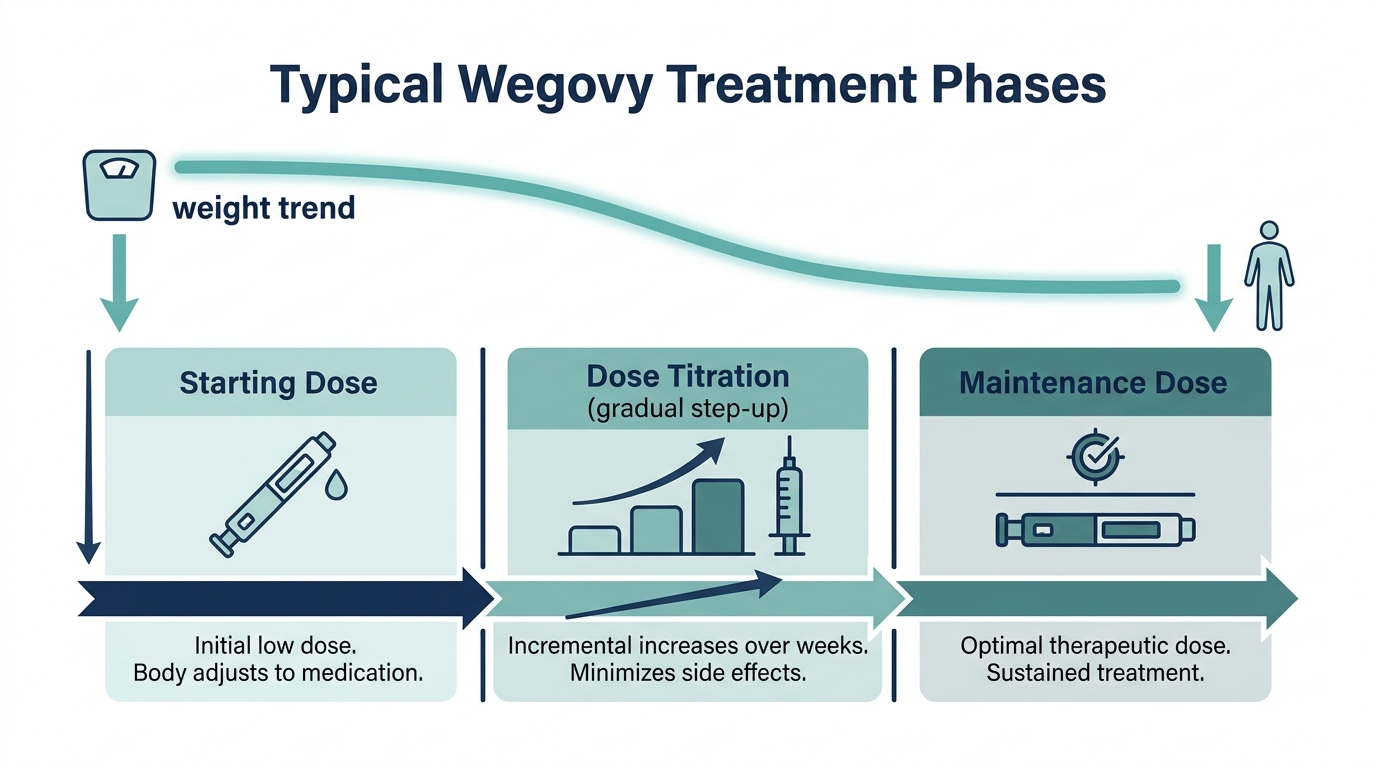
Here is the timeline people actually live through:
- Weeks 0 to 16: Slow dose escalation. You start at 0.25 mg once a week and step up roughly every 4 weeks (0.25, 0.5, 1.0, 1.7, then 2.4 mg) to limit nausea. This titration is not optional, and rushing it is the number one cause of people quitting from side effects.
- Months 4 to 6: Most people are at or near the 2.4 mg maintenance dose and start seeing clear scale movement, often 5 to 10 percent of body weight.
- Month 16 (about 68 weeks): Average peak weight loss in the STEP 1 trial, roughly 15 percent of starting body weight.
- Beyond that: A maintenance phase. You stay on a dose that holds the weight off, and most people do not stop entirely.
So when someone asks how long they take Wegovy, the honest answer is: plan for the long haul, built around staying on it.
Is Wegovy FDA approved for weight loss?
Yes. Wegovy is FDA approved for chronic weight management. It was approved in June 2021 for adults with a BMI of 30 or higher, or 27 or higher with at least one weight-related condition such as type 2 diabetes, high blood pressure, or high cholesterol. In late 2022 it was also approved for adolescents aged 12 and up with obesity, and in 2024 the FDA expanded the label to include reducing the risk of cardiovascular events like heart attack and stroke in adults with established heart disease and obesity, based on the SELECT trial.
This is an important distinction people blur all the time. Wegovy is the brand of semaglutide approved specifically for weight loss. Ozempic is the same molecule, semaglutide, but it is approved for type 2 diabetes, so using Ozempic purely for weight loss is technically off label. Compounded semaglutide, the cheaper version sold by many telehealth clinics, is not FDA approved at all. It is legally prescribed and dispensed by licensed clinicians and pharmacies, but it has not gone through the FDA approval process, so do not let anyone tell you compounded semaglutide is “FDA approved.” It is not.
Does Wegovy work for weight loss, and how much?
Yes, Wegovy works, and the data behind it is some of the strongest in the obesity drug space. In the STEP 1 trial, adults without diabetes who took Wegovy lost about 14.9 percent of their body weight over 68 weeks, compared to about 2.4 percent for placebo. For a 230-pound person, that is roughly 34 pounds.
The numbers shift depending on who you are:
- People with type 2 diabetes lose less, around 9 to 10 percent in STEP 2, because diabetes physiology blunts the response.
- About a third of people in trials lost 20 percent or more of body weight, approaching bariatric surgery territory.
- Roughly 1 in 10 are “non-responders” who lose under 5 percent. If that is you after several months at full dose, that is a real signal to talk to your clinician about switching drugs, not pushing harder.
Here is how Wegovy stacks up against the other major options:
| Drug | Active ingredient | Approved for weight loss? | Key trial | Average weight loss |
|---|---|---|---|---|
| Wegovy | Semaglutide 2.4 mg | Yes | STEP 1 | About 15% |
| Zepbound | Tirzepatide | Yes | SURMOUNT-1 | About 20% or more |
| Ozempic | Semaglutide (lower dose) | No (diabetes only, off label for weight) | SUSTAIN | About 6 to 14% |
| Saxenda | Liraglutide | Yes | SCALE | About 5 to 8% |
If you are weighing your choices, our breakdown of what is the best injection for weight loss goes deeper on how these compare head to head.
How does Wegovy cause weight loss?
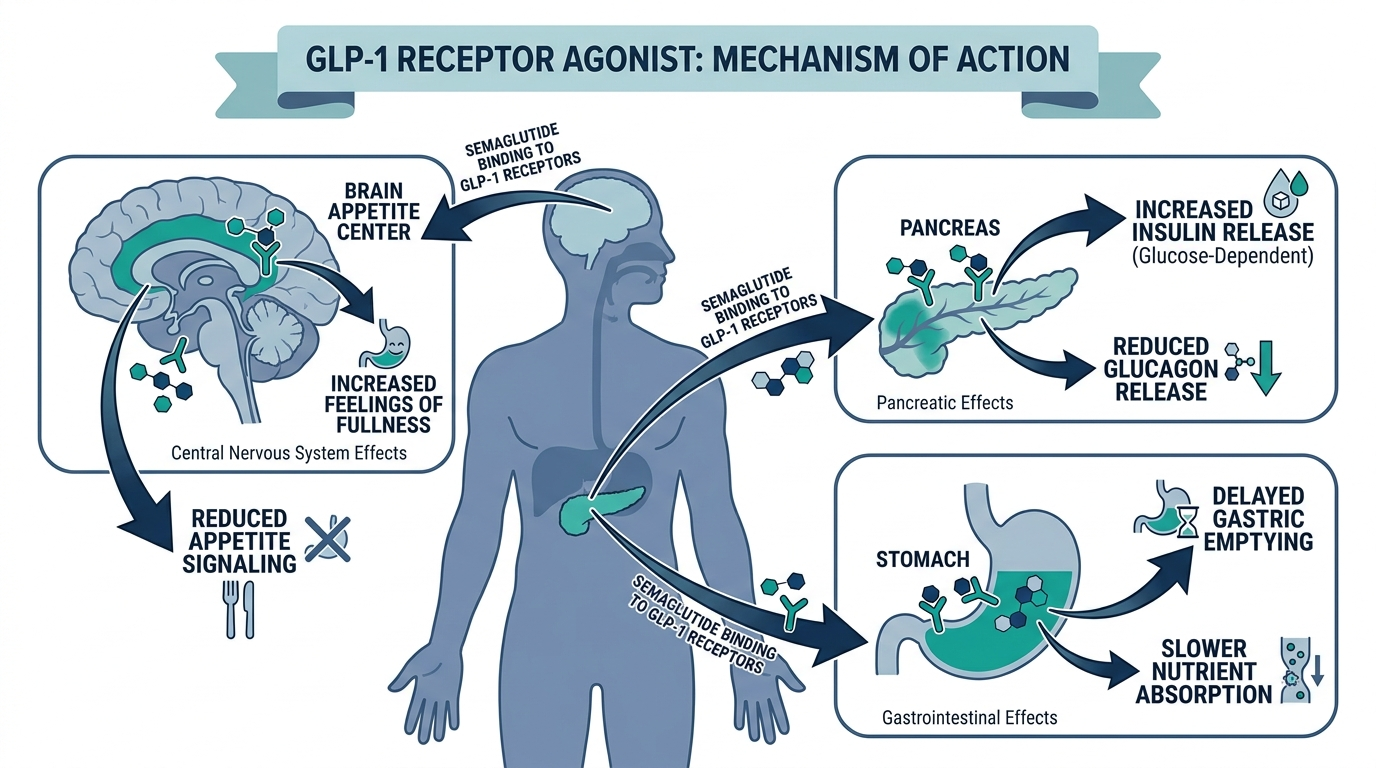
Wegovy works by mimicking a gut hormone called GLP-1 (glucagon-like peptide-1) that your body releases after you eat. Semaglutide is a GLP-1 receptor agonist, which is a long way of saying it switches on the same receptors your natural GLP-1 does, but it lasts about a week per injection instead of minutes.
It drives weight loss through three main mechanisms:
- It slows gastric emptying. Food sits in your stomach longer, so you feel full faster and stay full longer. This is also why nausea is the most common side effect.
- It acts on appetite centers in the brain. Most people describe a dramatic drop in “food noise,” the constant background chatter about snacking. That alone cuts calorie intake.
- It improves insulin response and blood sugar control. This is why the same molecule treats type 2 diabetes.
The combined effect is that people eat several hundred fewer calories a day without white-knuckling it. That is the real magic and the real limitation. When you stop the drug, GLP-1 levels return to baseline, food noise comes roaring back, and most people regain a large share of the weight. In the STEP 1 extension, people who stopped Wegovy regained about two-thirds of their lost weight within a year. That single fact is why the answer to “how long” is usually “keep taking it.”
How fast does Wegovy work for weight loss?
Wegovy starts working within the first few weeks, but the visible scale change usually lags the appetite change. Many people notice reduced hunger and smaller portions within 1 to 2 weeks of the very first 0.25 mg dose, even though that starter dose is too low to drive much weight loss on its own.
A realistic pace:
- Weeks 1 to 4: Appetite drops, scale may barely move. This is normal, do not panic.
- Months 2 to 4: As your dose climbs, weight loss accelerates. Many people lose 1 to 2 percent of body weight per month here.
- Months 4 to 16: Steady loss toward the average 15 percent, then it plateaus as your body reaches a new set point.
If you are six weeks in at full dose and have lost nothing, that is worth a conversation. Sometimes the issue is not the drug at all. A stalled scale on a GLP-1 is often an untreated thyroid problem, insulin resistance, or perimenopausal hormone shifts quietly working against you, and no injection fixes a number you have never measured.
Want a real clinician to run your Wegovy plan, not a gray-market guess?
Joi + Blokes is a telehealth clinic that prescribes GLP-1 medication (Zepbound, compounded semaglutide and tirzepatide), hormone therapy, thyroid care and peptides after a real lab panel and clinician review, with no membership or consult fee (prescriptions from about $59/month, hormone and GLP-1 lab panels from $149). Since how long you stay on Wegovy depends on your actual hormones and metabolism, starting with labs and supervision beats buying unverified vials online. Here is Joi + Blokes reviewed in full.
Does insurance cover Wegovy for weight loss?
Sometimes, and it is the single biggest variable in how long people actually stay on Wegovy. Coverage for weight loss is far patchier than coverage for diabetes, and that gap is the real reason many people stop before they reach maintenance.
What to expect:
- Commercial insurance: Many large employer plans cover Wegovy, but a growing number have dropped or restricted it because of cost. Most require prior authorization, proof of a qualifying BMI, and sometimes documented attempts at lifestyle change first.
- Medicare: Historically did not cover drugs for weight loss alone. As of 2024 to 2025, Wegovy can be covered under Medicare Part D specifically for cardiovascular risk reduction in eligible patients, not for weight loss by itself.
- Medicaid: Varies widely by state. Some states cover anti-obesity meds, many do not.
- Cash price: Without coverage, Wegovy runs roughly $1,000 to $1,350 a month at list price, though Novo Nordisk’s direct-pay program and savings cards can bring eligible patients down to a few hundred dollars a month.
Plan-specific rules matter a lot here. If you want to check your own situation, see does Blue Cross Blue Shield cover weight loss injections and does Cigna cover weight loss medication for how two of the biggest insurers handle prior authorization. This is also why many people end up on compounded semaglutide through telehealth, where the cash cost is far lower, often $150 to $300 a month.
How do I get Wegovy for weight loss?
You get Wegovy through a prescription, and you have three realistic paths. Wegovy is prescription-only, so there is no over-the-counter version, and anything sold without a clinician is a red flag.
- Your primary care doctor. If you meet the BMI criteria, your doctor can prescribe Wegovy and submit the prior authorization to your insurance. This is the cheapest route if your plan covers it.
- An obesity medicine or endocrinology specialist. Useful if you have complicating conditions like PCOS, thyroid disease, or insulin resistance that need managing alongside the drug.
- A legitimate telehealth clinic. Online clinics can prescribe brand Wegovy or, more affordably, compounded semaglutide after a medical intake and often lab work. The key word is legitimate: a real clinician reviews your case, you get bloodwork, and the pharmacy is licensed.
Talk to a clinician before starting or stopping any GLP-1, because dosing, side effects, and what happens when you pause matter more than people assume. Avoid the gray market entirely. “Research peptide” vials sold online with no prescription, no clinician, and no oversight are not the same as a compounded prescription from a licensed pharmacy, and the dosing errors and contamination risks are real. The same logic applies whether you are after semaglutide or looking at how to get Ozempic for weight loss or whether Mounjaro is approved for weight loss.
What stalls people on Wegovy, and the mistakes that end treatment early
The biggest reason people fail on Wegovy is not the drug, it is quitting before it works or sabotaging it without realizing. Here are the patterns clinicians see over and over:
- Rushing the titration. People who jump doses to lose faster get hammered by nausea and quit. Slow and steady reaches a higher dose with fewer side effects.
- Not eating enough protein. Because appetite crashes, people undereat protein and lose muscle along with fat. Aim for 0.7 to 1 gram of protein per pound of goal body weight and lift something heavy a couple of times a week.
- Treating it as a quick course. The people who regain weight are almost always the ones who stopped at goal. Maintenance is the point, not the failure.
- Ignoring a hidden metabolic problem. A stubborn plateau at full dose is frequently an untreated thyroid issue (hypothyroidism slows metabolism), insulin resistance, or low sex hormones in perimenopause or in men with low testosterone. These do not show up unless you test for them.
- No bloodwork at all. Buying vials online and self-injecting means you never see whether your thyroid, insulin, or hormones are working with you or against you.
That last point is where most weight-loss attempts quietly fail. People guess instead of measure. If the scale will not move no matter what you eat or inject, it is usually worth seeing your actual numbers first. Here is how a full-body panel works, including thyroid, insulin, and hormone markers that a GLP-1 alone cannot fix.
Which is better for weight loss, Wegovy or Ozempic?
For weight loss specifically, Wegovy is the better choice because it is the higher-dose, FDA-approved-for-weight version of semaglutide. Ozempic and Wegovy are the same molecule (semaglutide) made by the same company (Novo Nordisk), but they are dosed and labeled differently.
- Wegovy tops out at 2.4 mg weekly and is approved for chronic weight management. Trials show about 15 percent average loss.
- Ozempic tops out at 2.0 mg weekly and is approved only for type 2 diabetes. Using it for weight loss is off label, and the slightly lower max dose generally means somewhat less weight loss.
People often end up on Ozempic for weight loss because insurance covers it for diabetes but not Wegovy for obesity. Medically, if weight loss is the goal and access is equal, Wegovy is the on-label, higher-dose option. If you want even more weight loss and your clinician agrees, Zepbound (tirzepatide) outperforms both with roughly 20 percent or more average loss in SURMOUNT-1.
FAQ
How long can you take Wegovy for weight loss?
There is no maximum time limit. Wegovy is designed for long-term, often indefinite use because obesity is a chronic condition. The longest trials and real-world use now span several years with a continued safety profile. The practical limits are usually cost, insurance, and side effects, not a hard stop on duration.
Can you take Wegovy for weight loss if you do not have diabetes?
Yes. Wegovy is approved for weight loss in adults without diabetes who have a BMI of 30 or higher, or 27 or higher with a weight-related condition. In fact, the flagship STEP 1 trial that showed about 15 percent average loss was done in adults without type 2 diabetes.
What happens if I stop taking Wegovy?
Your appetite and “food noise” usually return within weeks, and most people regain a large portion of the lost weight over the following year. In trial data, people regained roughly two-thirds of their lost weight within about a year of stopping. This is why clinicians plan for a maintenance dose rather than a clean exit.
How fast is weight loss on Wegovy?
Appetite drops within the first 1 to 2 weeks, but visible weight loss usually picks up in months 2 to 4 as the dose increases. A typical pace is about 1 to 2 percent of body weight per month during the active phase, reaching peak loss around month 16.
How do I use Wegovy for weight loss?
Wegovy is a once-weekly self-injection under the skin of the abdomen, thigh, or upper arm, on the same day each week. You start at 0.25 mg and step up roughly every 4 weeks until you reach the 2.4 mg maintenance dose. Pair it with adequate protein, resistance training, and clinician follow-up for the best results.
How much weight loss can I expect on Wegovy?
On average about 15 percent of body weight over 68 weeks for adults without diabetes, based on STEP 1. People with diabetes average closer to 9 to 10 percent. Results vary widely: about a third lose 20 percent or more, while roughly 1 in 10 lose under 5 percent and may need a different drug.
Will insurance cover Wegovy for weight loss?
It depends entirely on your plan. Many commercial plans cover it with prior authorization and a qualifying BMI, but some employers have dropped weight-loss coverage. Medicare covers Wegovy only for cardiovascular risk reduction, not weight loss alone, and Medicaid varies by state. Without coverage, expect roughly $1,000 to $1,350 a month at list price, or lower through manufacturer programs and compounded options.
Is compounded semaglutide the same as Wegovy?
No. Wegovy is the FDA-approved brand of semaglutide. Compounded semaglutide is the same active ingredient mixed by a licensed compounding pharmacy and is not FDA approved, though it can be legally prescribed by a clinician. It is usually much cheaper, often $150 to $300 a month cash, which is why telehealth clinics use it, but quality depends entirely on the pharmacy, so get it through a real clinic, never from unverified online vials.
Do I need bloodwork before starting Wegovy?
It is strongly recommended even though it is not always required. Baseline labs for thyroid, blood sugar, insulin, kidney function, and hormones help your clinician confirm the right plan and catch a hidden metabolic problem that could blunt your results. A stalled scale on a GLP-1 is frequently a thyroid or insulin issue that only shows up on a lab panel.
Vital Signs Today may earn a commission if you buy through links on this page. It does not affect our editorial assessments.