Quick answer: Is Mounjaro approved for weight loss? No. Mounjaro is FDA-approved only for type 2 diabetes, not for weight loss. But the exact same drug, tirzepatide, is FDA-approved for weight loss under a different brand name: Zepbound. So doctors do prescribe Mounjaro off-label for weight loss, and it works. In the SURMOUNT-1 trial, people on the highest dose of tirzepatide lost about 21% of their body weight over 72 weeks, the largest average loss of any approved obesity drug to date.
Is Mounjaro approved for weight loss, or just diabetes?
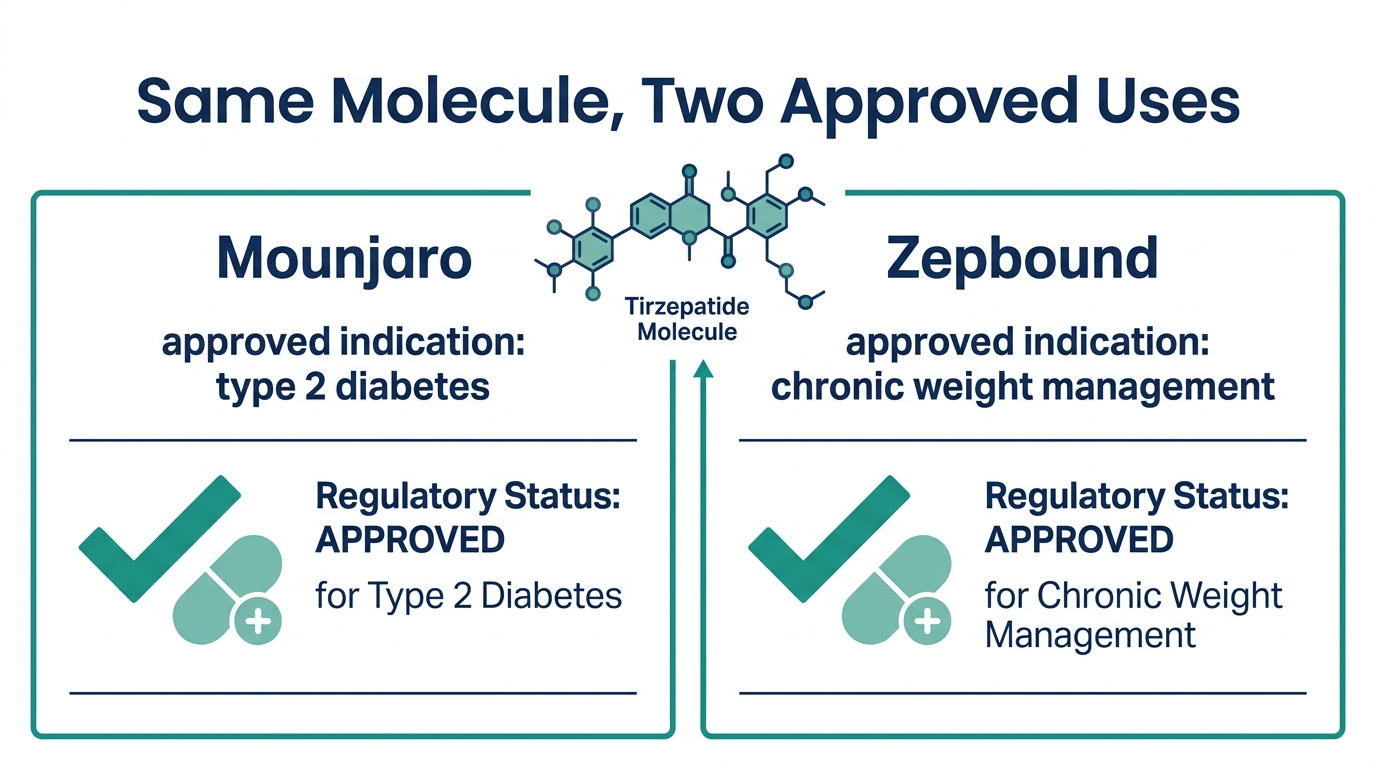
When people ask is Mounjaro approved for weight loss, they are usually surprised by the answer. Mounjaro is approved by the FDA only to improve blood sugar in adults with type 2 diabetes. That is the label. It is not approved as a weight-loss drug, and you will not find an obesity indication on its prescribing information.
Here is the part that confuses almost everyone. The active ingredient in Mounjaro is tirzepatide. The active ingredient in Zepbound is also tirzepatide. Same molecule, same manufacturer (Eli Lilly), same injection pen. Lilly ran a separate set of obesity trials, took the data to the FDA, and got tirzepatide approved for chronic weight management in November 2023 under the name Zepbound. So when someone asks whether tirzepatide is approved for weight loss, the honest answer is yes, but only the Zepbound-branded version carries that approval.
Why two names for one drug? Insurance and marketing. A diabetes drug and an obesity drug get covered under different parts of a plan and priced differently, so splitting the brand lets Lilly play in both lanes. The practical takeaway: a clinician can legally prescribe Mounjaro off-label for weight loss, but if weight is the goal and you want an on-label option, Zepbound is the version designed for it.
Does Mounjaro help with weight loss, and how does it work?
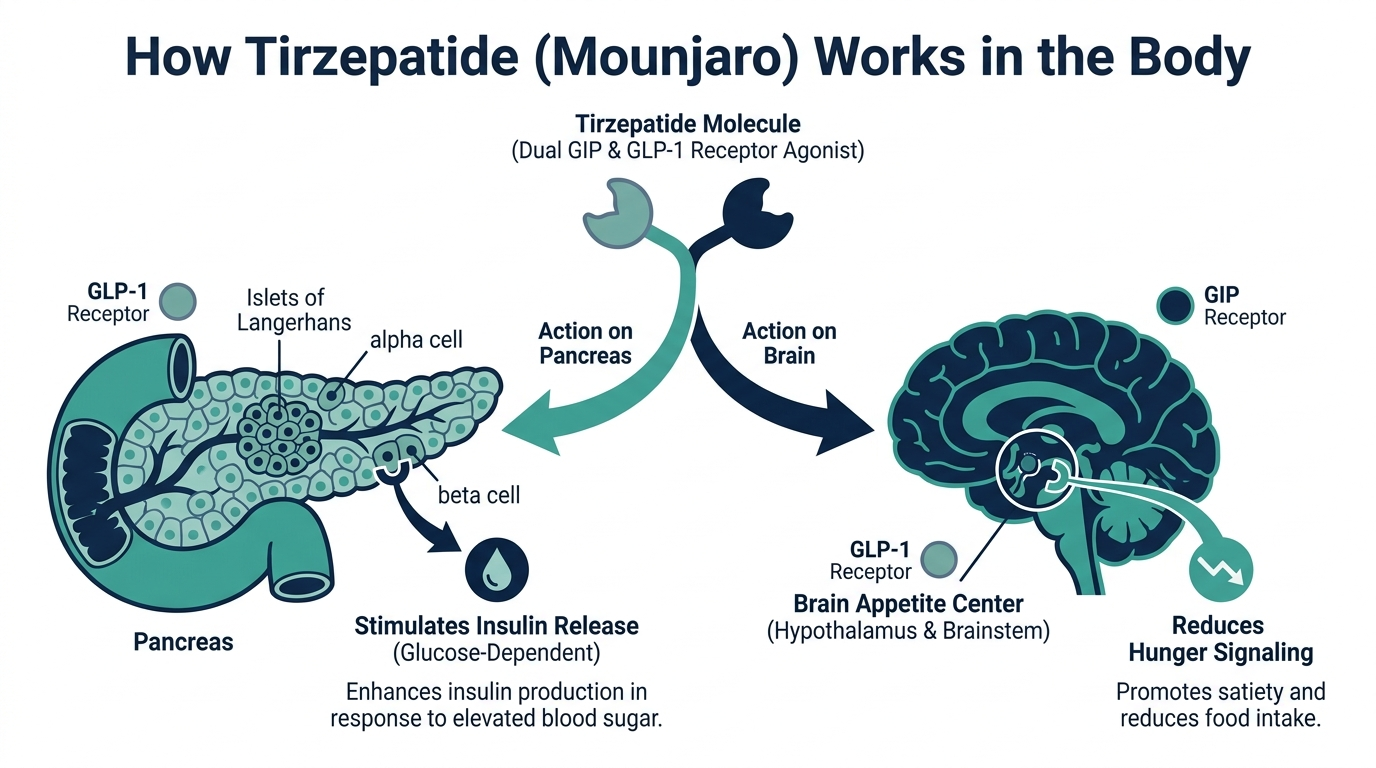
Yes, Mounjaro helps with weight loss, and the mechanism is why it beats the older drugs. Tirzepatide is a dual agonist. It mimics two gut hormones at once: GLP-1 and GIP. Most earlier injections (Wegovy, Ozempic, Saxenda) only hit GLP-1.
Both hormones do useful things. They slow how fast your stomach empties, so a normal meal keeps you full for hours instead of 45 minutes. They signal the brain’s appetite centers to turn down hunger and the “food noise” that has you thinking about snacks all afternoon. And they improve how your body handles insulin, which matters if you are insulin-resistant. Hitting GIP on top of GLP-1 is the leading theory for why tirzepatide outperforms single-hormone drugs in head-to-head data.
The honest insider detail: these drugs do not melt fat. They shrink how much you eat by making you genuinely not hungry. The weight comes off because your calorie intake drops, often dramatically, without the white-knuckle willpower that makes ordinary diets fail by week three.
How much weight loss on Mounjaro, and how fast does it work?
On average, people lose roughly 15% to 21% of their body weight on tirzepatide over about 16 to 18 months, depending on dose. The numbers come from SURMOUNT-1, the pivotal obesity trial.
In that trial, adults with obesity and without diabetes who reached the highest maintenance dose (15 mg) lost about 21% of their starting weight over 72 weeks. The 10 mg group lost around 19%, and the 5 mg group around 15%. For a 250-pound person, 21% is roughly 52 pounds. People with type 2 diabetes tend to lose somewhat less, which is a known pattern with every GLP-1 class drug.
Speed matters too, because the early weeks set expectations. Here is the realistic timeline.
| Time on Mounjaro | What usually happens | Typical dose |
|---|---|---|
| Weeks 1 to 4 | Appetite drops noticeably. 2 to 6 lbs off, some of it water. “Food noise” quiets. | 2.5 mg (starter, not therapeutic) |
| Weeks 4 to 12 | Steady loss as dose climbs. 1 to 2 lbs a week is common. | 5 to 7.5 mg |
| Months 4 to 9 | The bulk of the loss. Doses titrate toward 10 to 15 mg. | 10 to 15 mg |
| Months 12 to 18 | Loss slows and plateaus near your new set point. | Maintenance dose |
On dosing: you start at 2.5 mg once a week and step up roughly every four weeks if you tolerate it (2.5, 5, 7.5, 10, 12.5, then 15 mg), one injection a week in the abdomen, thigh, or upper arm. The 2.5 mg start is deliberately too low to do much; it just lets your gut adjust. The max is 15 mg, but many people get excellent results at 7.5 or 10 mg and stay there, because going higher only adds side effects without much extra loss. The right dose is the lowest one that keeps appetite controlled and the scale moving.
Is Mounjaro safe for weight loss?
For most healthy adults with obesity, tirzepatide is considered safe under medical supervision, with side effects that are usually gut-related and fade over time. It is not for everyone, and the gray-market version is where people get hurt.
The common side effects are nausea, constipation or diarrhea, burping, and occasional vomiting, mostly during dose increases. Eating smaller, lower-fat meals and going up in dose slowly takes the edge off. The serious but rarer risks include pancreatitis, gallbladder problems (rapid weight loss itself raises gallstone risk), and dehydration from severe vomiting.
You should not take tirzepatide if you or a close family member has had medullary thyroid carcinoma or the genetic syndrome MEN 2, or if you have had pancreatitis. It is not for pregnancy. Talk to a clinician before starting or stopping any GLP-1 medication, because these are real drugs with real interactions, not supplements.
The bigger safety problem in 2026 is sourcing. When brand pens are scarce or pricey, people buy “tirzepatide” from sketchy online sellers, overseas pharmacies, or peptide sites labeled “not for human use.” That product is unregulated. Dosing errors and contamination are the real danger here, far more than the drug itself. If you are going to use a powerful injectable, use one that came from a licensed pharmacy with a clinician checking your labs.
Is Ozempic or Mounjaro better for weight loss? And what about Wegovy?
For pure weight loss, Mounjaro (tirzepatide) beats Ozempic and Wegovy (semaglutide) on average, because it hits two hormones instead of one. In the SURMOUNT-5 head-to-head trial, tirzepatide produced clearly greater weight loss than semaglutide over 72 weeks.
A quick map of who is who, because the brand soup trips people up.
| Brand | Drug | FDA-approved for | Avg. weight loss (trial) | Hormones |
|---|---|---|---|---|
| Mounjaro | Tirzepatide | Type 2 diabetes (used off-label for weight) | ~21% (SURMOUNT-1, 15 mg) | GLP-1 + GIP |
| Zepbound | Tirzepatide | Weight loss | ~21% (SURMOUNT-1) | GLP-1 + GIP |
| Ozempic | Semaglutide | Type 2 diabetes (used off-label for weight) | ~15% (STEP, weekly) | GLP-1 only |
| Wegovy | Semaglutide | Weight loss | ~15% (STEP 1) | GLP-1 only |
“Better” is not only about the average number, though. Some people tolerate semaglutide better. Insurance may cover one and not the other. And the older drug having been on the market longer means more long-term real-world data. If you want a fuller breakdown of the injectable options, see what is the best injection for weight loss. The short version: tirzepatide wins on average pounds lost, but the best drug is the one you can actually get, afford, and stay on.
How to get a Mounjaro prescription for weight loss
You get Mounjaro for weight loss through a licensed clinician who prescribes it off-label, either your primary care doctor, an obesity-medicine specialist, or a telehealth clinic. There is no legitimate way to buy real Mounjaro without a prescription, and you should not try.
The standard path looks like this:
- Get evaluated. A clinician confirms you are a candidate, usually a BMI of 30 or higher, or 27 plus a weight-related condition like prediabetes, high blood pressure, or sleep apnea.
- Run baseline labs. Good prescribers check A1C, kidney and liver function, lipids, and often thyroid before starting, because a stalled metabolism sometimes has a fixable hormonal cause that a drug should not paper over.
- Get the script and titrate. Start at 2.5 mg, step up monthly, and check in for side effects and progress.
In practice, many people now use telehealth because in-person obesity specialists are booked out for months and Mounjaro itself has had supply swings. The key is choosing a clinic that does real medicine: actual labs, a clinician who reviews them, and follow-up, not a website that mails you vials after a 30-second checkbox quiz. If your insurance balks at brand Mounjaro for weight loss (it usually will, more on that below), a reputable telehealth clinic can often prescribe Zepbound or properly sourced compounded tirzepatide from a licensed pharmacy as a cash-pay route.
Want a real clinician on tirzepatide, not a gray-market vial?
Joi + Blokes is a telehealth clinic that prescribes GLP-1 medication (Zepbound, compounded semaglutide and tirzepatide), hormone therapy (TRT, HRT), thyroid care and peptides after a real lab panel and clinician review, with no membership or consult fee (prescriptions from about $59/month, hormone and GLP-1 lab panels from $149). Since Mounjaro is rarely covered for weight loss, this is a clean cash-pay way to get supervised tirzepatide with labs behind it. Here is Joi + Blokes reviewed in full.
Will insurance cover Mounjaro for weight loss?
Usually not. Most US insurance plans cover Mounjaro only for type 2 diabetes, and they explicitly exclude GLP-1 drugs prescribed for weight loss. This is the single biggest frustration patients hit.
The reason is cost: these drugs are expensive and many people would qualify, so insurers carve out obesity coverage to protect their budgets. A few things shift the odds:
- If you have type 2 diabetes, Mounjaro is often covered, because then it is being used on-label. The weight loss comes along for the ride.
- Some plans cover Zepbound for weight loss even when they will not cover Mounjaro for it, because Zepbound is on-label for obesity. Asking your plan about Zepbound specifically can change the answer.
- Prior authorization is almost always required, and many plans demand documented BMI, a weight-related condition, and sometimes proof you tried diet and lifestyle first.
- Medicare generally does not cover weight-loss drugs, though it may cover them when prescribed for diabetes or certain heart conditions.
Coverage varies wildly by carrier and even by employer group within the same carrier. It is worth checking your specific plan: see what we found on whether Blue Cross Blue Shield covers weight loss injections and on whether Cigna covers weight loss medication. Two people with the same logo on their card can get opposite answers.
How much is Mounjaro for weight loss without insurance?
Without insurance, brand Mounjaro typically runs about $1,000 to $1,300 a month at US pharmacy list price, though manufacturer savings programs and self-pay pricing can bring it down. That is the cash sticker that pushes most people toward alternatives.
Here is the realistic 2026 cost picture by route.
| Route | Typical monthly cash cost | Notes |
|---|---|---|
| Brand Mounjaro (list price) | ~$1,000 to $1,300 | Off-label for weight; savings cards mainly help people with commercial insurance |
| Brand Zepbound (self-pay vials) | ~$350 to $500+ | Lilly has offered lower-priced single-dose vials for cash-pay patients |
| Compounded tirzepatide | ~$200 to $450 | Not FDA-approved; legal only through a licensed pharmacy with a prescription |
| With insurance (covered) | ~$25 to $100 copay | Only if your plan covers it, usually for diabetes |
Two honest cautions. Compounded tirzepatide is not FDA-approved; it can be legally dispensed by a licensed compounding pharmacy with a valid prescription, but it lacks the FDA manufacturing oversight that brand pens carry, so the pharmacy matters. And prices move as supply shifts, so treat any number as a range, not a promise.
What stalls people on Mounjaro (and the mistake almost everyone makes)
Most people who “fail” on Mounjaro did not fail on the drug. They stalled for reasons a clinician should have caught. The pattern is consistent.
- Quitting and rebounding. This is the big one. Tirzepatide suppresses appetite while you take it. Stop, and hunger returns, and so does much of the weight, because obesity is chronic, not a one-time fix. In follow-up data, people who came off tirzepatide regained a large share of what they lost. The drug is a long-term tool, not a 12-week detox. (Same story with semaglutide, which is why how long you take Wegovy for weight loss is the question that actually decides your result.)
- Losing muscle, not just fat. Rapid loss without protein and resistance training strips muscle, which tanks your metabolism and sets up the rebound. Aim for ~0.7 to 1 g of protein per pound of goal weight and lift something twice a week.
- Treating the scale as the only data point. A stalled scale is often an insulin, thyroid, or sex-hormone problem the drug cannot see. If your weight will not move despite real appetite suppression, the lever is usually your metabolic numbers, not a higher dose. This is exactly why good prescribers run labs first and recheck them, and why testing your hormones and metabolic markers up front beats guessing. If the scale is stuck no matter what you do, it is worth seeing your actual numbers; here is how a full-body panel works.
- Going gray-market to save money, then under- or over-dosing. Unregulated vials with no clinician and no labs is how a safe drug becomes a dangerous one.
The throughline: Mounjaro works best as one input in a supervised plan, with labs, protein, training, and a clinician adjusting the dose, not as a vial you inject in a vacuum and hope.
FAQ
Is Mounjaro FDA-approved for weight loss?
No. Mounjaro is FDA-approved only for type 2 diabetes. The identical drug, tirzepatide, is FDA-approved for weight loss under the brand name Zepbound. Doctors prescribe Mounjaro off-label for weight loss legally, but it does not carry an obesity indication itself.
How fast does Mounjaro work for weight loss?
Appetite usually drops within the first week or two, and most people see 2 to 6 pounds gone in the first month. Steady loss of 1 to 2 pounds a week tends to kick in as the dose climbs over months two through nine. The biggest results come between months four and twelve.
How much weight can you lose on Mounjaro?
On average, about 15% to 21% of body weight over roughly 16 to 18 months, based on the SURMOUNT-1 trial, with the highest dose producing the most loss. For a 250-pound person, the top end is around 52 pounds. Results vary, and people with diabetes typically lose somewhat less.
Is Wegovy or Mounjaro better for weight loss?
On average loss, Mounjaro (tirzepatide) edges out Wegovy (semaglutide), because it activates two gut hormones instead of one. In a head-to-head trial, tirzepatide produced greater weight loss. That said, the best choice depends on tolerance, cost, and which one your insurance will actually cover.
How can I get Mounjaro for weight loss?
Through a licensed clinician: your primary care doctor, an obesity-medicine specialist, or a telehealth clinic that prescribes it off-label after evaluating you and running baseline labs. There is no safe or legal way to buy real Mounjaro without a prescription.
Does insurance cover Mounjaro for weight loss?
Usually not for weight loss alone, because most plans cover Mounjaro only for type 2 diabetes. Some plans will cover Zepbound (the on-label obesity version) instead. Prior authorization is almost always required, and coverage differs by carrier and employer.
How much is Mounjaro per month for weight loss?
Brand Mounjaro runs about $1,000 to $1,300 a month at list price without insurance. Self-pay Zepbound vials and compounded tirzepatide are cheaper, often in the $200 to $500 range, while a covered plan might mean a $25 to $100 copay.
Is Mounjaro safe for long-term weight loss?
For most healthy adults under medical supervision, yes, with monitoring. Side effects are mostly gut-related and ease over time, and serious risks like pancreatitis are uncommon. The real danger is unregulated gray-market product and stopping abruptly, which usually leads to weight regain.
What happens if I stop taking Mounjaro?
Appetite returns, and most people regain a significant portion of the weight they lost, because obesity is a chronic condition the drug manages rather than cures. That is why clinicians treat tirzepatide as a long-term medication and pair it with protein, strength training, and lab monitoring rather than a short course.
Can I get Mounjaro for weight loss if I do not have diabetes?
Yes, a clinician can prescribe it off-label if you qualify, typically a BMI of 30 or higher, or 27 with a weight-related condition. Without diabetes, insurance is far less likely to cover it, so many people use self-pay Zepbound or compounded tirzepatide through a telehealth clinic. If you want help comparing access routes, see how to get Ozempic for weight loss for a parallel walkthrough.
Vital Signs Today may earn a commission if you buy through links on this page. It does not affect our editorial assessments.