
Last updated 18 June 2026. Educational content, not medical advice. Semax is not FDA-approved in the United States. Talk to a licensed clinician before using any peptide.
Short answer: Semax is a synthetic heptapeptide derived from ACTH fragment 4-10 that raises brain-derived neurotrophic factor (BDNF) within minutes of intranasal administration. It has been a licensed pharmaceutical in Russia since the early 2000s for stroke recovery, optic nerve disease, and cognitive impairment, and as of April 2026, the FDA removed it from its Category 2 restriction list, scheduling a formal PCAC review for July 24, 2026 that could open the door to legal compounding in the US.
Semax raises BDNF in animal studies, but your own inflammation and metabolic markers are what’s provable for you today. One at-home Superpower draw checks 100+ biomarkers, physician-reviewed.
What exactly is Semax, and where does it come from?
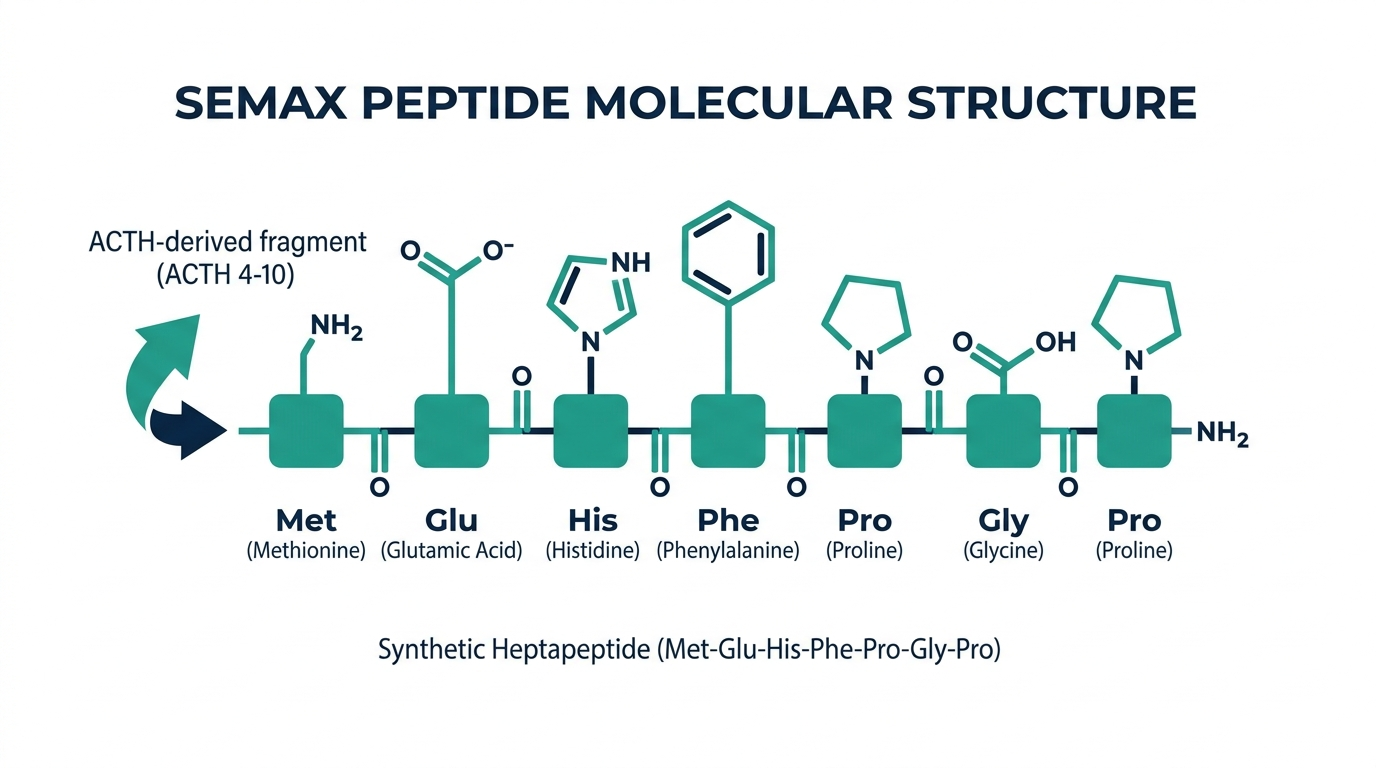
Semax has an unusually precise origin story. In 1982, a research team led by academicians Nikolai Myasoedov and Igor Ashmarin at the Institute of Molecular Genetics of the Russian Academy of Sciences in Moscow set out to solve a specific problem: ACTH fragments 4-7 had potent nootropic activity in animal models, but the naked sequence degraded in plasma within minutes, making it clinically useless.
Their solution was to add a stabilizing Pro-Gly-Pro tripeptide to the C-terminus of the ACTH(4-7) core. The resulting seven-amino-acid sequence, Met-Glu-His-Phe-Pro-Gly-Pro, is Semax. The Pro-Gly-Pro tail does two things: it blocks the enzymatic cleavage that destroyed the shorter fragment, and it contributes independent anti-inflammatory properties of its own. The full peptide retains the neurotrophic signaling of ACTH without any of the adrenal hormonal effects that make full-length ACTH impossible to use for cognition.
By the early 2000s, Semax was approved in Russia and Ukraine for ischemic stroke, transient ischemic attack, optic nerve disease, and cognitive impairment. It appears on Russia’s List of Vital and Essential Drugs, and Russian hospital protocols describe two approved concentrations: 0.1% nasal drops for cognitive disorders and the 1% formulation for acute stroke (Wikipedia: Semax).
That 40-year clinical history in a real healthcare system is the single most important context most English-language sources skip entirely.
How does Semax work in the brain?
Semax operates through three overlapping pathways that together explain why it generates interest in both clinical stroke research and the broader nootropic community.
Pathway 1: BDNF and NGF upregulation. This is Semax’s best-documented mechanism. Within minutes of intranasal administration, Semax activates CREB (cyclic AMP response element-binding protein) signaling in the hippocampus and prefrontal cortex, which drives increased gene expression of BDNF (brain-derived neurotrophic factor) and NGF (nerve growth factor). A 2006 preclinical study documented a maximal 1.4-fold increase in BDNF protein in rat hippocampal tissue. BDNF is sometimes called the brain’s “fertilizer” because it promotes neuronal survival, synaptic plasticity, and the formation of new connections that underlie learning and memory.
Pathway 2: Neurotransmitter modulation. Semax enhances dopamine and serotonin synthesis in prefrontal circuits and inhibits enzymes that break down enkephalins, the brain’s own opioid-like molecules linked to pain relief and mood regulation. This is why users commonly describe a sharpening of attention and motivation rather than sedation. The dopaminergic component is also why Semax carries a contraindication in individuals with bipolar disorder or psychosis: dopaminergic activation can destabilize mood in vulnerable populations.
Pathway 3: Anti-inflammatory and neuroprotective signaling. A 2021 study from the Institute of Molecular Genetics, Pirogov Russian National Research Medical University, and the A. Tsyb Medical Radiological Research Center used a rat transient middle cerebral artery occlusion model to show that Semax downregulated phosphorylated JNK in brain tissue and increased pCREB activation in subcortical structures by more than 1.5-fold. JNK is a stress-activated kinase implicated in neuronal death after ischemia; suppressing it while simultaneously boosting the recovery-associated pCREB pathway is the molecular signature of neuroprotection, not just performance enhancement.
What does the actual clinical evidence show?
This is where a clear-eyed read of the data matters more than the marketing.
The most cited human study comes from the Gusev group at the Russian National Research Medical University. A 2018 observational study enrolled 110 post-stroke patients (43 men, 67 women; mean age 58.0 years) and administered Semax at 6,000 mcg per day intranasally in two 10-day courses separated by a 20-day interval. The study reported improved Barthel index scores and MRC motor-scale scores at 5-month follow-up compared to baseline. An earlier 1997 trial from the same group enrolled 30 acute hemispheric stroke patients receiving 12-18 mg/day for 5-10 days and reported accelerated recovery of motor deficits versus 80 controls.
Do not take these studies at face value, though. Both are non-randomized, non-placebo-controlled, and neither reported numerical effect sizes, confidence intervals, or p-values in a form that satisfies modern standards. The evidence for Semax in stroke recovery is genuinely positive in direction, but it is not the kind of RCT data a Western regulator would accept for a new drug approval. What it is, accurately described, is 20-plus years of institutional clinical use supporting a reasonable safety and probable-benefit picture in a specific impaired population.
For healthy-adult cognitive enhancement, the honest answer is different: the evidence is mechanistic inference and self-report. Semax raises BDNF. BDNF promotes synaptic plasticity. Synaptic plasticity underlies learning. But that chain of logic is not the same as a randomized trial showing that healthy people who take Semax score better on cognitive tests than those who take placebo. That trial has not been done with adequate methodology.
A 60-patient Russian trial did find improved attention, working memory, and mental fatigue scores at Day 28 in patients with cognitive impairment, but again, impaired populations routinely respond to interventions that fail to move the needle in healthy subjects.
Full-body lab membership: 100+ biomarkers, doctor-reviewed, tracked over time.
How is Semax different from Selank, its closest relative?
Semax and Selank are the two most studied nootropic peptides out of the Russian Academy of Sciences, and they are frequently confused because both are administered as nasal sprays, both share the stabilizing Pro-Gly-Pro C-terminus, and both come with decades of institutional use behind them. The differences, however, are structural and experiential.
| Feature | Semax | Selank |
|---|---|---|
| Derived from | ACTH(4-7) fragment | Tuftsin (IgG Fc fragment) |
| Primary mechanism | BDNF/NGF via CREB, dopaminergic | GABAergic modulation, enkephalin stabilization |
| Subjective profile | Activating, stimulating, focus-sharpening | Calming, anxiolytic, stabilizing |
| Russian approval | Stroke, optic nerve, cognitive impairment | Anxiety disorder |
| Contraindication concern | Bipolar, psychosis, anxiety-prone individuals | Fewer stimulating effects, lower arousal risk |
| Best suited for | Brain fog, low drive, executive dysfunction | Rumination, stress reactivity, sleep disruption |
The two compounds work through non-overlapping mechanisms, which is why they are commonly stacked together. Semax provides the cognitive sharpening while Selank smooths out any edge of irritability or overstimulation. Whether to use one or both, and at what dose, is a clinical decision, not a forum recommendation.
Personally, the distinction that matters most is the anxiety question. A 1996 study identified what the authors called an “anxiogenic component” in Semax’s behavioral effects, noting the peptide would be optimally useful in people without elevated baseline anxiety. If stress and anxiety are the primary complaint, starting with Selank makes more pharmacological sense than starting with Semax.
What is Semax’s legal status in the United States in 2026?
This has changed significantly in the past 12 months, and most older articles have not caught up.
For most of 2023 through early 2026, the FDA had placed Semax on its 503A Category 2 list, the classification for bulk drug substances it determined “may present significant safety risks” for compounding. That designation effectively blocked licensed US pharmacies from including it in compounded preparations.
On April 15, 2026, the FDA published a revised 503A document that removed Semax (both acetate and free-base forms) from Category 2. The removal was part of a broader regulatory shift following a February 2026 HHS announcement (publicized on the Joe Rogan Experience on February 27, 2026) that approximately 14 peptides were expected to move toward Category 1 status. The FDA’s Pharmacy Compounding Advisory Committee is now scheduled to formally review Semax on July 24, 2026, alongside Emideltide (DSIP) and Epitalon.
What does this mean practically? As of mid-2026, Semax sits in regulatory transition. Some 503A compounding pharmacies in certain states are already compounding it pursuant to patient-specific prescriptions from licensed providers. The July 24 PCAC review will determine whether it formally enters Category 1, which would standardize compounding access nationwide.
Semax remains not FDA-approved as a finished drug product and is not available over the counter. Research-chemical vendors also sell it “for laboratory use only,” but the risks of that route, including unknown purity and no prescriber oversight, are the same risks that apply to every research peptide.
Who has used Semax clinically, and for what conditions?
The approved Russian indications give the clearest picture of the population where Semax has genuine clinical evidence:
Ischemic stroke and TIA. The 1% concentration nasal formulation (sold as “Semax 1%”) is the registered product for stroke. Russian neurological protocols describe it as an adjunct to standard care in the acute phase, not a standalone treatment.
Optic nerve disease. A randomized controlled trial in optic neuritis demonstrated reduced visual field deficits, which formed the basis for Semax’s approval in this indication. This is one of the more rigorously designed Russian studies and is notable because optic nerve tissue responds differently to neuroprotective agents than cortical tissue.
Cognitive impairment and asthenia. The 0.1% formulation is used for cognitive disorders, fatigue, and periods of high cognitive demand such as exam preparation or recovery from illness. Russian prescribers describe dosing ranges from 200 to 1,000 mcg/day intranasally for these indications.
ADHD-adjacent use. Some Russian clinicians have applied Semax in attention-deficit presentations, citing its dopaminergic and cholinergic effects on prefrontal executive function. This is off-label use even within Russia, and no controlled trial has been conducted specifically in diagnosed ADHD populations.
The insider read here: Semax was never designed as a performance drug for healthy young professionals. Its clinical development was aimed squarely at damaged or declining nervous systems. That does not make it useless outside those populations, but it should recalibrate expectations based on the actual evidence base.
What are the reported side effects and who should avoid it?
The Russian trial data and post-market reporting describe a reasonably clean safety profile at doses used clinically, with the following caveats:
Common, mild: Nasal irritation or tingling at the administration site (most frequent and typically transient), mild headache after dosing, fatigue in some individuals during the first few days.
Less common, dose-dependent: Irritability, mood changes, and sleep disruption, particularly if doses are taken later in the day. The dopaminergic activation can produce a stimulant-like difficulty in winding down.
Significant contraindications: Individuals with a history of bipolar disorder or psychosis should avoid Semax. The dopaminergic activation can destabilize mood cycling and amplify psychotic symptoms. Individuals with a primary anxiety disorder should also exercise caution: the 1996 paper documenting Semax’s anxiogenic component was explicit that the peptide’s risk-benefit calculus shifts unfavorably in high-anxiety individuals.
Unknown territory: Semax has not been studied in pregnancy, breastfeeding, or pediatric populations. No long-term (over 12-month continuous) safety data exists in any population outside short-course clinical use.
Personally, I think the most important safety point is the one the vendor pages universally omit: because Semax raises BDNF rapidly, and BDNF is involved in neuroplasticity broadly, there is a theoretical concern about amplifying plasticity in neural circuits that are already dysregulated, which is exactly the situation in untreated mood disorders. That concern is speculative, but it is the reason the bipolar/psychosis contraindication exists and should be taken seriously.
Telehealth GLP-1 program with provider visits and pharmacy coordination.
How does Semax get from the nose to the brain?
The intranasal delivery route is not incidental to how Semax works. It is the design.
Conventional drug delivery faces what pharmacologists call the blood-brain barrier: the tight junctions between the endothelial cells lining brain capillaries block most water-soluble molecules from crossing from blood into brain tissue. Semax, at 887 Daltons, is too large to cross the blood-brain barrier efficiently via systemic circulation.
The olfactory pathway bypasses this entirely. The olfactory epithelium in the upper nasal cavity contains olfactory receptor neurons whose axons project directly through the cribriform plate of the skull into the olfactory bulb. Molecules deposited on this tissue can travel along this nerve pathway into the central nervous system without entering the bloodstream at all. Published studies confirm BDNF and TrkB receptor elevation within minutes of intranasal Semax administration via this route.
This is why Semax works intranasally at doses 10 to 20 times lower than would be required subcutaneously. The flip side: nasal administration is highly technique-dependent. Directing the spray too far anteriorly deposits it on nasal mucosa where it gets absorbed systemically rather than directed to the olfactory epithelium. Russian clinical protocols specify tilting the head slightly forward and directing the spray toward the posterior superior nasal cavity.
Semax compared to other nootropic peptides: the honest map
For someone new to neuropeptides, the landscape is confusing because “nootropic peptide” covers a range of completely different molecules with different mechanisms, different evidence bases, and different risk profiles.
| Peptide | Primary mechanism | Evidence quality | US regulatory status |
|---|---|---|---|
| Semax | BDNF/NGF upregulation, dopaminergic | Moderate (20+ years Russian clinical) | Not approved; PCAC review July 2026 |
| Selank | GABAergic/enkephalin | Moderate (Russian clinical, anxiety) | Not approved; similar trajectory |
| BPC-157 | Angiogenesis, gut repair, tendon | Mostly preclinical | Removed from Cat 2 April 22, 2026 |
| Dihexa | IGF-1 pathway amplification | Only preclinical (no human data) | Research only |
| NAD+ precursors | Mitochondrial energy, sirtuins | Substantial human data | Supplement (OTC) |
| GLP-1 peptides | Incretin, metabolic, possible neuroprotection | Extensive human RCT data | FDA-approved |
The table shows why Semax occupies a genuinely unusual position: it has more real clinical use behind it than most research peptides, but far less rigorous RCT evidence than FDA-approved drugs. It is not a supplement and not a drug. That middle space requires a clinician who understands where the evidence begins and ends.
Curious what your own levels look like?
Baseline 100+ biomarkers today and retest as life changes, all in one membership with physician review.
Frequently asked questions
What is Semax peptide used for?
In Russia and Ukraine, where it is an approved pharmaceutical, Semax is used clinically for ischemic stroke recovery, optic nerve disease, and cognitive impairment. Researchers and some clinicians also investigate it for cognitive enhancement, neuroprotection, ADHD-adjacent attention difficulties, and as a complement to other peptide protocols. Its use in healthy adults for performance enhancement is based on mechanistic evidence and clinical self-report rather than controlled trials.
Is Semax a steroid or a hormone?
No. Semax is derived from a fragment of ACTH, which is a hormone, but Semax itself has no hormonal activity. It does not bind adrenal receptors, does not influence cortisol production, and does not produce androgenic effects. It is a small neuropeptide that acts on neurotrophin pathways and neurotransmitter systems.
How is Semax administered?
The well-documented clinical route is intranasal, directing the spray toward the olfactory epithelium in the posterior superior nasal cavity to exploit the olfactory pathway’s direct access to the brain. Some researchers have also studied subcutaneous injection, but this requires significantly higher doses to achieve comparable central nervous system exposure. Russian clinical doses range from 200 to 1,000 mcg/day for cognitive applications and up to 6,000 mcg/day (in two 10-day courses) for stroke rehabilitation.
Is Semax legal in the United States?
As of mid-2026, Semax is not FDA-approved as a finished drug and is not available over the counter. However, it was removed from the FDA’s 503A Category 2 restriction list on April 15, 2026, and a formal PCAC review is scheduled for July 24, 2026. Some licensed 503A compounding pharmacies can now compound it pursuant to a patient-specific prescription from a licensed US clinician. Research-chemical vendors also sell it “for laboratory use only,” which is a separate legal category that places full risk on the purchaser.
What is the difference between Semax and Semax amidate?
Semax amidate (also called N-Ac Semax amidate or “Semax with an amide group”) has a modified C-terminus that further slows enzymatic degradation, extending its active half-life in nasal tissue. Some users report it as more potent at lower doses. The clinical approval and published trial data covers the original Semax sequence; the amidate form has more limited independent evidence but is based on the same core mechanism.
Can Semax be taken with other nootropics?
The most studied combination is Semax with Selank. These two peptides work through complementary, non-overlapping pathways: Semax’s activating dopaminergic effect and Selank’s calming GABAergic modulation can offset each other’s edge cases. Stacking Semax with racetams (piracetam, aniracetam) or with microdosed stimulants is discussed in community forums but has no controlled trial data. Any combination use should be supervised by a clinician who can monitor for compounding dopaminergic effects.
Who should not use Semax?
Individuals with a history of bipolar disorder, psychosis, schizoaffective disorder, or severe anxiety disorder should avoid Semax without clinical supervision. The dopaminergic activation can destabilize mood cycling and amplify anxiety in susceptible individuals. Semax should also not be used in pregnancy, breastfeeding, or in pediatric populations due to absence of safety data. These are not disclaimers for legal cover; they are documented concerns from the Russian trial literature.
The bottom line on Semax in 2026
Semax is one of the few “nootropic peptides” that has actual decades-long clinical use behind it, rather than a stack of animal studies and enthusiastic forum posts. That history is genuine and worth crediting. The 2026 regulatory shift, with the FDA formally reviewing it for compounding access in July, represents the most significant opening for legitimate US clinical use in the compound’s history.
What Semax is not: a proven cognitive enhancer in healthy adults via controlled trial, an FDA-approved treatment for any condition, or a risk-free supplement you can self-administer without understanding the side effect profile.
The practical implication for 2026: if you are interested in Semax, the legal telehealth route is both the safest and, for the first time, a realistic option in the US, with prescribers who can evaluate whether the dopaminergic profile makes sense for your specific neurology before you start.
Telehealth GLP-1 program with provider visits and pharmacy coordination.
Author: Vital Signs Today Editorial Team, [credential]”]. Educational content, not medical advice. Sources linked inline.
Primary sources
- Semax – Wikipedia: structural overview, Russian approval history, mechanism summary
- PMC8226508: Brain Protein Expression Profile Confirms the Protective Effect of Semax in Rat Cerebral Ischemia-Reperfusion: 2021 preclinical study, pJNK/pCREB/MMP-9 data from Institute of Molecular Genetics and Pirogov University
- ResearchGate: Semax effect on BDNF level in rat hippocampus: BDNF upregulation data referenced
- Newtropin: Semax FDA Status 2026: April 15, 2026 FDA document change, July 24, 2026 PCAC review schedule
- Superpower: Semax Guide: Gusev 2018 trial details (n=110), Gusev 1997 trial details (n=30), BDNF plasma data
- PeakedLabs: Semax Peptide Evidence and Dosing 2026: dose ranges, mechanism pathways, side effect profile
- Exploring Peptides: What Is Semax?: Myasoedov/Ashmarin 1982 origin at Institute of Molecular Genetics
- Synapse/Patsnap: Mechanism of Semax: receptor binding, CREB pathway, neurotransmitter modulation
Related reading
Vital Signs Today may earn a commission if you buy through links on this page. It does not affect our editorial assessments.