You went in short of breath, maybe with swollen ankles or a cough that would not quit, and the emergency room drew a tube of blood and ran something called a BNP. The number came back, the doctor nodded or frowned, and a decision about your heart got made in minutes. For a test that quietly steers so many of those decisions, almost nobody explains what it actually is.
BNP can be thrown off by more than your heart. See it alongside a fuller panel for real context. One at-home Superpower draw checks 100+ biomarkers, physician-reviewed.
Here is the short version, and then the part that even a lot of patients with heart failure never get told. BNP is not a heart enzyme that leaks when the heart is damaged. It is a hormone your heart deliberately releases when it is under strain, and reading it well means knowing what can fool it.
What is BNP blood test?
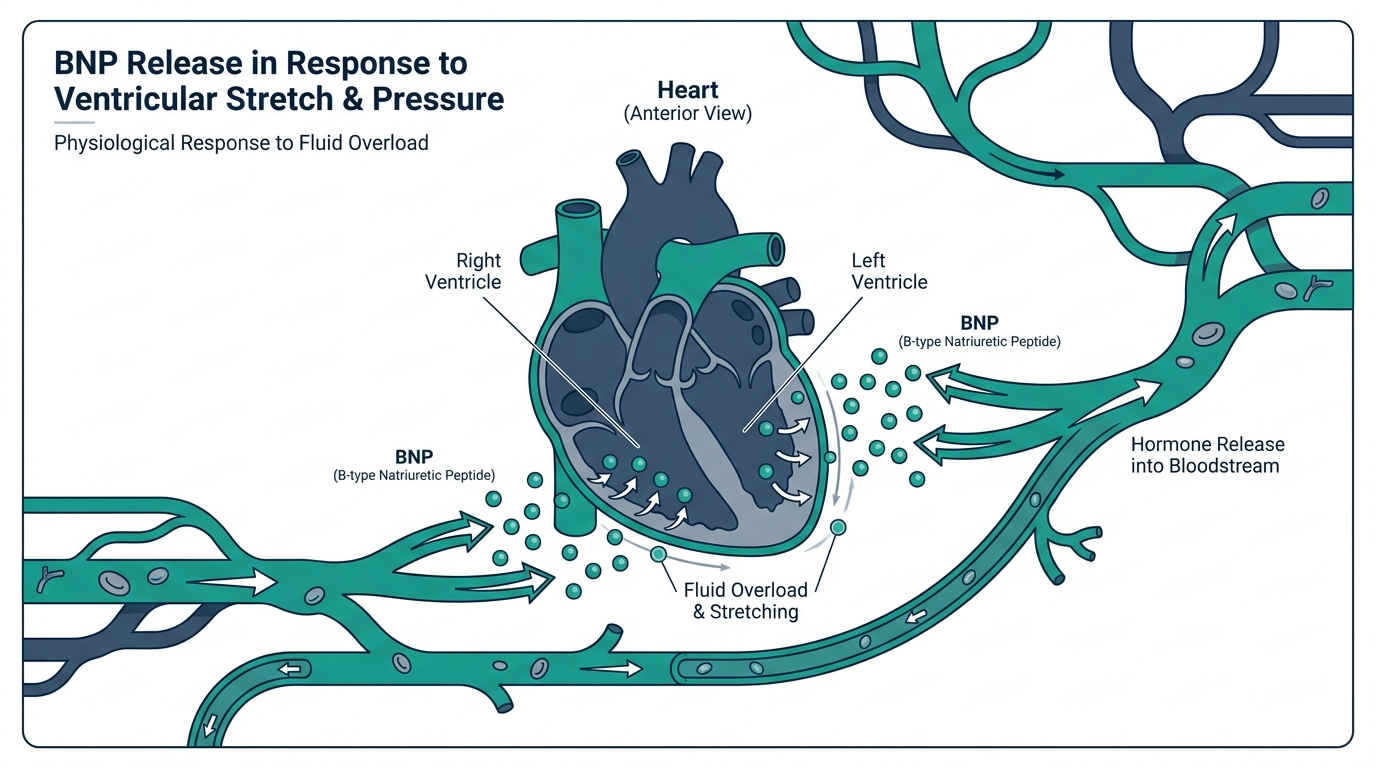
The what is BNP blood test question has a clean answer: it is a blood test that measures B-type natriuretic peptide, a hormone your heart makes when it is working harder than it should. Normal BNP is generally less than 100 picograms per milliliter (pg/mL) (Cleveland Clinic). The test is most often used to help confirm or rule out heart failure in someone who has symptoms like breathlessness, swelling, or fatigue (MedlinePlus).
The key idea, and the one that everything below hangs on, is that BNP rises with cardiac stretch. When your heart muscle, especially the left ventricle, is stretched and overworked, it releases more BNP into the blood (Cleveland Clinic). So a high BNP is your heart, in effect, calling for help.

What is BNP on a blood test actually measuring?
When you see BNP on a blood test, it is measuring the amount of B-type natriuretic peptide hormone circulating in your blood, in picograms per milliliter. This is a hormone with a job, not a waste product. BNP and the related peptides are made by your heart and blood vessels, and they act to lower blood pressure and help your body shed sodium and fluid (MedlinePlus).
Think of BNP as your heart’s pressure-relief valve. When the chambers fill and stretch under too much volume or pressure, the muscle releases BNP to widen blood vessels and push fluid out through the kidneys. The blood level you get back on your report is a snapshot of how hard that relief valve is currently working. The harder the heart is straining, the more BNP it pumps out, which is why the number tracks so closely with how much trouble the heart is in.
What is BNP in a blood test versus NT-proBNP?
You will often see two closely related tests, BNP and NT-proBNP, and they measure two halves of the same event. Your heart first makes a large precursor molecule called proBNP. When it is released under strain, that precursor splits into two pieces: active BNP, the working hormone, and NT-proBNP, the inactive leftover fragment (MedlinePlus). MedlinePlus describes NT-proBNP as the “ingredient” for making the BNP hormone.
Both tests give similar information about heart strain, but their normal ranges are completely different, so you cannot compare the two numbers head to head (Cleveland Clinic). For NT-proBNP, a level under 125 pg/mL is generally considered normal if you are under 75 years old, while under 450 pg/mL is used for people over 75 (Cleveland Clinic). Many hospitals favor NT-proBNP because the fragment lingers longer in the blood, giving a more stable reading. The practical lesson: always check whether your lab ran BNP or NT-proBNP before you panic at the number.

What is a normal BNP level?
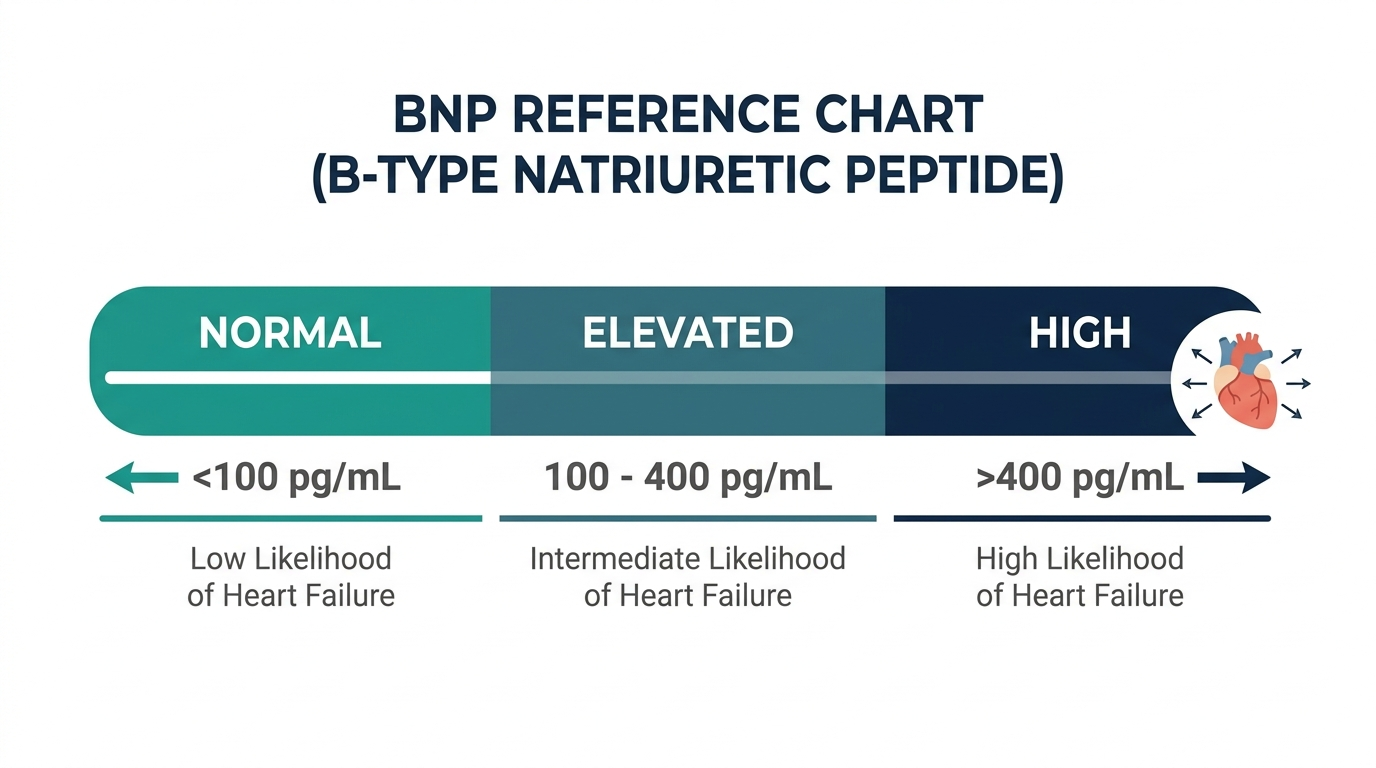
A normal BNP level is generally less than 100 pg/mL, and a result under that threshold makes heart failure much less likely as the cause of your symptoms (MedlinePlus Encyclopedia). That ruling-out power is one of the most useful things about the test. A low BNP in someone who is short of breath points the workup away from the heart and toward the lungs or other causes.
Reference ranges shift a little by laboratory, instrument, age, and sex, so the most reliable comparison is always the reference range printed on your own report. As a rough orientation, BNP over 100 pg/mL and NT-proBNP over 900 pg/mL raise the suspicion of heart failure, and the higher the level climbs, the more serious the heart failure tends to be (Cleveland Clinic).
What does a high BNP mean?
A high BNP means your heart is under more strain than it should be, most commonly from heart failure. Higher than normal levels of BNP or NT-proBNP indicate that you could have heart failure, and in general the higher the number, the more severe the disease (MedlinePlus). This is why doctors use BNP both to diagnose heart failure and to gauge how bad it is.
But heart failure is not the only thing that pushes BNP up. The same hormone rises with other stresses on the heart and circulation, including:
- Kidney failure, because the kidneys help clear these peptides, so impaired kidneys let BNP accumulate (MedlinePlus).
- Heart valve problems, which load and stretch the heart chambers (MedlinePlus).
- Pulmonary embolism, a clot in the lung that strains the right side of the heart (MedlinePlus).
- Older age, since levels naturally drift higher as you get older (Cleveland Clinic).
This is the trap with a single high reading. An elevated BNP says the heart and circulation are stressed, not why. That is a job for your clinician, your symptoms, and usually an echocardiogram, not for the lab value standing alone.

What does a low or normal BNP mean?
A low or normal BNP is usually reassuring, especially when you are being checked for heart failure. A result under about 100 pg/mL suggests heart failure is unlikely to be driving your symptoms (MedlinePlus Encyclopedia). In a breathless patient, that negative result is often enough to redirect the search toward the lungs, infection, or other causes.
There is one important caveat. A normal BNP does not always mean a healthy heart, and that brings us to the most underappreciated part of this test.
The insider catch: why obesity can hide a bad heart
Here is the detail that trips up even experienced clinicians and that patients almost never hear. People with obesity tend to have lower BNP levels than you would expect for how strained their heart actually is (Cleveland Clinic). So a “normal” BNP in someone with a high body mass index can be falsely reassuring.
The mechanism is not that obese hearts are healthier. Research on heart failure patients found that obesity changes how the proBNP precursor is processed, through increased glycosylation at a specific site that blocks normal cleavage, resulting in lower measured concentrations of both NT-proBNP and BNP despite real cardiac dysfunction (PMC, proBNP processing in obesity). In plain terms, the heart may be struggling, but the signal it sends gets muted before it reaches the lab.
The flip side matters just as much. Kidney disease and older age push BNP up independently of heart failure (MedlinePlus). So the same number can mean very different things depending on who is being tested. A modest BNP in a slim 40-year-old is not the same as a modest BNP in someone with obesity, and a high BNP in someone with advanced kidney disease needs careful interpretation. This is exactly why BNP is a clue read in context, never a verdict read in isolation.

How BNP is drawn and what can skew the number
The mechanics of the test are simple. Blood is taken from a vein, usually in the arm, and no fasting is required, which is part of why BNP is so practical in an emergency room where a fast answer is needed. There is no special prep on your part. That said, several real-world factors change the number you get back, and knowing them keeps you from misreading a result.
- Age and sex. BNP drifts upward with age and tends to run somewhat higher in women, which is why lab reference ranges are often age adjusted.
- Kidney function. The kidneys help clear natriuretic peptides, so reduced kidney function raises the baseline even without worsening heart failure. A high BNP in someone with advanced kidney disease has to be read against that backdrop.
- Body weight. As covered above, higher body mass tends to lower measured BNP, so a normal value in someone with obesity carries less reassurance than the same value in a lean person.
- Atrial fibrillation. An irregular, fast rhythm stretches the atria and can push BNP up on its own, separate from ventricular heart failure.
- Which assay your lab uses. BNP and NT-proBNP have entirely different scales, and even different BNP instruments can vary. Always anchor to the reference range printed on your own report.
None of these are reasons to distrust the test. They are reasons to read it the way a cardiologist does, as one number that only makes sense next to your age, weight, kidney function, rhythm, and symptoms.
The tests usually ordered alongside BNP
BNP is almost never interpreted alone. When you arrive breathless or swollen, it is typically part of a small cluster of tests that together separate a heart problem from a lung problem and gauge how urgent the situation is.
| Test | What it adds next to BNP |
|---|---|
| Troponin | Flags heart muscle injury, such as a heart attack. BNP says the heart is strained; troponin says whether muscle is actively being damaged. |
| Basic metabolic panel | Shows kidney function and electrolytes, which both shape how BNP is interpreted and guide diuretic dosing. |
| Complete blood count | Detects anemia or infection, either of which can cause breathlessness that mimics heart failure. |
| D-dimer | Helps assess the chance of a pulmonary embolism, another cause of a strained right heart and a raised BNP. |
| Chest imaging and ECG | Look for fluid in the lungs, an enlarged heart, and rhythm or ischemia clues. |
| Echocardiogram | The confirmatory step. It measures the ejection fraction and shows valve and wall function, turning a suspicious BNP into an actual diagnosis. |
The pattern across these tests is what tells the story. A high BNP with a normal troponin and a poor ejection fraction on echo points toward heart failure. A high BNP with a positive D-dimer and clear echo findings might point toward a clot in the lung instead. The lab value opens the question; the panel answers it.
Using BNP to track heart failure over time
Beyond diagnosis, BNP and NT-proBNP are used to follow known heart failure. When treatment is working and fluid overload eases, the heart is stretched less and the peptide level tends to fall. A rising trend, on the other hand, can signal that heart failure is decompensating before symptoms fully catch up, which is why some patients have these levels checked periodically rather than just once.
There is a crucial, commonly missed wrinkle here. One of the most effective modern heart failure medications, sacubitril-valsartan (sold as Entresto), blocks an enzyme called neprilysin that normally breaks down BNP. Because BNP is a target of that enzyme, this drug can actually raise measured BNP even as the heart improves (Oxford Academic, Clinical Chemistry). NT-proBNP is not broken down by neprilysin, so it is the more reliable marker to follow in people on this medication, and studies show it drops substantially with effective treatment. If you are on Entresto and your BNP looks high, that number may be misleading, and NT-proBNP is what your team should be watching.
This is a perfect example of why a single lab result, read without knowing your medications, can send exactly the wrong message.
When a BNP result should prompt urgent action
A BNP is a piece of a clinical picture, and the picture, not the number, drives urgency. Certain symptoms mean you should seek care without waiting for any lab, and they should never be talked down by a reassuring result:
- Sudden or severe shortness of breath, or breathlessness that forces you to sleep sitting up.
- Chest pain or pressure, especially with sweating, nausea, or pain spreading to the arm or jaw.
- Rapidly worsening swelling in the legs, or sudden weight gain over a day or two, which often signals fluid buildup.
- Fainting, a racing irregular heartbeat, or coughing up pink frothy sputum.
On the other side, a genuinely normal BNP in a low risk person who is short of breath is one of the more useful negatives in medicine, because it steers the workup away from the heart and toward causes like asthma, pneumonia, or deconditioning. The value of the test is not that it delivers a verdict, but that it sharpens the next question your clinician asks.
Common misconceptions about the BNP test
Because BNP shows up at high-stakes moments, it collects more than its share of myths. Clearing them up changes how you read your own result.
- “A high BNP means I am having a heart attack.” No. A heart attack is muscle injury, and the marker for that is troponin, not BNP. BNP reflects strain and stretch, which is why heart failure, valve disease, and even a lung clot can raise it without any heart attack.
- “BNP and NT-proBNP are the same test with the same numbers.” They come from the same precursor but run on completely different scales. A value that is normal for one would be wildly abnormal for the other, so you cannot compare them directly.
- “A normal BNP guarantees my heart is fine.” Usually reassuring, but not absolute. Obesity can suppress the number, and some forms of heart failure, particularly with preserved ejection fraction, can show only modest elevations. Symptoms still matter.
- “If my BNP is high, I can just repeat it until it comes down.” Chasing the number is not the goal. The point of a follow-up level is to track your response to treatment, interpreted by your clinician alongside your weight, symptoms, and medications, not to hit a target on a lab slip.
- “A single BNP tells the whole story.” It rarely does. Its real power is comparative, either against your own prior values or against the rest of your panel and your echocardiogram. One reading is a snapshot of a moving system.
Read this way, BNP stops being a scary number and becomes what clinicians actually treat it as: a fast, sensitive alarm that tells you the heart is under pressure and that it is time to find out why. The takeaway for anyone holding their own result is simple. Note whether the lab ran BNP or NT-proBNP, check the reference range on your specific report, factor in your age, weight, kidney function, and medications, and then bring the number to your clinician as the opening of a conversation rather than the conclusion of one.
How BNP shifts with age, sex, and kidney function
BNP is not a single fixed number that means the same thing for everyone. It tends to rise gradually with age, so a value that would be clearly abnormal in a healthy 30-year-old can sit closer to expected in someone in their late seventies. Women, on average, run slightly higher BNP than men at the same age, which is why context matters more than a raw figure. This is one reason a good clinician reads BNP against the person in front of them rather than a one-size cutoff.
Kidney function is the other big modifier. BNP and its companion NT-proBNP are partly cleared by the kidneys, so as kidney function declines the levels drift upward even when the heart itself has not changed. In someone with reduced kidney function, a moderately high BNP may reflect slower clearance rather than worsening heart failure, and the two possibilities have to be weighed together. The practical takeaway is that a BNP result should always be interpreted alongside age, sex, kidney markers such as creatinine and eGFR, and body weight, all of which pull the expected range in one direction or another. A number that looks worrying in isolation can be entirely consistent with a stable heart once these factors are accounted for.
What patients most often ask their cardiologist about BNP
A recurring question is whether a single high BNP means heart failure is certain. It does not. BNP raises the probability, but the diagnosis rests on symptoms, physical examination, and imaging such as an echocardiogram that actually shows how the heart is pumping. BNP is a strong pointer, not a verdict on its own.
People also ask whether they can lower their BNP through lifestyle. The honest answer is that BNP reflects the pressure and stretch on the heart, so it moves when the underlying situation improves, for example when fluid overload is treated, blood pressure is controlled, or heart failure medication is optimized. Chasing the number directly with diet or supplements misses the point, because the number follows the heart, not the other way around. Another common question is how often BNP should be repeated. There is no single schedule, but in someone being treated for heart failure it is often checked when symptoms change or when a treatment is adjusted, so the trend can confirm whether the plan is working. Finally, many people worry about a normal BNP when they still feel unwell. A normal result makes heart failure much less likely as the cause, which is useful, but it does not rule out every heart or lung problem, so ongoing symptoms still deserve evaluation.
Don’t just read about BNP, track it.
A single result is a snapshot. Superpower re-tests BNP and 100+ markers over time so you can watch them move as you change sleep, food, and training.
Frequently asked questions
What is a BNP blood test used for?
It is used mainly to help confirm or rule out heart failure in people who have symptoms such as shortness of breath, swelling, or fatigue, and to gauge how severe known heart failure is (MedlinePlus). The blood sample is usually drawn from a vein, often in an emergency room or hospital (MedlinePlus Encyclopedia).
What is a normal BNP level?
A normal BNP is generally less than 100 pg/mL, and a result under that threshold makes heart failure unlikely as the cause of symptoms (Cleveland Clinic). Compare your value to the reference range printed on your own lab report.
What is the difference between BNP and NT-proBNP on a blood test?
Both come from the same precursor and reflect heart strain, but BNP is the active hormone and NT-proBNP is the inactive fragment split off with it. Their normal ranges differ, so the numbers are not interchangeable (Cleveland Clinic).
Can BNP be high without heart failure?
Yes. Kidney failure, heart valve problems, pulmonary embolism, and older age can all raise BNP without heart failure being the cause (MedlinePlus). An elevated result tells you the heart or circulation is stressed, not why.
Why might my BNP look normal if my heart is struggling?
Obesity can lower BNP levels, so a normal-looking number can be falsely reassuring in someone with a high body mass index (Cleveland Clinic). Research links this to altered processing of the proBNP precursor in obesity (PMC, proBNP processing in obesity).
This article is for general educational purposes and is not medical advice. It cannot diagnose or treat you and does not replace your clinician. Always discuss your lab results and any health decisions with a qualified healthcare professional.
Related reading
Related: test your thyroid and hormones from home.
Vital Signs Today may earn a commission if you buy through links on this page. It does not affect our editorial assessments.