Wegovy weight loss results from major clinical trials show that people taking the medication lose an average of 14.9 percent of their initial body weight over 68 weeks, compared to about 2.4 percent with placebo. This means a person starting at 200 pounds can expect to lose roughly 30 pounds on average, though individual results vary widely. Those headline numbers get quoted constantly, but the number by itself hides the more useful story: who loses the most, how fast it happens, what the curve looks like month by month, and what the scale does once the drug stops. This article walks through the actual trial data, the real world numbers that run a little lower, and the practical levers that decide whether you land near the top of the response range or the bottom.
Key Takeaways
- In the STEP 1 trial, 86.4 percent of people taking Wegovy lost at least 5 percent of their body weight after 68 weeks.
- Nearly half of participants (48.1 percent) lost at least 15 percent of their initial body weight on Wegovy versus 4.9 percent on placebo.
- Weight loss typically begins within 4 to 8 weeks and continues gradually over the first year of treatment.
- Stopping Wegovy often leads to regaining about two thirds of lost weight within one year off the drug.
- Real world data suggests average weight loss of 10 to 12 percent after six months, slightly less than clinical trials due to adherence differences.
- People with type 2 diabetes tend to lose less on average, and body composition matters, since some of the weight lost is lean mass, not just fat.
What Do Clinical Trials Say About Wegovy Weight Loss Results?
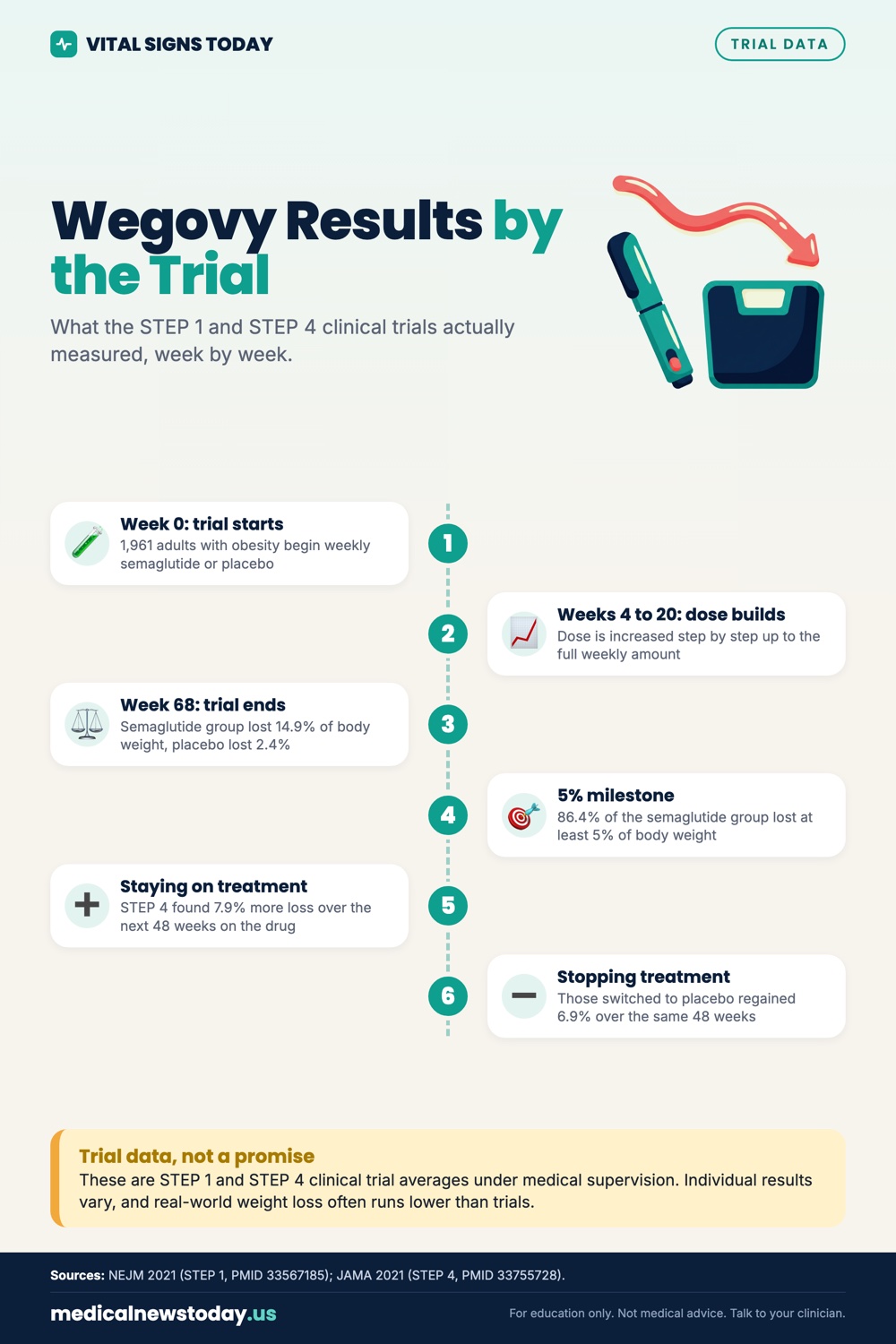
The largest clinical trial for Wegovy, known as STEP 1, enrolled nearly 2,000 adults without diabetes who had a body mass index (BMI) of 30 or higher, or a BMI of 27 with at least one weight related condition. Participants received weekly injections of 2.4 mg semaglutide, the active ingredient in Wegovy, along with lifestyle counseling. After 68 weeks, those on Wegovy lost an average of 14.9 percent of their starting weight. For context, this equates to approximately 33 pounds for a person weighing 220 pounds. In the placebo group, average loss was only 2.4 percent, or about 5 pounds.
A secondary analysis found that 86.4 percent of Wegovy users lost at least 5 percent of their body weight, a threshold often considered clinically meaningful. Over one third (38.6 percent) lost at least 20 percent of their weight. These numbers are significantly higher than those seen with older weight loss medications. Comparatively, the STEP 4 trial examined what happens after stopping the drug: those who continued Wegovy lost an additional 7.9 percent of their weight over 48 weeks, while those switched to placebo gained back 6.9 percent.
STEP 1 is only one chapter of a much larger program, and reading across the trials is where the nuance lives. STEP 2 studied people who also had type 2 diabetes and found a smaller average loss, closer to 9 to 10 percent, a reminder that diabetes physiology blunts the response for reasons researchers are still untangling. STEP 3 paired the drug with intensive behavioral therapy and a low-calorie diet and pushed average loss higher still. STEP 8 compared semaglutide head to head against an older GLP-1 drug, liraglutide, and semaglutide won clearly. The consistent thread is that Wegovy outperforms both placebo and earlier medications by a wide margin, but the exact figure you should expect depends heavily on which trial population you most resemble.
How Much Weight Do People Lose on Wegovy in Real World Settings?
Real world evidence, collected from electronic medical records and patient surveys, shows slightly lower but still substantial weight loss. A large study published in 2023 tracking over 3,000 adults found that after six months, people on Wegovy lost an average of 10.6 percent of their initial body weight. After one year, average loss reached about 13.2 percent. These figures are modestly lower than the 15 percent seen in clinical trials, likely because real world patients may not always receive intensive lifestyle counseling or may have adherence challenges. However, even this real world weight loss is more than double what is typically achieved with diet and exercise alone.
The gap between trial results and clinic results is not a mystery, and understanding it helps you avoid falling into it. Trial participants get free medication, structured dietitian support, and regular check-ins that keep them on schedule. In the real world, insurance denials, supply gaps, and the cost of the drug lead many people to skip doses, stall at a lower dose, or stop entirely for a stretch. Studies of prescription refill data have found that a large share of patients discontinue GLP-1 therapy within the first year, and every interruption tends to slow the curve or reverse part of it. The lesson is not that the real world is hopeless, but that the single biggest predictor of a trial-like result is staying on a consistent dose without long gaps.
It is important to note that insurance coverage and access to Wegovy vary, which can affect how consistently people take the medication. For a deeper look at how Wegovy and similar drugs work, see our full guide on GLP-1 Medications Explained.
How Quickly Does Wegovy Start Showing Results?
Most people notice some weight loss within the first 4 to 8 weeks of starting Wegovy. The drug is started at a low dose of 0.25 mg once weekly and gradually increased every four weeks to minimize side effects like nausea. During this titration phase, which lasts about 16 to 20 weeks, weight loss is typically modest, averaging 2 to 4 percent of starting weight. Once the full maintenance dose of 2.4 mg is reached, weight loss accelerates. The greatest rate of loss occurs between weeks 20 and 40, after which it plateaus. By week 68, most people reach their maximum weight loss.
Early responders, defined as those who lose at least 5 percent of their weight by week 12, are more likely to lose 15 percent or more by week 68. If little weight loss occurs after three months at the full dose, doctors may reassess treatment.
It helps to picture the curve rather than a single monthly average. The first four to five months are the slow build, because you are still climbing the dose ladder and appetite suppression has not reached full strength. Many people find this frustrating and quit too early, before the drug has actually been given a fair test. The steepest part of the descent usually comes after you settle onto the full dose, when hunger and food noise drop noticeably and portions shrink almost without effort. Then, somewhere in the second half of the first year, the line flattens. That plateau is not the drug failing. It is your body reaching a new equilibrium where the calories you now eat roughly match the calories you burn at the lower weight.
What Percentage of Users Lose Significant Weight?
Clinical trial data show that weight loss on Wegovy falls along a spectrum. In the STEP 1 trial, 86.4 percent lost at least 5 percent of body weight. 69.1 percent lost at least 10 percent. 48.1 percent lost at least 15 percent. 38.6 percent lost at least 20 percent. Only 8.3 percent of people taking Wegovy lost less than 5 percent, meaning the vast majority achieve a medically meaningful outcome. In comparison, in the placebo group, only 4.9 percent lost 15 percent or more.
These figures highlight that Wegovy does not work equally for everyone, but the odds of achieving significant weight loss are high. Factors that predict greater weight loss include younger age, male sex, higher starting weight, and better medication adherence.
How Does Wegovy Compare to Ozempic and Zepbound?
People often ask why Ozempic seems to produce less dramatic weight loss than Wegovy when both are semaglutide. The answer is dose and labeling. Ozempic is approved for type 2 diabetes and is typically dosed up to 2.0 mg, while Wegovy is approved specifically for weight management and goes to 2.4 mg. They are the same molecule, so the difference in results comes mostly from the higher target dose and the different populations who take each one. When someone loses less on Ozempic, it is often because they never reached a weight-management dose, not because the drug is weaker.
Zepbound, whose active ingredient is tirzepatide, is the newer benchmark. It works on two gut hormone pathways rather than one, and in its pivotal trial the highest dose produced average weight loss above 20 percent, exceeding what semaglutide achieves in its own trials. There has since been a head to head study of the two drugs in obesity, and tirzepatide came out ahead on average weight lost. That does not automatically make it the right choice for everyone, since tolerance, cost, insurance coverage, and side effect profile all differ from person to person, but it does set expectations: if the goal is the largest possible average loss, the two-hormone drug currently leads, while Wegovy remains a highly effective and more established option.
What Happens to Muscle, and Why Does Body Composition Matter?
The scale measures total weight, not fat, and that distinction matters more than most headlines admit. When people lose weight rapidly through appetite suppression, a meaningful portion of what comes off is lean mass, including muscle, not just fat. Substudies using body-composition scans have reported that a notable share of the weight lost on GLP-1 drugs, often cited around one third, can be lean tissue. Losing muscle is not just a cosmetic issue. Muscle drives your resting metabolism and supports strength and mobility, and losing too much of it can make long-term weight maintenance harder and raise concerns particularly for older adults.
This is exactly why the how of losing weight matters as much as the how much. Two people can both drop 15 percent of their body weight and end up in very different places: one preserved muscle and lost mostly fat, the other lost a chunk of both. The person who protected their lean mass will generally maintain more easily and function better. It is also a reason many clinicians now pair GLP-1 therapy with resistance training and higher protein intake, and a reason that tracking more than the scale number, whether through waist measurements or a body-composition scan, gives a truer picture of progress than pounds alone.
How Can You Get the Most Out of Wegovy?
Wegovy does a lot of the hard work by quieting appetite, but a few habits reliably move people toward the top of the response range rather than the bottom.
- Prioritize protein. When you are eating far less, protein protects muscle and helps you feel full. Aim to build each meal around a protein source.
- Add resistance training. Lifting weights or bodyweight exercise two or three times a week is the most direct way to defend lean mass while the fat comes off.
- Stay consistent with the dose. Long gaps between doses let hunger return and slow the curve. Set a fixed weekly injection day and keep it.
- Hydrate and mind fiber. GLP-1 drugs slow digestion, so dehydration and constipation are common. Water and fiber-rich foods ease both.
- Do not chase the plateau with crash dieting. Once loss flattens, extreme restriction tends to strip muscle and backfire. Maintenance is a legitimate goal, not a failure.
Does Weight Loss Continue Beyond One Year?
The longest controlled trial of Wegovy, the STEP 5 extension study, followed people for 104 weeks (two years). At two years, those on Wegovy maintained an average weight loss of 15.2 percent of their starting weight, nearly identical to the 14.9 percent at 68 weeks. This suggests that weight loss reaches a plateau after about a year, but the loss is well maintained with continued use. Without the drug, weight regain is common: the STEP 4 trial showed that after stopping Wegovy, participants regained 11.6 percent of their body weight over 48 weeks, meaning they kept only about one third of their original loss.
Long term data beyond two years for Wegovy specifically are limited, but studies of semaglutide in diabetes show sustained effects for up to four years with continued use. The benefit picture also extends past the scale. In the SELECT cardiovascular outcomes trial, semaglutide reduced the risk of major cardiovascular events such as heart attack and stroke by about 20 percent in adults with established heart disease who were overweight or obese but did not have diabetes. That result reframed the conversation: for the right patient, the drug is not only reshaping weight but lowering hard cardiovascular risk, which is part of why it is increasingly viewed as a long-term therapy rather than a short course.
What Are the Main Side Effects to Expect?
Most side effects are gastrointestinal and cluster in the titration phase as the dose climbs. Nausea is the most common, followed by diarrhea, constipation, vomiting, and reflux. These are usually mild to moderate and tend to ease as the body adjusts, which is the whole reason the dose is raised slowly rather than started high. Eating smaller portions, avoiding very fatty meals, and slowing the dose escalation when needed all help. Less common but more serious risks include gallbladder problems, which can accompany rapid weight loss, and pancreatitis, so severe abdominal pain that will not let up deserves prompt medical attention. Wegovy also carries a boxed warning about a thyroid tumor risk seen in rodent studies, and it is not recommended for people with a personal or family history of medullary thyroid carcinoma. None of this means the drug is unsafe for most people, but it does mean it belongs under real clinical supervision rather than a no-questions-asked website.
Want a real clinician to run the numbers, not a guess?
Joi + Blokes is a telehealth clinic that prescribes GLP-1 medication (Zepbound, compounded semaglutide and tirzepatide), hormone therapy (TRT, HRT), thyroid care, and peptides after a real lab panel and clinician review, with no membership or consult fee (prescriptions from about $59/month, lab panels from $149). If the scale will not budge, this is where you find out whether insulin, thyroid, or hormones are the real reason. Here is Joi + Blokes reviewed in full.
Frequently Asked Questions
How much weight can I lose with Wegovy in one month?
In the first month, most people lose 2 to 5 pounds (1 to 3 percent of body weight). This early loss is partly due to reduced appetite and water loss. Because of the dose escalation schedule, full effects are not seen until the maintenance dose is reached after roughly four months. Setting realistic expectations for the first month is important for staying motivated.
Is Wegovy weight loss permanent?
Weight loss with Wegovy is not permanent if the medication is stopped without making lasting lifestyle changes. Clinical trials show that within one year off the drug, people regain about two thirds of the weight they lost. Maintaining weight loss likely requires continuing the medication long term or adopting very strict dietary and exercise habits. Some people transition to a lower maintenance dose for long term weight management.
Why do some people not lose weight on Wegovy?
About 8 to 12 percent of people in clinical trials lost less than 5 percent of their body weight, classifying them as non-responders. Possible reasons include genetic differences in metabolism, inconsistent dosing, side effects that limit dose escalation, or underlying medical conditions like hypothyroidism or certain medications that counteract weight loss. Doctors may stop Wegovy after three months if a patient has not lost at least 5 percent of their starting weight.
Why has my weight loss stalled even though I am still taking Wegovy?
A plateau after several months is expected, not a sign the drug quit working. As you lose weight, your body burns fewer calories at rest, so intake and expenditure reach a new balance at a lower weight. Reaching the full dose, protecting muscle with protein and resistance training, and reassessing habits can sometimes restart progress, but for many people the plateau simply marks a stable new set point that is worth maintaining rather than fighting.
Do I have to stay on Wegovy forever?
Obesity is treated as a chronic condition, and Wegovy manages it rather than curing it, so weight tends to return after stopping. Many people stay on a maintenance dose long term for that reason. Whether you can eventually taper depends on how firmly new eating and activity habits have taken hold, and it is a decision to make with a clinician rather than by quitting abruptly.
Is Wegovy safe to combine with other weight loss efforts?
Yes, and combining it with a sensible diet, resistance training, and adequate protein generally improves both the amount and the quality of weight lost. What is not advisable is stacking it with unproven fat-burner supplements or extreme crash diets, which add risk without adding benefit. Any additional prescription weight loss product should be reviewed by the prescribing clinician to avoid overlapping effects.
How do I know if Wegovy is actually working for me?
The clearest early signal is not the scale at all, it is your relationship with food. Most responders describe a quieter appetite and less constant thinking about eating within the first weeks at a meaningful dose, and that change tends to precede the bigger numbers on the scale. On weight itself, the practical benchmark clinicians use is roughly 5 percent loss by around three months at the full dose. Hitting that early milestone strongly predicts a larger result by the end of the first year, while stalling well below it is the usual trigger to reassess the plan, check adherence, and rule out other causes. Because day to day weight swings with hydration and sodium, judge progress on the trend over several weeks rather than any single morning, and pair the scale with a waist measurement so you can see fat loss even during a plateau.
This article is for general information and is not medical advice. See our Medical Disclaimer.